
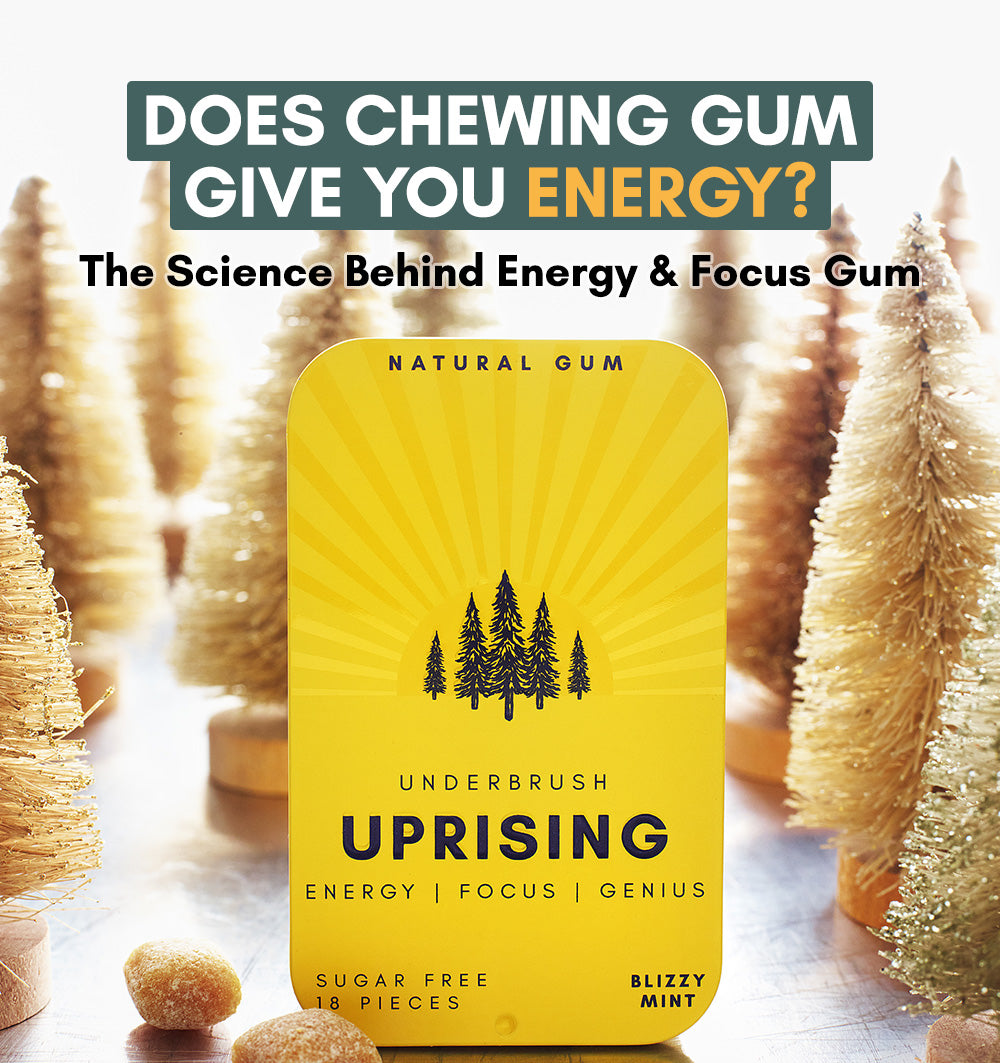
Does chewing gum give you energy or help you focus?
It’s a question people ask because the experience is real. Many notice that when they chew gum, they fidget less, stop biting pens or nails, and feel more mentally engaged.
But focus and energy are not the same thing.
Regular chewing gum can directly support focus and attention.
But energy and focus gum is specifically formulated to support real, sustained energy.
This article is informational and references peer-reviewed research on cognition, stimulation, and energy metabolism. Below, we break down what science actually says, why chewing alone feels helpful, and how functional chewing gum formulated with caffeine and natural adaptogenic ingredients works differently.
How Chewing Gum Can Help You Focus
Chewing gum has been studied for its effects on attention and cognitive engagement. Several mechanisms help explain why many people feel more focused while chewing.

Research suggests chewing gum may:
- Increase blood flow to brain regions involved in attention and executive function
- Increase alertness through rhythmic jaw movement
- Reduce distracting behaviors such as fidgeting or repetitive habits
- Provide continuous oral sensory input that helps maintain attention
Studies have linked gum chewing with improvements in reaction time, alertness, and sustained attention during cognitive tasks, particularly during monotonous or extended work periods (Smith, 2002; Lorist & Tops, 2003).
Therefore, the act of chewing creates a focused state.
That alone is a win - but we decided to take it a step further with Uprising gum (more on that later).
Focus vs Energy: Why the Difference Matters
Focus and energy are often used interchangeably, but they are technically different.
- Focus is the ability to direct attention and resist distraction.
- Energy is alertness, wakefulness, and the capacity to sustain mental effort.
Regular chewing gum can help reduce distractions and keep attention anchored. But when mental fatigue sets in, chewing alone does not increase neurotransmitter availability or cellular energy production.
That’s when many people reach for a cup of coffee or a sugary energy drink. You’re not seeking focus anymore, but energy.
There’s a better solution though.
One that delivers both energy and focus without jitters, without sugar, and without the crash.
Meet: caffeine gum.

The Science of Chewing (And Why It Actually Matters)
You've probably never stopped to think about what happens in your brain when you chew gum. You just chew it. Maybe it helps you focus, maybe it's just habit. But there’s a surprisingly interesting story happening under the surface — and it touches on everything from how your jaw communicates with areas of the brain involved in attention to why a mint mid-afternoon can sometimes feel refreshing during a long meeting, occasionally feeling more noticeable than reaching for another cup of coffee.
Your Jaw Is Doing More Than You Think
When you chew, your brain doesn't simply wait for food to arrive. The rhythmic motion of your jaw sends signals through the trigeminal nerve — one of the most extensively connected nerve pathways in the skull — toward areas of the brain associated with attention, decision-making, and working memory.
Some research suggests that repetitive chewing may be associated with small changes in alertness and physiological arousal, such as slight shifts in heart rate or nervous system activity. These responses are generally mild but may contribute to the feeling of being a bit more mentally engaged during certain tasks.
Think about the last time you were really working through something challenging. There’s a good chance you were doing something with your mouth — chewing gum, tapping a pen against your teeth, or lightly biting the end of a pencil. Researchers who study behavior and cognition often note that small physical movements like these can coincide with periods of concentration.
In other words, movement and attention sometimes go hand in hand.
Your Mouth Is Basically a Sensory Anchor
Here’s something many people don't realize: the mouth is one of the most densely innervated sensory regions of the body. The tissues inside the mouth contain a large number of nerve endings that respond to pressure, texture, temperature, and taste.
All of that sensory information travels continuously to areas of the brain involved in processing sensation and regulating attention.
When your mouth has something to work with — chewing, flavor, or texture — that steady stream of sensory input may help maintain engagement with a task. When that input disappears, the brain may be more likely to shift toward internal thought processes.
Neuroscientists often refer to this shift as activation of the default mode network, a pattern of brain activity commonly associated with mind-wandering, reflection, or daydreaming.
So that mint someone handed you halfway through a long workshop? Beyond the taste, it may have simply provided an extra bit of sensory input that helped bring your attention back to the moment.
Three Chemicals, One Team
Focus is not controlled by a single chemical. Instead, it emerges from multiple neurotransmitter systems working together. Three that are commonly discussed in relation to attention and mental energy are acetylcholine, dopamine, and adenosine.
Acetylcholine plays an important role in attention and cognitive processing. It is involved in helping the brain filter incoming information and maintain engagement with tasks that require concentration.
Dopamine is widely associated with motivation and reward signaling. Rather than simply creating a “feel good” response, it helps influence whether a task feels interesting enough to continue pursuing.
Adenosine functions differently. It gradually accumulates in the brain the longer someone stays awake and is often associated with the sensation of mental fatigue.
Researchers often describe focus as the result of these systems interacting together. Attention, motivation, and fatigue signals all influence whether the brain stays engaged with a particular activity.
Why Chewing Sometimes Feels Faster Than a Pill
If you've ever taken a supplement in capsule form and waited 30 to 45 minutes before noticing anything, there’s a straightforward biological reason for that timeline.
When a capsule is swallowed, it must first dissolve in the stomach. The contents are then absorbed through the digestive tract before entering the bloodstream and circulating through the body. This process naturally takes time.
Chewing changes the pathway slightly. When something is chewed, it mixes with saliva and comes into contact with the tissues lining the cheeks and the underside of the tongue.
These tissues contain small blood vessels that can allow certain compounds to enter circulation without passing entirely through the digestive system first. For some ingredients, this route may contribute to a faster perceived onset compared with products that rely exclusively on digestion.
The total amount absorbed may still vary depending on the ingredient and formulation, but the rate at which something is noticed can sometimes feel different.
It’s not uncommon to see athletes chewing gum on the sidelines, students chewing pencils before exams, or people reaching for something to chew while working through a difficult idea.
These behaviors don’t necessarily guarantee improved performance. But they do reflect a long-observed connection between sensory input, movement, and mental engagement.
The biology behind that connection has likely been part of human behavior for a very long time.
Now you simply understand a little more about what might be happening when it occurs.
Understanding the Difference Between Regular Gum Vs. Energy & Focus Gum
At first glance, most chewing gums look and function the same. They provide flavor, freshness, and something to chew. However, not all gums are formulated with the same purpose in mind. Traditional chewing gum is generally designed for taste and oral activity, using sweeteners and flavoring agents to create a pleasant chewing experience.
Energy and focus gums represent a newer category. These products are often formulated with additional ingredients such as caffeine or other compounds commonly associated with alertness and mental engagement. While both types of gum share the same basic chewing format, their intended roles and ingredient profiles can differ significantly.
The chart below highlights some of the key distinctions between regular chewing gum and energy and focus gum, including differences in purpose, ingredients, and the type of support each product may provide.

Regular gum may help you stay engaged.
Energy and focus gum is designed to help you sustain output.
Each has it’s place in your day-to-day life, but it’s important to understand how they are working.
Energy Gum vs Coffee: Why They Feel Different
Many people report that energy gum feels cleaner or more controlled than coffee.
The difference comes down to delivery and balance.
Coffee delivers caffeine rapidly through digestion, often alongside acids and other compounds that can increase jitter or stomach discomfort. Energy drinks may amplify spikes and crashes through sugar or additional stimulants.
Energy gum:
- Uses smaller, controlled doses of caffeine
- Avoids large liquid volumes
- Reduces rapid stimulation peaks
- Is often better tolerated by caffeine-sensitive individuals
That could be why our customers love chewing energy gum before long work sessions and travel days!
Are All Energy Gums the Same?
No.
Some energy gums are simply caffeine delivery systems. Others are built to support balanced stimulation, cognitive signaling, and stress modulation.
Formulation depth matters more than caffeine dose. Gums that combine stimulants with nootropics, adaptogens, and supportive nutrients (like Uprising) tend to produce smoother, more sustainable effects than caffeine alone.
Introducing Nathan and Sons Underbrush Uprising

Underbrush Uprising is a functional energy chewing gum designed to support energy, focus, cognitive performance, mood, and flow state.
It was built for people who want sustained mental clarity without harsh stimulant spikes or synthetic shortcuts.
Unlike conventional energy gums, Underbrush Uprising:
- Uses a natural tree-resin gum base, not plastic
- Combines balanced nootropics and adaptogens
- Includes oral-health-supporting ingredients
- Focuses on productive performance, not short-lived stimulation
How Underbrush Uprising Works
Underbrush Uprising supports cognitive performance through four complementary mechanisms.

1. Rapid Oral Delivery
Chewing increases saliva flow and allows certain compounds to begin interacting earlier, contributing to faster perceived onset.
2. Balanced Stimulation
Caffeine and theobromine support alertness and wakefulness. L-theanine moderates overstimulation and jitter. Research shows caffeine plus L-theanine improves attention and mood compared to caffeine alone (Owen et al., 2008; Giesbrecht et al., 2010).
3. Neurochemical Support
Alpha-GPC supports acetylcholine synthesis, which research has associated with attention and memory function (Parker et al., 2015; Kerksick et al., 2024).
(These statements have not been evaluated by the Food and Drug Administration. This product is not intended to diagnose, treat, cure, or prevent any disease.)**
B vitamins and NAD-related compounds support cellular energy metabolism (Cantó et al., 2015).
4. Mood and Stress Modulation
Rhodiola & Saffron: Your Brain's Chill Button
Ever had one of those days where everything's fine on paper, but your brain just feels like it's running in sand? Deadlines piling up, focus slipping, that low-grade mental fog that no amount of coffee seems to cut through? Yeah. Science has some thoughts on that.
Meet two of the more quietly impressive ingredients in the functional wellness world: Rhodiola rosea and saffron extract. They don't get the hype that caffeine does, but researchers have been paying close attention to both — and for good reason.
Rhodiola has been used for centuries in Scandinavian and Russian traditional medicine, where it was reportedly given to Viking warriors before battle and to Soviet-era athletes and cosmonauts to support performance under extreme conditions. Whether or not you're planning to raid a coastal village or orbit the Earth, the underlying logic holds up — Rhodiola belongs to a class of plants called adaptogens, which are studied for their potential to help the body handle physical and mental stress more efficiently. Research suggests it may support mental endurance during prolonged, demanding tasks — the kind where most people start making mistakes or checking out (Panossian & Wikman, 2010).
Saffron, on the other hand, is best known as the world's most expensive spice — the stuff that makes paella golden and costs more per pound than gold. But beyond the kitchen, researchers have been investigating its potential role in mood and emotional balance. Studies suggest saffron extract may support a positive mood and emotional steadiness, which matters more for focus than people often realize. When your emotional state is dysregulated — anxious, irritable, checked out — cognitive performance tends to follow it right off a cliff (Hausenblas et al., 2013).
Put them together and the idea is elegant: Rhodiola helps you endure, saffron helps you stay even-keeled, and the result is a mental environment where focus has a fighting chance — even when the pressure is on.
It's the difference between white-knuckling your way through a hard afternoon and actually feeling like you have some capacity left in the tank.
(These statements have not been evaluated by the Food and Drug Administration. This product is not intended to diagnose, treat, cure, or prevent any disease.)**
Why the Gum Base Matters
Most chewing gum uses a synthetic plastic base. Underbrush Uprising does not.
Natural Tree-Resin Gum Base
Underbrush Uprising uses:
These ingredients have demonstrated antibacterial, anti-inflammatory, and oral-tissue-supporting properties. Xylitol further supports saliva production and an enamel-friendly oral environment.
What the Science Says (Synthesis)
So here's the deal — if you've ever slammed an energy drink hoping for laser focus and ended up with jittery hands and a racing heart, you already understand why the science on this stuff matters.
Researchers have spent a surprising amount of time studying what actually moves the needle on mental energy and focus — and the short answer is: it's not just caffeine. Caffeine is the obvious starting point (and yes, it works), but studies suggest that when you combine it thoughtfully with other ingredients, something interesting happens. The peaks get smoother, the crashes get smaller, and your brain seems to actually cooperate for longer.
Think of it like a band. Caffeine is the lead guitarist — loud, fast, gets everyone's attention. But without a rhythm section, it's just noise. That's where supporting ingredients come in. Compounds that support neurotransmitter activity — the brain chemicals responsible for motivation, attention, and mood — help keep the whole performance tight. And ingredients that address how your body responds to stress? Those are the soundcheck that makes everything else sound better.
Research on adaptogenic and nootropic compounds suggests that targeting multiple pathways simultaneously — stimulation, cognitive support, and stress response — tends to produce more consistent results than stimulation alone. The analogy researchers sometimes use is a three-legged stool: pull one leg out and the whole thing tips over.
The practical upside? Formulations that take this balanced approach appear to support steadier energy levels, improved concentration during demanding tasks, and a more comfortable experience overall — without the familiar "I should not have done that" feeling that comes with going too heavy on stimulants.
(These statements have not been evaluated by the Food and Drug Administration. This product is not intended to diagnose, treat, cure, or prevent any disease.)**
What Energy and Focus Gum Is Not
Important note we ask you to keep in mind, energy gum is NOT:
- A replacement for sleep
- A mega-dose stimulant
- Designed for instant intensity
It is designed for sustained mental performance.
So, Does Chewing Gum Give You Energy?
Chewing gum can support focus.
Energy and focus gum can support real, sustained energy.
The difference is formulation.
Nathan and Sons Underbrush Uprising combines chewing stimulation with ingredients commonly studied for their role in alertness and cognitive support.
Shop Uprising Energy Gum now!
Frequently Asked Questions
Does chewing gum give you energy or just focus?
Chewing gum primarily supports focus. Energy and focus gum formulated with caffeine and cognitive-support ingredients can support alertness and focus.
Does caffeine gum work faster than coffee?
Many people report a faster perceived onset because oral delivery and chewing begin immediately.
Is energy gum better than coffee?
It depends on the person. Energy gum often feels smoother and more controlled, especially for those sensitive to coffee.
How long does energy gum last?
Balanced formulations are designed to last longer than quick caffeine spikes, though duration varies by individual.
Can energy gum be used daily?
When responsibly formulated and used as directed, energy gum can be part of a daily routine.
About the Author
Written by the Nathan and Sons Research Team. The team specializes in functional chewing gum formulation, oral health science, and evidence-based energy and focus support. Every product is developed with clean ingredients, scientific grounding, and long-term wellness in mind.
References
Smith A. Effects of caffeine on human behavior. Food and Chemical Toxicology, 2002.
https://pubmed.ncbi.nlm.nih.gov/12204388/
Lieberman HR et al. Low doses of caffeine and performance. Psychopharmacology, 1987.
https://pubmed.ncbi.nlm.nih.gov/3306420/
McLellan TM et al. Caffeine and cognitive performance. Neuroscience & Biobehavioral Reviews, 2016.
https://pubmed.ncbi.nlm.nih.gov/26899133/
Owen GN et al. L-theanine and caffeine on cognition. Nutritional Neuroscience, 2008.
https://gwern.net/doc/nootropic/caffeine/2008-owen.pdf
Giesbrecht T et al. Caffeine and L-theanine synergy. Nutritional Neuroscience, 2010.
https://pubmed.ncbi.nlm.nih.gov/21040626/
Panossian A, Wikman G. Rhodiola rosea efficacy. Phytomedicine, 2010.
https://pubmed.ncbi.nlm.nih.gov/20378318/
Hausenblas HA et al. Saffron supplementation and mood. Journal of Affective Disorders, 2013.
https://pubmed.ncbi.nlm.nih.gov/23265391/
Parker AG et al. Alpha-GPC and cognition. JISSN, 2015.
https://www.ncbi.nlm.nih.gov/pmc/articles/PMC4595381/
Kerksick CM et al. Alpha-GPC performance. Nutrients, 2024.
https://www.mdpi.com/2072-6643/16/3/415
This product supports normal cognitive and metabolic function.
These statements have not been evaluated by the Food and Drug Administration. This product is not intended to diagnose, treat, cure, or prevent any disease.