
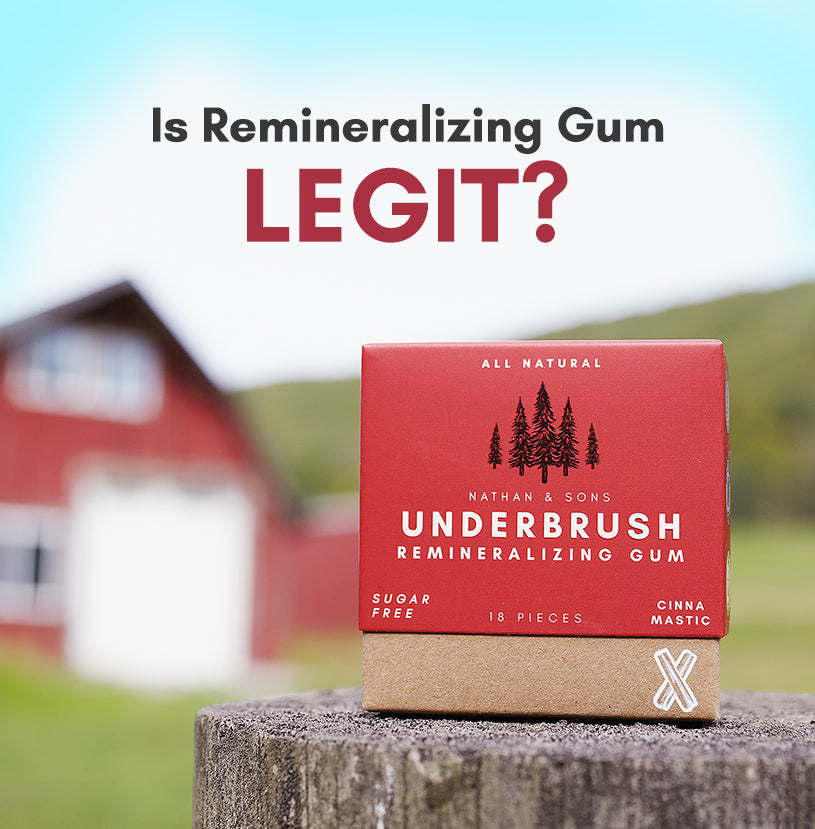
Is Remineralizing Gum Legit? What the Research Actually Says
You've seen it on the shelf, maybe spotted it on social media, or heard someone mention it at the dentist.
Remineralizing gum.
A piece of gum that's supposed to help strengthen your teeth.
And your first reaction was probably the same as most people's: that sounds almost too good to be true.
Here's the honest answer — it depends entirely on what's in it, how it works, and what the research actually says about the ingredients.
This article breaks all of that down clearly — the science, the evidence, the limitations, and why Nathan and Sons chose to build our remineralizing gum around specific, researched ingredients rather than marketing claims.
These statements have not been evaluated by the Food and Drug Administration.
This product is not intended to diagnose, treat, cure, or prevent any disease.
What Is Remineralizing Gum?

Standard chewing gum is mostly a delivery vehicle for flavor and sweetener.
Remineralizing gum is formulated differently.
It combines the saliva-stimulating effect of chewing with ingredients that have been examined in enamel remineralization research — most notably nano-hydroxyapatite and xylitol.
The idea behind it is straightforward.
Your enamel is composed primarily of hydroxyapatite — a naturally occurring mineral compound.
When acids from food, drink, or bacteria wear down enamel, they strip calcium and phosphate ions from its surface in a process called demineralization.
Remineralization is the process of redepositing those minerals, potentially supporting enamel integrity over time.
Saliva does this naturally — it carries calcium and phosphate ions that can reintegrate into enamel under the right conditions.
The American Dental Association notes that increased salivary flow carries calcium and phosphate ions that can contribute to enamel remineralization, and that stimulated saliva has higher concentrations of bicarbonate, calcium, and chloride than unstimulated saliva — increasing its buffering capacity against acids.
Chewing gum stimulates that saliva flow.
Remineralizing gum is designed to amplify that effect by delivering ingredients directly associated with enamel mineral composition alongside the chewing action.
Is Remineralizing Gum Legit? What the Research Says About Nano-Hydroxyapatite

The most researched active ingredient in remineralizing oral care products is nano-hydroxyapatite — often written as n-HAp.
Because nano-hydroxyapatite is chemically identical to the mineral that makes up tooth enamel, it is described in the research literature as biomimetic — meaning it mimics the natural material it is designed to work alongside.
This isn't marketing language.
It's the actual chemistry.
A study published in BDJ Open examining hydroxyapatite versus fluoride toothpaste in children found that hydroxyapatite deposited specifically in areas of demineralization on enamel surfaces — and appeared to integrate with the natural enamel structure in scanning electron microscopy analysis.
A randomized clinical trial published in BDJ Open by Amaechi et al. examined nanohydroxyapatite-containing products in the context of dentin hypersensitivity research over eight weeks and found statistically significant changes in sensitivity measurements compared to placebo.
An 18-month double-blinded randomized clinical trial examining hydroxyapatite toothpaste versus fluoride toothpaste in adults found that hydroxyapatite was not statistically inferior to fluoride for its primary oral care endpoint — with no increase in the decayed missing filled surfaces index observed in 89.3 percent of the hydroxyapatite group.
A 2023 systematic review published in Frontiers in Public Health confirmed the caries-supporting effects of hydroxyapatite toothpaste in children over a study period.
A 2025 narrative review published in the journal Biomimetics examined multiple clinical studies and found no demonstrated inferiority of hydroxyapatite compared to fluoride in studies evaluating enamel remineralization and oral care outcomes.
It is important to be honest about the limits of this research.
Most studies have been conducted on toothpastes and gels rather than chewing gum specifically.
The delivery mechanism of chewing gum — extended contact time with the oral environment — is theoretically favorable, but product-specific clinical trials on nano-hydroxyapatite chewing gum are still limited.
These statements have not been evaluated by the FDA and should not be interpreted as disease-treatment claims.
Is Remineralizing Gum Legit? What the Research Says About Xylitol
The second key ingredient in well-formulated remineralizing gum is xylitol — a naturally occurring sweetener with one of the strongest oral health research profiles of any ingredient in the oral care space.
And unlike nano-hydroxyapatite, xylitol has been studied specifically in chewing gum form for decades.
A 2022 study published in Frontiers in Nutrition examined xylitol chewing gum and found a 20 percent reduction in dental plaque accumulation among participants, along with a meaningful decrease in cariogenic and periodontopathic bacteria compared to controls.
A 2024 systematic review published in European Archives of Paediatric Dentistry found that xylitol's effect on oral health is linked to increased saliva production — especially when used in chewing gum form.
A 2022 systematic review published in Clinical Oral Investigations found that xylitol gum was associated with decreased plaque accumulation in the majority of studies examined.
A 2023 systematic review published in Frontiers in Oral Health examining chewing gum as an anti-cariogenic agent found that three out of four studies showed chewing gum lowered oral health risk increments compared to no gum use — with sugar-free xylitol-containing gums among the top performers.
Think about what that means for a daily routine.
Most people brush twice a day and stop there.
After every meal, every coffee, every acidic snack — the mouth is left to manage on its own until the next brushing session.
A piece of remineralizing gum after meals extends active oral care into those gaps.
For more context on how gum fits into a daily routine, our article on does remineralizing gum work examines the evidence in detail.
These statements have not been evaluated by the FDA.
Why Saliva Is the Mechanism Worth Understanding
Here's something most people have never been told clearly: the mechanism behind remineralizing gum isn't just the ingredients themselves.
It's the saliva those ingredients work with.
Imagine your mouth after a meal.
Acids from food are temporarily lowering the pH in your mouth.
Bacteria are active.
Your enamel is in a more vulnerable state than it was before you ate.
The American Dental Association's oral health resource on chewing gum notes that increased saliva flow helps neutralize acids and brings more calcium and phosphate to support enamel health.
Chewing gum — specifically sugar-free gum — is one of the most efficient ways to stimulate that saliva response in a portable, practical format.
Remineralizing gum adds nano-hydroxyapatite and xylitol to that already beneficial chewing action.
The result is a product that works with your body's existing oral defense system rather than replacing it.
This is also why post-meal use makes the most scientific sense — the timing aligns with when your oral environment most benefits from buffering and mineral support.
What Remineralizing Gum Is Not
This is the part most brands skip — and it's worth saying clearly.
Remineralizing gum is not a cavity treatment.
It does not address existing dental decay that has progressed to cavitation.
It does not replace brushing, flossing, or professional dental care.
It is not a dental treatment of any kind.
If you have existing cavities, gum sensitivity, or diagnosed dental conditions, the conversation about remineralizing gum belongs with your dentist — not a blog article.
What remineralizing gum is, based on the available research, is a well-formulated complementary oral care tool — designed for the gaps in your day when brushing isn't possible and your enamel could benefit from mineral support and acid buffering.
It is a smart addition to a routine.
Not a magic fix.
Not a replacement for dentistry.
These statements have not been evaluated by the FDA and are not intended to diagnose, treat, cure, or prevent any disease.
Why Not All Remineralizing Gums Are Equal
Here's where the consumer has to pay attention.
The term "remineralizing gum" isn't regulated.
Any brand can put those words on a package.
What separates a legitimately formulated product from a marketing claim is the ingredient list.
Look for gum that clearly lists nano-hydroxyapatite as an active ingredient — not buried in a proprietary blend or listed as a trace additive.
Look for xylitol as the primary sweetener — not sucralose, aspartame, or acesulfame potassium.
Look for a plant-based gum base — not a synthetic polymer base.
Look for brands that link their claims to actual published research rather than vague wellness language.
Nathan and Sons' remineralizing gum is formulated with nano-hydroxyapatite as the active ingredient, xylitol as the primary sweetener, natural flavorings, and a plant-based gum base — with no artificial sweeteners, synthetic polymers, or artificial colors.
The full ingredient list is on our product page because transparency is the baseline, not a selling point.
For a side-by-side look at how our formulation compares to what else is on the market, our Underbrush hydroxyapatite gum vs competitors guide breaks it down in detail.
How to Use Remineralizing Gum Effectively

The research points to a few clear best practices.
Chew after meals rather than randomly throughout the day — this is when acid buffering and mineral support are most relevant.
Chew for approximately five to twenty minutes — enough time to stimulate meaningful saliva flow without overworking your jaw.
Use it as an addition to your routine rather than a replacement for brushing and flossing.
The ADA recommends sugar-free gum chewing for approximately twenty minutes after meals for its saliva-stimulating benefits — and remineralizing gum fits naturally into that recommendation.
For more detail on how to incorporate remineralizing gum alongside your existing oral care routine, our oral care collection includes full product information and usage guidance.
What the Research Does Not Yet Confirm
Honesty matters here.
Most nano-hydroxyapatite studies have been conducted on toothpastes and gels — not chewing gum specifically.
The extrapolation from toothpaste research to gum research is theoretically sound but has not been fully validated in large-scale human clinical trials for the chewing gum format.
Most xylitol chewing gum studies have examined the ingredient in the context of general oral health — not specifically in combination with nano-hydroxyapatite.
The synergistic effects of nano-hydroxyapatite and xylitol together in gum form represent an area where more research would strengthen the evidence base.
Anyone considering remineralizing gum should discuss it with a qualified dental professional — particularly if they have existing dental conditions.
These statements have not been evaluated by the FDA and are not intended to diagnose, treat, cure, or prevent any disease.
Key Takeaways: Is Remineralizing Gum Legit?

Remineralizing gum is formulated with ingredients that have been examined in enamel remineralization research contexts — primarily nano-hydroxyapatite and xylitol.
Nano-hydroxyapatite is chemically identical to the mineral compound that makes up tooth enamel and has been examined in multiple peer-reviewed studies for its potential to support enamel mineral interactions.
Xylitol has a well-researched oral health profile including associations with reduced cariogenic bacteria, decreased plaque accumulation, and increased saliva production.
Chewing gum in general has been recognized by the American Dental Association for its saliva-stimulating benefits.
Most studies have been conducted on toothpastes rather than gum specifically — product-specific clinical trials for remineralizing chewing gum are still limited.
Remineralizing gum is not a dental treatment and is not a substitute for brushing, flossing, or professional dental care.
Not all remineralizing gums are formulated equally — the ingredient list is the most important thing to evaluate.
These statements have not been evaluated by the FDA.
Not intended to diagnose, treat, cure, or prevent any disease.
Frequently Asked Questions: Is Remineralizing Gum Legit?
Is remineralizing gum actually effective?
Remineralizing gum formulated with clinically researched ingredients like nano-hydroxyapatite and xylitol has a meaningful research basis.
Nano-hydroxyapatite has been examined in multiple peer-reviewed studies for its potential to support enamel mineral interactions.
Xylitol has been associated in research with reduced cariogenic bacteria, decreased plaque accumulation, and increased saliva production.
The evidence is strongest for the individual ingredients — product-specific clinical trials on remineralizing chewing gum specifically are still developing.
These statements have not been evaluated by the FDA.
Can remineralizing gum reverse cavities?
Remineralizing gum is not a treatment for cavities.
Research on hydroxyapatite and xylitol relates to early-stage enamel mineral support — not the treatment of cavitated lesions or advanced dental decay.
For existing cavities, consult a qualified dental professional.
These statements have not been evaluated by the FDA.
How long does remineralizing gum take to work?
Individual timelines vary significantly based on oral health status, diet, frequency of use, and other factors.
Research on xylitol gum has examined outcomes over periods ranging from two weeks to several months.
Results are not guaranteed and individual responses vary.
Consult your dental provider for guidance specific to your oral health situation.
Is xylitol gum safe for daily use?
Xylitol has been studied in oral health research contexts with a generally favorable safety profile reported.
For most adults, daily use of xylitol-containing gum in reasonable quantities is considered appropriate.
Consult a healthcare provider if you have specific health concerns, are pregnant, or are managing a medical condition.
These statements have not been evaluated by the FDA.
Can remineralizing gum replace brushing?
No.
Remineralizing gum is designed to complement a regular oral care routine — not replace it.
Brushing, flossing, and regular professional dental care remain the foundation of oral health maintenance.
What should I look for in a remineralizing gum?
Look for nano-hydroxyapatite listed clearly as an active ingredient.
Look for xylitol as the primary sweetener rather than sucralose, aspartame, or acesulfame potassium.
Look for a plant-based gum base rather than a synthetic polymer base.
Look for brands that link their claims to published research.
Our remineralizing gum meets all of these criteria — with the full ingredient list available on the product page.
These statements have not been evaluated by the FDA and are not intended to diagnose, treat, cure, or prevent any disease.
Who should not use remineralizing gum?
Children under the age where chewing gum is age-appropriate should not use chewing gum.
Anyone with jaw conditions such as TMJ should consult their healthcare provider before beginning regular gum use.
Anyone with existing dental conditions should discuss remineralizing gum with their dental provider before use.
Consult a qualified healthcare provider before beginning any new oral care regimen.
These statements have not been evaluated by the FDA.
Legal & Compliance Disclaimer
These statements have not been evaluated by the Food and Drug Administration.
This product is not intended to diagnose, treat, cure, or prevent any disease.
The information in this article is for educational purposes only and is not a substitute for professional dental or medical advice.
Consult a qualified dental or healthcare provider before making changes to your oral care routine.
Content current as of 2026.
Subject to revision.
References
American Dental Association. Chewing Gum. ADA Oral Health Topics. ada.org/resources/ada-library/oral-health-topics/chewing-gum
American Dental Association. Chewing Gum. MouthHealthy. mouthhealthy.org/all-topics-a-z/chewing-gum
Amaechi BT, Lemke KC, Saha S, Luong MN, Gelfond J. (2021). Clinical efficacy of nanohydroxyapatite-containing toothpaste at relieving dentin hypersensitivity: an 8 weeks randomized control trial. BDJ Open, 7(1), 23. PMC8233401.
O'Hagan-Wong K, et al. (2021). The use of hydroxyapatite toothpaste to prevent dental caries. BDJ Open. PMC8930857.
Paszynska E, et al. (2023). Caries-preventing effect of a hydroxyapatite toothpaste in children. Frontiers in Public Health. frontiersin.org/journals/public-health/articles/10.3389/fpubh.2023.1199728/full
Meyer F, Enax J, et al. (2023). Caries-preventing effect of a hydroxyapatite toothpaste in adults: an 18-month double-blinded randomized clinical trial. PMC10393266.
Naim J, et al. (2025). The remineralizing and desensitizing potential of hydroxyapatite in dentistry: a narrative review. Biomimetics, 16(9), 325.
Wu YF, Salamanca E, et al. (2022). Xylitol-containing chewing gum reduces cariogenic and periodontopathic bacteria in dental plaque: microbiome investigation. Frontiers in Nutrition, 9, 882636. PMC9131035.
Söderling E, Pienihäkkinen K. (2022). Effects of xylitol chewing gum and candies on the accumulation of dental plaque: a systematic review. Clinical Oral Investigations, 26, 119–129.
Latifi-Xhemajli B, et al. (2024). The effect of xylitol chewing gums and candies on caries occurrence in children: a systematic review. European Archives of Paediatric Dentistry, 25, 145–160. PMC11058973.
Yeung CY, Chu CH, Yu OY. (2023). A concise review of chewing gum as an anti-cariogenic agent. Frontiers in Oral Health, 4, 1213523. PMC10299855.
Ludovichetti FS, et al. (2025). Effect of xylitol and maltitol chewing gums on plaque reduction and salivary pH modulation. Dentistry Journal, 13(6), 233.