
The Benefits of Nano-Hydroxyapatite Gum for Enamel Remineralization Support

Tooth enamel is the hardest substance in the human body.
It's also the only tissue your body cannot regenerate on its own.
Once enamel is lost — through acid exposure, wear, or poor oral hygiene habits — the body has no natural mechanism to replace it.
This is why researchers have spent decades studying ways to support enamel remineralization from the outside in.
Nano-hydroxyapatite is one of the most researched ingredients in this conversation.
And the question most people ask when they first encounter it is a simple one: can nano hydroxyapatite support enamel remineralization?
This article answers that question honestly — covering what the science says, where the evidence is strong, where it's still developing, and how Nathan and Sons incorporates nano-hydroxyapatite into our remineralizing gum.
These statements have not been evaluated by the Food and Drug Administration.
This product is not intended to diagnose, treat, cure, or prevent any disease.
What Is Nano-Hydroxyapatite?
Hydroxyapatite is the primary mineral compound that makes up tooth enamel and dentin.
Researchers estimate that enamel is composed of approximately 90 to 97 percent hydroxyapatite by weight, making it the dominant structural material in the outer layer of your teeth.
Nano-hydroxyapatite — often written as n-HAp or nano-HAp — is a synthetically produced form of this same mineral, engineered at the nanoscale.
Its particle size is small enough to interact with the microscopic structure of enamel surfaces.
Because nano-hydroxyapatite is chemically identical to the mineral already present in your teeth, it is described in the research literature as biomimetic — meaning it mimics the natural material it is designed to work alongside.
This biomimetic property is the foundation for the research interest in nano-hydroxyapatite as an oral care ingredient.
For a deeper look at what nano-hydroxyapatite is and how it was developed, our article on what is nano-hydroxyapatite covers the full background.

What Does Enamel Remineralization Actually Mean?
Before exploring whether nano hydroxyapatite can support enamel remineralization, it helps to understand what remineralization means in a dental context.
Enamel demineralization occurs when acids — from food, drink, bacteria, or dry mouth — strip calcium and phosphate ions from the enamel surface.
This weakens the enamel structure at a microscopic level.
Remineralization is the process by which minerals are redeposited into those weakened areas, potentially supporting enamel integrity over time.
This process happens naturally through saliva, which carries calcium and phosphate ions that can reintegrate into enamel under the right conditions.
The question researchers have been examining is whether topically applied agents — including fluoride and nano-hydroxyapatite — can meaningfully support or contribute to this process.
What Does the Research Say About Nano-Hydroxyapatite and Enamel?
This is where the science becomes genuinely interesting.
Multiple peer-reviewed studies and systematic reviews have examined nano-hydroxyapatite's potential to support enamel remineralization.
Here is an honest summary of what the research currently shows.
A randomized clinical trial published in BDJ Open examined nanohydroxyapatite-containing toothpaste in the context of dentin hypersensitivity research over eight weeks and found statistically significant changes in sensitivity measurements compared to placebo.
A double-blind randomized controlled trial found that nano-hydroxyapatite toothpaste was associated with changes in dentin hypersensitivity measurements at two and four weeks compared to both fluoride toothpaste and placebo groups.
A systematic review and meta-analysis published in Clinical Oral Investigations examined nano-hydroxyapatite's potential in oral care and remineralization research contexts across multiple studies and found significant remineralization potential when surface hardness testing was used as the measurement standard.
A study published in BDJ Open examining hydroxyapatite versus fluoride toothpaste in children found that hydroxyapatite achieved comparable findings in certain research settings to fluoride in oral care and remineralization outcomes.
A 2025 narrative review of recent clinical evidence published in the journal Biomimetics examined multiple studies and found no demonstrated inferiority of hydroxyapatite compared to fluoride in studies evaluating enamel remineralization and oral care outcomes.
A 2023 observational study published in Health Science Reports found a significant difference in enamel surface texture between nano-hydroxyapatite-treated surfaces and sodium fluoride-treated surfaces.
These findings are meaningful and represent a growing body of peer-reviewed evidence.
However, it is equally important to note what the research also acknowledges.
The 2022 systematic review published in Clinical Oral Investigations noted that the level of evidence across nano-hydroxyapatite studies remains relatively low due to small study sizes, short follow-up periods, high risk of bias in some studies, and methodological heterogeneity.
The same review noted that further well-designed in vivo studies are needed before conclusive evidence can be established.
These statements have not been evaluated by the FDA and should not be interpreted as disease-treatment claims.
Nano-Hydroxyapatite vs. Fluoride: What the Research Compares

Fluoride has been the standard active ingredient in remineralizing oral care products for decades.
It works by encouraging mineral absorption from saliva into enamel surfaces.
Nano-hydroxyapatite works differently.
Because it is chemically identical to enamel's mineral composition, it may interact directly with enamel surfaces rather than stimulating an indirect mineral exchange process.
Multiple studies have examined how these two approaches compare.
A systematic review published in 2025 examined hydroxyapatite-based fluoride-free toothpastes and found them to be a promising approach in enamel remineralization and oral care research contexts, while noting that more well-designed comparative studies are still needed.
A pH cycling study published in BDJ Open found that hydroxyapatite gel produced comparable findings in certain research settings to a high-concentration fluoride gel in remineralizing initial caries lesions in laboratory conditions.
A meta-analysis examining nano-hydroxyapatite's efficacy found a pooled estimate in favor of fluoride that was not statistically significant — meaning the difference between the two was not demonstrated to be meaningful in the analyzed studies.
It is important to frame this accurately.
These findings do not establish nano-hydroxyapatite as superior to fluoride.
They suggest that nano-hydroxyapatite is an area of active and serious research interest as a fluoride-free alternative — with a growing evidence base that warrants continued investigation.
Consumers seeking a fluoride-free oral care option have more peer-reviewed research to reference today than at any previous point.
For a detailed comparison of these two approaches, our article on nano-hydroxyapatite vs fluoride covers the research in depth.
These statements have not been evaluated by the FDA.
Why Chewing Gum Is an Interesting Delivery Format for Nano-Hydroxyapatite
Most oral care products — toothpastes, mouthwashes, gels — are in contact with teeth for a relatively short period before being rinsed away.
Chewing gum offers a different contact format.
When you chew gum, the active ingredients remain in contact with the oral environment during use — rather than being rinsed away immediately as with conventional products.
Chewing also stimulates saliva production.
Research on xylitol-containing chewing gum has found that chewing gum may support natural salivary flow, which plays a role in the oral environment.
A 2024 systematic review published in European Archives of Paediatric Dentistry noted that xylitol is a naturally occurring sweetener whose effect on oral health is linked to increased saliva production, especially when used in chewing gum form.
A 2022 systematic review published in Clinical Oral Investigations found that in the majority of chewing gum studies examined, xylitol gum was associated with decreased plaque accumulation compared to control conditions.
While ingredient-level research is still evolving, Nathan and Sons incorporates nano-hydroxyapatite into a fluoride-free gum formulation designed for everyday oral care use.
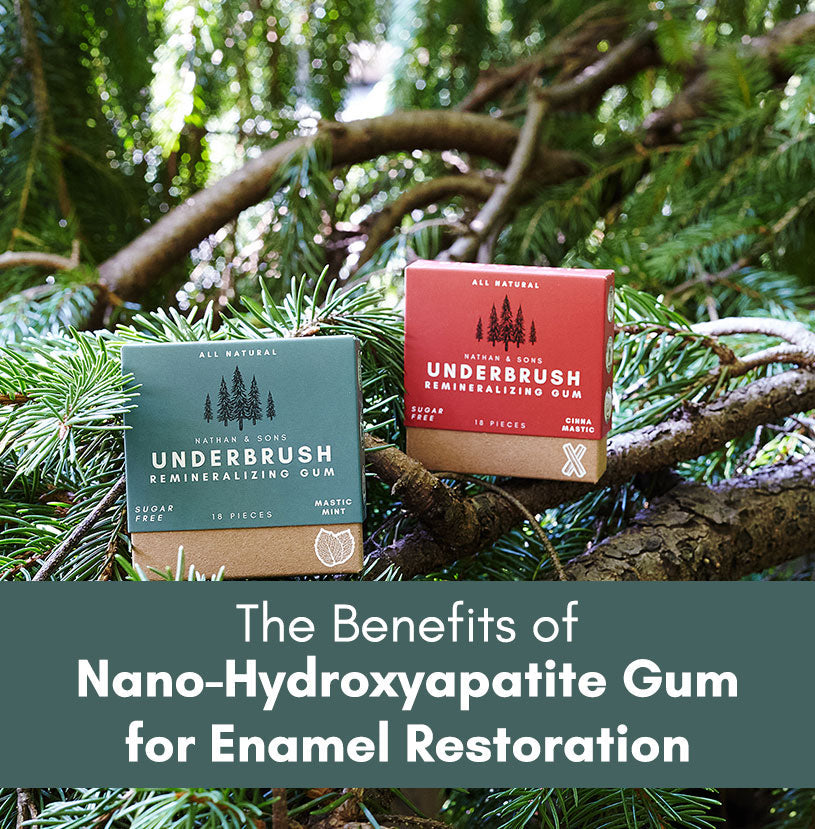
Our remineralizing gum combines nano-hydroxyapatite with xylitol in a plant-based gum format — delivering both ingredients in a chewing gum format that allows prolonged contact with the oral environment during use.
These statements have not been evaluated by the FDA.
This product is not intended to diagnose, treat, cure, or prevent any disease.
What Is in Nathan and Sons Remineralizing Gum?
Nathan and Sons' remineralizing gum is formulated with:
Nano-hydroxyapatite — the active ingredient examined in enamel remineralization research contexts.
Xylitol — a naturally occurring sweetener associated in research with saliva production and oral microbiome research.
Natural flavorings — no artificial flavors, dyes, or preservatives.
A plant-based gum base — formulated without synthetic polymer additives.
No artificial sweeteners — no aspartame, sucralose, or acesulfame potassium.
The full ingredient list is available on our remineralizing gum product page.
For a side-by-side look at how our formulation compares to other products in the market, our Underbrush hydroxyapatite gum vs competitors guide is a useful resource.
Who Is Remineralizing Gum Formulated For?
Nathan and Sons' remineralizing gum is designed for adults and children seeking a fluoride-free oral care option that can be used conveniently between brushing.
It may be of particular interest to:
Consumers seeking fluoride-free oral care alternatives.
Consumers interested in oral care ingredients that have been examined in tooth sensitivity research.
Those who want a sugar-free gum formulated without artificial sweeteners.
Individuals who chew gum regularly and want their gum to contain ingredients with a research basis.
People who are often away from home and want a portable oral care option.
This gum is not a dental treatment.
It is not a substitute for brushing, flossing, or professional dental care.
Consult your dentist before making changes to your oral care routine.
These statements have not been evaluated by the FDA.
How to Use Remineralizing Gum as Part of Your Oral Care Routine
Nathan and Sons' remineralizing gum is designed to complement — not replace — a regular oral care routine.
Chewing one piece after meals, after coffee or acidic drinks, or at times when brushing is not possible is the most natural way to incorporate it.
Saliva production is supported during and shortly after chewing, which is why post-meal use is a common context in chewing gum oral health research.
For more context on how gum fits into a broader oral care approach, our article on does remineralizing gum work examines the evidence in detail.
You might also find our articles on nano-hydroxyapatite powder oral care benefits and natural solutions for tooth sensitivity useful alongside this one.
What the Research Does Not Yet Confirm
It would be dishonest to discuss nano-hydroxyapatite without being clear about the current limits of the evidence.
Most nano-hydroxyapatite studies to date have been conducted in laboratory or in vitro settings.
Human clinical trials with large sample sizes and long follow-up periods are still limited in number.
The 2022 systematic review published in Clinical Oral Investigations noted that high risk of bias, short follow-up periods, and methodological heterogeneity limit the conclusions that can currently be drawn.
The research is genuinely promising — but it is still developing.
Anyone considering nano-hydroxyapatite as part of their oral care routine should discuss it with a qualified dental professional.
These statements have not been evaluated by the FDA and are not intended to diagnose, treat, cure, or prevent any disease.
Key Takeaways: The Benefits of Nano-Hydroxyapatite Gum for Enamel Remineralization Support

Nano-hydroxyapatite is a synthetically produced form of the same mineral that makes up tooth enamel.
Multiple peer-reviewed studies have examined its potential to support enamel remineralization and contribute to oral care outcomes.
Some studies have found nano-hydroxyapatite to produce comparable findings in certain research settings to fluoride in oral care and remineralization contexts.
The overall level of clinical evidence is still developing — more large-scale human trials are needed before definitive conclusions can be drawn.
Chewing gum offers a format that allows prolonged contact with the oral environment during use compared to conventional rinse-and-spit products.
Nathan and Sons' remineralizing gum combines nano-hydroxyapatite with xylitol in a plant-based, artificial sweetener-free formulation.
This gum is not a dental treatment and is not a substitute for professional dental care.
These statements have not been evaluated by the FDA.
Not intended to diagnose, treat, cure, or prevent any disease.
Frequently Asked Questions: Nano-Hydroxyapatite Gum and Enamel Remineralization Support
Can nano hydroxyapatite support enamel remineralization?
Research has examined nano-hydroxyapatite's potential to support enamel remineralization in relation to enamel surface mineral composition.
Multiple studies have found associations between nano-hydroxyapatite use and changes in enamel surface hardness and texture measures.
However, the overall clinical evidence base is still developing and more large-scale human trials are needed.
Nano-hydroxyapatite oral care products are not dental treatments and are not intended to diagnose, treat, cure, or prevent any disease.
These statements have not been evaluated by the FDA.
How does nano-hydroxyapatite compare to fluoride?
Multiple studies have examined nano-hydroxyapatite and fluoride in oral care and remineralization research contexts.
Some studies have found nano-hydroxyapatite to produce comparable findings in certain research settings to fluoride in laboratory and oral care research contexts.
A 2025 narrative review found no demonstrated inferiority of hydroxyapatite compared to fluoride in studies evaluating enamel remineralization and oral care outcomes.
However, the evidence base for nano-hydroxyapatite is less established than for fluoride, which has decades of large-scale clinical research behind it.
These statements have not been evaluated by the FDA.
Is nano-hydroxyapatite safe?
Nano-hydroxyapatite is chemically identical to the mineral compound that makes up tooth enamel.
It has been examined in multiple clinical and laboratory studies with a generally favorable safety profile reported.
Consult your dental or healthcare provider before making changes to your oral care routine.
These statements have not been evaluated by the FDA.
What is remineralizing gum?
Remineralizing gum is a chewing gum formulated with ingredients that have been examined in enamel remineralization research contexts — in Nathan and Sons' case, nano-hydroxyapatite and xylitol.
The gum format allows these ingredients to remain in contact with the oral environment during use.
It is not a dental treatment and is not a substitute for brushing, flossing, or professional dental care.
These statements have not been evaluated by the FDA.
Does xylitol support oral health?
Xylitol is a naturally occurring sweetener that has been examined in oral health research contexts.
A 2024 systematic review found that xylitol's effect on oral health is linked to increased saliva production, especially when used in chewing gum form.
A 2022 systematic review found that xylitol gum was associated with decreased plaque accumulation in the majority of studies examined.
Xylitol-containing products are not dental treatments and are not intended to diagnose, treat, cure, or prevent any disease.
These statements have not been evaluated by the FDA.
Is remineralizing gum a substitute for toothpaste or brushing?
No.
Nathan and Sons' remineralizing gum is designed to complement a regular oral care routine — not replace it.
Brushing, flossing, and regular professional dental care remain the foundation of oral health maintenance.
Who should use remineralizing gum?
Nathan and Sons' remineralizing gum is formulated for adults and children seeking a fluoride-free oral care option for use between brushing.
Consult your dental provider before making changes to your oral care routine, particularly if you have existing dental concerns.
These statements have not been evaluated by the FDA.
Where can I learn more about nano-hydroxyapatite oral care products?
Our full oral care collection is available at nathanandsons.com/collections/oral-care.
Related reading includes our articles on what is nano-hydroxyapatite, nano-hydroxyapatite vs fluoride, and does remineralizing gum work.
Legal & Compliance Disclaimer
These statements have not been evaluated by the Food and Drug Administration.
This product is not intended to diagnose, treat, cure, or prevent any disease.
The information in this article is for educational purposes only and is not a substitute for professional dental or medical advice.
Consult a qualified dental or healthcare provider before making changes to your oral care routine.
Content current as of 2026.
Subject to revision.
References
Amaechi BT, Lemke KC, Saha S, Luong MN, Gelfond J. (2021). Clinical efficacy of nanohydroxyapatite-containing toothpaste at relieving dentin hypersensitivity: an 8 weeks randomized control trial. BDJ Open, 7(1), 23.
Amaechi BT, et al. (2019). Comparative efficacy of a hydroxyapatite and a fluoride toothpaste for prevention and remineralization of dental caries in children. BDJ Open, 5, 18.
Wierichs RJ, Wolf TG, Campus G, Carvalho TS. (2022). Efficacy of nano-hydroxyapatite on caries prevention: a systematic review and meta-analysis. Clinical Oral Investigations, 26, 2593–2612.
Limeback H, Enax J, Meyer F. (2023). Clinical evidence of biomimetic hydroxyapatite in oral care products for reducing dentin hypersensitivity: an updated systematic review and meta-analysis. Biomimetics, 8, 23.
Pawinska M, Paszynska E, et al. (2024). Hydroxyapatite as an active ingredient in oral care: an international symposium report. Biomimetic Nanobiomaterials, 13, 1–14.
Hassan MH. (2023). Nano-hydroxyapatite preparation for the remineralization of primary tooth enamel surface subjected to liquid medication: an observational study. Health Science Reports, 6, e1188.
Anil A, et al. (2022). Nano-hydroxyapatite in the remineralization of early dental caries: a scoping review. International Journal of Environmental Research and Public Health, 19, 5629.
Söderling E, Pienihäkkinen K. (2022). Effects of xylitol chewing gum and candies on the accumulation of dental plaque: a systematic review. Clinical Oral Investigations, 26, 119–129.
Latifi-Xhemajli B, et al. (2024). The effect of xylitol chewing gums and candies on caries occurrence in children: a systematic review. European Archives of Paediatric Dentistry, 25, 145–160.
Wu YF, et al. (2022). Xylitol-containing chewing gum reduces cariogenic and periodontopathic bacteria in dental plaque: microbiome investigation. Frontiers in Nutrition, 9, 882636.
Juntavee A, Juntavee N, Sinagpulo AN. (2021). Nano-hydroxyapatite gel and its effects on remineralization of artificial carious lesions. International Journal of Dentistry, 7256056.
National Institutes of Health. (2014). Nano-hydroxyapatite and enamel remineralization. PMC4252862.
National Institutes of Health. (2022). Nano-hydroxyapatite oral care research. PMC9102186.