
What Is Sorbitol? What Researchers and Consumers Are Asking About This Common Sweetener
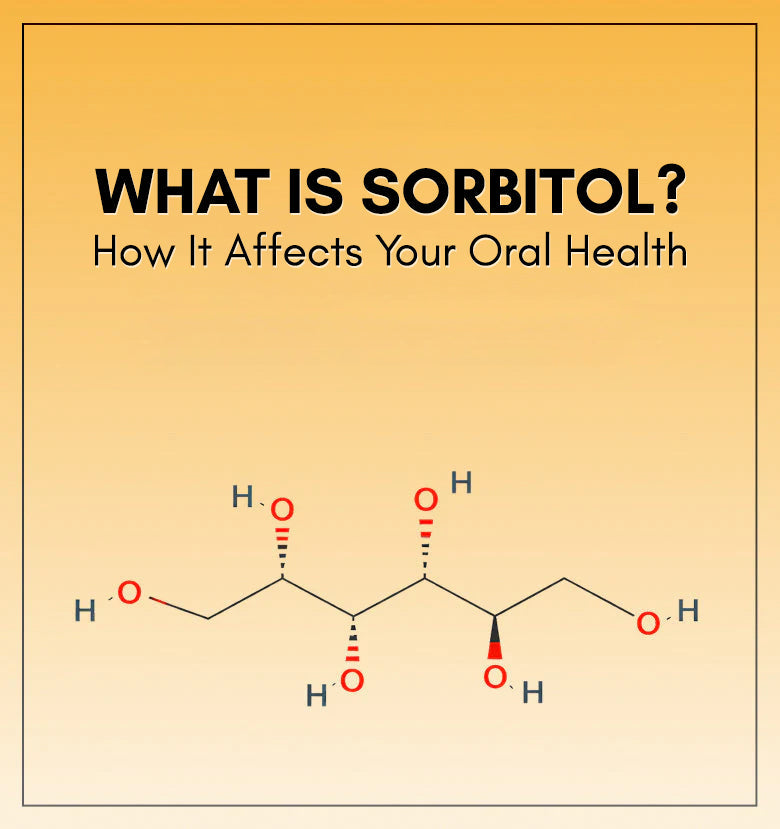
Sorbitol is a sugar alcohol — a class of carbohydrate compounds that provide sweetness with fewer calories than regular sugar — and it is one of the most widely used sweeteners in sugar-free products worldwide.
It occurs naturally in small amounts in certain fruits including apples, pears, and prunes.
For commercial use it is primarily manufactured through the hydrogenation of glucose — most commonly from corn syrup.
It is approximately 60 percent as sweet as table sugar, contains roughly 2.5 to 3.4 calories per gram compared to sugar's 4 calories per gram, and is FDA-approved as a food additive.
Now here's the part most people never think to ask.
Pick up almost any sugar-free gum off the shelf at a gas station or pharmacy.
Flip it over.
Look at the ingredients.
You will almost certainly see sorbitol somewhere on that list.
Most people who chew it every day have never once thought to ask what it actually is, how it works, or what the research says about its long-term effects on oral health.
This article answers those questions honestly — presenting what the science says, where the evidence is strong, and where researchers continue studying.
These statements have not been evaluated by the Food and Drug Administration.
This product is not intended to diagnose, treat, cure, or prevent any disease.
What Is Sorbitol Used For?
Sorbitol serves several distinct functions across different industries — and understanding those functions helps explain why it shows up in so many products.
In food and beverages, sorbitol is used as a low-calorie sweetener in sugar-free gum, candies, mints, protein bars, baked goods, and diet products.
Its low glycemic impact makes it popular in products marketed to people managing blood sugar levels.
In pharmaceuticals, sorbitol is used as a sweetening agent in liquid medications — particularly cough syrups and children's medicines — and as a laxative in clinical settings where it functions as an osmotic agent.
In oral care products including toothpaste and mouthwash, sorbitol serves primarily as a humectant — a compound that attracts and retains moisture — giving toothpaste its characteristic texture and preventing it from drying out in the tube.
It also contributes mild sweetness that makes oral care products more palatable.
In cosmetics and personal care, sorbitol is used as a moisturizing agent and texture stabilizer.
Sorbitol was first isolated in 1872 by French chemist Jean-Baptiste Boussingault from the berries of the mountain ash tree.
Today the global sorbitol market is valued at hundreds of millions of dollars annually — driven primarily by demand for sugar-free and low-calorie food and beverage products.
Sorbitol vs. Sugar: How Are They Different?
This is one of the most commonly searched questions about sorbitol — and the answer is more nuanced than most product labels suggest.
The primary difference is fermentability.
Table sugar — sucrose — is rapidly fermented by oral bacteria, producing lactic acid that lowers mouth pH and contributes to enamel demineralization.
This is the well-established mechanism behind sugar-related tooth decay.
Sorbitol is fermentable by certain oral bacteria, but at a significantly slower rate than glucose or sucrose.
A study published in Caries Research found that the total amount of acid formed from sorbitol was considerably less than from glucose — and that sorbitol was fermented at a slower rate under the same conditions.
From a calorie perspective, sorbitol provides approximately two-thirds of the calories of table sugar while delivering about 60 percent of the sweetness.
Unlike sugar, sorbitol does not cause a rapid rise in blood sugar — which is why it is widely used in diabetic-friendly products.
The FDA has recognized that sugar alcohols like sorbitol may reduce the risk of tooth decay compared to sugar — though not to the same extent as non-fermentable alternatives like xylitol.
So the honest answer to sorbitol vs. sugar is this: sorbitol is meaningfully less harmful to teeth than sugar and produces fewer calories and less blood sugar impact.
But "less harmful than sugar" is not the same as "actively beneficial for oral health" — and this distinction is what areas researchers continue studying.
Sorbitol and Oral Bacteria: What the Research Has Found

Here's the distinction that matters most for anyone using sorbitol in a dental care context.
Unlike sucralose — which oral bacteria cannot ferment, as explored in our article on whether sucralose causes tooth decay — sorbitol is fermentable by certain oral bacteria.
This is a meaningful difference worth understanding.
A 1990 study published in the Journal of Dental Research examined sorbitol fermentation in dental plaque and found that after a period of regular sorbitol exposure, an increase in sorbitol-fermenting bacteria and mutans streptococci was observed in plaque samples.
The same study found that the pH drop in dental plaque after sorbitol exposure was more pronounced in participants with lower salivary secretion rates — meaning those who already had less saliva protection were more affected.
A separate study published in Caries Research found that while sorbitol is fermented at a slower rate than glucose, acid production from sorbitol by certain oral bacterial strains was measurable — though considerably less than the acid produced from glucose.
A review published in the Journal of Dental Research examining sorbitol compared to xylitol in dental health research found that data from multiple studies suggest xylitol-containing gums may provide superior oral health outcomes compared to sorbitol-containing gums in certain research contexts.
It is important to frame this accurately.
Sorbitol is not as cariogenic as sugar.
The research does not establish that sorbitol causes cavities in the same way fermentable sugars do.
What the research does suggest is that sorbitol occupies a more complex middle ground than its "sugar-free" label implies — and that its fermentability by certain oral bacteria is an area researchers continue studying.
These statements have not been evaluated by the FDA and should not be interpreted as disease-treatment claims.
Sorbitol in Toothpaste: Why It's There and What to Know
Sorbitol appears in toothpaste and mouthwash for reasons that have little to do with sweetening.
It functions primarily as a humectant — a moisture-retaining compound that gives toothpaste its smooth, spreadable texture and prevents it from drying out in the tube.
It also contributes mild sweetness that makes brushing more pleasant.
These are legitimate functional roles.
A tube of toothpaste without a humectant would separate, dry out, and become difficult to use within weeks.
However, for consumers who are evaluating the full ingredient picture of their oral care routine, sorbitol's presence in toothpaste is worth understanding alongside its oral bacteria research profile.
The 1990 Kalfas et al. study found that regular sorbitol exposure was associated with adaptation of sorbitol-fermenting bacteria in dental plaque.
For most people this is unlikely to be a significant concern from toothpaste use alone — the contact time is brief and the product is rinsed away.
But for consumers who use sorbitol across multiple products simultaneously — toothpaste, mouthwash, gum, and sugar-free foods — cumulative exposure is something some consumers consider when evaluating oral care ingredients.
A review published in the Journal of Global Oral Health noted that the data on sugar alcohols and oral health specifically remains an area where more targeted research would be valuable.
For more on what goes into oral care products worth considering, browse our oral care collection.
The Sorbitol and Saliva Connection
Imagine two people chewing the same brand of sugar-free gum after lunch.
One has healthy, abundant saliva production.
The other has reduced salivary flow — common among older adults, people on certain medications, or anyone managing chronic dry mouth.
For the first person, sorbitol's fermentability is partially buffered by saliva's natural neutralizing capacity.
For the second person, the 1990 Kalfas et al. study found the pH drop from sorbitol fermentation was significantly more pronounced.
This is the oral health context that matters.
The American Dental Association notes that stimulated saliva carries calcium and phosphate ions that contribute to enamel remineralization and buffers the effects of acids.
Saliva is protective.
When saliva is reduced — for any reason — the oral environment becomes less buffered against acid exposure.
Sorbitol's behavior in a well-salivated mouth, a dry mouth may be meaningfully different and this is an area researchers continue exploring.
These statements have not been evaluated by the FDA.
Sorbitol Side Effects: What the Research Shows
Sorbitol has a well-documented set of side effects that most people encounter before they ever read about them on a label.
The most significant is its laxative effect.
Sorbitol is a well-established osmotic laxative — it draws water into the large intestine, softening stool and stimulating bowel movements.
This is a medically useful property when treating constipation.
It is considerably less useful when it's happening because you chewed half a pack of sugar-free gum while watching television.
A study published in the American Journal of Gastroenterology found that ingestion of as little as 5 grams of sorbitol was associated with a significant increase in breath hydrogen concentration in healthy volunteers.
Mild gastrointestinal distress — gas and bloating — was reported after 10 grams.
Severe symptoms including cramps and diarrhea were reported after 20 grams.
A review published in the American Journal of Medicine found that gastrointestinal side effects from sorbitol are an underappreciated and frequently overlooked cause of digestive complaints — particularly because sorbitol appears in so many products simultaneously and cumulative intake is difficult to track.
Other documented side effects of sorbitol at higher doses include nausea, vomiting, stomach pain, and dry mouth.
The oral health implication of gastrointestinal distress is indirect but worth noting.
Significant digestive distress from sorbitol consumption can contribute to dehydration.
Dehydration reduces saliva production.
And reduced saliva production leaves the oral environment less buffered against acid exposure.
This represents a theoretical oral health consideration rather than a demonstrated direct oral outcome.
For most people using sorbitol in one or two products in moderate amounts, these effects are unlikely to be significant.
For people using sorbitol across multiple product categories simultaneously, cumulative intake is something some consumers consider when evaluating their routine.
These statements have not been evaluated by the FDA.
The 2025 Liver Health Research: What It Says and What It Doesn't
This is the most recent area of scientific discussion around sorbitol — and it deserves careful, accurate handling.
A study published in Science Signaling in October 2025 by researchers at Washington University in St. Louis found that sorbitol can be converted into fructose within the liver — triggering metabolic effects similar to those associated with fructose consumption.
The study found that in animal models where gut bacteria were depleted, sorbitol transferred to the liver where it was converted to fructose-1-phosphate, activating metabolic pathways associated with steatotic liver disease — a condition formerly known as fatty liver disease that now affects an estimated 30 percent of adults worldwide.
The researchers found that when healthy gut bacteria were present, those bacteria degraded sorbitol before it could reach the liver in significant quantities.
This is important context.
This study was conducted in zebrafish and animal models — not in human subjects.
The findings represent a significant area of emerging research interest rather than established conclusions about human health at normal sorbitol consumption levels.
Current evidence does not establish that consuming sorbitol in typical dietary amounts causes liver disease in humans with healthy gut microbiomes.
What the research does suggest is that sorbitol's metabolic behavior is more complex than its "sugar-free" label implies — particularly in the context of gut microbiome health — and that this is an area researchers are actively continuing to study.
We are presenting this research because it is real, peer-reviewed, and part of an evolving scientific conversation.
We are not making definitive claims about what sorbitol does in the human body at normal consumption levels.
These statements have not been evaluated by the FDA and are not intended to diagnose, treat, cure, or prevent any disease.
Sorbitol vs. Xylitol: A Different Research Profile
Not all sugar alcohols are the same.
Sorbitol and xylitol have distinct chemical and oral health research characteristics — and those characteristics are a distinction many oral-care-focused consumers consider relevant.
Xylitol — unlike sorbitol — is not fermentable by oral bacteria.
That's not a marketing claim.
It's the underlying chemistry.
A 2022 study published in Frontiers in Nutrition found that xylitol gum was associated with a 20 percent reduction in dental plaque accumulation and a meaningful decrease in cariogenic bacteria compared to controls.
A 2016 review published in the International Journal of Dentistry examining erythritol, xylitol, and sorbitol found important differences in the effect of individual polyols on oral health — with both erythritol and xylitol demonstrating more extensively studied oral health research profiles than sorbitol.
A systematic review published in the International Journal of Dentistry examining xylitol versus sorbitol found that while direct comparative evidence was not conclusive, data from multiple studies suggested xylitol-containing gums may provide superior outcomes in high-risk populations — and called for further high-quality randomized controlled trials to fully separate the effects of the two compounds.
The honest summary: sorbitol and xylitol have distinct chemical and oral health research characteristics.
Sorbitol is fermentable by certain oral bacteria.
Xylitol is not.
That difference has a well-researched oral health basis — and for a product designed to support oral wellness, it is a distinction many oral-care-focused consumers consider relevant.
These ingredients have different research profiles and are studied in different oral health contexts.
This is exactly why Nathan and Sons uses xylitol — not sorbitol or other artificial sweeteners — in our remineralizing gum and across our oral care product line.
For a deeper look at xylitol's research profile, our guide to everything you need to know about xylitol as a natural sweetener covers the full evidence base.
If you're ready to make the switch, our guide to gum that contains xylitol and why it matters walks through exactly what to look for on a label.
What This Means for Your Gum and Dental Product Choices
Here's the bottom line.
Sorbitol is FDA-approved, widely used, and not as harmful as sugar in the direct cavity-causing sense.
But the full picture — its fermentability by certain oral bacteria, its gastrointestinal effects at higher consumption levels, its behavior in low-saliva environments, the 2025 liver health research, and the comparative research showing xylitol with a more extensively studied oral health research profile — is something some consumers consider when evaluating oral care ingredients.
The case for choosing xylitol-based oral care products over sorbitol-based ones isn't that sorbitol definitively causes harm at typical consumption levels.
The case is that we prefer ingredients with more extensively studied oral-health-focused research profiles — and for products you're using in your mouth every day, that preference is a distinction many oral-care-focused consumers consider relevant.
For a side-by-side look at how our formulation compares to what else is on the market, our Underbrush hydroxyapatite gum vs competitors guide breaks it down.
To learn more about who we are and why ingredient choices matter to us, visit our about page.
Key Takeaways: What Is Sorbitol?
Sorbitol is a sugar alcohol used as a sweetener, humectant, and texturizer in sugar-free gum, toothpaste, mouthwash, pharmaceuticals, and processed foods.
It is FDA-approved and considered safe under current regulatory standards.
It is less harmful to teeth than fermentable sugars like sucrose — but unlike xylitol, it is fermentable by certain oral bacteria, producing acid at a measurable level in research settings.
The pH drop from sorbitol fermentation was found to be more pronounced in individuals with lower salivary secretion rates in peer-reviewed research.
Sorbitol is a well-documented osmotic laxative — gastrointestinal effects including bloating, gas, and diarrhea have been reported at higher consumption levels.
A 2025 study published in Science Signaling found that sorbitol can be converted to fructose in the liver in animal models — research in this area is ongoing and current evidence does not establish definitive harm at normal human dietary consumption levels.
Xylitol has a more extensively studied oral health research profile than sorbitol — it is non-fermentable by oral bacteria and has been associated in research with reduced cariogenic bacteria and decreased plaque accumulation.
Nathan and Sons uses xylitol rather than sorbitol in our oral care products based on the ingredient profile and oral care research discussed above.
These statements have not been evaluated by the FDA.
Not intended to diagnose, treat, cure, or prevent any disease.
Looking for a change? Check out our Underbrush gum today!
Frequently Asked Questions: What Is Sorbitol?
What is sorbitol and where does it come from?
Sorbitol is a sugar alcohol that occurs naturally in small amounts in certain fruits including apples, pears, and prunes.
For commercial use, it is primarily manufactured through the hydrogenation of glucose — most commonly from corn syrup.
It is approximately 60 percent as sweet as table sugar and is used as a sweetener, humectant, and texturizer in sugar-free gum, toothpaste, mouthwash, pharmaceuticals, and processed foods.
What is sorbitol used for?
Sorbitol is used as a low-calorie sweetener in sugar-free foods and beverages, as a humectant and texture agent in toothpaste and mouthwash, as a sweetening vehicle in liquid medications, as an osmotic laxative in clinical settings, and as a moisturizing agent in cosmetics and personal care products.
Is sorbitol safe?
Sorbitol is FDA-approved as a food additive and is considered safe under current regulatory standards.
At higher consumption levels it is a well-documented osmotic laxative with documented gastrointestinal side effects including bloating, gas, and diarrhea.
A 2025 study published in Science Signaling raised questions about sorbitol's metabolic behavior in animal models — current evidence does not establish definitive harm at normal human dietary consumption levels.
Consult a healthcare provider if you have specific digestive sensitivities or existing health concerns.
These statements have not been evaluated by the FDA.
Is sorbitol bad for your teeth?
Sorbitol is less harmful to teeth than fermentable sugars like sucrose.
However, unlike xylitol — which oral bacteria cannot ferment — sorbitol is fermentable by certain oral bacteria, producing acid at a slower rate than glucose in research settings.
Research has found that the pH drop from sorbitol fermentation was more pronounced in individuals with lower salivary secretion rates.
These are research observations and should not be interpreted as disease-treatment claims.
These statements have not been evaluated by the FDA.
What are the side effects of sorbitol?
At higher consumption levels, sorbitol's documented side effects include gas, bloating, abdominal cramping, diarrhea, nausea, and dry mouth.
A peer-reviewed study found mild gastrointestinal distress after 10 grams and severe symptoms after 20 grams in healthy volunteers.
For most people using sorbitol in one or two products in moderate amounts, these effects are unlikely to be significant.
Consult a healthcare provider if you experience persistent digestive symptoms.
These statements have not been evaluated by the FDA.
Is sorbitol in gum a concern?
The amount of sorbitol in a single piece of gum is unlikely to cause significant gastrointestinal effects for most adults.
However, sorbitol's fermentability by certain oral bacteria means it does not have the same non-fermentable profile as xylitol.
For consumers choosing gum specifically for oral health support, xylitol has a more extensively studied oral health research basis.
These statements have not been evaluated by the FDA.
Sorbitol vs. sugar — which is better for teeth?
Sorbitol is considerably less harmful to teeth than sugar because it is fermented by oral bacteria at a much slower rate and produces significantly less acid.
The FDA has recognized that sugar alcohols like sorbitol may reduce the risk of tooth decay compared to sugar.
However, xylitol — which is entirely non-fermentable by oral bacteria — has a more extensively studied oral health research profile than sorbitol for active oral health support.
These statements have not been evaluated by the FDA.
Is xylitol better than sorbitol for oral health?
Sorbitol and xylitol have distinct chemical and oral health research characteristics.
Xylitol is non-fermentable by oral bacteria — sorbitol is fermentable by certain oral bacterial strains.
Research has associated xylitol with reduced cariogenic bacteria, decreased plaque accumulation, and increased saliva production.
A systematic review comparing the two found data suggesting xylitol may provide superior outcomes in higher-risk populations — while noting that more high-quality comparative trials are needed.
These statements have not been evaluated by the FDA.
Is sorbitol vegan?
Sorbitol is commercially produced from glucose derived from plant sources — primarily corn syrup.
It does not contain animal-derived ingredients and is generally considered vegan.
Always check the specific product's sourcing and manufacturing claims if this is a priority for you.
Is sorbitol gluten free?
Sorbitol is generally considered gluten free.
It is produced from glucose through a hydrogenation process that does not typically involve gluten-containing grains.
However, sorbitol can be derived from various plant sources including wheat in some European manufacturing contexts.
If gluten avoidance is medically important for you, verify the specific source of sorbitol in the products you use.
Why does Nathan and Sons use xylitol instead of sorbitol?
Nathan and Sons uses xylitol in our oral care products based on the ingredient profile and oral care research discussed above.
We prefer ingredients with more extensively studied oral-health-focused research profiles and formulations some consumers feel more comfortable using daily.
We do not use sorbitol, sucralose, aspartame, or acesulfame potassium.
The full ingredient list for every product is available on our product pages.
What products commonly contain sorbitol?
Sorbitol is found in sugar-free chewing gum, toothpaste, mouthwash, sugar-free candies and mints, certain liquid medications, protein bars, and a wide range of processed sugar-free food and beverage products.
Reading ingredient labels is the most reliable way to identify sorbitol content across your daily routine.
Legal & Compliance Disclaimer
These statements have not been evaluated by the Food and Drug Administration. This product is not intended to diagnose, treat, cure, or prevent any disease. The information in this article is for educational purposes only and is not a substitute for professional dental or medical advice. Consult a qualified dental or healthcare provider before making changes to your oral care routine. Content current as of 2026. Subject to revision.
References
Kalfas S, Svensater G, Birkhed D, Edwardsson S. (1990). Sorbitol adaptation of dental plaque in people with low and normal salivary-secretion rates. Journal of Dental Research, 69(2), 436–441. PMID: 2307746.
Kalfas S, Maki Y, Birkhed D, Edwardsson S. (1990). Effect of pH on acid production from sorbitol in washed cell suspensions of oral bacteria. Caries Research, 24(2), 107–112. PMID: 2111221.
Birkhed D, et al. (2000). Sorbitol compared with xylitol in prevention of dental caries. Journal of Dental Research. PMID: 10669192.
Mackay AD, Bladon PT. (1994). Gastrointestinal effects of sorbitol as an additive in liquid medications. American Journal of Medicine. PMID: 8059785.
Hyams JS. (1983). Sorbitol intolerance: an unappreciated cause of functional gastrointestinal complaints. American Journal of Gastroenterology. PMID: 6847853.
Jackstadt MM, Fowle-Grider R, et al. (2025). Intestine-derived sorbitol drives steatotic liver disease in the absence of gut bacteria. Science Signaling, 18(910), eadt3549. DOI: 10.1126/scisignal.adt3549.
de Cock P, Mäkinen K, et al. (2016). Erythritol is more effective than xylitol and sorbitol in managing oral health endpoints. International Journal of Dentistry. PMC5011233.
Rethman J, et al. (2012). Effect of xylitol versus sorbitol: a quantitative systematic review of clinical trials. International Journal of Dentistry. PMID: 23016999.
Wu YF, Salamanca E, et al. (2022). Xylitol-containing chewing gum reduces cariogenic and periodontopathic bacteria in dental plaque. Frontiers in Nutrition, 9, 882636. PMC9131035.
Söderling E, Pienihäkkinen K. (2022). Effects of xylitol chewing gum and candies on the accumulation of dental plaque: a systematic review. Clinical Oral Investigations, 26, 119–129.
Journal of Global Oral Health. (2024). Non-sugar substitutes: effects on oral health.
American Dental Association. Chewing Gum. ADA Oral Health Topics. ada.org/resources/ada-library/oral-health-topics/chewing-gum.