

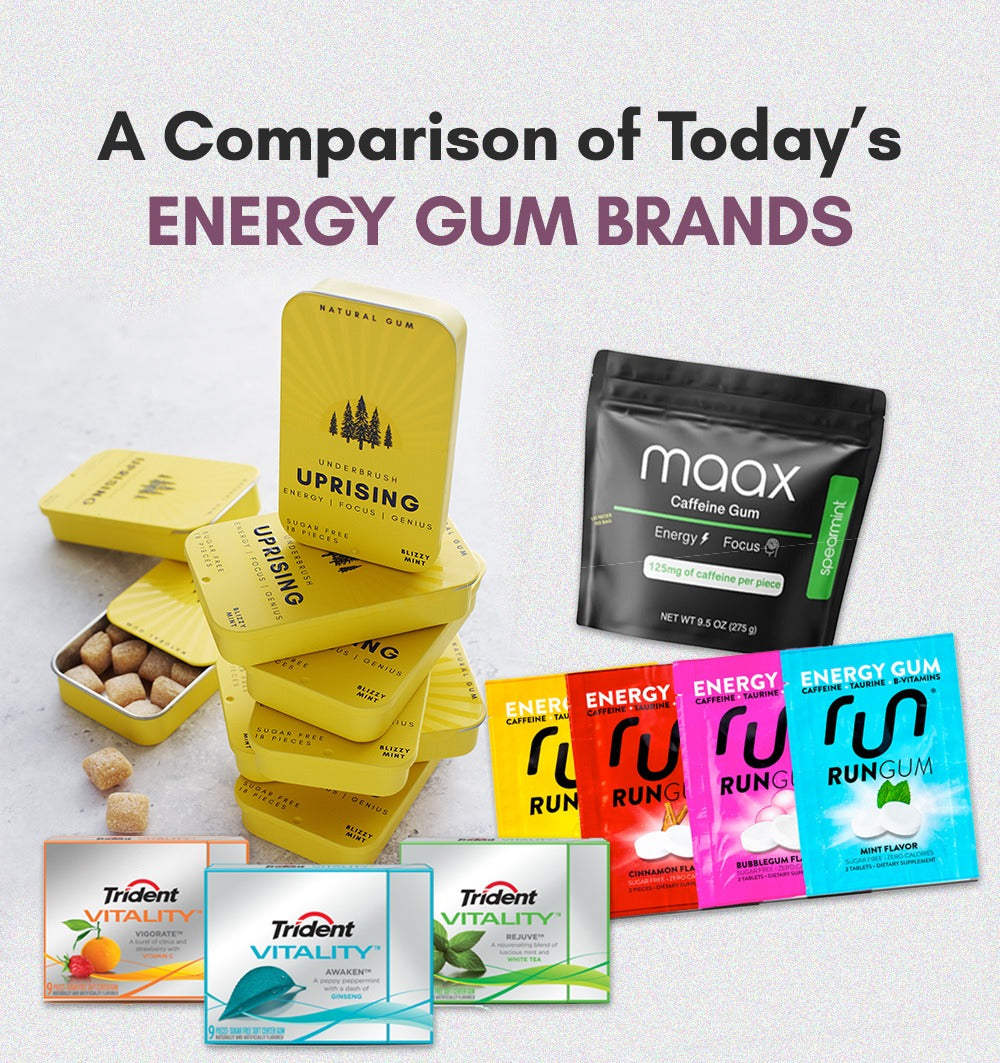
How the Energy Gum Category Evolved, What’s Inside Each Formula, and What to Look For
Energy gum has moved well beyond novelty status. What once lived on the fringes of endurance sports and military rations has grown into a serious functional category used by students, creatives, professionals, athletes, travelers, and people deliberately reducing their reliance on coffee and energy drinks.
Here at Nathan and Sons, we approach energy gum as a formulation discipline, not a stimulant shortcut. This guide is designed to educate first. Rather than ranking winners and losers, it explains how the category evolved, what actually differentiates energy gum brands, and how today’s most recognized options compare based on ingredients, structure, and intent.
If you are new to energy gum or evaluating different brands, this article will help you understand what matters and why.
What Is Energy Gum?
Energy gum is a type of functional chewing gum designed to support alertness, focus, and mental performance. Most energy gums use caffeine as the primary active ingredient, delivered through chewing rather than liquid consumption.
The chewing format offers several unique advantages:

As the category matured, many brands expanded beyond caffeine alone, incorporating amino acids, nootropics, adaptogens, vitamins, and alternative stimulants to improve balance and duration.
How Energy Gum Became a Category
Energy gum did not appear overnight. Its rise reflects broader shifts in how people think about energy, focus, and performance in daily life.
The modern concept of caffeinated or “energy” gum is widely associated with research efforts in the late 1990s, when scientists working with the Walter Reed Army Institute of Research explored caffeine-containing gum for military use. Early versions, often referred to as Stay Alert gum, were developed to support alertness during extended operations without requiring coffee or energy drinks.
Because of this origin, some of the earliest forms of energy gum were created for performance-focused environments such as the military and endurance settings. In those contexts, portability and convenience mattered more than flavor or consumer experience. Gum offered a compact format that could be carried easily and used without water or preparation.
Over time, consumer preferences also began to evolve. As awareness increased around sugar levels, artificial additives, and the strong stimulant profiles commonly associated with many energy drinks, some consumer interest began shifting toward alternatives with different ingredient profiles. Smaller caffeine servings delivered through formats like gum started gaining interest.
Coffee fatigue also played a role. While coffee remains widely consumed, some individuals report sensitivity such as jitters or digestive discomfort when consuming larger liquid caffeine servings. Energy gum offered another way for people to consume caffeine in smaller portions without drinking a full acidic beverage like coffee.
At the same time, the format began gaining cultural visibility. Athletes, podcasters, and public figures started mentioning energy gum as part of their routines, helping increase awareness of the format and introducing it to wider audiences. Over time, it became another option some people use as part of their routines for alertness and focus during work, travel, or training.
Energy Gum vs Coffee and Energy Drinks
Understanding how energy gum compares to other energy sources helps clarify its role.

Energy gum is not intended to replace all caffeine sources, but it fills a specific niche for controlled, functional use.
What Actually Differentiates Energy Gum Brands
From a formulation perspective, energy gum products can differ more than many consumers initially realize. Several factors contribute to these differences, including the caffeine content used, the presence of additional ingredients, the type of gum base, and the sweeteners included in the formulation.
One of the most noticeable differences involves the caffeine source and dosage. Some formulations contain higher caffeine amounts intended to provide a more pronounced stimulant profile, while others use more moderate levels. In certain cases, caffeine may be paired with additional ingredients that are commonly discussed in research related to alertness or cognitive performance.
Another point of variation is the inclusion of ingredients sometimes used in functional foods or dietary supplements. Compounds such as L-theanine or Alpha-GPC may appear in some formulations alongside caffeine. These ingredients have been examined in scientific literature related to cognitive performance, although their inclusion and amounts vary widely between products.
Some energy gums also incorporate botanical ingredients commonly referred to as adaptogens. Plants such as rhodiola rosea or saffron extract occasionally appear in functional food or supplement formulations and have been studied in relation to the body’s response to stress and mental workload. Their use in gum products reflects broader trends in ingredient experimentation across the functional food category.
The gum base itself can also vary between brands. Many chewing gums use a synthetic base made from food-approved polymers, while a smaller number of manufacturers explore bases derived from natural tree resins. These choices primarily affect manufacturing methods, ingredient sourcing, and product positioning.
Sweeteners represent another area where products can differ. While many gums are labeled sugar-free, the sweeteners used can vary between formulations. Ingredients such as xylitol are frequently referenced in dental research related to oral care, while other sweeteners are used primarily for flavor, texture, or stability within the gum.
Why Gum Base Is Often Overlooked
One of the least discussed aspects of energy gum is the gum base itself.
Most conventional chewing gum uses a synthetic polymer base. While effective for chew texture, it provides no functional benefit beyond mechanical chewing.
Natural gum bases, derived from tree resins, have historically been used for oral health and breath freshness. Ingredients such as chicle, mastic, spruce resin, and myrrh have long-standing cultural and traditional use for oral hygiene.
For brands focused on long-term daily use, gum base selection matters more than it appears at first glance.
Energy Gum Brand Comparison Overview
Below is a category-level comparison of widely recognized energy gum brands. This table is designed to support visual layout and further design refinement.

Understanding the Spectrum of Energy Gum Formulations
Not all energy gums are trying to do the same thing — and once you understand what's actually happening in your brain and bloodstream, the differences start to make a lot more sense.
Basic Caffeine Gums: The Blunt Instrument
Picture a truck driver at 2am somewhere on I-40, two hundred miles from the next stop. He's not thinking about neuroplasticity. He needs to be awake in the next five minutes or he's pulling over. He reaches for a caffeine gum, chews it for thirty seconds, and that's exactly what he gets.
These are the no-frills option, and honestly? They work. When you chew a caffeine gum, the caffeine absorbs directly through the tissue in your cheek — bypassing your digestive system entirely and hitting your bloodstream 3–5 times faster than a coffee or capsule would. Your adenosine receptors (the ones responsible for making you feel tired) get blocked almost immediately, and within minutes you feel sharper, more alert, more awake.
The catch is that there's nothing else in the formula to manage that signal. It's like turning a dial all the way up with no fine-tuning. You get a sharp spike, a productive window, and then — when the caffeine clears — a fairly hard landing. Military units have used basic caffeine gum for exactly this reason: fast onset, no liquid required, predictable effect. In and out. For a pre-workout or a single intense task, that's totally fine. For a four-hour writing session? You might be staring at the ceiling by hour two.
Balanced Stimulation Gums: The Smart Stack
Imagine two people walking into a big presentation. One slammed a double espresso in the parking lot. The other had a balanced caffeine-theanine gum about twenty minutes before. The first person is sharp but visibly wired — talking fast, a little scattered, checking their phone. The second is calm, locked in, and somehow more articulate than usual. Same caffeine. Completely different experience.
This is where things get interesting. Formulators figured out that caffeine is a powerful but blunt tool, and started pairing it with ingredients that shape the experience rather than just amplify it.
The star of the show is L-theanine, an amino acid found naturally in green tea. L-theanine promotes alpha-wave activity in the brain — the same calm, focused mental state associated with meditation. On its own it's mildly relaxing. Paired with caffeine, something almost paradoxical happens: the alertness stays, but the edge comes off. The jitteriness, the racing thoughts, the caffeine anxiety — largely gone. Research backs this up pretty consistently, which is rare in the supplement world.
There's a reason Japanese tea culture has been pairing these two compounds for centuries without knowing the biochemistry. The calm alertness that monks described after drinking matcha — that's the theanine modulating the caffeine. They just called it clarity.
Many of these gums also add theobromine, caffeine's quieter cousin from cacao. Theobromine is a weaker stimulant but it metabolizes much more slowly, adding a gentle, extended tail to the energy curve so you don't fall off a cliff two hours in. Toss in some B vitamins for metabolic support and you've got a formula that delivers real, sustained focus — typically two to four hours of smooth, usable energy without the crash.
Functional Cognitive Gums: The Full Stack
Think about a surgeon going into hour six of a complex procedure. Or a novelist trying to write on a deadline while her kid is sick and she hasn't slept well in three days. Or a founder prepping for a board meeting after a month of nonstop fires. These aren't people who just need to be awake. They need their brain to actually work well — under pressure, for hours, without their stress response eating them alive.
That's the problem functional cognitive gums are trying to solve.
On top of the caffeine-theanine base, they layer in ingredients targeting memory, mood, stress resilience, and neurological health. It sounds like marketing until you look at what some of these compounds actually do.
Adaptogens like ashwagandha and rhodiola rosea work on the HPA axis — the hormonal pathway that governs your stress response. Think of it like a volume knob on your cortisol. When you're under real pressure, cortisol spikes hard, and that spike is cognitively expensive — it narrows your thinking, kills creativity, and makes complex reasoning harder. Adaptogens help keep that response proportional, so the stimulants feel cleaner and more sustainable rather than tipping you into fight-or-flight mode. Rhodiola in particular has a history of use by Soviet-era military researchers who were looking for ways to keep soldiers sharp in extreme conditions. Whether or not that story impresses you, the underlying research is solid.
Cholinergic compounds like alpha-GPC boost acetylcholine, the neurotransmitter most tightly linked to working memory and focused attention. If caffeine is the gas pedal, acetylcholine is the steering wheel — it's what lets you actually direct all that energy somewhere useful. Lion's mane mushroom supports nerve growth factor (NGF), which plays a role in neuroplasticity — your brain's ability to form and strengthen connections. Bacopa monnieri has a decent body of research behind it for memory consolidation, though it's a slow burn: most studies run eight to twelve weeks before seeing significant results.
That last point is the honest caveat with this whole tier. A lot of these ingredients are building blocks, not light switches. One piece of functional gum won't turn you into a genius — but think of it less like a shot of espresso and more like going to the gym. One session doesn't do much. Six weeks in, you're different. People who stick with functional cognitive stacks long enough usually describe the shift not as feeling "on" but as feeling more like themselves — less reactive, more resilient, easier to focus when it counts.
They're also more expensive, the ingredient interactions are more complex, and individual response varies more than with straight caffeine. What works brilliantly for one person does nothing for another.
So which one do you actually need?
The truck driver at 2am doesn't need lion's mane. The surgeon in hour six doesn't just need a jolt of caffeine. Context is everything.
If the task is short and the stakes are low, a basic caffeine gum does exactly what it promises. If you're sitting down for a long work session and you hate that jittery, wired feeling, a balanced formula is probably your sweet spot. And if you're someone who does high-stakes cognitive work regularly, deals with a lot of stress, and wants something you can build a routine around — the functional tier is worth exploring. Just go in with realistic expectations and give it time to work.
The gum is just the delivery mechanism. What's in it determines everything else.
Spotlight: Nathan and Sons Underbrush Uprising
Underbrush Uprising was developed to represent what energy gum can become when formulation is treated as a system rather than a shortcut.
It is a functional energy chewing gum designed to support:
- Alertness
- Focus
- Cognitive performance
- Mood balance
- Flow state
Rather than relying on sharp stimulant spikes, Underbrush Uprising is built for sustained mental clarity and productive performance.
How Underbrush Uprising Works
Underbrush Uprising supports cognitive performance through four complementary mechanisms.
1. Rapid Oral Delivery
Chewing increases saliva flow and allows certain compounds to begin interacting earlier, contributing to faster perceived onset.
2. Balanced Stimulation
Caffeine and theobromine support alertness and wakefulness. L-theanine moderates overstimulation, helping reduce jitter and abrupt crashes.
3. Neurochemical Support
Alpha-GPC supports acetylcholine synthesis, which plays a central role in attention and memory. B vitamins and NAD-related compounds support cellular energy metabolism.
4. Mood and Stress Modulation
Rhodiola rosea and saffron extract support stress resilience, emotional balance, and sustained mental endurance.

Ingredient Philosophy Behind Underbrush Uprising
Underbrush Uprising combines energy and focus ingredients with oral-health-supporting compounds typically absent from energy gum.
Oral and Gum Base Ingredients
- Xylitol
- Chicle
- Mastic gum
- Spruce resin
- Myrrh
- Peppermint oil
- Acacia gum
These ingredients support saliva production, breath freshness, and an enamel-friendly oral environment.
Energy and Focus Stack
- Caffeine
- L-theanine
- Theobromine
- Rhodiola rosea
- Alpha-GPC
- Saffron extract
Vitamins and Cellular Support
- NAD-related compounds
- Vitamin B12
- Folate (Vitamin B9)
This combination reflects research showing that balanced formulations outperform caffeine alone for sustained mental performance.
Scientific Context: What the Research Supports
Peer-reviewed research supports the inclusion of these ingredient classes:
- Caffeine improves alertness, reaction time, and cognitive performance
- Caffeine combined with L-theanine improves focus with fewer side effects
- Theobromine provides smoother, longer-lasting stimulation
- Rhodiola rosea supports resistance to mental fatigue under stress
- Alpha-GPC supports attention and acetylcholine signaling
- Saffron extract supports mood balance and emotional well-being
- NAD and B vitamins support cellular energy metabolism
Taken together, this research suggests that energy gum works best when stimulation, neurotransmitter support, and stress modulation are addressed simultaneously.
Energy Gum Is a Tool, Not a Crutch
Regardless of brand, energy gum is best understood as:
- A performance support tool
- A supplement to sleep and nutrition
- Most effective when used intentionally
It is not designed to replace sleep or override biological limits.
Evaluate How to Choose the Right Energy Gum
When evaluating energy gum brands, consider:
- Do you want fast stimulation or sustained focus?
- Are you sensitive to caffeine spikes?
- Do you care about oral health ingredients?
- Do you want cognitive support beyond caffeine?
- Will you use it occasionally or daily?
Your answers will naturally point toward different formulations.
Shop Uprising Energy Gum now!
Energy Gum Brands – FAQs
What is energy gum used for?
Energy gum is used to support alertness and focus, usually through caffeine delivered in a chewing format. Many people use it for studying, long drives, work blocks, training, or travel days.
Does energy gum work faster than coffee?
Many users report faster perceived onset because chewing begins immediately and can feel more direct than waiting on a beverage to digest.
How do I compare energy gum brands accurately?
Start with caffeine dose, then look for balancing ingredients like L-theanine or theobromine, plus any nootropics or adaptogens. Also compare gum base type (synthetic vs natural), sweeteners, and overall value per serving.
Are all energy gums sugar-free?
Most modern energy gum brands are sugar-free, but sweeteners vary widely. If oral health matters to you, look for enamel-friendly sweeteners like xylitol rather than focusing on “sugar-free” alone.
What makes Nathan and Sons Underbrush Uprising different?
Underbrush Uprising combines balanced stimulation (caffeine plus theobromine and L-theanine) with cognitive support nutrients, adaptogens, and oral-health-supporting ingredients, using a natural tree-resin gum base rather than a synthetic base.
About the Author
Written by the Nathan and Sons Research Team. The team specializes in functional chewing gum formulation, oral health science, and evidence-based approaches to energy and cognitive performance. Content is developed to educate first and promote transparency within the functional gum category.
References
Smith A. Effects of caffeine on human behavior. Food and Chemical Toxicology, 2002.
https://pubmed.ncbi.nlm.nih.gov/12204388/
McLellan TM et al. Caffeine and cognitive performance. Neuroscience & Biobehavioral Reviews,2016.
https://pubmed.ncbi.nlm.nih.gov/26899133/
Owen GN et al. L-theanine and caffeine synergy. Nutritional Neuroscience, 2008.
https://gwern.net/doc/nootropic/caffeine/2008-owen.pdf
Giesbrecht T et al. L-theanine improves cognitive performance. Nutritional Neuroscience, 2010.
https://pubmed.ncbi.nlm.nih.gov/21040626/
Panossian A, Wikman G. Rhodiola rosea efficacy. Phytomedicine, 2010.
https://pubmed.ncbi.nlm.nih.gov/20378318/
Hausenblas HA et al. Saffron supplementation and mood. Journal of Affective Disorders, 2013.
https://pubmed.ncbi.nlm.nih.gov/23265391/
Parker AG et al. Alpha-GPC and cognition. Journal of the International Society of Sports Nutrition, 2015.
https://www.ncbi.nlm.nih.gov/pmc/articles/PMC4595381/
This article is informational. These statements have not been evaluated by the Food and Drug Administration. This product is not intended to diagnose, treat, cure, or prevent any disease.