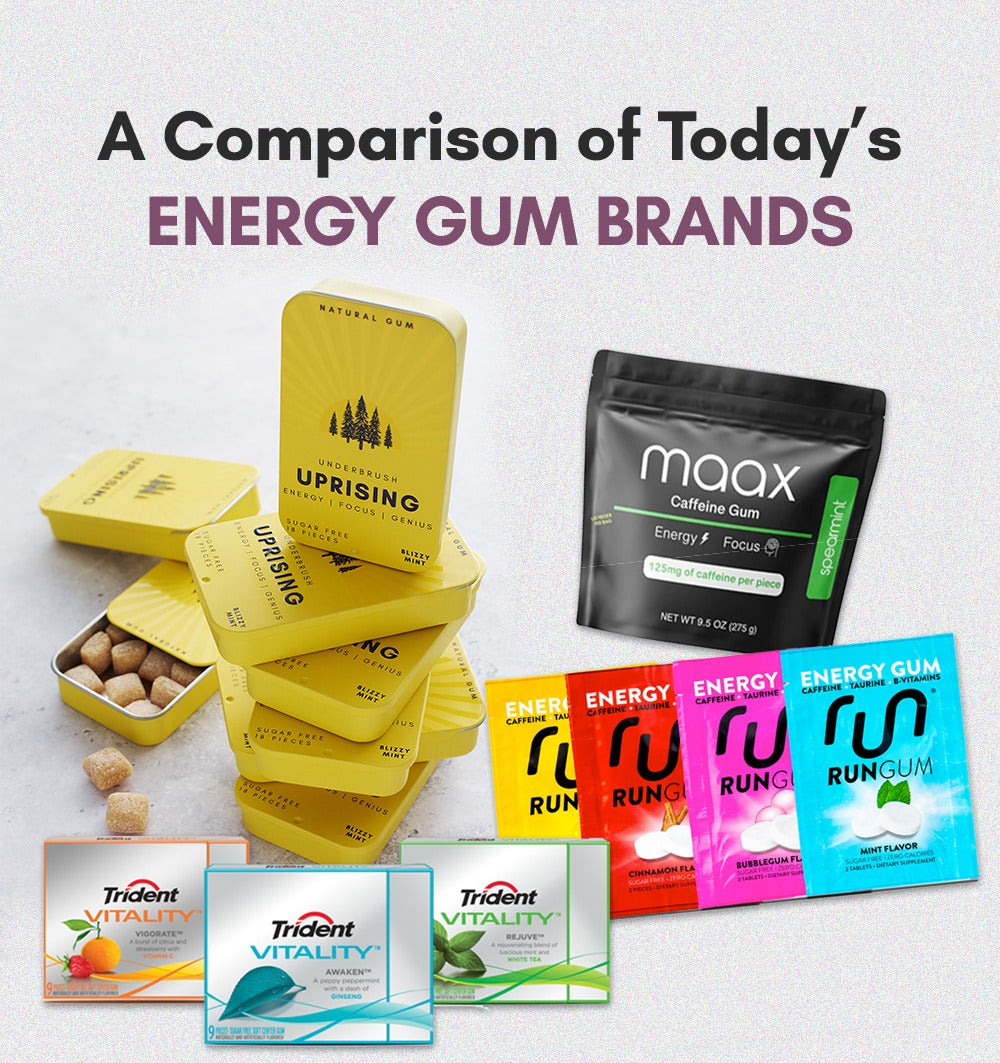

Quick Facts
- Both Uprising and NeuroGum deliver caffeine and L-theanine through chewing gum — but the ingredient depth, gum base, and formulation philosophy are fundamentally different
- Uprising combines caffeine with theobromine, L-theanine, Alpha-GPC, adaptogens, and oral-health-supporting tree resins
- NeuroGum focuses primarily on caffeine and L-theanine delivery in a conventional synthetic gum base
- This comparison is written by Nathan & Sons — the makers of Uprising. We've done our best to be fair and factual throughout.
A lot of people searching Uprising vs. NeuroGum aren't really comparing two products.
They're asking a bigger question.
Is caffeine gum actually worth it — and if so, which one was built with some intention behind it?
That's the question this Uprising vs. NeuroGum breakdown is going to answer. Honestly, even though we make one of these products — and we'll say that upfront so you can factor it in.
These statements have not been evaluated by the Food and Drug Administration. This product is not intended to diagnose, treat, cure, or prevent any disease.
Why We Built Uprising in the First Place
Most energy gums stop at caffeine.
That's not a knock — caffeine works.
The research is solid and we use it in Uprising too.
But caffeine alone delivers alertness without much else. No balance. No sustained output. No consideration for what happens to your teeth after chewing a piece of gum every day.
We kept asking: what if the gum itself was actually doing more for you beyond the energy hit?
Uprising came out of that question.
We wanted something formulated with ingredients commonly studied in connection with focus and alertness — without the spike-and-crash pattern a lot of people experience with caffeine alone.
We also wanted to use a gum base made from real ingredients — not synthetic plastic polymers — because if you're chewing something every day, what it's made of actually matters.
The result is a functional gum that combines an energy and focus stack with the same oral-health-supporting ingredients used in our Underbrush Remineralizing Gum.
As far as we know, it's one of the first gums to intentionally do both.

Uprising vs. NeuroGum: Two Very Different Philosophies
Uprising is built around a core belief: that how you feel at your best shouldn't require a lab.
It's a food-first brand that happens to boost energy. NeuroGum, on the other hand, starts from the other direction entirely — it's a nootropic delivery system disguised as gum.
One brand is asking what does the body already respond to?
The other is asking what can we engineer?
That difference in starting point shapes everything downstream: the ingredient lists, the marketing, the customer they're each trying to reach.
Uprising's Approach
Uprising is designed around what we call balanced stimulation.
The goal isn't maximum alertness — it's a more consistent alertness experience.
The kind that gets you through a four-hour work block or a long study session without feeling like you hit a wall at hour two.
The formulation is built on three principles:
Balanced stimulation rather than sharp peaks.
Multi-pathway cognitive support rather than single-ingredient reliance.
And oral wellness built into the formula — not an afterthought.
That last one matters to us because chewing gum is a daily habit for a lot of people.
If you're going to chew something every day, it should be working for you in more than one way.

NeuroGum's Approach
NeuroGum is positioned around speed and simplicity.
Fast caffeine delivery. Straightforward ingredient profile.
It's a well-known product with a real following, and the caffeine-plus-L-theanine combination it uses is genuinely well-studied.
It's a different goal. Not a worse one — just different.
If all you want is a fast, clean caffeine hit in gum form, NeuroGum does that.
Uprising is designed for people who want more than that.
The Gum Base: A Difference Most People Don't Think About
This is the part of the Uprising vs. NeuroGum comparison that surprises most people.
Almost every chewing gum on the market — including most functional gums — uses a synthetic gum base.
That means polyvinyl acetate, polyethylene, or similar plastic polymers.
These are FDA-approved and considered safe.
Uprising uses a natural tree-resin gum base as an alternative to conventional synthetic gum bases — a blend of chicle, mastic gum, spruce resin, and myrrh.
These are ingredients with long histories of use going back thousands of years.
Mastic gum, harvested from Pistacia lentiscus trees on the Greek island of Chios, has been chewed since ancient times and has a meaningful body of modern research behind it.
Spruce resin gum was the original American chewing gum before synthetic bases took over in the twentieth century.
We also use xylitol as our sweetener — recognized by the American Dental Association as an ingredient that may help reduce the risk of cavities.
And if you want to understand why sucralose isn't something we're willing to use, we wrote about that separately.
NeuroGum uses a conventional synthetic gum base and does not appear to emphasize oral health as part of its formulation philosophy.
That's a real difference — especially for daily users.
Uprising vs. NeuroGum: Ingredient Depth Compared
Both products deliver caffeine and L-theanine. That's where the overlap largely ends.
Here's a side-by-side look at what each product brings to the table:

Ingredient information for NeuroGum is based on publicly available product information at the time of writing. Formulations may change. Always check current product labels before making a purchasing decision.
What's in Uprising
Uprising is formulated around four complementary pathways studied in published research.
Rapid oral delivery through buccal absorption — the same mechanism validated by military caffeine gum research at Walter Reed.
You can read more about how that works and why gum absorbs faster than capsules.
Balanced stimulation using caffeine, theobromine, and L-theanine together.
Theobromine — a compound also found naturally in cacao — has a slower onset and longer duration than caffeine.
Some users prefer formulations that combine caffeine with theobromine because the experience may feel smoother compared to caffeine alone.
Individual results will vary.
L-theanine, at the 2:1 ratio most studied in published research, moderates the overstimulation that caffeine alone can sometimes produce.
Neurochemical support from Alpha-GPC and B vitamins.
Alpha-GPC is a choline donor studied for its potential role in supporting acetylcholine synthesis.
Some research suggests this pathway may be relevant to attention and cognitive function.
A study published in the Journal of the International Society of Sports Nutrition found Alpha-GPC supplementation was associated with improvements in cognitive function measures.
Mood and stress support via rhodiola rosea and saffron extract.
Rhodiola is an adaptogen — a class of compounds studied for their potential to support the body's response to stress.
A review published in Phytomedicine found evidence supporting rhodiola's role in stress resilience and fatigue reduction.
Saffron has been studied for mood support — a meta-analysis in the Journal of Affective Disorders found saffron supplementation was associated with improvements in mood-related outcomes compared to placebo.
What's in NeuroGum
NeuroGum's core stack is caffeine and L-theanine, with some B vitamins.
That combination is well-researched — we cite the same body of literature in our own deep-dive on L-theanine gum.
It's a solid, clean combination.
But it doesn't include adaptogens, choline donors, natural tree-resin bases, or oral health ingredients.
Different goal. Different outcome.
Energy Profile: What the Experience Actually Feels Like
Caffeine alone hits fast and fades.
For a lot of people, that means a noticeable peak followed by a drop — sometimes within 90 minutes.
Adding L-theanine, as both products do, smooths that curve.
The research on this is consistent and well-documented.
But Uprising takes it a step further with theobromine.
Theobromine works by blocking adenosine receptors — the same general mechanism as caffeine — but more slowly and for longer.
Its half-life in the body is roughly twice that of caffeine.
The practical effect is that the energy curve stays flatter for longer. Less of a peak, less of a drop.
For short bursts of alertness, caffeine-forward products work well.
For sustained focus sessions — the kind that last three or four hours — the theobromine addition makes a real difference in how steady that output feels.
Individual results will vary. This is not a guarantee of any specific experience or outcome.
People who try Uprising tend to describe it in pretty consistent terms.
"Is what the name suggests, uplifting. Good for a quick wake me up." — Lemiah
"Best gum ever. Plus now with caffeine?! Yep. Sign me up." — Blake
These statements reflect individual consumer opinions and experiences. Individual results may vary. Results not typical.
Scientific Substantiation: What the Research Actually Covers
This is an area where we want to be direct rather than just promotional.
The research supporting caffeine and L-theanine together is robust.
Both NeuroGum and Uprising can point to a genuine body of clinical literature on that combination.
We've cited much of it in our L-theanine gum science article.
Uprising's additional ingredients — Alpha-GPC, rhodiola, saffron, theobromine — each have their own published research.
We've cited those studies throughout this article.
What we won't do is claim the full Uprising stack has been studied as a combined formula in clinical trials, because it hasn't.
That would be misleading.
The ingredient-level research is solid. The combined formula research is still emerging — as it is for virtually all multi-ingredient supplement products.
NeuroGum's scientific support is primarily centered on caffeine and L-theanine, which is a well-substantiated foundation.
The difference is the breadth of what each product is trying to do — and how much ingredient-level research supports each element of that broader goal.
What to Look for in Any Energy Gum
Whether you're evaluating Uprising vs. NeuroGum or any other energy gum, here's an honest checklist worth applying:
- Exact milligrams per piece — not just "contains caffeine." You need a number to make an informed decision.
- Sweetener transparency — xylitol supports oral health. Aspartame and sucralose are worth scrutinizing. Here's everything you need to know about xylitol if you want to go deeper.
- Gum base disclosure — natural vs. synthetic. Most brands don't highlight this because synthetic is the default.
- Research-backed ingredients at studied doses — look for actual clinical doses, not trace amounts included for label appeal.
- Clean additives — no artificial colors, synthetic flavors, or unnecessary preservatives.
We hold ourselves to this list.
We're also transparent that we don't yet have a third-party Certificate of Analysis to offer — that's something we're working toward.
Pros and Cons: The Honest Version
Uprising
What it does well:
- Multi-layered energy and focus stack — caffeine, theobromine, L-theanine, Alpha-GPC, adaptogens
- Natural, plastic-free gum base using chicle, mastic, spruce resin, and myrrh
- Oral health ingredients built into the formula — xylitol, ingredients commonly used in enamel-focused oral care products
- Designed for a more consistent energy experience rather than a fast spike
What to know:
- More complex formula means more to evaluate — not everyone needs all of it
- If you want maximum, fast stimulation above everything else, Uprising isn't optimized for that
- No third-party COA currently available
We also share honest feedback from our customers — including the mixed reviews.
"I think the flavor is only slightly better than it was before because the original bitter flavor was actually starting to grow on me. The texture seems a bit softer now when chewing so, that's a slight negative for me. Overall, it's a wash. I like both variations. I just hope it's regularly available soon." — Will
NeuroGum
What it does well:
- Simple, fast caffeine delivery in a clean format
- Well-studied core ingredients — caffeine and L-theanine
- Widely available and easy to find
What to know:
- Limited cognitive support beyond the caffeine-theanine combination
- Conventional synthetic gum base
- Minimal oral health functionality
- No adaptogen or choline support
Who Should Choose Which?
If you want a fast, simple caffeine hit in gum form and that's the whole goal — NeuroGum delivers that well.
If you care about clean ingredients, a natural gum base, a more consistent focus experience without the spike-and-drop pattern, ingredients studied for stress response support, and oral health built into the formula — Uprising was designed with all of that in mind.
Neither product is wrong.
They're just built for different people with different priorities.
The people who reach for Uprising tend to be the ones who need to stay sharp for extended stretches — not just a quick boost.
"I'm thinking of buying this for all my O-T-R truck driving friends!! This really works." — Lou
These statements reflect individual consumer opinions and experiences. Individual results may vary. Results not typical.
Frequently Asked Questions
About the Uprising vs. NeuroGum Comparison
Which has more caffeine — Uprising or NeuroGum?
Please check current labeling for both products, as formulations can change.
In general, both products are designed to deliver caffeine in functional doses typical of the energy gum category.
What differs is the supporting stack around that caffeine — which affects how it feels, not just how much there is.
Is Uprising or NeuroGum better for studying?
For shorter study sessions where you mainly need a fast alertness boost, NeuroGum's simpler stack may be enough.
For longer sessions where sustained focus and mood stability matter, Uprising's combination of theobromine, Alpha-GPC, and adaptogens is designed to support that kind of extended output.
Individual results will vary.
Does NeuroGum have a natural gum base?
Based on available product information, NeuroGum uses a conventional synthetic gum base.
Uprising uses a natural tree-resin blend of chicle, mastic gum, spruce resin, and myrrh.
Is this comparison fair?
We've done our best.
We make Uprising, so there's an inherent bias here that you should factor in.
We've cited research throughout, avoided fabricating claims about NeuroGum, and tried to represent both products accurately.
We'd encourage you to read NeuroGum's own materials alongside this and form your own view.
About Uprising Specifically
How fast does Uprising work?
Because Uprising is delivered through chewing, some research suggests buccal absorption may allow faster onset than capsules or drinks.
Some users report noticing effects within 15–30 minutes.
Individual results will vary.
How is Uprising different from regular caffeine gum?
Most caffeine gums deliver alertness through caffeine alone, sometimes with L-theanine.
Uprising is formulated as a multi-pathway functional gum — combining caffeine with theobromine, Alpha-GPC, adaptogens, and oral-health-supporting tree resins.
Different scope, different design.
Is Uprising sugar-free?
Yes.
Uprising is sugar-free and sweetened with xylitol and other non-sugar sweeteners that do not promote tooth decay.
Xylitol may also support saliva production and an enamel-friendly oral environment, per the American Dental Association.
Does Uprising cause jitters or crashes?
The formulation combines ingredients studied for their potential to support a smoother stimulant experience.
L-theanine, theobromine, and adaptogens each have their own published research in this area.
Individual results will vary — this is not a guarantee of any specific experience.
Who is Uprising best for?
People who want sustained mental clarity for work, studying, creative output, or long focus sessions — especially those who care about ingredient quality and prefer a natural gum base.
It's not optimized for maximum stimulation.
It's optimized for a more consistent and manageable alertness experience.
What sweetener does Uprising use?
Uprising uses xylitol — a natural sugar alcohol recognized by the American Dental Association as an ingredient that may help reduce the risk of cavities.
We don't use aspartame, sucralose, or artificial sweeteners.
These statements have not been evaluated by the Food and Drug Administration. This product is not intended to diagnose, treat, cure, or prevent any disease.
This article is for informational purposes only and does not constitute medical advice. Consult a qualified healthcare professional before starting any supplement, especially if you have existing medical conditions or take medications.
About the Author
The Nathan & Sons Team
Nathan & Sons was founded by Nathan — a former executive chef who got personally interested in functional ingredients while looking for cleaner ways to manage daily focus and energy.
That led to Underbrush Remineralizing Gum and, most recently, Uprising.
The team is focused on ingredient transparency, clean labels, and honest science.
Disclosure: Nathan & Sons makes and sells Uprising energy gum. This article reflects our formulation philosophy and a summary of publicly available research. It should not be interpreted as a guarantee of any specific health outcome.
References
Smith A. "Effects of caffeine on human behavior." Food and Chemical Toxicology, 2002.
Lieberman HR, et al. "Effects of low doses of caffeine on performance and mood." Psychopharmacology, 1987.
McLellan TM, et al. "A review of caffeine's effects on cognitive, physical and occupational performance." Neuroscience & Biobehavioral Reviews, 2016.
Owen GN, et al. "The combined effects of L-theanine and caffeine on cognitive performance and mood." Nutritional Neuroscience, 2008.
Panossian A, Wikman G. "Evidence-based efficacy of adaptogens in fatigue, and molecular mechanisms related to their stress-protective activity." Phytomedicine, 2010.
Parker AG, et al. "The effects of alpha-glycerylphosphorylcholine, caffeine or placebo on markers of mood, cognitive function, power, speed, and agility." Journal of the International Society of Sports Nutrition, 2015.
Hausenblas HA, et al. "Saffron supplementation and mood: a systematic review and meta-analysis." Journal of Affective Disorders, 2013.
Cantó C, et al. "NAD+ metabolism and its roles in cellular processes during ageing." Cell Metabolism, 2015.
Kamimori GH, et al. "The rate of absorption and relative bioavailability of caffeine administered in chewing gum versus capsules." International Journal of Pharmaceutics, 2002.
American Dental Association. "Chewing Gum." ada.org.