
Quick Facts
- L-theanine gum is a functional chewing gum that delivers L-theanine — a naturally occurring amino acid found in green tea — studied for its effects on alpha brain waves and how the brain handles stress
- Chewing gum may absorb through the tissues in your mouth, skipping part of the digestive process entirely
- Some research suggests pairing L-theanine with caffeine may support a smoother caffeine experience for some individuals
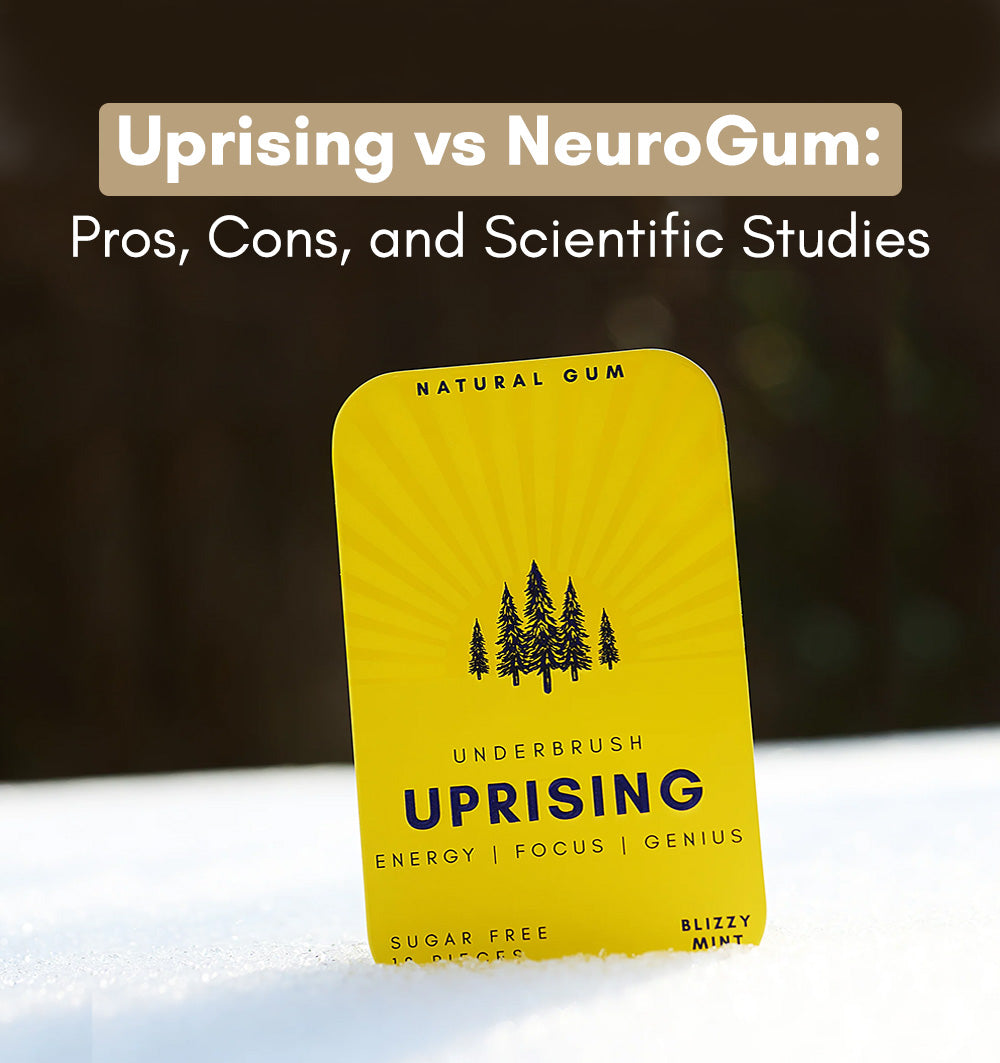
- Uprising is our newly released L-theanine gum, built around that exact combination
You know that feeling where coffee kicks in too hard and too late?
You're jittery. A little scattered. Waiting for it to level out.
You didn't want to feel wired. You just wanted to focus.
That gap — between what caffeine promises and what it actually delivers — is what we kept coming back to when building Uprising. Not because caffeine is the enemy. Caffeine works.
The research on that is solid. But a lot of people have a complicated relationship with it. Too much and you're bouncing off the walls.
Not enough and you're dragging. The window where it actually feels good is narrower than it should be.
That's what we set out to change.
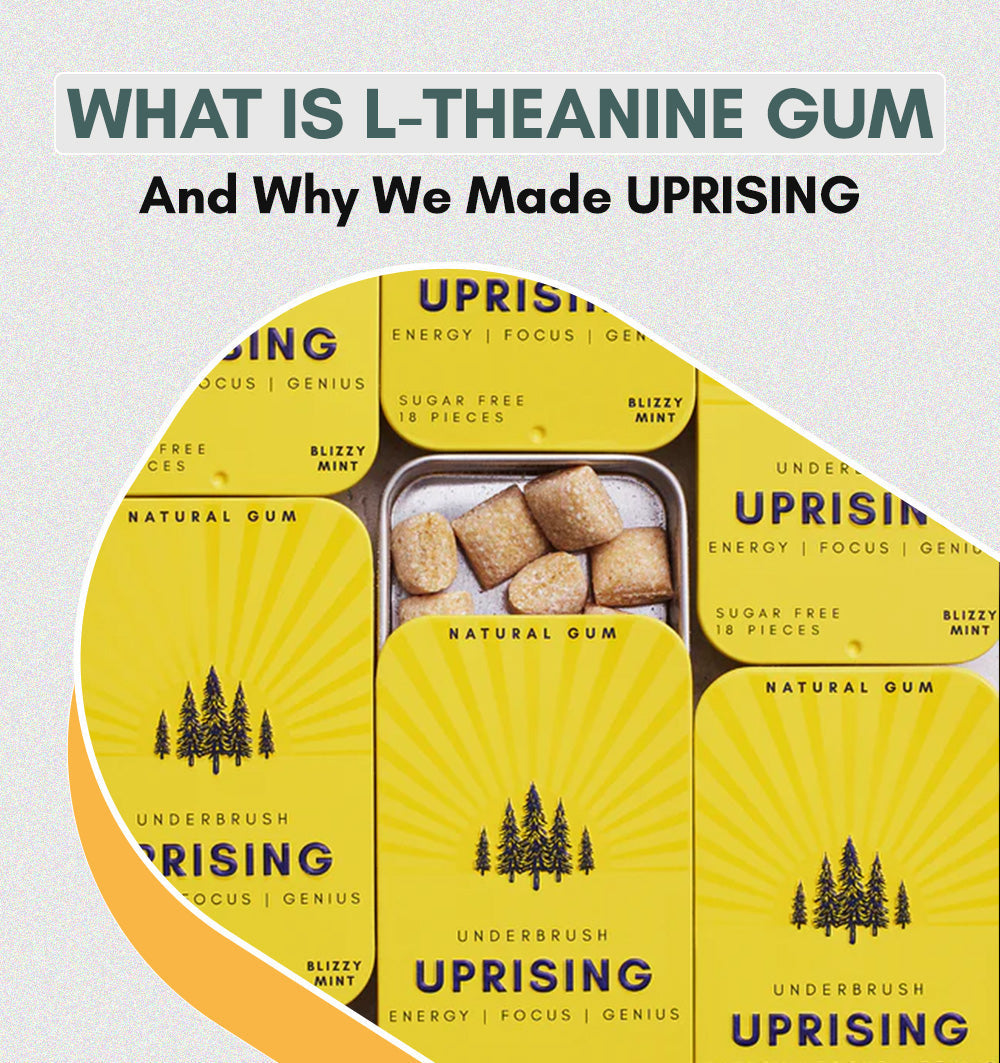
Uprising is our L-theanine gum — formulated with L-theanine and caffeine together. Not to replace caffeine. To make it work better.
Here's the science behind it, explained like a normal person.
These statements have not been evaluated by the Food and Drug Administration. This product is not intended to diagnose, treat, cure, or prevent any disease.
What Even Is L-Theanine?
It's an amino acid. Naturally found in green tea.
Specifically, it lives in the leaves of Camellia sinensis — the plant behind green tea, black tea, white tea, and oolong. L-theanine makes up roughly 1–2% of the dry weight of those leaves.
It's also part of what gives high-quality green tea that distinctive savory, almost brothy flavor the Japanese call umami.
Here's an interesting piece of history. L-theanine wasn't identified until 1949, when Japanese researchers first isolated it from green tea.
A year later, a laboratory in Kyoto successfully extracted it from gyokuro — a premium shade-grown green tea known for having exceptionally high L-theanine content.
For decades after, it remained mostly a subject of academic curiosity in Japan.
That started to change in the 1990s, when a Japanese company called Taiyo Kagaku developed a way to produce pure L-theanine at scale through an enzymatic fermentation process.
Their trademarked form, Suntheanine, won the Food Ingredient Research Award at Food Ingredients Europe in 1998.
That recognition opened the floodgates for supplement research. Most of the clinical studies you'll see cited today used a form of L-theanine that traces back to that work.
Now think about why tea feels different from coffee in the first place. Both contain caffeine. But a cup of green tea tends to deliver a softer kind of alertness — present, but not wired.
L-theanine is a big part of why.
Researchers have studied its ability to cross the blood-brain barrier, where it may influence alpha brain waves, neurotransmitter activity, and how the brain responds to stress.
Buddhist monks in China and Japan drank tea for centuries before any of this had a name.
They used it to maintain calm alertness during long meditation sessions — awake enough to hold concentration, settled enough not to be scattered.
They didn't know they were dosing L-theanine and caffeine together. They just knew it worked.
A 2025 meta-analysis in the Journal of Clinical Medicine reviewed the clinical research and confirmed L-theanine was safe across dose ranges studied — with a side-effect profile that didn't meaningfully differ from placebo.
That same review was honest about the limits. Some claims need more research. We're saying that plainly because we think you deserve to know.
How Researchers Have Studied L-Theanine and Brain Activity
The most studied effect? Alpha brain waves.

The Alpha Wave Connection
Here's a quick primer on brain waves, because it matters.
Your brain generates electrical activity measurable in cycles per second — what scientists call hertz (Hz). Different mental states produce different wave patterns.
Beta waves, in the 14–30 Hz range, are associated with active, focused thinking. Delta and theta waves show up during sleep and drowsiness.
And then there's alpha — sitting in the 8–13 Hz range — which researchers consistently associate with something they call "wakeful relaxation."
Wakeful relaxation sounds like a contradiction. But anyone who's experienced a really good flow state knows exactly what it is. You're alert. Things are clicking.
But you're not grinding or straining. There's no mental noise. It's the headspace that creative people, athletes, and experienced meditators often describe as "being in the zone."
Alpha waves are what your brain produces in that state.
What makes L-theanine gum interesting is that it delivers an ingredient that appears to promote alpha wave activity even when you're not meditating or in an especially relaxed environment.
In fact, researchers have measured alpha wave increases within about 40 minutes of consuming L-theanine in ordinary settings.
You don't have to be sitting cross-legged in a quiet room.
A triple-blind, placebo-controlled study in Neurology and Therapy found that a single 200mg dose of L-theanine was associated with significantly greater alpha wave activity in the study population compared to placebo — and also brought down salivary cortisol, a commonly used biological marker of stress response.
Participants weren't in a meditation retreat.
They were just people in a lab. Still, the effect showed up clearly against placebo.
A follow-up 28-day trial, also in Neurology and Therapy (2024), backed that up over a longer stretch. Participants reported less perceived stress and better sleep quality.
The study also found sustained improvement in cognitive attention — participants were measurably sharper on attention tasks compared to placebo.
That's not just a one-day blip. That's consistent improvement across nearly a month of supplementation.
The Neurotransmitter Part
Alpha waves are the headline, but there's more going on underneath.
Some early research has explored whether L-theanine may influence pathways associated with GABA activity — gamma-aminobutyric acid, which is the brain's primary inhibitory neurotransmitter.
GABA's job is essentially to pump the brakes. When your nervous system gets overexcited, GABA helps calm things back down.
Think of it as the counterweight to stress and overstimulation.
There's also early research exploring whether L-theanine may have some influence on serotonin and dopamine activity. Both are involved in mood, motivation, and focus.
The evidence here is less settled than the alpha wave research — it's still developing and not considered conclusive.
But it's part of why the scientific interest in L-theanine goes beyond just "calm focus" and into broader questions about mood and wellbeing.
What's notable across all of this is what L-theanine doesn't appear to do. It doesn't sedate.
It doesn't slow you down. The consistent finding in the research is relaxation without drowsiness — which is a combination most calming compounds can't claim.
Individual results may vary. This isn't a guarantee of any specific outcome.
A Note on L-Theanine and Sleep
Uprising has caffeine in it. So this isn't a nighttime product.
But L-theanine on its own has a separate and genuinely interesting relationship with sleep — and it's worth understanding if you're curious about the ingredient beyond just energy and focus.
Think about what makes it hard to fall asleep for most people. It's not usually that the body isn't tired. It's that the mind won't stop.
The day keeps replaying. The mental chatter doesn't switch off. That's the alpha wave problem in reverse — your brain is stuck in high-beta mode when it needs to downshift.
L-theanine's ability to promote alpha wave activity and support GABA may be part of why some research connects it to better sleep.
Not by making you drowsy in the way a sedative does — but by helping the brain transition into a more relaxed state, which makes sleep easier to enter and maintain.
The 28-day Neurology and Therapy trial found that participants in the L-theanine group showed measurably reduced light sleep — meaning more time in deeper, more restorative sleep stages — compared to placebo.
That's a meaningful finding. Light sleep is the fragmented, shallow kind. Reducing it means the sleep you're getting is actually doing more work.
A study published in Frontiers in Nutrition also found that a magnesium and L-theanine combination produced improvements in sleep quality.
For anyone interested in L-theanine specifically for sleep support, a caffeine-free format is the right choice. Uprising is built for focus and performance — not bedtime.
But if you're someone who finds their mind racing at night, L-theanine is an ingredient worth knowing about independently of the caffeine conversation.
Why We Paired L-Theanine With Caffeine
The honest story of how this combination ended up in Uprising starts with a simple observation.
Caffeine is the most widely consumed psychoactive substance on the planet.
Something like 80% of adults use it daily in some form.
And most of them have experienced both sides of it — the good side, where you're sharp and dialed in, and the bad side, where you're anxious, jittery, and can't quite land on a thought.
The frustrating thing is that the bad side isn't really about the caffeine itself.
It's about the dose, the timing, and the absence of anything to moderate it.
Caffeine blocks adenosine receptors in the brain — adenosine being the compound that builds up while you're awake and makes you feel progressively more tired.
Block those receptors and you feel alert. But caffeine also ramps up adrenaline and cortisol in doing so, which is where the jitters and the crash come from.
L-theanine and caffeine together have their own dedicated research — and it's one of the more compelling pairing stories in functional ingredients.
The two compounds work on different systems in a complementary way. Caffeine pushes alertness up. L-theanine smooths out the rough edges via alpha wave activity and potential GABA support.
The result, in a lot of study participants, is something closer to what most people actually want from caffeine: focus without friction.
A systematic review in Cureus examined multiple clinical trials and found the combination produces improvements in attention, reaction time, and inhibitory control — that last one being the ability to filter out distractions and stay on task.
A 2024 meta-analysis in Nutrition Reviews found small-to-moderate improvements in attentional tasks — with the effects showing up primarily in the first two hours after intake.
Across multiple studies, the combination produced a state researchers describe as alert but calm.
That phrase shows up repeatedly in the literature because it captures something specific. Not sedated. Not wired. Alert, but without the noise.
The most studied ratio in the published research is 2:1 — two parts L-theanine to one part caffeine. That's the ratio we use in Uprising, because that's what the science uses.
Why L-Theanine Gum and Not a Capsule
This is one of the questions we get most often, and it's a fair one.
Most supplements come in capsule form.
You swallow it, it goes to your stomach, your digestive system breaks it down, and eventually the ingredient makes its way into your bloodstream.
That's a well-worn path. It works.
But it takes time — often 45 minutes to an hour before you feel anything meaningful. And your digestive system can be unpredictable.
How much you've eaten, how fast your metabolism is running, whether you have acid reflux — all of it affects how quickly and how completely that capsule delivers its payload.
The Buccal Absorption Difference
Here's where the military story becomes relevant — and it's a real one.
In the late 1990s, researchers at the Walter Reed Army Institute of Research began investigating whether caffeine could be delivered more rapidly through chewing gum.
The problem they were solving wasn't about performance optimization for athletes. It was about keeping sleep-deprived soldiers alive in the field.
Fatigue-related injuries and errors in combat were a documented problem, and there was no reliable way to get caffeine into a soldier quickly without hot water or a beverage.
Congress funded the first study in 1999. The results were striking enough that the U.S. Army Medical Research and Materiel Command launched a full development program.
After six years of research, the product they developed — originally called Stay Alert Gum, later renamed Military Energy Gum — was approved for inclusion in first-strike rations for Special Forces.
It's been used in Iraq and Afghanistan since 2003, and was eventually adopted by Israeli pilots for missions lasting more than 48 hours.
The research showed that caffeine delivered through chewing gum reaches the bloodstream four to five times faster than a capsule or liquid.
Dr. Tom Balkin of Walter Reed described it this way: "When you chew the gum, the caffeine is absorbed right through the tissues in the mouth into the bloodstream.
It gets into the brain very quickly — in about five minutes. It takes coffee about 20 to 25 minutes."
That process — absorbing an ingredient through the mucous membranes in your mouth directly into circulation, bypassing the digestive system — is called buccal absorption.
It's the same mechanism that made nicotine gum effective years earlier.
If gum could move nicotine into the bloodstream efficiently, the reasoning went, what about caffeine? The answer turned out to be yes, and quickly.
A study published in the International Journal of Pharmaceutics by Dr. Gary Kamimori — the Walter Reed researcher who led much of this work — directly compared caffeine absorption from gum versus capsules in healthy volunteers and confirmed gum produced faster absorption rates.
We chose L-theanine gum as a format because some research suggests this delivery method may allow faster absorption compared to capsules. Whether that applies equally to all compounds requires further study, and individual results will vary. But the buccal absorption pathway is real, validated, and the reason functional gum exists as a category in the first place.
Curious about the broader science ofwhether chewing gum can actually give you energy? We break that down in a separate piece.
We always include transparent ingredient lists on our packaging and product pages.
What to Expect When You First Try L-Theanine Gum
This is the question most people actually have. And it's worth answering honestly.
L-theanine isn't a stimulant. You're not going to feel a jolt. The experience is more subtle than that — which is kind of the point.
Most people describe it as a gradual smoothing out.
The caffeine is still doing its thing. You're alert.
But the scattered, wired-around-the-edges feeling that caffeine can sometimes create? That tends to be less present.
Some people notice it within 15–30 minutes. Others take a little longer.
A lot depends on your individual caffeine tolerance, what you've eaten, and how sensitive you are to these compounds in general.
Here's what the research suggests about timing.
A 2011 study in the Journal of Functional Foods found that L-theanine's effects on attention and reaction time were measurable within the first hour.
The combination studies generally show peak effects in the first one to two hours.
What this means practically: don't chew a piece and expect to feel something in 60 seconds.
Give it a full chewing session — 5 to 10 minutes minimum — then settle into your task.
The effects tend to be noticeable not because something dramatic happens, but because something doesn't happen.
Some users describe the experience as smoother and less abrupt compared to caffeine alone.
That's the experience most people are going for. Not a hit of energy. A more usable version of it.
Individual results will vary. This is not a guarantee of any specific experience or outcome.
How to Use Uprising L-Theanine Gum
Simple. Three steps.
Step 1: Pop a piece. Check the label for the recommended serving.
Start there — don't double up on your first go, especially if you're new to the combination or tend to be sensitive to caffeine.
Step 2: Chew for at least 5–10 minutes. This is where the buccal absorption happens.
The longer you chew, the more contact the ingredients have with the tissues in your mouth. Don't just chew twice and swallow it — that defeats the purpose.
The gum is the delivery mechanism.
Step 3: Let it work. Give it 15–30 minutes.
Onset may feel faster than a capsule — but it's not instant. Drink some water.
Get into your task.
Don't sit there waiting to feel something; just start working and let the combination do what it does.
That's it.
One quick note on using L-theanine gum in the afternoon and evenings: the combo may support focus, but keep your own caffeine tolerance and cutoff time in mind.
Don't exceed your daily intake comfort zone and you're good.
When People Use L-Theanine Gum

A few common scenarios where Uprising tends to fit naturally:
- When you need focused work — studying, writing, heads-down project work. A combo like this may be just the ticket to help you lock in mentally. The attention and reaction time research applies most directly here.
- When you need to physically perform — a 2025 study in Physical Education of Students found performance-supporting effects among competitive wrestlers, including reaction time improvements.
Need to crush a run or hit a PR? Some research suggests the combo may support a more balanced subjective experience of alertness for some individuals. Individual results will vary.
- When you need to unwind in social settings — the alert-but-calm profile is useful when you need to be present and sharp without feeling like you're running too hot.
Long meetings, networking events, presentations — situations where being on edge works against you.
A few things Uprising is NOT for:
- Before bed. It has caffeine. Don't do that to yourself.
- Low-stimulation situations where you just want to relax. For that, a caffeine-free L-theanine option makes more sense.
What to Look for in Any L-Theanine Gum

Not all functional gum is formulated the same way. The category has grown quickly, and ingredient quality and transparency vary a lot across brands. Here's an honest checklist — one we hold ourselves to as well.
- Exact milligrams on the label — not just "contains L-theanine." You need a number. If a brand won't tell you how much is in each piece, that's a problem.
- 100–200mg of L-theanine per serving — that's the range studied in published research
- 2:1 ratio if caffeine is included — that's what the research uses and what we use in Uprising
- Xylitol, not aspartame or sucralose — the American Dental Association recognizes xylitol as an ingredient that may reduce your risk of cavities. We use xylitol in all our gum — here's everything you need to know about it, and why sucralose isn't something we're interested in
- No artificial colors, synthetic flavors, or synthetic preservatives — the gum base shouldn't need a chemistry degree to read
- FDA GRAS status for key ingredients — L-theanine has it. GRAS Notice No. 209. This matters because GRAS status means the FDA has reviewed the safety data and found it acceptable for general use.
One thing we don't currently have to offer on this list: a third-party Certificate of Analysis.
We're being transparent about that because we think you deserve to know. It's something we're working toward as the brand grows.
Is L-Theanine Gum Safe?
L-theanine has been studied extensively — it's been commercially available in Japan since the 1980s — and carries GRAS status from the FDA, meaning it's generally recognized as safe within studied dose ranges.
That said, we want to be straightforward about what that means in practice.
GRAS status applies to the ingredient at studied doses. It doesn't mean everyone will respond identically or that there are no individual considerations worth knowing.
A 2025 meta-analysis confirmed L-theanine's side-effect profile didn't differ from placebo across the studied dose range of 50–500mg.
Some people experience mild headaches, dizziness, or stomach discomfort — but researchers generally associated these with higher doses.
We also want to be honest that Uprising contains caffeine.
Caffeine is safe for most healthy adults at reasonable doses, but it does have real effects on heart rate, blood pressure, and sleep — effects that are dose-dependent and vary significantly between people.
That's worth factoring in alongside anything you're already consuming.
Talk to a doctor first if you:
- Take blood pressure medication — some research suggests L-theanine may have a mild blood-pressure-lowering effect, which could interact with antihypertensive medications
- Are pregnant or breastfeeding — the safety of L-theanine during pregnancy and breastfeeding has not been established. Consult your healthcare provider before use.
- Have known adverse effects to L-theanine supplements or food products
Remember that your response will always vary based on your lifestyle, diet, and daily caffeine intake.
This is informational only. Not medical advice.
Frequently Asked Questions About L-Theanine Gum
What does L-theanine gum actually do?
Some research suggests it may support a calm, focused state by influencing alpha brain waves and neurotransmitter activity.
Paired with caffeine — like in Uprising — some studies suggest it may support attention while reducing the jitteriness caffeine can cause on its own.
Individual results will vary. Not evaluated by the FDA. Not intended to diagnose, treat, cure, or prevent any disease.
Does L-theanine gum work faster than a capsule?
Some research suggests it may — because of buccal absorption through the mouth's soft tissues.
A study in the International Journal of Pharmaceutics found caffeine in gum absorbed faster than in capsule form.
Whether that applies to every compound needs more study. But the pathway is real and well-documented in the scientific literature.
How long does it take to feel the effects?
Most research on the L-theanine and caffeine combination shows measurable effects on attention within the first one to two hours.
With gum specifically, some research suggests buccal absorption may speed up onset compared to capsules.
Practically speaking, chew for at least 5–10 minutes, then give it 15–30 minutes before expecting to notice anything. Individual results will vary.
Can I use L-theanine gum every day?
L-theanine has been studied in both short-term and multi-week settings and is generally well-tolerated within studied dose ranges.
As with any supplement, consult a healthcare professional if you have any specific health concerns or take medications.
Does L-theanine gum help with sleep?
L-theanine alone — without caffeine — has been studied for sleep support. The 28-day Neurology and Therapy trial found participants in the L-theanine group showed reduced light sleep and improved sleep quality compared to placebo.
Uprising contains caffeine and is not intended for evening use. For sleep support specifically, a caffeine-free L-theanine format is the right choice.
Questions about Uprising specifically
How much L-theanine is in Uprising?
Check the label for exact amounts. Published research commonly studies 100–200mg per serving. Uprising is formulated in that range, at the 2:1 L-theanine to caffeine ratio.
What's the 2:1 ratio?
Two parts L-theanine to one part caffeine.
That's the ratio most commonly used in published research on the L-theanine and caffeine combination — and the one consistently associated with the alert-but-calm response in study participants.
It's what we use in Uprising.
Can I use Uprising before the gym?
Some research has looked at the L-theanine and caffeine combination in athletic contexts.
A 2025 study found performance-supporting effects among competitive wrestlers, including improvements in reaction time. Individual results will vary.
Gum vs. capsule — what's the real difference?
Delivery. Capsules go through your digestive system before reaching your bloodstream — a process that takes time and depends on your digestive environment.
L-theanine gum may absorb through the tissues in your mouth, skipping that step entirely. Same ingredient, different path, potentially different timing.
The military caffeine gum research at Walter Reed found the difference could be four to five times faster onset.
Is there anything in Uprising I should watch out for?
Check the label for caffeine content and factor in any other caffeine you're consuming that day.
If you stay within your daily caffeine comfort zone, most people tolerate it well — but individual responses vary.
If you have any health concerns, check with your doctor first. And if you're evaluating gum sweeteners more broadly, here's why we chose xylitol.
These statements have not been evaluated by the Food and Drug Administration. This product is not intended to diagnose, treat, cure, or prevent any disease.
This article is for informational purposes only and does not constitute medical advice.
Consult a qualified healthcare professional before starting any supplement, especially if you have existing medical conditions or take medications.
About the Author
The Nathan & Sons Team
Nathan & Sons was founded by Nathan — a former executive chef who got personally interested in functional ingredients while looking for cleaner ways to manage daily focus and energy. That led to Underbrush Gum, and then Uprising. The team is focused on ingredient transparency, clean labels, and honest science. You can explore the full lineup of our best sugar-free gums with xylitol to see how Uprising fits into the broader range.
Disclosure: Nathan & Sons makes and sells functional chewing gum, including Uprising. This article summarizes publicly available research and isn't an endorsement of any specific health outcome.
References
Nobre AC, Rao A, Owen GN. "L-theanine, a natural constituent in tea, and its effect on mental state." Asia Pacific Journal of Clinical Nutrition, 2008.
Evans M, et al. "A Randomized, Triple-Blind, Placebo-Controlled, Crossover Study to Investigate the Efficacy of a Single Dose of AlphaWave® L-Theanine on Stress in a Healthy Adult Population." Neurology and Therapy, 2021.
Moulin M, et al. "Safety and Efficacy of AlphaWave® L-Theanine Supplementation for 28 Days in Healthy Adults with Moderate Stress." Neurology and Therapy, 2024.
Sohail A, et al. "The Cognitive-Enhancing Outcomes of Caffeine and L-theanine: A Systematic Review." Cureus, 2021.
Senanayake N, et al. "Effects of Tea or its Bioactive Compounds on Cognition, Sleep, and Mood: A Systematic Review and Meta-Analysis." Nutrition Reviews, 2024.
Zając-Lamparska L, et al. "Promising, but Not Completely Conclusive — The Effect of L-Theanine on Cognitive Performance Based on Systematic Review and Meta-Analysis." Journal of Clinical Medicine, 2025.
Higashiyama A, et al. "Effects of L-theanine on attention and reaction time response." Journal of Functional Foods, 2011.
Haskell CF, et al. "The effects of L-theanine, caffeine and their combination on cognition and mood." Biological Psychology, 2008.
Kamimori GH, et al. "The rate of absorption and relative bioavailability of caffeine administered in chewing gum versus capsules to normal healthy volunteers." International Journal of Pharmaceutics, 2002.
"GABA and L-theanine mixture decreases sleep latency and improves NREM sleep." Pharmaceutical Biology, 2019.
Yoto A, et al. "A Novel Theanine Complex, Mg-L-Theanine Improves Sleep Quality via Regulating Brain Excitation and Inhibition." Frontiers in Nutrition, 2022.
Shaaban AF, et al. "Performance-enhancing effects of caffeine and L-Theanine among Iranian elite wrestlers." Physical Education of Students, 2025.
FDA GRAS Notice No. 209 — L-theanine.
American Dental Association. "Chewing Gum." ada.org.
Juneja LR, et al. "L-theanine — a unique amino acid of green tea and its relaxation effect in humans." Trends in Food Science & Technology, 1999.