
The short answer is: it depends on the stage.
Early-stage enamel demineralization — the process that precedes actual cavity formation — can be arrested and in some cases reversed through remineralization, a natural process your body is already carrying out every day.
Once decay has progressed to true cavitation — an actual hole in the tooth — the structural integrity of the enamel is compromised beyond what remineralization can restore.
That distinction matters enormously.
And it is the distinction most articles targeting this question either get wrong, overstate, or obscure for marketing purposes.
This article covers what the research actually says — what demineralization is, when remineralization is possible, what supports it, and where its limits are.
These statements have not been evaluated by the Food and Drug Administration.
This product is not intended to diagnose, treat, cure, or prevent any disease.
Consult a qualified dental professional before making decisions about your oral health.
What Is Tooth Decay? The Science Behind the Process
Tooth decay — clinically known as dental caries — is not a single event.
It is a dynamic, ongoing process of mineral loss and mineral gain that occurs continuously at the surface of your teeth.
A 2022 chapter published in the peer-reviewed dental compendium Dental Caries via IntechOpen describes it this way: dental caries results from repeated cycles of demineralization and remineralization at the interface of the biofilm and the tooth surface — and the management of early caries by remineralization has the potential to significantly advance the noninvasive clinical management of the disease.
Here is how that process works.
Demineralization
Your tooth enamel is composed primarily of hydroxyapatite — a crystalline calcium phosphate mineral compound.
When you eat fermentable carbohydrates — sugars and refined starches — the bacteria in your oral biofilm metabolize them and produce organic acids including lactic acid as a byproduct.
When those acids lower the pH at the tooth surface below approximately 5.5 — the critical threshold for enamel — your saliva is no longer supersaturated with the calcium and phosphate ions that keep enamel intact.
A chemical gradient forms.
Mineral ions begin to leach out of the enamel crystals.
This is demineralization.
A 2022 review published via ResearchGate examining demineralization and remineralization dynamics confirmed that the enamel demineralization process begins when acids lower the pH of the biofilm to below 5.5 — causing the loss of calcium and phosphates from the surface and subsurface enamel.
Remineralization
When the acid challenge ends — when you stop eating, the bacteria stop producing acids, and saliva begins buffering the oral environment back toward neutral — the process reverses direction.
At pH above approximately 5.5, saliva becomes supersaturated with calcium and phosphate ions again.
Those ions can redeposit into the partially dissolved enamel crystallites.
This is remineralization.
A PMC review examining the role of salivary contents in enamel remineralization confirmed that at normal pH, saliva is supersaturated with calcium and phosphate ions — meaning demineralization does not take place under neutral conditions — and that saliva acts as both a remineralizing agent and a delivery vehicle for ions that can incorporate into enamel tissue.
The back-and-forth between demineralization and remineralization happens multiple times every day in every mouth.
The question is not whether it happens — it is which direction the net balance tips over time.
What Are White Spot Lesions and What Do They Mean?
White spot lesions are the earliest visible sign of a tipping balance — and the most hopeful indicator that the decay process is still in a stage where it can potentially be arrested or supported through remineralization.
A white spot lesion appears as a chalky, opaque area on the tooth surface that looks different from the surrounding healthy enamel.
It forms when significant mineral loss has occurred in the subsurface enamel while the surface layer remains relatively intact — creating microscopic pores that scatter light differently, producing the characteristic white appearance.
A StatPearls review of remineralization of initial carious lesions published in 2023 describes the white spot as the first clinical sign of the caries process — and confirms that the progression of the white spot to the next stage, a cavitated caries lesion, can be prevented, reversed, or arrested by controlling the caries process.
The key phrase is "by controlling the caries process."
That control comes from the factors discussed in this article — diet, oral hygiene, saliva quality, and the ingredients that have been studied in remineralization research contexts.
It does not come from any single product, gum, or supplement.
And it is most meaningful when the white spot lesion is still pre-cavitation — before an actual hole has formed.
These statements have not been evaluated by the FDA.
Can You Reverse Tooth Decay? The Critical Distinction Between Pre-Cavitation and Post-Cavitation

This is the most important distinction in the entire conversation about tooth decay reversal — and most articles either miss it or deliberately obscure it.
Pre-cavitation — early demineralization:
The tooth surface is weakened but structurally intact.
The organic matrix of the enamel remains largely intact — providing a scaffold upon which new minerals can be deposited.
Remineralization is a genuine biological possibility when conditions support it.
This is the window where diet, oral hygiene, saliva stimulation, and mineral-supporting ingredients have documented research relevance.
Post-cavitation — actual hole formation:
The tooth surface has broken down structurally.
The physical architecture of the enamel has been compromised beyond what remineralization can restore.
Professional dental intervention — drilling and filling, or other restorative procedures — is required.
No dietary change, supplement, or oral care product can restore a cavitated tooth.
A 2023 systematic review examining remineralization agents on white spot lesions published in BDJ Open confirmed that early enamel demineralization can be reversed through remineralization — which restores lost minerals to strengthen enamel and prevent decay — but that once cavitation occurs, the structural integrity has been compromised.
If you have a visible hole in a tooth, a persistent toothache, or sensitivity that has been worsening over time, consult a qualified dental professional immediately.
These statements have not been evaluated by the FDA.
Saliva and Tooth Decay: Why It Is the Foundation of Remineralization
Before discussing any specific ingredient or practice, the most important thing to understand about remineralization is what your body is already doing.
Saliva is the primary vehicle for natural remineralization — and it is working continuously.
A PMC review of remineralization of enamel from saliva: a chemical perspective describes saliva's mechanism directly: the remineralization effect is characterized by the presence of calcium and phosphate ions in saliva that form hydroxyapatite on the enamel surface — making tooth remineralization a major mechanism for ensuring the integrity and hardness of enamel over a person's lifetime.
Saliva does several things simultaneously that support enamel:
It neutralizes acids produced by oral bacteria — buffering the oral environment back toward neutral pH after an acid challenge.
It delivers calcium and phosphate ions to enamel surfaces — providing the raw materials for remineralization.
It contains antimicrobial enzymes including lysozyme and lactoferrin that help control the bacterial populations most responsible for acid production.
It physically washes away food particles and bacteria.
The American Dental Association notes that stimulated saliva carries calcium and phosphate ions that contribute to enamel remineralization and buffers the effects of acids — and specifically recommends sugar-free gum chewing for approximately 20 minutes after meals because of its saliva-stimulating effect.
Anything that reduces saliva — certain medications, dehydration, mouth breathing, medical conditions — reduces your body's natural remineralization capacity.
Anything that stimulates saliva — chewing sugar-free gum, staying hydrated, eating fibrous foods — supports it.
This is why chewing gum is not a trivial component of oral health maintenance.
It is one of the most consistently studied non-invasive methods for increasing salivary flow during the gaps in your day when brushing is not possible.
These statements have not been evaluated by the FDA.
Diet: The Most Powerful Variable in the Tooth Decay Equation
The single most impactful thing most people can do to support remineralization is to reduce the frequency of fermentable carbohydrate exposure.
Not necessarily the total amount — the frequency.
Each time you consume fermentable carbohydrates, you trigger an acid challenge.
The pH drops below 5.5.
Demineralization begins.
It takes approximately 20 to 40 minutes after the acid challenge ends for saliva to buffer the oral environment back to neutral and for remineralization to resume.
If you are eating or drinking something acidic or sugary every 30 to 45 minutes throughout the day — a common pattern for many people — your oral environment never fully recovers.
Remineralization never catches up.

A 2022 chapter on demineralization and remineralization dynamics confirmed that dietary ingestion of fermentable carbohydrates, especially sucrose, provides the substrate for the cariogenic microorganisms in the biofilm to form organic acids — and that the demineralization process begins when these acids lower the pH to below 5.5.
The practical implication: consolidating eating occasions rather than grazing throughout the day gives saliva the time it needs to buffer acids and support remineralization between meals.
Foods that support remineralization:
Dairy products — cheese, milk, plain yogurt — provide calcium and phosphate directly and have been studied specifically for their role in oral pH buffering and remineralization support.
Fibrous vegetables — leafy greens, celery, carrots — stimulate saliva through chewing and provide minerals.
Water — particularly between and after meals — dilutes acids and supports saliva production.
Foods and patterns that undermine remineralization:
Frequent snacking on fermentable carbohydrates — crackers, bread, dried fruit, sugary drinks — extends acid exposure beyond what saliva can buffer.
Sipping acidic beverages — sparkling water, juice, coffee with sugar — throughout the day creates sustained acid exposure.
Sticky foods that adhere to tooth surfaces prolong contact time between fermentable substrates and bacteria.
These statements have not been evaluated by the FDA.
Can You Reverse Tooth Decay With Nano-Hydroxyapatite? What the Research Says
Nano-hydroxyapatite — the primary active ingredient in Nathan and Sons' remineralizing gum — is the most extensively researched non-fluoride remineralization ingredient currently available.
It is chemically identical to the hydroxyapatite that makes up approximately 90 to 97 percent of tooth enamel by weight.
The research examining its potential in remineralization contexts is both substantial and growing.
A 2024 systematic review and meta-analysis examining nano-hydroxyapatite on white spot lesions analyzed 14 studies and concluded that the effect of nano-hydroxyapatite on white spot lesions can potentially be promising — while noting that the available evidence remains limited and that further high-quality clinical trials are needed.
A 2022 randomized clinical trial published in PMC examining biomimetic hydroxyapatite versus fluoride toothpaste on white spot lesions found that hydroxyapatite-based home oral care was comparable to fluoride toothpaste in improving enamel remineralization measures over the study period.
For a direct comparison of how hydroxyapatite and fluoride have been studied in oral care research contexts, our article on nano-hydroxyapatite vs fluoride covers the evidence in detail.
A 2025 narrative review published in Biomimetics examining hydroxyapatite across multiple clinical studies found that hydroxyapatite-containing products are among the formats being studied for enamel and dentin remineralization support — and that its nanoscale particle size allows it to interact with enamel microporosities.
A 2025 study published in Scientific Reports found that nano-hydroxyapatite may function as a reservoir of calcium and phosphate — and that under acidic conditions, nano-HA can enhance remineralization by promoting greater ion diffusion into the core of the demineralized area — with nanosized calcium and phosphate ions directly infiltrating small pores within the demineralized subsurface lesion.
While these findings are promising, the overall body of evidence continues to develop and larger long-term studies are needed.
These statements have not been evaluated by the FDA and should not be interpreted as disease-treatment claims.
What the Research Says About Xylitol and Tooth Decay
Xylitol's relevance to the question of tooth decay remineralization operates through a different mechanism than nano-hydroxyapatite — but it is equally well-researched.
Xylitol is non-fermentable by the oral bacteria most associated with acid production — particularly Streptococcus mutans.
This means that when xylitol is the sweetener in a chewing gum, the bacteria that would normally produce lactic acid from fermentable sugars cannot use it as a metabolic substrate.
The acid challenge does not occur.
Demineralization is not triggered.
Beyond simply not causing harm, xylitol has been examined for actively supporting remineralization.
A peer-reviewed literature review of sugar alcohols, caries incidence, and remineralization published in PMC states directly: dental caries is reversible if detected and treated sufficiently early — and that habitual use of xylitol can be associated with significant reduction in caries incidence and with tooth remineralization.
The same review notes that at high pH, xylitol can form complexes with calcium in solution — thereby stabilizing the calcium and phosphates present in saliva and stimulating the remineralization of dental tissues through calcium.
A 2022 study published in Frontiers in Nutrition found that xylitol gum was associated with a statistically significant 20 percent reduction in dental plaque accumulation and meaningful decreases in cariogenic and periodontopathic bacteria over two weeks.
For a deeper look at xylitol's full oral health research profile, our guide to everything you need to know about xylitol as a natural sweetener covers the full evidence base.
The practical implication: chewing xylitol gum after meals removes the acid challenge that drives demineralization while stimulating the saliva that supports remineralization — and the xylitol itself may stabilize salivary calcium in ways that support mineral availability.
These statements have not been evaluated by the FDA.
Oral Hygiene and Tooth Decay: Removing the Bacterial Conditions That Drive Demineralization

Brushing and flossing do not directly remineralize teeth.
But they do remove the bacterial biofilm that produces the acids driving demineralization — which is equally important.
The most critical timing principle most people do not know: do not brush immediately after consuming acidic food or drink.
Acid temporarily softens enamel.
Brushing softened enamel causes abrasion rather than cleaning.
Waiting 30 to 60 minutes after an acid challenge allows saliva to begin buffering and rehardening the surface before brushing occurs.
This is consistent with current dental guidance and supported by the research on the demineralization-remineralization cycle.
Beyond brushing, interdental cleaning is particularly important for decay prevention because decay frequently begins between teeth — areas where plaque accumulates and saliva access is limited.
These are areas that remineralization has difficulty reaching precisely because saliva cannot get there consistently.
Professional dental cleanings remove calcified deposits that home care cannot address — and professional monitoring allows early detection of white spot lesions at the stage when they are most responsive to remineralization support.
For more on supporting enamel health and managing tooth sensitivity between professional visits, our article on natural solutions for tooth sensitivity covers the research in detail.
Consult a qualified dental professional for guidance specific to your oral health situation.
The Role of Chewing Gum in Supporting Remineralization Between Meals

Chewing gum cannot treat tooth decay.
What chewing gum can do — particularly a well-formulated gum that stimulates saliva while delivering mineral-supporting active ingredients — is support the oral conditions that make remineralization more likely during the gaps in your day when brushing is not an option.
The ADA specifically recommends sugar-free gum chewing for approximately 20 minutes after meals for its saliva-stimulating effect.
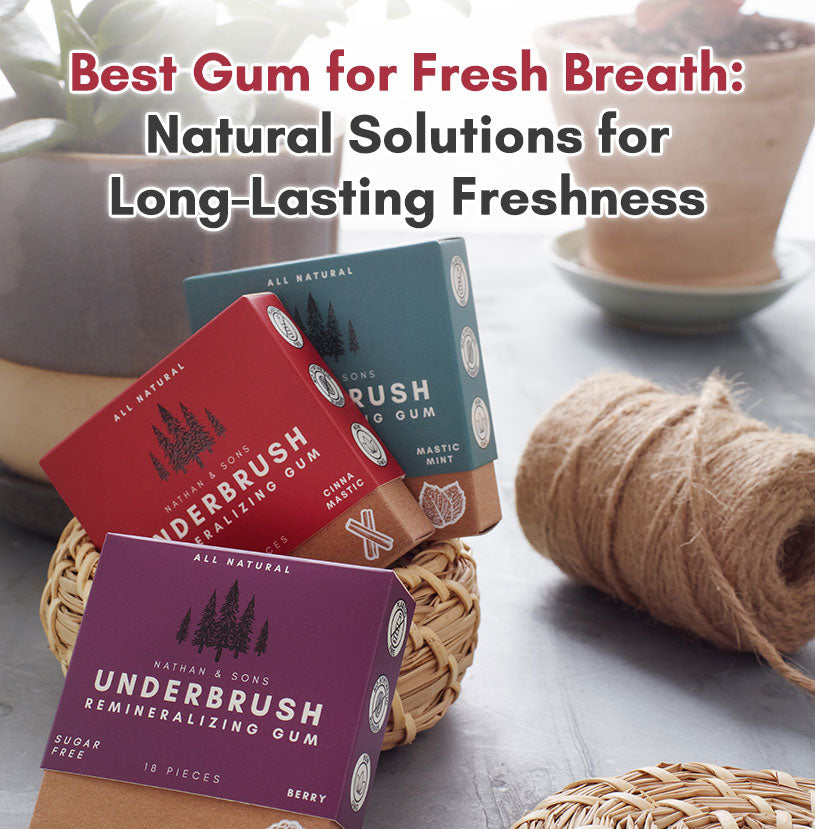
Nathan and Sons' remineralizing gum adds nano-hydroxyapatite and xylitol to that saliva-stimulating baseline — two ingredients among the most extensively studied oral care ingredients in remineralization research contexts.
It also contains mastic gum — which has been examined in research for antibacterial activity against the oral bacteria most associated with acid production and plaque formation.
And zinc gluconate — which research has examined for interaction with volatile sulfur compounds and antimicrobial properties in oral care contexts.
The formulation is not a treatment.
The individual ingredients have been studied in remineralization and oral health research contexts — the finished product itself has not been evaluated by the FDA for the prevention, treatment, or mitigation of any condition.
For a deeper look at how these ingredients work and what the research says, our articles on what is remineralizing gum, is remineralizing gum legit, and does remineralizing gum work examine the evidence in detail.
For more on nano-hydroxyapatite specifically, our article on nano-hydroxyapatite oral care benefits covers the research base.
Browse our full oral care collection to see everything we make.
When to See a Dentist: The Limits of Any Non-Professional Approach
This section is the most important one in the article.
Remineralization research — however promising — applies to pre-cavitation demineralization.
It does not apply to:
Cavitated lesions — actual holes in teeth.
Decay that has reached the dentin layer beneath enamel.
Decay approaching or involving the tooth's pulp.
Any tooth decay associated with pain, sensitivity that has been worsening, visible darkening, or structural changes.
Any of these signs require professional dental evaluation and intervention — not dietary changes, not supplements, not any chewing gum.
The StatPearls review on remineralization of initial carious lesions is explicit: dental caries is a dynamic disease — and the window for non-invasive management exists only at the earliest pre-cavitation stages.
Regular dental examinations — typically every six months for most adults — are the most reliable way to identify white spot lesions at the stage when they are most responsive to remineralization support.
Professional monitoring is not optional even for people with excellent home care.
To learn more about who we are and why ingredient transparency matters to us, visit our about page.
Key Takeaways: Can You Reverse Tooth Decay?
Early-stage enamel demineralization — before cavitation — can be arrested and potentially supported through remineralization when the right conditions are present.
Once cavitation occurs — an actual hole in the tooth — remineralization cannot restore the structural integrity of the enamel and professional dental intervention is required.
Remineralization is a natural process driven primarily by saliva — which delivers calcium and phosphate ions to enamel surfaces and buffers oral pH after acid challenges.
The most impactful dietary change most people can make is reducing the frequency of fermentable carbohydrate exposure — giving saliva time to buffer acids and support remineralization between eating occasions.
Nano-hydroxyapatite has been examined in multiple peer-reviewed studies and systematic reviews for its potential in enamel remineralization — the overall body of evidence continues to develop and larger long-term studies are needed.
Xylitol is non-fermentable by the oral bacteria most associated with acid production and has been associated in research with reduced cariogenic bacteria and potential stabilization of salivary calcium — supporting remineralization conditions.
Chewing sugar-free gum stimulates saliva — the ADA recommends it for approximately 20 minutes after meals for this reason.
No dietary change, supplement, or oral care product treats tooth decay — professional dental care remains essential for any condition beyond early pre-cavitation demineralization.
These statements have not been evaluated by the FDA.
Not intended to diagnose, treat, cure, or prevent any disease.
Frequently Asked Questions: Can You Reverse Tooth Decay?
Can you reverse tooth decay naturally?
Early-stage enamel demineralization — before an actual hole has formed — can be arrested and potentially supported through remineralization, a natural process driven by saliva delivering calcium and phosphate ions to enamel surfaces.
Once tooth decay has progressed to true cavitation — an actual hole in the tooth — the structural integrity of the enamel is compromised beyond what natural remineralization can restore, and professional dental intervention is required.
The distinction between pre-cavitation demineralization and true cavitation is the most important factor in determining whether non-invasive approaches are relevant.
Consult a qualified dental professional for evaluation specific to your situation.
These statements have not been evaluated by the FDA.
What causes tooth decay?
Tooth decay results from repeated cycles of demineralization at the tooth surface driven by organic acids produced by oral bacteria as they metabolize fermentable carbohydrates.
When the oral pH drops below approximately 5.5, saliva is no longer supersaturated with the calcium and phosphate ions that keep enamel intact — and mineral ions begin to leach out of the enamel crystals.
The frequency of fermentable carbohydrate exposure — rather than total amount — is among the most important dietary factors because each exposure triggers an acid challenge that must be fully buffered before remineralization can resume.
What is a white spot lesion?
A white spot lesion is the earliest visible clinical sign of enamel demineralization — appearing as a chalky, opaque area on the tooth surface where significant mineral loss has occurred in the subsurface enamel.
White spot lesions represent pre-cavitation demineralization — the stage most responsive to remineralization support and non-invasive management.
A qualified dental professional should evaluate any white spot lesion to determine appropriate management.
These statements have not been evaluated by the FDA.
What is remineralization?
Remineralization is the natural process by which calcium and phosphate ions from saliva are redeposited into partially demineralized enamel — restoring some of the mineral content lost during acid challenges.
It occurs continuously between eating occasions when oral pH is above the critical threshold of approximately 5.5.
Saliva is the primary vehicle for natural remineralization — making saliva flow, quality, and buffering capacity central to the body's natural enamel defense system.
Does nano-hydroxyapatite support remineralization?
Nano-hydroxyapatite has been examined in multiple peer-reviewed studies and systematic reviews as a potential remineralization-supporting ingredient.
A 2024 systematic review found that nano-hydroxyapatite's effect on white spot lesions can potentially be promising — while noting that available evidence remains limited and that further high-quality clinical trials are needed.
A 2025 study found that nano-HA may function as a reservoir of calcium and phosphate — promoting greater ion diffusion into demineralized enamel under acidic conditions.
These are research observations and should not be interpreted as treatment claims for any dental condition.
These statements have not been evaluated by the FDA.
Does xylitol help with tooth decay?
Xylitol is non-fermentable by the oral bacteria most associated with acid production — meaning it does not trigger the acid challenges that drive enamel demineralization.
Research has associated habitual xylitol use with significant reductions in cariogenic bacterial counts and with tooth remineralization support.
Xylitol may also stabilize calcium in saliva at higher pH levels — potentially supporting the mineral availability needed for remineralization.
These are research observations and should not be interpreted as treatment claims.
Consult a qualified dental professional for guidance specific to your oral health situation.
These statements have not been evaluated by the FDA.
Can chewing gum help with tooth decay?
The ADA recommends sugar-free gum chewing for approximately 20 minutes after meals because chewing stimulates saliva — which buffers acids and delivers calcium and phosphate ions to enamel surfaces.
Gum formulated with xylitol and nano-hydroxyapatite adds ingredients that have been individually studied in oral health and remineralization research contexts on top of that saliva-stimulation baseline.
The individual ingredients have been examined through mechanisms relevant to the caries process — the finished product has not been evaluated by the FDA for the prevention, treatment, or mitigation of any condition.
Chewing gum does not replace brushing, flossing, or professional dental care.
These statements have not been evaluated by the FDA.
When should I see a dentist about tooth decay?
See a dentist if you have visible holes or dark spots in teeth, tooth pain or sensitivity that has been worsening, sensitivity to hot or cold that persists after the stimulus is removed, or any visible changes to tooth structure.
These signs suggest decay has progressed beyond the pre-cavitation stage where non-invasive approaches are relevant.
Regular dental examinations — typically every six months for most adults — are the most reliable way to identify early demineralization at the stage when it is most responsive to remineralization support.
No dietary change, supplement, or oral care product replaces professional dental evaluation and care.
Legal & Compliance Disclaimer
These statements have not been evaluated by the Food and Drug Administration.
This product is not intended to diagnose, treat, cure, or prevent any disease.
The information in this article is for educational purposes only and is not a substitute for professional dental or medical advice.
Consult a qualified dental or healthcare provider before making changes to your oral care routine or making decisions about dental health conditions.
Content current as of 2026.
Subject to revision.
References
Daruich PM, Brizuela M. (2023). Remineralization of Initial Carious Lesions. StatPearls Publishing. ncbi.nlm.nih.gov/books/NBK573067.
Intechopen. (2022). Demineralization and Remineralization Dynamics and Dental Caries. intechopen.com/chapters/82497.
Dimensions of Dental Hygiene. (2019). The Dynamic Process of Demineralization and Remineralization. dimensionsofdentalhygiene.com.
PMC. (2020). The role of salivary contents and modern technologies in the remineralization of dental enamel: a narrative review. PMC7076334.
PMC. (2024). The Remineralization of Enamel from Saliva: A Chemical Perspective. PMC11592461.
American Dental Association. Chewing Gum. ADA Oral Health Topics. ada.org/resources/ada-library/oral-health-topics/chewing-gum.
BDJ Open. (2025). Comparison of the remineralization effectiveness of three remineralizing agents on artificial enamel lesions. nature.com/articles/s41405-025-00330-y.
ScienceDirect. (2024). The effect of nano-hydroxyapatite on white spot lesions: a systematic review and meta-analysis. sciencedirect.com/article/abs/pii/S0300571224005724.
PMC. (2022). Home Oral Care with Biomimetic Hydroxyapatite vs. Conventional Fluoridated Toothpaste for the Remineralization and Desensitizing of White Spot Lesions: Randomized Clinical Trial. PMC9317292.
Biomimetics. (2025). The Remineralizing and Desensitizing Potential of Hydroxyapatite in Dentistry: A Narrative Review. PMC12470856.
Scientific Reports. (2025). Effect of remineralization after in office followed by home treatment of white spot lesions in children. nature.com/articles/s41598-025-15829-5.
Mäkinen KK. (2010). Sugar Alcohols, Caries Incidence, and Remineralization of Caries Lesions: A Literature Review. PMC2836749.
Wu YF, Salamanca E, et al. (2022). Xylitol-containing chewing gum reduces cariogenic and periodontopathic bacteria in dental plaque. Frontiers in Nutrition, 9, 882636. PMC9131035.