
DIM — diindolylmethane — is one of those compounds that attracts a lot of claims and not always enough context.
It forms naturally in the body during the digestion of cruciferous vegetables.
It has been studied in peer-reviewed research for its influence on estrogen metabolism pathways.
And it has attracted growing scientific interest in oral biology contexts.
But how does DIM actually work — and what does the research actually say?
This article covers the mechanism, the research, and the honest picture of what is known and what is still being studied.
These statements have not been evaluated by the Food and Drug Administration.
This product is not intended to diagnose, treat, cure, or prevent any disease.
How DIM Forms: The Starting Point
Understanding how DIM works begins with understanding how it forms.
DIM does not exist preformed in cruciferous vegetables.
It is created during digestion.
When you chew cruciferous vegetables — broccoli, kale, cauliflower, cabbage, Brussels sprouts — the enzyme myrosinase comes into contact with glucobrassicin stored in the plant cells.
This converts glucobrassicin into indole-3-carbinol.
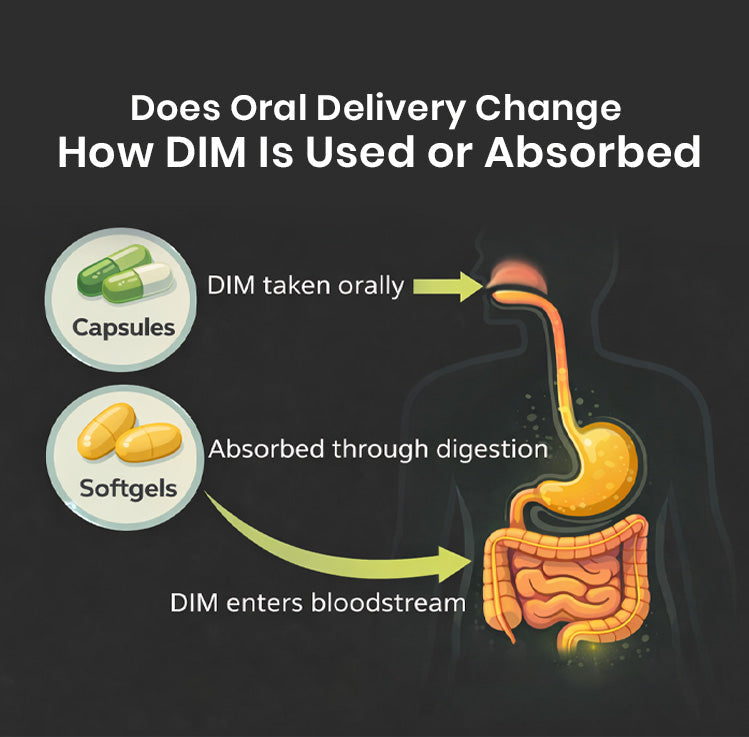
Indole-3-carbinol then undergoes condensation reactions in the acidic environment of the stomach — with approximately 60 percent converting into DIM.
A 2024 review published in Annual Reviews confirmed that DIM is formed by the condensation of two molecules of indole-3-carbinol — and that both compounds alter multiple signaling pathways controlling diverse cellular events including oxidation, inflammation, and immunity.
This formation process matters because it explains both DIM's bioavailability challenges and why supplemental DIM differs from dietary DIM obtained through whole food consumption.
For a deeper look at how DIM forms and its oral science research profile, our article on what is DIM covers the full background.
These statements have not been evaluated by the FDA.
How Does DIM Work in Estrogen Metabolism Research?

The most studied mechanism of DIM is its influence on estrogen metabolism pathways — specifically how it interacts with the enzymes involved in how estrogen is processed and eliminated in the body.
Estrogen is not a single compound.
It is a family of related hormones that are metabolized — broken down — through several distinct pathways, producing different metabolites with different biological profiles.
Research has focused on DIM's potential to influence which metabolic pathways are more active — specifically the 2-hydroxylation pathway versus the 16-alpha-hydroxylation pathway.
A 2025 peer-reviewed study published in PMC examining DIM's impact on estradiol and estrogen metabolism in postmenopausal women confirmed that DIM's mechanism of action involves the alteration of estrogen metabolism — and noted that DIM is an active area of research due to its influence on estrogen metabolism pathways.
The same study noted that DIM is sometimes recommended to postmenopausal women by functional or integrative medicine providers — and that since DIM's mechanism involves estrogen metabolism alteration, potential interactions with hormone therapy are an area of ongoing clinical investigation.
A PMC comprehensive review of the pharmacological actions of indole-3-carbinol and diindolylmethane confirmed that DIM alters multiple signaling pathways — and specifically emphasized that most protective effects of DIM are from preclinical studies, with large-scale clinical trials still needed to confirm findings in humans.
This distinction between preclinical and clinical evidence is essential for understanding what is and is not known about how DIM works.
What the research establishes: DIM influences estrogen metabolism pathways in ways researchers have studied across multiple clinical and preclinical settings.
What the research does not yet establish: definitive clinical outcomes for specific health conditions in large human populations.
Consult a qualified healthcare provider before using supplemental DIM — particularly if you are using hormone therapy or managing a hormone-related health condition.
These statements have not been evaluated by the FDA and are not intended to diagnose, treat, cure, or prevent any disease.
How Does DIM Work Alongside Mineral Cofactors?
This is the part of the DIM story that is less commonly discussed — and it matters for understanding why DIM is often formulated alongside mineral-rich ingredients.
Estrogen metabolism — like most biological processes — depends on enzyme activity.
And enzymes depend on mineral cofactors to function.
A 2022 peer-reviewed editorial published in Frontiers in Nutrition examining mineral bioavailability and enzyme function confirmed that minerals such as calcium and zinc serve as cofactors for hundreds of enzymes — with zinc specifically serving as a catalytic component for a large number of enzymes and playing structural and biological roles in many proteins, peptides, and hormones.
The Linus Pauling Institute at Oregon State University confirms that magnesium is an essential mineral that serves as a cofactor for hundreds of enzymes — needed for energy production, nucleic acid and protein synthesis, ion transport, and cell signaling.
A 2023 peer-reviewed editorial published in Frontiers in Molecular Biosciences examining the role of cofactors in protein stability and human metabolism confirmed that in approximately one-third of all proteins, functioning depends on the presence of cofactors.
The practical implication: if DIM is studied for its influence on enzyme-mediated metabolic pathways, the minerals that serve as cofactors for those enzymes are part of the same biological system.
This is why mineral availability — calcium, magnesium, zinc, and trace minerals — is relevant context when discussing how DIM works rather than a separate topic.
For more on the specific mineral ingredients examined alongside DIM, our article on minerals that support DIM effectiveness covers the research in detail.
These statements have not been evaluated by the FDA.
How Does DIM Work in Oral Science Research?
A growing area of DIM research examines its behavior in oral biology environments — a research direction that connects DIM's anti-inflammatory and antimicrobial properties to oral health contexts.
A 2023 peer-reviewed study published in the journal Antibiotics found that DIM attenuated Streptococcus mutans biofilm formation by 92 percent in laboratory conditions — and that DIM lowered extracellular polymeric substance production and decreased biofilm durability under acidic conditions.
Laboratory research has also examined DIM for its effects on inflammatory signaling molecules in macrophage models — with a PubMed study finding that DIM significantly decreased the release of inflammatory signaling molecules including nitric oxide, tumor necrosis factor alpha, and interleukin-6 in laboratory conditions.
These are preclinical findings from laboratory settings — not established clinical outcomes for oral health conditions in humans.
For the full oral science research context, our article on what is DIM covers the evidence base in detail.
These statements have not been evaluated by the FDA and should not be interpreted as disease-treatment claims.
How Does DIM Work in the Context of Elimination Pathways?
Hormone metabolism involves two stages — processing and elimination.
Research on how DIM works focuses primarily on the processing stage — how estrogen is broken down and which metabolites are produced.
The elimination stage — how those metabolites are cleared from the body — is supported by separate biological systems including liver detoxification pathways and gastrointestinal elimination.
A PMC pharmacological review of DIM confirmed that DIM has been examined in research for its effects on xenobiotic metabolism pathways — the biological systems through which the body processes and eliminates foreign compounds including hormone metabolites.
These pathways involve enzyme systems that — like the estrogen metabolism enzymes discussed above — depend on mineral cofactors to function effectively.
This is the research-supported basis for the systems-based framing of how DIM works — not as a single-mechanism compound but as a compound whose activity is embedded in a broader biological network involving enzyme function, mineral availability, and elimination capacity.
For more on DIM's interaction with elimination pathway research, our article on DIM detox pathways explained covers that evidence.
These statements have not been evaluated by the FDA.
How Does DIM Work Alongside Oral Care Ingredients?

The connection between DIM research and oral care ingredients follows from the research on both sides.
DIM has been studied in oral biology contexts for its effects on biofilm and inflammatory signaling.
Nano-hydroxyapatite has been examined in peer-reviewed research for enamel remineralization support.
A systematic review published in Clinical Oral Investigations found significant remineralization potential for nano-hydroxyapatite when surface hardness testing was used as the measurement standard.
Hormonal fluctuations — the systemic context in which DIM is most commonly studied — have been documented in peer-reviewed research to influence saliva composition, oral pH, and gum tissue sensitivity.
A 2025 cross-sectional study published in BMC Oral Health confirmed that hormonal fluctuations can influence salivary flow rate, oral pH, and gingival sensitivity across hormonal life stages.
The connection is not that DIM treats oral conditions.
The connection is that the same hormonal environment DIM is studied in also influences oral health conditions — making oral care support a relevant parallel consideration during periods of hormonal change.
For more on this connection, our article on hormonal balance and oral health covers the peer-reviewed evidence in detail.
For more on DIM's broader research profile including how it influences estrogen metabolism specifically, our article on how DIM supports estrogen metabolism covers that research area.
For a comprehensive overview of all DIM research areas, our ultimate guide to DIM benefits covers the full landscape in one place.
The research discussed above evaluates individual ingredients in laboratory and clinical research contexts.
The finished product has not been evaluated by the FDA for the prevention, treatment, or mitigation of any condition.
Nathan and Sons' pearl powder tooth scrub combines DIM with mineral-rich ingredients examined in oral care research contexts.
Browse our full oral care collection to see everything we make.
To learn more about who we are, visit our about page.
What the Research Does Not Yet Confirm
The research on how DIM works is active and developing — but it is predominantly preclinical.
The PMC comprehensive review was explicit: most reports about DIM's protective effects are from preclinical studies — emphasizing the need for large-scale clinical trials on these phytochemicals against human diseases.
What is established in the research literature:
DIM influences estrogen metabolism pathways — confirmed in peer-reviewed clinical and preclinical research.
DIM attenuated oral biofilm formation by 92 percent in a 2023 laboratory study — a significant preclinical finding.
DIM has been examined for anti-inflammatory properties in laboratory macrophage models.
Mineral cofactors are essential for the enzyme systems involved in hormone metabolism pathways.
What is not yet established:
Definitive clinical outcomes for specific hormonal health conditions in large human populations.
Clinical outcomes for oral health conditions from DIM supplementation in humans.
Optimal dosing, formulation, and delivery for DIM's various studied mechanisms.
These statements have not been evaluated by the FDA and are not intended to diagnose, treat, cure, or prevent any disease.
Key Takeaways: How Does DIM Work?
DIM forms in the body through the digestion of cruciferous vegetables — it is not stored preformed in plants.
DIM's primary studied mechanism is its influence on estrogen metabolism pathways — specifically its effects on how estrogen is broken down and which metabolic pathways are more active.
A 2025 peer-reviewed study confirmed DIM's mechanism of action involves the alteration of estrogen metabolism — while noting that potential interactions with hormone therapy are an area of ongoing research.
DIM's activity in estrogen metabolism pathways depends on enzyme systems — which in turn depend on mineral cofactors including magnesium, zinc, and calcium to function.
DIM has been examined in oral biology research contexts including a 2023 laboratory study finding 92 percent attenuation of Streptococcus mutans biofilm formation — a preclinical finding not yet established as a clinical outcome.
Most DIM research remains preclinical — large-scale human clinical trials are still needed to confirm findings across DIM's studied mechanisms.
These statements have not been evaluated by the FDA.
Not intended to diagnose, treat, cure, or prevent any disease.
Frequently Asked Questions: How Does DIM Work?
How does DIM work in the body?
DIM forms during the digestion of cruciferous vegetables and has been studied in peer-reviewed research for its influence on estrogen metabolism pathways — specifically how it interacts with the enzymes involved in processing and eliminating estrogen and its metabolites.
A 2025 peer-reviewed study confirmed DIM's mechanism of action involves the alteration of estrogen metabolism.
Most research on how DIM works has been conducted in preclinical settings — large-scale human clinical trials are still needed.
Consult a qualified healthcare provider before using supplemental DIM.
These statements have not been evaluated by the FDA and are not intended to diagnose, treat, cure, or prevent any disease.
How does DIM affect estrogen metabolism?
Research has studied DIM for its potential to influence which estrogen metabolism pathways are more active — specifically the 2-hydroxylation pathway which produces metabolites researchers have studied in health contexts.
A 2025 peer-reviewed PMC study confirmed that DIM's mechanism of action involves the alteration of estrogen metabolism — and that this mechanism means potential interactions with hormone therapy are an area of ongoing clinical investigation.
Consult a qualified healthcare provider before using DIM if you are using hormone therapy or managing a hormone-related health condition.
These statements have not been evaluated by the FDA and are not intended to diagnose, treat, cure, or prevent any disease.
Why do minerals matter when using DIM?
Estrogen metabolism depends on enzyme activity — and enzymes depend on mineral cofactors to function.
A 2022 peer-reviewed editorial published in Frontiers in Nutrition confirmed that minerals including calcium and zinc serve as cofactors for hundreds of enzymes — and that zinc specifically plays catalytic, structural, and biological roles in many proteins and hormones.
The Linus Pauling Institute confirms that magnesium serves as a cofactor for hundreds of enzymes needed for energy production and cell signaling.
When mineral availability is adequate, the enzyme systems involved in hormone metabolism have the cofactors they need to function.
These statements have not been evaluated by the FDA and are not intended to diagnose, treat, cure, or prevent any disease.
How does DIM relate to oral health?
DIM has been examined in oral biology research for its effects on Streptococcus mutans biofilm formation and inflammatory signaling in oral tissue contexts.
The same hormonal environment DIM is studied in — specifically hormonal fluctuations affecting estrogen levels — has been documented in peer-reviewed research to influence saliva composition, oral pH, and gum tissue sensitivity.
This makes oral care support a relevant parallel consideration during periods of hormonal change — not because DIM treats oral conditions but because the systemic and oral environments are connected through the same hormonal dynamics.
These statements have not been evaluated by the FDA and are not intended to diagnose, treat, cure, or prevent any disease.
Is DIM research based on human clinical trials?
DIM has been studied in both clinical and preclinical settings — but the majority of research remains preclinical.
A comprehensive PMC review specifically noted that most reports about DIM's protective effects are from preclinical studies and emphasized the need for large-scale clinical trials.
A 2025 peer-reviewed study in the Menopause Journal examined DIM's impact on estrogen profiles in postmenopausal women receiving hormone therapy — representing one of the more recent human clinical investigations.
The current evidence base is meaningful and developing — but does not yet establish definitive clinical outcomes across DIM's studied mechanisms.
These statements have not been evaluated by the FDA and are not intended to diagnose, treat, cure, or prevent any disease.
Legal & Compliance Disclaimer
These statements have not been evaluated by the Food and Drug Administration. This product is not intended to diagnose, treat, cure, or prevent any disease. The information in this article is for educational purposes only and is not a substitute for professional medical or dental advice. Consult a qualified healthcare provider before making changes to your supplement or oral care routine — particularly if you are using hormone therapy or managing a health condition.Content current as of 2026. Subject to revision.
References
Annual Reviews. (2024). Indole-3-carbinol: occurrence, health-beneficial properties, and cellular/molecular mechanisms. annualreviews.org.
PMC. (2025). The impact of 3,3′-diindolylmethane on estradiol and estrogen metabolism in postmenopausal women using a transdermal estradiol patch. PMC12188845.
PMC. (2025). Unveiling the multifaceted pharmacological actions of indole-3-carbinol and diindolylmethane: a comprehensive review. PMC11902694.
PMC. (2022). Editorial: bioactive compounds in mineral bioavailability — activities, structures, and mechanisms. Frontiers in Nutrition. PMC9623313.
Linus Pauling Institute, Oregon State University. Magnesium. lpi.oregonstate.edu/mic/minerals/magnesium.
PMC. (2023). Editorial: the role of cofactors in protein stability and homeostasis — focus on human metabolism. Frontiers in Molecular Biosciences. PMC9907023.
Baruch Y, et al. (2023). 3,3′-Diindolylmethane (DIM): a potential therapeutic agent against cariogenic Streptococcus mutans biofilm. Antibiotics, 12(6), 1017. PMC10295630.
Kim EK, et al. (2008). 3,3′-Diindolylmethane suppresses the inflammatory response to lipopolysaccharide in murine macrophages. PubMed. PMID: 18156398.
Wierichs RJ, et al. (2022). Efficacy of nano-hydroxyapatite on caries prevention: a systematic review and meta-analysis. Clinical Oral Investigations. PMC8979882.
Colaco AS, et al. (2025). Impact of hormonal phases on salivary characteristics and oral hygiene in women. BMC Oral Health. PMC12790710.