
DIM is a naturally occurring compound that forms during the digestion of cruciferous vegetables.
It has been studied in peer-reviewed research for its influence on estrogen metabolism pathways — and increasingly in oral biology contexts for its interactions with biofilm and inflammatory signaling.
But there is a practical question that often gets skipped in the discussion about DIM:
Does the way you take it matter?
The answer involves two distinct considerations — absorption, and consistency.
This article covers both.
These statements have not been evaluated by the Food and Drug Administration.
This product is not intended to diagnose, treat, cure, or prevent any disease.
Why Oral Delivery of DIM Is More Complex Than It Appears
DIM is lipophilic.
A lipophilic compound is one that behaves chemically more like fat than water — dissolving more effectively in oils and fatty environments than in water-based ones.
This single property is what makes DIM's oral delivery more complex than most commonly used supplements.
Because most biological fluids are water-based, lipophilic compounds like DIM face absorption challenges that water-soluble compounds do not.
A 2024 peer-reviewed study published in the Journal of Drug Delivery Science and Technology confirmed that DIM has poor oral bioavailability due to its low solubility and high lipophilicity — and that lipid-based delivery systems have shown promise in enhancing the oral bioavailability of poorly soluble compounds like DIM.
Research from the IIT Research Institute presented at the American Association for Cancer Research confirmed that DIM's in vivo biological activity is limited by poor solubility and very low oral bioavailability in standard formulations — and that DIM was well-tolerated in clinical trials but its oral bioavailability remained quite low without enhanced delivery.
This is not a minor technical footnote.
It is a central consideration for anyone evaluating how DIM is formulated and how much of what is consumed actually reaches systemic circulation.
For more on what DIM is and how it forms, our article on what is DIM covers the full background.
These statements have not been evaluated by the FDA.
What Formulation Research Has Found About DIM Absorption
Because standard crystalline DIM has low oral bioavailability, researchers have studied several approaches to improving absorption.
A 2024 study published in the Journal of Drug Delivery Science and Technology found that liquid DIM formulations — specifically oil solutions — show higher bioavailability compared to crystalline DIM — and that lipid-based delivery systems including nanoemulsions, liposomes, and solid lipid nanoparticles have been examined as strategies for improving systemic delivery.
The same study confirmed that self-nanoemulsifying systems form oil-in-water microemulsions in gastric fluid — increasing DIM solubility and improving systemic absorption in the research conditions studied.
A separate study examining nanostructured lipid carrier formulations found a significant increase in oral bioavailability for DIM formulated in lipid nanocarriers compared to standard DIM — with notably higher peak concentration and area under the curve values in the experimental conditions studied.
Products described as absorption-enhanced or microencapsulated DIM refer to formulations developed specifically to address this low-bioavailability challenge — and represent the application of the lipid-based delivery research described above to consumer supplement formats.
What this research collectively establishes: how DIM is formulated influences how much of it is absorbed — and lipid-based carrier systems have been examined specifically to address DIM's low water solubility.
These are research findings from pharmaceutical and preclinical formulation studies — not established clinical outcomes for specific health conditions.
These statements have not been evaluated by the FDA.
Systemic Action Versus Local Oral Exposure
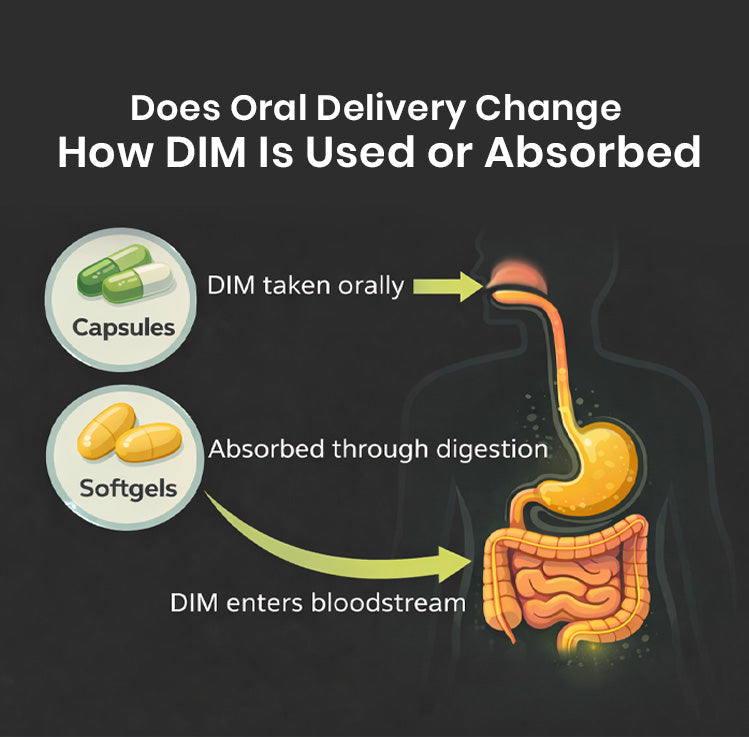
One of the most important things to understand about oral delivery of DIM is where it actually acts.
DIM does not work in the mouth itself.
Its studied mechanisms — including its influence on estrogen metabolism pathways — begin after it is absorbed from the gastrointestinal tract into systemic circulation.
What the mouth provides in the context of oral delivery is an entry point — not the site of action.
This means the mouth-level experience of an oral DIM product — texture, taste, comfort — is primarily relevant to one thing: whether someone uses it consistently.
A 2025 peer-reviewed study published in PMC confirmed that DIM's mechanism of action involves the alteration of estrogen metabolism — a systemic process that occurs after absorption, not at the point of oral delivery.
For more on DIM's studied mechanisms including estrogen metabolism research, our article on how does DIM work covers the full evidence base.
For more on how DIM specifically influences estrogen metabolism pathways, our article on how DIM supports estrogen metabolism covers that research in detail.
These statements have not been evaluated by the FDA.
Why Consistency Matters for Oral Delivery of DIM
DIM has been studied in research contexts that involve sustained exposure over time — not single-dose effects.
This means consistency of use is a practical consideration that formulation researchers take seriously.

A comprehensive PMC review of the pharmacological actions of DIM noted that DIM alters multiple signaling pathways — and that the research examining these effects has generally used repeated dosing protocols rather than one-time administration.
The connection to oral delivery format is straightforward: a format that is comfortable, easy to incorporate into a daily routine, and consistently used is more relevant to sustained exposure than one that is technically optimized but practically difficult to maintain.
This is not a health claim.
It is a practical observation about compliance that applies to any compound studied in a sustained-use research context.
These statements have not been evaluated by the FDA.
DIM in Oral Care Formulations: What to Know
Because DIM is lipophilic, formulations designed to deliver it effectively use carrier systems consistent with the principles identified in the research literature above.

DIM has also been examined in oral biology research specifically — separately from the systemic estrogen metabolism research.
A 2023 peer-reviewed study published in the journal Antibiotics found that DIM attenuated Streptococcus mutans biofilm formation by 92 percent in laboratory conditions — a preclinical finding from an in vitro setting that should not be interpreted as a clinical outcome.
This oral biology research profile is one reason DIM appears in oral care formulations alongside mineral-rich ingredients examined in oral science research contexts.
For more on the oral science research behind DIM, our article on what is DIM covers that evidence in detail.
For more on how DIM interacts with the mineral ingredients used alongside it, our article on minerals that support DIM effectiveness covers that research context.
For more on the connection between hormonal health and oral biology, our article on hormonal balance and oral health covers the peer-reviewed evidence.
For a comprehensive overview of all DIM research areas, our ultimate guide to DIM benefits covers the full landscape in one place.
The research discussed above evaluates DIM as an ingredient in laboratory and clinical research contexts.
The finished product has not been evaluated by the FDA for the prevention, treatment, or mitigation of any condition.
Nathan and Sons' pearl powder tooth scrub combines DIM with mineral-rich ingredients examined in oral care research contexts.
Browse our full oral care collection to see everything we make.
To learn more about who we are, visit our about page.
Key Takeaways: Oral Delivery of DIM
DIM is lipophilic — a compound that dissolves more effectively in fats than in water — which creates oral bioavailability challenges that researchers have specifically studied.
Peer-reviewed research has confirmed that standard crystalline DIM has low oral bioavailability — and that lipid-based delivery systems have been examined as approaches to improving absorption.
Products described as absorption-enhanced or microencapsulated DIM refer to formulations developed specifically to address this low-bioavailability challenge.
DIM acts systemically after absorption — its studied mechanisms including estrogen metabolism pathway influence occur after gastrointestinal absorption, not at the point of oral delivery.
Formulation matters — liquid DIM and lipid-based carrier systems have shown higher bioavailability than standard crystalline formulations in research settings.
Consistency of use is a practical consideration for a compound studied in sustained-exposure research contexts — and delivery format influences consistency in everyday practice.
DIM has been examined in oral biology research separately from its systemic mechanisms — including a 2023 laboratory study finding 92 percent attenuation of Streptococcus mutans biofilm formation.
These statements have not been evaluated by the FDA.
Not intended to diagnose, treat, cure, or prevent any disease.
Frequently Asked Questions: Oral Delivery of DIM
Does oral delivery change what DIM does in the body?
No — DIM's studied mechanisms including its influence on estrogen metabolism pathways occur after it is absorbed into systemic circulation, not at the point of oral delivery.
What oral delivery format influences is absorption efficiency and consistency of use — not the biological mechanisms researchers have studied.
These statements have not been evaluated by the FDA and are not intended to diagnose, treat, cure, or prevent any disease.
Why does DIM have low oral bioavailability?
DIM is lipophilic — a compound that dissolves more effectively in fats and oils than in water-based biological fluids.
Because standard oral delivery involves a water-based gastrointestinal environment, lipophilic compounds like DIM face absorption challenges that water-soluble compounds do not.
Peer-reviewed research has confirmed that DIM's in vivo biological activity is limited by poor solubility and very low oral bioavailability in standard crystalline formulations.
These statements have not been evaluated by the FDA and are not intended to diagnose, treat, cure, or prevent any disease.
Does formulation affect DIM absorption?
Yes — research has found that formulation significantly influences DIM's oral bioavailability.
A 2024 peer-reviewed study found that liquid DIM formulations show higher bioavailability than crystalline DIM — and that lipid-based delivery systems including nanoemulsions have been examined specifically to address DIM's poor water solubility.
Products described as absorption-enhanced or microencapsulated DIM are formulated specifically to address this challenge.
These are research findings from pharmaceutical formulation studies — not established clinical outcomes for specific health conditions.
These statements have not been evaluated by the FDA and are not intended to diagnose, treat, cure, or prevent any disease.
Is oral DIM the same as eating cruciferous vegetables?
No — they are meaningfully different in delivery context.
When you eat cruciferous vegetables, DIM forms through your own digestive process — at concentrations that vary with how thoroughly you chew, your stomach acidity, and your gut microbiome composition.
The DIM produced arrives alongside fiber, vitamins, minerals, and dozens of other phytochemicals present in the whole food matrix.
Supplemental DIM delivers the compound directly — at concentrations that may differ significantly from normal dietary exposure — and without the co-occurring nutrients present in whole foods.
Formulated oral DIM products sit in a third category — combining direct DIM delivery with carrier systems designed to improve the absorption that whole-food dietary DIM achieves through the natural digestive process.
Consult a qualified healthcare provider for guidance on which approach is appropriate for your situation.
These statements have not been evaluated by the FDA and are not intended to diagnose, treat, cure, or prevent any disease.
Why pair DIM with oral care ingredients?
DIM has been examined in oral biology research for its interactions with oral biofilm and inflammatory signaling in oral tissue contexts — research that is distinct from its systemic estrogen metabolism research.
Oral care ingredients including nano-hydroxyapatite and mineral compounds contribute their own research profiles to an oral care formulation.
The combination is designed to support daily oral use as part of a consistent routine — with each ingredient contributing its own individually studied properties.
The finished product has not been evaluated by the FDA for the prevention, treatment, or mitigation of any condition. These statements have not been evaluated by the FDA and are not intended to diagnose, treat, cure, or prevent any disease.
Legal & Compliance Disclaimer
These statements have not been evaluated by the Food and Drug Administration. This product is not intended to diagnose, treat, cure, or prevent any disease. The information in this article is for educational purposes only and is not a substitute for professional medical or dental advice. Consult a qualified healthcare provider before making changes to your supplement or oral care routine. Content current as of 2026. Subject to revision.
References
Bakrania A, et al. (2024). Development of a self-nanoemulsifying drug delivery system of diindolylmethane for enhanced bioaccessibility, bioavailability and anti-breast cancer efficacy. Journal of Drug Delivery Science and Technology.
Johnson WD, et al. (2018). Enhanced oral bioavailability of 3,3′-diindolylmethane administered in a self-microemulsifying drug delivery system. IIT Research Institute.
PMC. (2025). The impact of 3,3′-diindolylmethane on estradiol and estrogen metabolism in postmenopausal women using a transdermal estradiol patch. PMC12188845.
PMC. (2025). Unveiling the multifaceted pharmacological actions of indole-3-carbinol and diindolylmethane: a comprehensive review. PMC11902694.
Baruch Y, et al. (2023). 3,3′-Diindolylmethane (DIM): a potential therapeutic agent against cariogenic Streptococcus mutans biofilm. Antibiotics, 12(6), 1017. PMC10295630.
ScienceDirect. Novel diindolylmethane derivatives based NLC formulations to improve oral bioavailability and anticancer effects in triple negative breast cancer.