
Nano-hydroxyapatite is considered safe for use in oral care products — a conclusion supported by peer-reviewed research and confirmed in a June 2025 final opinion by the European Commission's Scientific Committee on Consumer Safety.
Here is a question that comes up constantly in oral care conversations right now.
Someone mentions nano-hydroxyapatite — in a toothpaste, in a remineralizing gum, in a mouthwash — and somewhere in the room, someone else says: "But is it actually safe? I mean... nano particles?"
It is a reasonable thing to wonder.
Nano is a word that carries a certain amount of ambient anxiety in 2026 — partly because of how it sounds, partly because of how little most people know about what it actually means for safety.
So let us answer the question properly.
What does the peer-reviewed research say?
What do regulators say?
And what do you actually need to know before deciding whether nano-hydroxyapatite belongs in your oral care routine?
These statements have not been evaluated by the Food and Drug Administration.
This product is not intended to diagnose, treat, cure, or prevent any disease.

What Is Nano-Hydroxyapatite and Why Does It Raise Safety Questions?
Before getting to the safety data, it helps to understand what nano-hydroxyapatite actually is — because the "nano" part is where most of the concern originates.
Hydroxyapatite is the mineral compound that makes up approximately 90 to 97 percent of tooth enamel by weight.
Your teeth are already largely made of it.
The "nano" prefix refers to particle size — nanoparticles are particles measured in nanometers, or billionths of a meter.
Nano-hydroxyapatite particles are engineered to be small enough to interact with enamel microporosities — the microscopic gaps and imperfections in enamel surface structure that form when enamel undergoes demineralization.
A 2025 narrative review published in Biomimetics confirmed that nano-hydroxyapatite's nanoscale particle size allows it to interact with enamel microporosities and surface structures — and that it is among the formats being studied for enamel and dentin remineralization support.
The reason safety questions arise is a reasonable one: nanoparticles of some materials behave differently than the same materials at larger scales.
A material that is safe at conventional scale may raise different questions at nanoscale — which is exactly why regulators spent years specifically evaluating hydroxyapatite in nanoform rather than simply relying on the general safety record of hydroxyapatite itself.
That rigorous regulatory process is actually the most reassuring part of the nano-hydroxyapatite safety story.
And it just reached a significant milestone.
These statements have not been evaluated by the FDA.
A History Worth Knowing: 30 Years of Use Before the Safety Debate Started
Here is something that tends to get lost in the current conversation about nano-hydroxyapatite.
Japan approved hydroxyapatite for use in oral care products in the early 1990s.
That was over 30 years ago.
For three decades, Japanese consumers have been brushing with hydroxyapatite-containing toothpastes — and that long consumer use history without documented systemic safety concerns is part of what informed the European regulatory review process.
The safety debate in Europe was not sparked by evidence of harm.
It was sparked by the general precautionary principle that the EU applies to all nanomaterials in consumer products — requiring specific safety data for any ingredient in nanoform, regardless of its track record at conventional scale.
That precautionary process ran its full course.
And in June 2025, it reached its conclusion.
These statements have not been evaluated by the FDA.

The 2025 SCCS Decision: What It Means and Why It Matters
In June 2025 — after four rounds of review spanning years of safety dossier submissions — the European Commission's Scientific Committee on Consumer Safety issued its final opinion on hydroxyapatite in nanoform.
The conclusion: the SCCS determined that hydroxyapatite in nanoform is safe for use in oral care products at concentrations up to 29.5 percent in toothpaste and up to 10 percent in mouthwash.
That is not a marketing claim.
That is the European Union's independent scientific advisory body for consumer product safety — the same body that evaluates every ingredient used in cosmetics and personal care products across EU member states — issuing a formal safety clearance after four rounds of review.
As the RIVM — the Dutch National Institute for Public Health and Environment — summarized: new safety data showed that HAP nano does not cause genetic mutations, cytotoxicity, or inflammation, and is not significantly taken up by cells.
The SCCS conclusion was based on the available evidence showing that hydroxyapatite in nanoform does not pose a mutagenic hazard, cytotoxicity, or inflammatory effects — even when tested at high concentrations in a buccal mucosa cell model.
One important technical detail: the SCCS safety clearance applies specifically to rod-shaped nanoparticles meeting certain criteria regarding length-to-width ratios.
Needle-shaped hydroxyapatite nanoparticles were not approved — they raise different biological concerns.
This distinction matters when evaluating products — rod-shaped is the approved form used in reputable oral care formulations.
These statements have not been evaluated by the FDA.
What the Peer-Reviewed Research Found
The SCCS decision did not emerge from nowhere.
It was built on a foundation of peer-reviewed safety research that had been accumulating for years — much of it specifically designed to address the cytotoxicity and genotoxicity questions that had kept earlier SCCS assessments inconclusive.
Cytotoxicity research
A 2019 peer-reviewed study published in Scientific Reports characterized a commercially available nano-hydroxyapatite and evaluated its cytocompatibility against human gingival fibroblasts — finding that the nanoparticles were highly cytocompatible and did not alter the normal behavior of cells.
The same study found no irritation potential in the HET-CAM assay — a validated test for tissue irritation.
Genotoxicity research
A 2021 peer-reviewed biocompatibility assessment published in PMC evaluated three batches of commercial nano-hydroxyapatite for cytotoxicity and genotoxicity using ISO 10993-5 and OECD 487 guidelines — finding the nanoparticles cytocompatible and showing no genotoxicity in the in vitro micronucleus assay.
What happens if you swallow it
This is one of the most practically important safety questions — especially relevant for chewing gum, where some product contact with saliva is inevitable.
A 2022 review published in Frontiers in Dental Medicine examining hydroxyapatite as a remineralization agent for children's dental care confirmed that oral administration of hydroxyapatite is safe when swallowed — as the particles dissolve in the stomach by gastric acid resulting in a release of calcium and phosphate ions that the body already processes routinely.
The SCCS 2025 final opinion confirmed this directly: any unintentionally ingested hydroxyapatite nanoparticles during the use of oral care products will undergo rapid dissolution in the gastric fluid and therefore do not raise any nano-specific concern over safety.
In other words — if you accidentally swallow some, your stomach acid dissolves it into calcium and phosphate.
The same calcium and phosphate that are in dairy products and many foods you eat every day.
These statements have not been evaluated by the FDA.

Nano-Hydroxyapatite Side Effects: What the Research Shows
Fair question — and one that deserves a direct answer rather than a vague reassurance.
At concentrations used in consumer oral care products, nano-hydroxyapatite has not been associated with significant adverse effects in the peer-reviewed research reviewed by the SCCS.
The 2025 SCCS opinion specifically found no cytotoxicity, no mutagenic hazard, and no inflammatory effects — even at high concentrations in buccal mucosa cell models.
The 2019 Scientific Reports study found no irritation potential.
The 2021 biocompatibility assessment found no genotoxicity.
What the research has not documented as a concern: systemic absorption through intact oral tissue, accumulation in organs, or toxicity at normal dietary swallowing exposure.
What is worth knowing: the SCCS safety clearance applies specifically to rod-shaped nano-hydroxyapatite at approved concentrations.
Products using needle-shaped particles — which were not approved — sit outside this safety clearance.
And as with any ingredient where active research is ongoing, the evidence base will continue to develop.
Consult a qualified dental or healthcare provider for guidance specific to your situation.
These statements have not been evaluated by the FDA.
What About Absorption Through Oral Tissues?
Another common safety question: can nano-hydroxyapatite particles pass through the gum tissue or oral mucosa into the body?
The research addresses this directly.
The SCCS 2025 opinion concluded that any uptake of hydroxyapatite nanoparticles by the buccal mucosa is considered negligible — and that the epithelial cells that line the mouth continuously renew themselves, meaning that any cells that may have come into contact with particles will eventually be replaced through the normal cell turnover process.
The 2021 biocompatibility assessment published in PMC found that while some cellular internalization was observed, the nanoparticles were identified only in the cytoplasm and extracellular space — not in the cell nucleus where genetic material is housed.
The practical implication: nano-hydroxyapatite in oral care products at approved concentrations does not appear to create systemic exposure concerns through the oral mucosa — based on the currently available evidence.
These statements have not been evaluated by the FDA.
Is Nano-Hydroxyapatite Safe for Children?
This is one of the most searched sub-questions within the nano-hydroxyapatite safety topic — and it deserves its own answer.
Nano-hydroxyapatite has been specifically studied in pediatric dental care contexts.
A 2022 review published in Frontiers in Dental Medicine examining hydroxyapatite as a remineralization agent for children found that oral administration of hydroxyapatite is safe when swallowed — as the particles dissolve in gastric acid into calcium and phosphate — and that hydroxyapatite has been used as a bone substitute and implant coating with no adverse effects reported due to its biological resorption.
The practical reason this matters for children specifically: children are more likely to swallow toothpaste and oral care products than adults.
The gastric dissolution finding is particularly reassuring in this context — because the worst-case scenario of accidental swallowing results in calcium and phosphate release rather than nanoparticle accumulation.
Nano-hydroxyapatite also does not carry the fluorosis risk profile associated with fluoride — which requires age-specific usage warnings precisely because excessive fluoride consumption during tooth development can cause permanent enamel discoloration.
This does not mean nano-hydroxyapatite is clinically superior to fluoride for children.
It means the risk profile differs in ways that are relevant to parents evaluating their options.
Consult a qualified dental or healthcare provider for guidance specific to your child's oral health situation.
These statements have not been evaluated by the FDA.

Nano-Hydroxyapatite vs Fluoride: A Safety Comparison
People searching this topic often want to know whether nano-hydroxyapatite is safer than fluoride — and it is worth answering this honestly rather than either dismissing it or overclaiming.
The two ingredients have meaningfully different safety profiles — not because one is dangerous and the other is not, but because they carry different risk considerations.
Fluoride has a well-established decades-long safety record at the concentrations used in oral care products.
At higher exposures — particularly in children whose teeth are still developing — fluoride can cause dental fluorosis, a condition causing permanent changes to enamel appearance.
At very high doses, fluoride is toxic — which is why fluoride toothpastes carry poison control warnings and age-specific usage guidance.
At normal use levels for adults, fluoride is considered safe by every major dental and public health organization globally.
Nano-hydroxyapatite dissolves into calcium and phosphate when swallowed — compounds already present in normal diet and routinely processed by the body.
It does not carry a fluorosis risk.
It does not have a documented toxicity threshold at dietary exposure levels.
The SCCS 2025 final opinion found no mutagenic hazard, cytotoxicity, or inflammatory effects at high concentrations in oral tissue models.
The honest comparison:
Both ingredients have research-supported safety profiles at recommended use levels.
The primary practical difference is what happens when they are accidentally consumed in excess — fluoride carries a documented toxicity concern at higher doses while nano-hydroxyapatite dissolves into mineral ions the body already manages.
This is not a claim that nano-hydroxyapatite is safer than fluoride for oral care purposes.
It is an accurate description of how the two safety profiles differ — which is the information consumers searching this topic are actually looking for.
For a full research comparison of how nano-hydroxyapatite and fluoride have been studied in oral care efficacy contexts, our article on nano-hydroxyapatite vs fluoride covers that evidence in detail.
These statements have not been evaluated by the FDA.
The Safety Question No One Asks — But Should
Here is something worth thinking about that most nano-hydroxyapatite safety articles skip.
The safety question is not just "is nano-hydroxyapatite safe."
It is "safe compared to what."
And the honest answer to that comparison requires acknowledging both what the research supports and what it does not.
These statements have not been evaluated by the FDA.
What to Look for in a Nano-Hydroxyapatite Product
Not all nano-hydroxyapatite formulations are equivalent — and the safety research applies specifically to certain forms.
Rod-shaped particles only. The SCCS safety clearance applies to rod-shaped nanoparticles with specific length-to-width ratios. Needle-shaped particles were not approved. Reputable manufacturers use rod-shaped nano-hydroxyapatite — but this is worth verifying.
Concentration within studied ranges. Most consumer oral care products use nano-hydroxyapatite at concentrations of 10 percent or below — well within the SCCS-approved range.
Full ingredient disclosure. Any product worth using discloses its nano-hydroxyapatite content and form clearly — rather than listing it ambiguously or obscuring it within a proprietary blend.
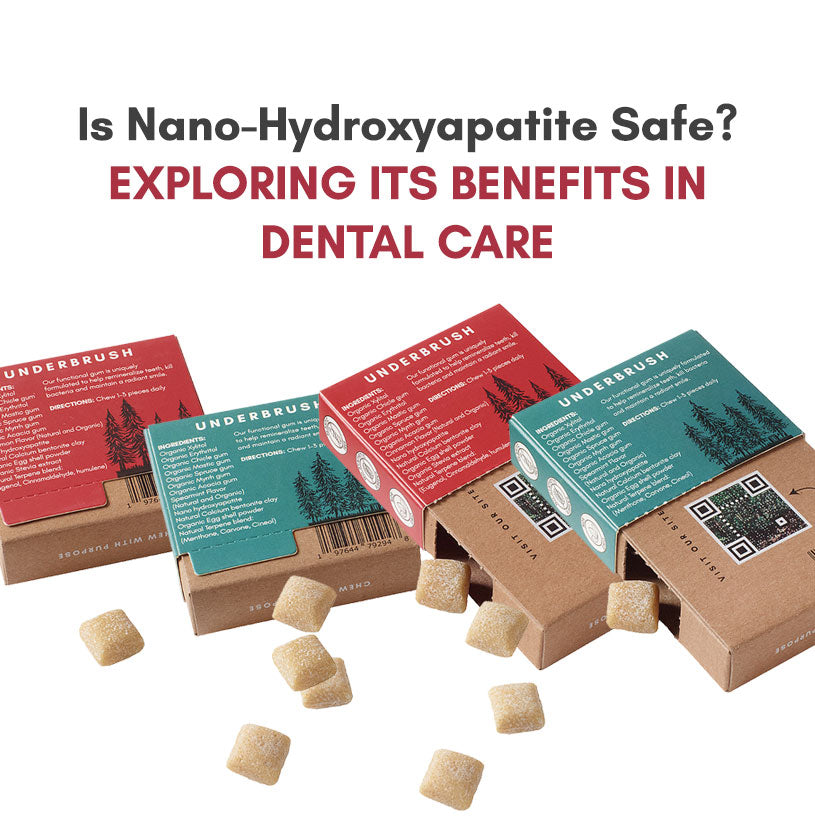
Nathan and Sons' remineralizing gum uses both nano and micro hydroxyapatite as part of a fully disclosed ingredient list — alongside xylitol, mastic gum, chicle, zinc gluconate, and the other plant-based ingredients covered in our oral care research articles.
For more on the remineralization research behind nano-hydroxyapatite, our article on nano-hydroxyapatite oral care benefits explained covers the full evidence base.
For a direct comparison of how nano-hydroxyapatite and fluoride have each been studied in oral care research contexts, our article on nano-hydroxyapatite vs fluoride covers that evidence in detail.
For more on what remineralizing gum is and how it works, our article on what is remineralizing gum explains the formulation rationale.
For more on the broader question of whether tooth enamel can remineralize, our article on can you reverse tooth decay covers the demineralization and remineralization science in detail.
The research discussed above evaluates nano-hydroxyapatite as an ingredient in laboratory and clinical research contexts.
The finished product has not been evaluated by the FDA for the prevention, treatment, or mitigation of any condition.
Browse our full oral care collection to see everything we make.
To learn more about who we are and why ingredient transparency matters to us, visit our about page.
What the Research Does Not Yet Confirm
Honest disclosure matters here — and it is something this article takes seriously.
The SCCS 2025 clearance applies to specific nano-hydroxyapatite particle forms at specific concentrations in toothpaste and mouthwash.
Long-term safety studies on nano-hydroxyapatite across all delivery formats — including chewing gum — are still developing.
The safety research is substantially reassuring — but as with any ingredient where active research is ongoing, the evidence base will continue to develop.
Earlier SCCS assessments prior to 2025 were inconclusive regarding potential DNA damage from rod-shaped particles — which is precisely why additional safety data was submitted and why the 2025 final opinion required four rounds of review before reaching its conclusion.
The current evidence base is strong.
But "currently well-supported" and "definitively settled forever" are not the same thing — and the honest picture acknowledges both.
Consult a qualified dental or healthcare provider for guidance specific to your situation.
These statements have not been evaluated by the FDA and are not intended to diagnose, treat, cure, or prevent any disease.
Key Takeaways: Is Nano-Hydroxyapatite Safe?
Nano-hydroxyapatite is considered safe for use in oral care products based on currently available evidence — including a June 2025 final opinion from the European Commission's Scientific Committee on Consumer Safety.
Nano-hydroxyapatite is the same mineral compound that makes up 90 to 97 percent of tooth enamel — engineered at nanoscale to interact with enamel microporosities.
The SCCS 2025 conclusion is based on evidence showing nano-hydroxyapatite does not cause genetic mutations, cytotoxicity, or inflammation — and is not significantly taken up by oral tissues.
If swallowed, nano-hydroxyapatite nanoparticles dissolve rapidly in gastric acid into calcium and phosphate ions — which the body already processes routinely.
The safety clearance applies specifically to rod-shaped particles meeting certain criteria — needle-shaped particles were not approved.
Japan approved hydroxyapatite for oral care in the early 1990s — giving it over 30 years of consumer use history before the European regulatory debate began.
Peer-reviewed research published in Scientific Reports and PMC has found nano-hydroxyapatite to be cytocompatible and non-genotoxic across multiple cell models and testing protocols.
The evidence base is strong and continues to develop — ongoing research will continue to refine the full safety picture across all delivery formats and concentrations.
These statements have not been evaluated by the FDA.
Not intended to diagnose, treat, cure, or prevent any disease.
Frequently Asked Questions: Is Nano-Hydroxyapatite Safe?
Is nano-hydroxyapatite safe?
Yes — based on the currently available evidence, nano-hydroxyapatite in rod-shaped form at concentrations used in oral care products is considered safe.
In June 2025 the European Commission's Scientific Committee on Consumer Safety issued a final opinion confirming that rod-shaped nano-hydroxyapatite does not cause genetic mutations, cytotoxicity, or inflammation — and is not significantly absorbed by oral tissues.
These statements have not been evaluated by the FDA and are not intended to diagnose, treat, cure, or prevent any disease.
Is nano-hydroxyapatite safe to swallow?
Research and the 2025 SCCS opinion both confirm that nano-hydroxyapatite nanoparticles undergo rapid dissolution in gastric fluid when swallowed — breaking down into calcium and phosphate ions that the body already processes routinely.
The SCCS specifically noted that ingested hydroxyapatite nanoparticles do not raise nano-specific safety concerns due to this rapid gastric dissolution.
A 2022 review published in Frontiers in Dental Medicine confirmed the same finding — oral administration of hydroxyapatite is safe when swallowed as the particles dissolve in the stomach by gastric acid.
These statements have not been evaluated by the FDA and are not intended to diagnose, treat, cure, or prevent any disease.
Is nano-hydroxyapatite safe for children?
Nano-hydroxyapatite has been specifically studied in the context of children's dental care.
A 2022 review in Frontiers in Dental Medicine examined hydroxyapatite as a remineralization agent for children — noting its favorable dissolution profile when swallowed and its studied use in pediatric oral care contexts.
Because nano-hydroxyapatite dissolves into calcium and phosphate rather than accumulating, it does not carry the fluorosis risk profile associated with fluoride — which requires age-specific usage warnings.
Consult a qualified healthcare provider for guidance specific to your child's situation.
These statements have not been evaluated by the FDA and are not intended to diagnose, treat, cure, or prevent any disease.
What are the side effects of nano-hydroxyapatite?
At concentrations used in consumer oral care products, nano-hydroxyapatite has not been associated with significant adverse effects in peer-reviewed research.
The 2025 SCCS final opinion found no cytotoxicity, no mutagenic hazard, and no inflammatory effects — even at high concentrations in oral tissue models.
The safety clearance applies specifically to rod-shaped particles at approved concentrations — products using needle-shaped particles were not approved by the SCCS.
As with any ingredient where active research is ongoing, consult a qualified healthcare provider for guidance specific to your situation.
These statements have not been evaluated by the FDA and are not intended to diagnose, treat, cure, or prevent any disease.
What did the SCCS say about nano-hydroxyapatite?
The European Commission's Scientific Committee on Consumer Safety issued its final opinion in June 2025 — confirming that hydroxyapatite in nanoform is safe for use in oral care products at concentrations up to 29.5 percent in toothpaste and up to 10 percent in mouthwash.
The conclusion was based on evidence showing no mutagenic hazard, cytotoxicity, or inflammatory effects — even at high concentrations in buccal mucosa cell models.
The clearance applies specifically to rod-shaped particles meeting defined criteria — needle-shaped particles were not approved.
These statements have not been evaluated by the FDA and are not intended to diagnose, treat, cure, or prevent any disease.
Is nano-hydroxyapatite FDA approved?
The FDA has not issued a specific approval for nano-hydroxyapatite as a drug or medical device for oral care applications.
Nano-hydroxyapatite used in oral care products is generally regulated as a cosmetic ingredient in the United States rather than as a drug — which means it falls under the FDA's food additive and cosmetic ingredient framework rather than the drug approval pathway.
The European SCCS 2025 final opinion represents the most comprehensive independent regulatory safety assessment currently available for nano-hydroxyapatite in oral care contexts.
These statements have not been evaluated by the FDA and are not intended to diagnose, treat, cure, or prevent any disease.
Is nano-hydroxyapatite safe in chewing gum?
Nano-hydroxyapatite has been studied in oral care delivery formats including chewing gum — and the gastric dissolution findings are particularly relevant here, as some product contact with saliva during chewing is expected.
The SCCS 2025 finding that ingested nano-hydroxyapatite nanoparticles dissolve rapidly in gastric fluid addresses the swallowing scenario directly.
The long-term safety research specifically for chewing gum delivery format continues to develop alongside the broader nano-hydroxyapatite safety literature.
These statements have not been evaluated by the FDA and are not intended to diagnose, treat, cure, or prevent any disease.
Is nano-hydroxyapatite safer than fluoride?
Both nano-hydroxyapatite and fluoride have research-supported safety profiles at recommended use levels.
The primary practical difference is what happens when accidentally consumed in excess — fluoride carries a documented toxicity concern at higher doses while nano-hydroxyapatite dissolves into mineral ions the body already manages routinely.
Nano-hydroxyapatite does not carry the fluorosis risk profile associated with fluoride — which requires age-specific usage warnings for children.
This is not a claim that nano-hydroxyapatite is clinically superior to fluoride — it is an accurate description of how the two safety profiles differ.
Consult a qualified dental professional for guidance on which approach is appropriate for your oral health situation.
These statements have not been evaluated by the FDA and are not intended to diagnose, treat, cure, or prevent any disease.
Legal & Compliance Disclaimer
These statements have not been evaluated by the Food and Drug Administration. This product is not intended to diagnose, treat, cure, or prevent any disease. The information in this article is for educational purposes only and is not a substitute for professional dental or medical advice. Consult a qualified dental or healthcare provider before making changes to your oral care routine. Content current as of 2026. Subject to revision.
References
SCCS. (2025). Scientific Opinion on Hydroxyapatite (nano) — Submission IV, SCCS/1677/25, final version of 26 June 2025. health.ec.europa.eu/publications/sccs-scientific-opinion-hydroxyapatite-nano-submission-iv_en.
RIVM. (2025). New safety data confirms hydroxyapatite in nanoform is safe for oral care products. rivm.nl/en/weblog/new-safety-data-confirms-hydroxyapatite-in-nanoform-is-safe-for-oral-care-products.
National Law Review. (2025). EC Scientific Committee Issues Final Opinion on Hydroxyapatite (Nano) in Oral Products. natlawreview.com.
Coelho CC, et al. (2019). Nano-hydroxyapatite in oral care cosmetics: characterization and cytotoxicity assessment. Scientific Reports. PMC6667430.
Kavasi RM, et al. (2021). In vitro biocompatibility assessment of nano-hydroxyapatite. Nanomaterials. PMC8145068.
Lim MN, et al. (2022). Hydroxyapatite as remineralization agent for children's dental care. Frontiers in Dental Medicine. DOI: 10.3389/fdmed.2022.859560.
Naim J, et al. (2025). The remineralizing and desensitizing potential of hydroxyapatite in dentistry: a narrative review. Biomimetics. PMC12470856.
Wierichs RJ, et al. (2022). Efficacy of nano-hydroxyapatite on caries prevention: a systematic review and meta-analysis. Clinical Oral Investigations. PMC8979882.