
Reviewed by the Nathan & Sons Editorial Team, September 2026.
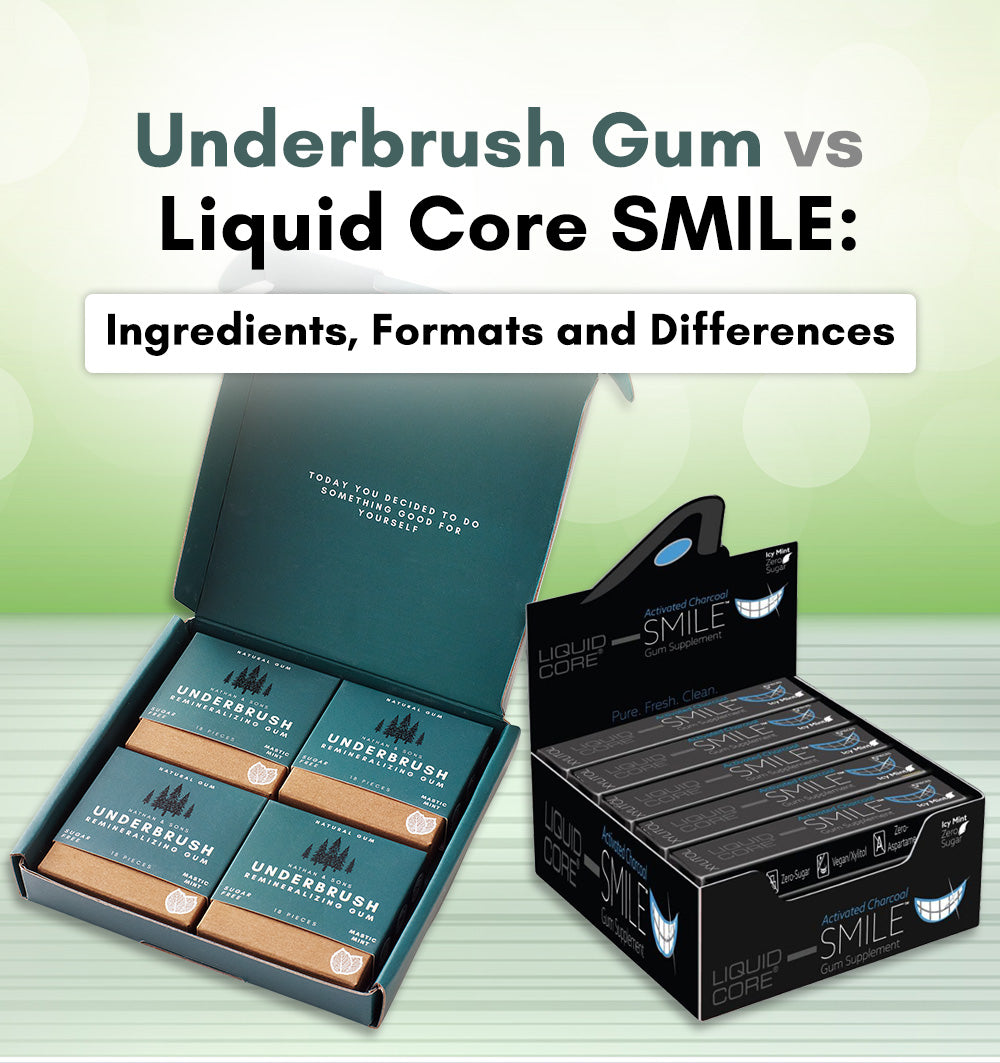
Remember the first time you bit into a piece of gum and got a sudden squirt of liquid flavor? That same tiny trick sits at the heart of the Underbrush Gum vs Liquid Core SMILE comparison.
Functional gum used to mean regular gum with one extra ingredient tossed in. Now brands are taking very different paths, so this matchup is about a lot more than which one tastes better.
Advertising disclosure: Nathan & Sons manufactures and sells Underbrush Gum. This comparison was prepared by Nathan & Sons using publicly available product information from both brands. Liquid Core did not participate in or approve this comparison. Since we obviously know one of these gums pretty well, we stuck to what each brand publishes on its own website. We checked both ingredient lists in September 2026. Formulas change, though, so check the label on the pack you actually buy. A quick note on names. When we say "Underbrush" in this article, we mean Underbrush Gum by Nathan & Sons.
Let's dig into Underbrush Gum vs Liquid Core SMILE.
Underbrush Gum vs Liquid Core SMILE: The Quick Answer
These products are marketed with different formulations and intended uses. Underbrush is positioned as an oral-care gum.
It pairs xylitol and hydroxyapatite with natural gums, resins and minerals in a chicle-based gum.
Liquid Core, on the other hand, offers several liquid-center gum products. Its lineup includes energy, health and wellness gums, plus the oral-care product SMILE.
So the right pick depends on what you're looking for. Think of it as choosing between two products designed around different ingredients, formats and intended uses.
What's Inside Underbrush Gum by Nathan & Sons?
The Mastic Mint label for Underbrush Gum by Nathan & Sons starts with xylitol, a chicle gum base (chicle, candelilla wax and citric acid) and erythritol. Next come mastic, spruce, acacia and myrrh gums, plus mint flavor.
Then it lists nano and micro hydroxyapatite, calcium carbonate, calcium bentonite clay, magnesium carbonate and zinc gluconate. A terpene blend of menthone, carvone and cineol rounds it out.
Also, the supporting ingredients change a bit by flavor. For example, Cinna-Mastic uses Ceylon cinnamon and a different terpene blend.
Tropic Twist adds sorbitol, monk fruit and dicalcium phosphate.
As of September 2026, Underbrush was offered in four flavors (Mastic Mint, Berry, Cinna-Mastic and Tropic Twist) plus a variety pack. According to the product page, Underbrush is formulated without gluten, sugar, aspartame or sucralose.
Customers also notice that ingredient list. The reviews in this article come from recent verified buyers on our website.
We picked them, and each one reflects one person's experience.
"The gum is good and I like the natural ingredients." - Marian Y., verified buyer
New to this category? Start with What Is Remineralizing Gum? Just remember that any gum like this is an extra, not a replacement for brushing, flossing or seeing your dentist.
What Makes Liquid Core Different?
To begin with, Liquid Core's big idea is right there in the name. Liquid Core describes its products as having a liquid-filled center that is released during chewing.
We found no independent tests that compare how its center releases with Underbrush or other solid gums.
According to a 2022 company press release, Liquid CORE Gum Co. calls Denver home. On its website (https://liquidcore.store/), Liquid Core markets certain products as "fast-acting."
We did not check that claim ourselves. We also didn't identify a head-to-head study comparing the delivery speed of Liquid Core SMILE with Underbrush.
For oral care, the Liquid Core SMILE product page (https://liquidcore.store/products/smile) lists xylitol, gum base, maltitol, activated charcoal, MCT oil and hydroxyapatite. It also lists natural flavors, sucralose, citric acid and vitamin E.
Thanks to the activated charcoal, the page says the liquid center coats your teeth and gums in black liquid.
Liquid Core's energy collection (https://liquidcore.store/collections/energy) also includes gums like Apollo Energy Gum and Golf Gum. Want a liquid-center gum mainly for energy or general wellness?
Then that wider lineup may matter more to you than any single oral-care formula.
Underbrush Gum vs Liquid Core SMILE: Side-by-Side Ingredients
Here's how Underbrush Gum vs Liquid Core SMILE looks on paper. This table compares only Underbrush Mastic Mint and Liquid Core SMILE, as listed on each brand's website in September 2026.

A common Underbrush Gum vs Liquid Core SMILE question is whether they're the same type of product. Not really.
They overlap on two ingredients, but the rest of each formula goes in a different direction.
People also ask whether both contain xylitol and hydroxyapatite. Yes, both current oral-care formulas list both.
However, Underbrush specifies nano and micro hydroxyapatite, while the SMILE page doesn't say which form it uses.
Does the Liquid Center Actually Matter?
Here's where it gets interesting. Liquid Core says chewing releases SMILE's liquid center.
However, we couldn't find any study comparing a liquid-center gum with Underbrush, or with solid gums in general.
However, research does show that chewing time matters for how much of an ingredient comes out of gum. In a 2019 study in Food & Function, people chewed a caffeinated gum for different lengths of time.
The gum released about 48% of its caffeine after 2 minutes, 78% after 5 minutes and 96% after 10 minutes.
These percentages apply only to the caffeinated gum and study conditions the researchers evaluated. They can't tell you how fast Underbrush or Liquid Core SMILE releases its ingredients.
So the study helps explain why release matters, but it doesn't show that a liquid center works better than a solid gum.
Is Liquid Core SMILE better because the ingredients sit in a liquid center? There isn't independent head-to-head evidence to say so.
Delivery format is worth noticing, but it isn't proof that one whole category of gum works better than another.
Meanwhile, on the solid-gum side, one Underbrush customer kept it simple.
"It had good flavor, consistent chewing."
Gabriel M., verified buyer
What Research Says About the Shared Ingredients
Now for the science part. We'll keep it painless.
Xylitol is the biggest overlap between these two gums. A 2025 systematic review in BMC Oral Health compared xylitol gum with sorbitol gum.
In 12 of 14 studies, xylitol gum was linked to lower levels of mutans streptococci, a type of mouth bacteria. It was also linked to less plaque in 6 of 10 studies.
The authors noted that many of the trials were older, and very few earned a low risk-of-bias rating. Also, the review didn't test Underbrush or Liquid Core SMILE.
So it doesn't show that either finished gum prevents cavities or delivers the same results.
If you're a xylitol fan, check out Everything You Need to Know About Xylitol.
Hydroxyapatite is also shared by both gums. A 2014 review in Annali di Stomatologia describes it as the main part of the mineral in bone and teeth.
That's why researchers have studied it in oral care for years.
A 2022 scoping review looked at nano-hydroxyapatite toothpastes and early tooth decay. The authors found a range of possible benefits.
However, they said the evidence for baby teeth is still insufficient and called for longer, standardized studies.
Note, however, that those studies looked at toothpaste, not gum. They don't show that either finished gum prevents, treats or reverses cavities, repairs enamel or works the same way hydroxyapatite toothpaste does.
Want to dig deeper? We cover the safety questions in Is Nano-Hydroxyapatite Safe?
Underbrush Gum vs Liquid Core SMILE: What About Price?
Here's where the matchup gets interesting. The Liquid Core SMILE product page (https://liquidcore.store/products/smile) lists 5 pieces per pack.
A single pack is $4.99, or about $1.00 a piece. The 15-pack (75 pieces) is $46.99, or about 63 cents a piece.
Liquid Core also offers a subscribe-and-save option at 25% off. If that discount applies to the 15-pack, it would come to about 47 cents a piece.
Underbrush comes in 18-piece packs sold in bundles. For example, the Underbrush product page lists the 4-pack (72 pieces) at $44.99 for a one-time order, or about 62 cents a piece.
With a subscription, that same 4-pack is listed at $31.49, or about 44 cents a piece. So at larger sizes, the two land in a similar range per piece.
The products have different formulas, formats, pack sizes and purchasing options, and piece sizes may differ too. This comparison doesn't determine why their retail prices differ.
Prices were recorded from each brand's website in September 2026, before taxes and shipping. Promotional and subscription prices, availability and subscription terms may change.
Can Underbrush Gum or Liquid Core SMILE Replace Brushing?
Nope. Even Liquid Core's SMILE page says the gum isn't meant to replace brushing your teeth.
In other words, think of any functional gum as a sidekick, not the superhero. Brushing, flossing, regular dental checkups and professional advice still do the heavy lifting.
Underbrush Gum vs Liquid Core SMILE: Which Fits Your Routine?
Overall, the Underbrush Gum vs Liquid Core SMILE decision comes down to what you're looking for. Want a gum positioned around oral care?
Underbrush puts hydroxyapatite, xylitol, natural gums, resins and minerals in one chew.
For some people, however, it's simply about having a gum that fits into a busy day. Here's how one customer put it.
"This is my go to gum. Perfect when I'm running around work and when I'm on a long commute home." - Gerico V., verified buyer
Maybe you care more about a liquid-center format, or about gums for energy and general wellness. In that case, Liquid Core's range is its clearest point of difference.
That's a different goal, not evidence that one format is better in every situation.
Bottom line? Check the labels, then pick the chew you like.
And flavor matters more than any spec sheet.
"This was my favorite flavor of gum. I enjoy the gum and I enjoy the flavor I got." - James J., verified buyer
For a closer look at the evidence behind this category, read Does Remineralizing Gum Work? You can also see how Underbrush compares with other brands in our 2026 hydroxyapatite gum guide.
Does Underbrush Gum by Nathan & Sons sound like your kind of chew? You can see every flavor and its full ingredient list on the Underbrush product page.
You can also browse our oral care collection or learn more about Nathan & Sons.
This article is for educational purposes only and isn't dental or medical advice. In September 2026, we checked the Underbrush ingredient list on our own website and the Liquid Core SMILE list on liquidcore.store.
Formulas may change. Talk to your dentist about any specific oral health concerns.
References
- Nathan & Sons. Underbrush Gum by Nathan & Sons (Underbrush Remineralizing Gum) product page and ingredient lists.
- Liquid Core. Liquid Core SMILE product page and ingredient list.
- Liquid Core. Energy collection.
- Liquid CORE Gum Co. Company press release. New Liquid Core SMILE Gum with Activated Charcoal and Hydroxyapatite. PR Newswire. June 9, 2022.
- Morris C, Viriot SM, Farooq Mirza QUA, Morris GA, Lynn A. Caffeine release and absorption from caffeinated gums. Food & Function. 2019.
- Söderling E, Pienihäkkinen K. Specific effects of xylitol chewing gum on mutans streptococci levels, plaque accumulation and caries occurrence: a systematic review. BMC Oral Health. 2025. doi:10.1186/s12903-025-06602-1.
- Pepla E, Besharat LK, Palaia G, Tenore G, Migliau G. Nano-hydroxyapatite and its applications in preventive, restorative and regenerative dentistry: a review of literature. Annali di Stomatologia. 2014;5(3):108-114.
- Anil A, Ibraheem WI, Meshni AA, Preethanath RS, Anil S. Nano-Hydroxyapatite (nHAp) in the Remineralization of Early Dental Caries: A Scoping Review. International Journal of Environmental Research and Public Health. 2022;19(9):5629. doi:10.3390/ijerph19095629.