
Quick answer: Spry is the stronger pick if you want a budget xylitol gum — about $0.09 a piece, simple, and available everywhere. Underbrush is a premium mineral-forward oral-care gum — it adds nano-hydroxyapatite, a mineral stack, and a named natural tree-sap base, but costs more and has shorter-lasting flavor. If price is your deciding factor, Spry is the rational buy. If you want a hydroxyapatite gum with a broader ingredient profile, Underbrush is built for you.
We make Underbrush, so here's the rest of the story — including every place Spry beats us.
Let's get the awkward part out of the way first.
We make Underbrush.
So no, we are not neutral, and you should read everything below knowing we want our gum to win.
But here's the thing — we'd rather you buy the right gum than buy ours for the wrong reasons.
So we're going to tell you exactly where Spry beats us, not just where we think we win.
And we'll start with the truth most brands tiptoe around.
Spry beats us on price, on simplicity, and on low-friction daily use.
That's not a small thing, and we're not going to insult you by pretending it is.
Picture the moment this comparison actually matters.
You're standing in the oral-care aisle, or three tabs deep on Amazon, and two "healthy" gums are staring back at you.
One's been around forever and costs about a nickel a piece.
The other is made of tree sap and has a word on the label you can barely pronounce.
Which one do you grab?
Let's figure it out together.
What's the difference between Underbrush and Spry gum?
Spry is the seasoned veteran.
It's made by Xlear, it's been on shelves for decades, and it's a genuinely respected xylitol gum.
It is not a knockoff, not a gimmick, and we're not going to pretend it is.
Its ingredient list is short and honest: xylitol, gum base, natural flavors, calcium carbonate, gum arabic, vegetable glycerin, sunflower lecithin, and carnauba wax.
https://xlear.com/products/55ct-bag-xylitol-gum
That's it.
Spry picks one job — deliver xylitol simply and affordably — and it does that job well.
Underbrush is the newer, more ambitious kid.
We start with a base made from actual tree saps — chicle, mastic, spruce, acacia, and myrrh — instead of a conventional gum base.
Then we add nano-hydroxyapatite, the mineral your tooth enamel is mostly built from, plus xylitol and erythritol.
On top of that sits a small mineral stack: calcium bentonite clay, calcium carbonate, magnesium carbonate, and zinc gluconate (Nathan & Sons, Underbrush Gum; confirm the live label for your specific flavor, as ingredients vary by flavor).
So here's the honest one-liner.
Spry is the more economical xylitol gum.
Underbrush is a premium mineral-forward oral-care gum.
If price is the deciding factor, Spry deserves the win.
If ingredient depth, gum-base transparency, and a mineral-forward formula matter more, that's where we make our case.
If you want the full backstory on the category itself, we wrote a plain-English primer on what remineralizing gum actually is.
Underbrush vs. Spry: price and cost per piece
This is the first brutal truth, so let's just look at it.
Spry's official page lists a 55-count bag for $4.99 (Xlear, Spry 55ct).
That works out to roughly nine cents per piece before tax and shipping.
Underbrush starts at $29.99 on our site, and using the 2-pack / 36-piece format, that's about eighty-three cents per piece.
Even with a subscription or a promo, Spry is still the budget winner — it's not close.
Here's how the two stack up on price and cost per piece (prices as of June 2026 and subject to change; check the current listings before you buy).

Any subscription or promotional discounts we run would narrow that gap, but they wouldn't close it — Spry is still the budget winner.
And this matters more than it looks, because of how xylitol actually works.
Xlear's own instructions say that to get the benefit, you need to keep exposing your teeth to xylitol throughout the day (Xlear, Spry 55ct).
A narrative review describes habitual xylitol intake as roughly 5–7 grams a day, at least three times daily, with about 6–10 grams cited for caries prevention (Nayak et al., 2014).
If the whole game is repeated exposure, then a gum you can chew guilt-free all day has a real advantage.
That's Spry's lane, and we tip our hat to it.
We don't think the answer is to hide from that price gap.
We think the answer is to be clear about what you're paying for.
With Spry, you're paying for affordable xylitol.
With Underbrush, you're paying for a different philosophy: a natural resin base, a mineral system, and nano-hydroxyapatite.
What is "gum base," really?
Here's a fact that surprises most people the first time they hear it.
That satisfying, long-lasting chew in most conventional gum?
A big part of it comes from synthetic gum base — which can include the same family of materials as food-grade plastics and elastomers (Yeung, Chu & Yu, 2023).
We learned this the way a lot of people do: by reading a label out of idle curiosity and never quite un-knowing it.
That's the itch Underbrush was built from scratch.
Now, here's where we refuse to fear-monger.
A generic "Gum Base" label does not mean a product is unsafe — Spry is doing something completely normal for the industry.
The issue isn't toxicity. The issue is transparency.
"Gum Base" is a broad catchall that tells you almost nothing about what's actually in your mouth.
Underbrush names its base components — chicle, mastic, spruce, acacia, myrrh — and is marketed around a named natural resin base rather than the conventional synthetic gum-base systems used in many mainstream gums, and without aspartame or sucralose.
Is naming your resins automatically better for your teeth?
No, and we won't claim it is — that's a philosophy and chew-experience choice, not a clinical one.
But we think shoppers deserve to know what they're chewing, and that's a hill we're happy to stand on.
Underbrush vs. Spry gum: the full comparison grid
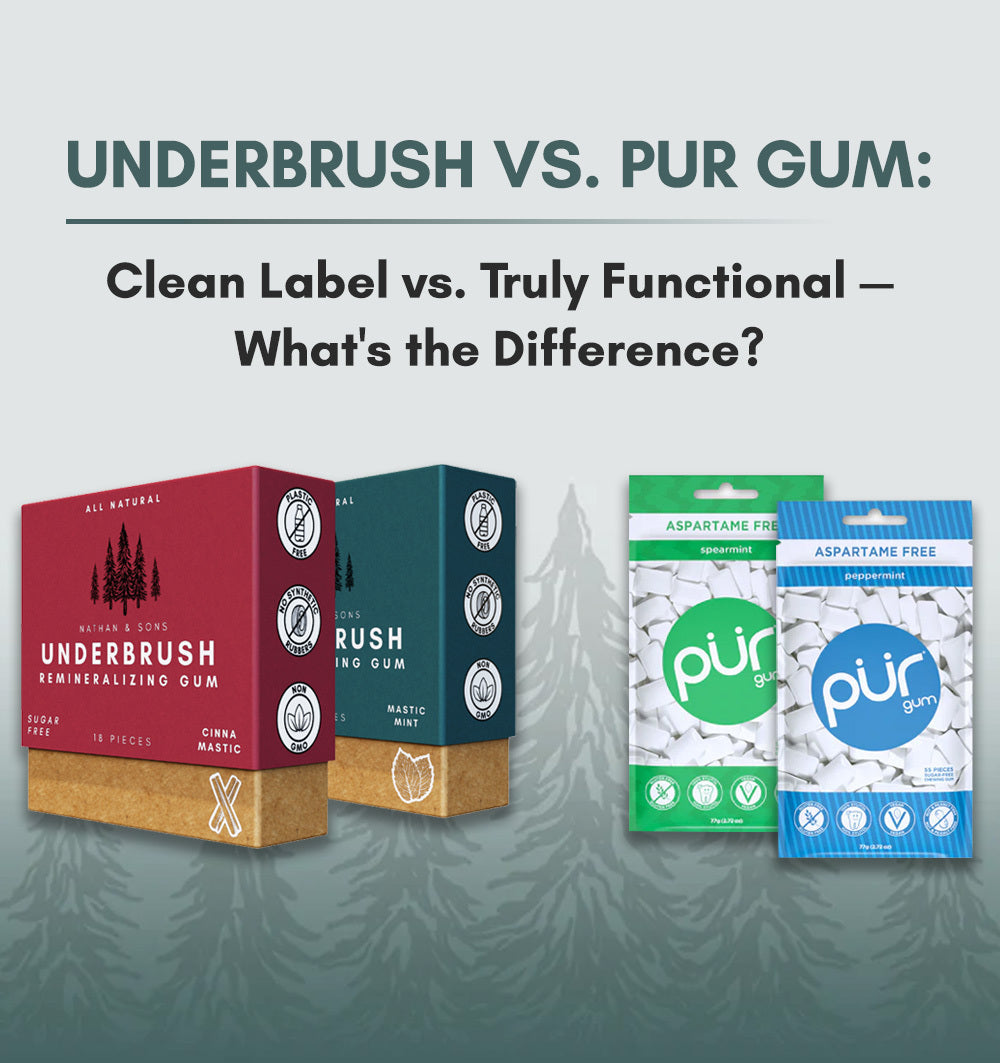
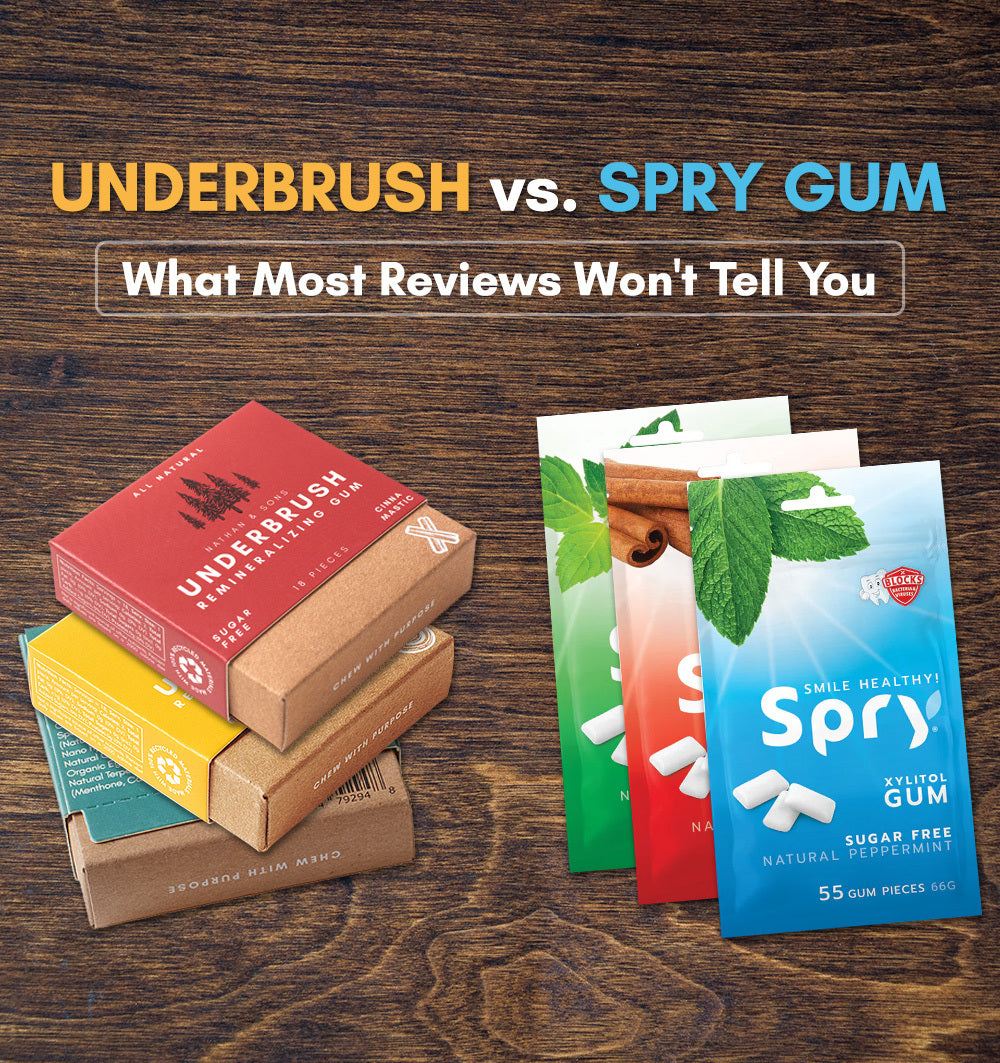
Here's how Underbrush and Spry compare on price, ingredients, and overall formulation at a glance.

For a deeper, lens-by-lens look at how Underbrush measures up against other hydroxyapatite gums, see our Underbrush hydroxyapatite gum vs. competitors guide.
Where Spry flat-out beats us
We promised honesty, so here's the uncomfortable part.
Spry is cheaper, and it's everywhere.
You can grab it at the pharmacy, the grocery store, the dentist's office, and online without thinking twice.
Underbrush costs more, and you have to go looking for it.
If your only goal is "xylitol benefits, lowest price, least hassle," Spry is the smarter buy. Full stop.
Spry's flavor lasts longer, and ours fades.
This is the single most common knock on our gum, and it's fair.
Think of it like the difference between a candle made with synthetic fragrance and one made with real essential oils.
The synthetic one fills the room for hours.
The real one is lovely but quieter and shorter-lived.
We use real tree-sap resins and isolated essential oils instead of flavor systems engineered to persist, so ours fades faster.
If long-lasting taste is your top priority, that's a point for Spry.
Spry's simplicity is a genuine virtue.
A short ingredient list is easier to trust, easier to scan for allergies, and makes fewer promises it has to keep.
There's real value in "boring and proven."
Does xylitol gum for teeth actually work? What the science says
The most established mechanism here isn't exotic at all.
It's saliva.
Chewing stimulates saliva, and saliva buffers acids, clears debris, and carries calcium and phosphate that support enamel.
The American Dental Association says sugar-free gum may help reduce caries risk when added to brushing twice daily with fluoride toothpaste and cleaning between teeth.
Notice that phrase — when added to.
Gum is not toothpaste, not floss, and not a dental exam.
It's an adjunct, and that's true for Underbrush and Spry alike.
A 2023 review in Frontiers in Oral Health credits chewing gum's anti-caries potential to things like oral clearance, acid neutralization, and processes associated with remineralization.
That supports the category — both gums benefit.
It does not prove every gum is equal, because formula, dose, chew time, and consistency all matter.
Now the xylitol-specific evidence — and we'll give you the honest, two-sided version.
Xylitol is a sugar alcohol that cavity-causing bacteria can't easily ferment, and it's been tied to reduced mutans streptococci, lower acid production, and increased saliva when delivered by gum.
The supportive side is real: a 2024 systematic review found xylitol gum and candy significantly reduced cavities versus placebo, especially in higher-risk kids and teens.
The skeptical side is also real: the 2015 Cochrane review found the evidence for most xylitol products (outside fluoride toothpaste) was low to very low quality.
And a 2017 pediatric meta-analysis found only a small effect size, rating the evidence very low quality.
So our take is measured.
Xylitol is worth using, but it's risk-supportive oral care — not a guaranteed anti-cavity shield.
Spry is cheaper if pure xylitol exposure is your goal.
We add other strategies on top, but we'd need finished-product trials to make the strongest possible claims — and we don't have those.
If you want the long version of this honesty, we laid out the evidence and the limits in is remineralizing gum legit?
Hydroxyapatite gum: what the research actually supports
This is where Underbrush differs most from Spry.
Your enamel is built largely from hydroxyapatite, so using the same mineral as a repair material is chemically sensible (O'Hagan-Wong et al., 2021).
A 2021 systematic review and meta-analysis concluded hydroxyapatite in fluoride-free products effectively reduces caries; its meta-analysis of three randomized controlled trials — all of them toothpaste studies, not gum — found about 17% protection against caries.
So treat that number as evidence for the ingredient in toothpaste form, not as a result measured for any gum, including ours.
That's genuinely good news for our formula's direction.
But here's the caveat we think a responsible brand has to say out loud.
Most of that evidence comes from toothpaste, not gum (O'Hagan-Wong et al., 2021).
Toothpaste is brushed on at a different concentration, with different contact time and rinse behavior than a gum chewed and mixed with saliva.
The ingredient rationale is strong.
The finished-product gum evidence is the missing piece.
So here's the line we won't cross.
We'll say Underbrush includes nano-hydroxyapatite in a mineral-rich gum, and that the science behind the ingredient is real.
We won't say Underbrush is clinically proven to reverse cavities, or that you can swap it in for brushing, flossing, or your dentist.
That's the difference between confident and careless, and we'd rather be confident.
For a fuller breakdown of the ingredient and where the evidence stands, see what the research says about nano-hydroxyapatite gum.
Is xylitol gum safe for dogs?
This one isn't optional, and it applies to both gums equally.
Both Underbrush and Spry contain xylitol, and xylitol is dangerous — potentially deadly — for dogs.
The FDA warns that xylitol can trigger a rapid insulin release in dogs, causing hypoglycemia that can become life-threatening (FDA, Paws Off Xylitol).
If you keep gum in a bag, a nightstand, a coat pocket, or a car console and you have a dog, you need a real storage plan.
Suspected ingestion is an emergency — call your vet or animal poison control right away (FDA, Paws Off Xylitol).
For humans, xylitol is widely used and generally well tolerated, but high intakes can cause bloating, gas, or diarrhea (Nayak et al., 2014).
Tolerance varies by person and body weight, so ease into any xylitol product rather than chewing a whole bag on day one.
The honest verdict: which gum should you buy?
Spry is not a bad product — it's the opposite.
It's a clean, affordable xylitol gum that knows exactly what it is and delivers it economically.
If all you want is the cheapest credible xylitol gum here, buy Spry. We mean it.
Underbrush is more expensive, more complex, and more opinionated — which means it has more to prove.
Our view is that the formula earns its place by pairing xylitol with nano-hydroxyapatite, a mineral stack, named natural resins, and a more transparent gum base.
But the honest claim isn't "Underbrush cures tooth decay."
The honest claim is that Underbrush is a premium mineral-forward oral-care gum for people who want a broader ingredient profile than a basic xylitol chew.
So, in short: Spry is the more economical xylitol gum, and Underbrush is the premium mineral-forward option.
If price is the only thing that matters, Spry is the clear pick.
If a broader ingredient profile, a cleaner gum-base approach, and a mineral-forward formula are what you're after, Underbrush is the one we'd reach for — and the one we built because we wanted that option to exist.
Ready to try Underbrush?
If the premium side of this comparison is the one that fits you, we'd love for you to chew on it yourself — literally.
Underbrush pairs nano-hydroxyapatite, a natural tree-sap base, and xylitol in flavors like Mastic Mint, Berry, and Cinna-Mastic.
Pop a piece after meals, keep brushing and flossing like always, and let it ride alongside the routine you already trust.
Try Underbrush remineralizing gum →
And if you're still weighing it against other options, our hydroxyapatite gum vs. competitors guide lays the choices out side by side.
Frequently Asked Questions
Can a chewing gum really "remineralize" my teeth?
It can support the natural process, but don't picture it patching a cavity like spackle.
Chewing boosts saliva, which ferries calcium and phosphate back to your enamel, and ingredients like xylitol and nano-hydroxyapatite have been studied for their role in that chemistry (Yeung, Chu & Yu, 2023).
It's an adjunct to brushing and flossing — not a replacement — and it won't fix established decay, which is a dentist's job.
Is nano-hydroxyapatite safe, and is the gum evidence as strong as toothpaste evidence?
Hydroxyapatite has been studied with a generally favorable safety profile, and it's the same mineral family your enamel is made of (O'Hagan-Wong et al., 2021).
But be clear-eyed: most of the strongest evidence is from toothpastes and gels, not gum specifically.
The ingredient rationale is solid; finished-product gum trials are still the missing piece, and we won't pretend otherwise.
Why is Underbrush so much more expensive than Spry?
Because they're built on different philosophies — Spry is an efficient $0.09-a-piece xylitol gum, and Underbrush is a premium formula at roughly $0.83 a piece.
You're paying for the tree-sap base, the mineral stack, and the nano-hydroxyapatite, not just a sweetener and a chew.
If repeated low-cost xylitol exposure is your only goal, Spry is honestly the rational pick.
Is Spry a "bad" gum? You're awfully nice to a competitor.
Not at all — Spry is a genuinely good xylitol gum with a decades-long track record and a clean, simple label.
We just built Underbrush around a different bet: a named natural base plus added mineral support.
Different lane, not a "better at everything" claim.
I have a dog. Is either gum safe to keep around?
Both contain xylitol, which the FDA warns can be dangerous or deadly to dogs even in small amounts (FDA, Paws Off Xylitol).
Neither is "dog-safe" — the real answer is careful storage well out of reach, and treating any suspected ingestion as an emergency.
That caution applies to essentially every xylitol gum on the market, not just these two.
Underbrush is a chewing gum sold as a food, not a drug or dietary supplement, and is not intended to diagnose, treat, cure, or prevent any disease. The information here is for general educational purposes and is not medical or dental advice. Chewing gum is an adjunct to, not a replacement for, brushing, flossing, fluoride as recommended by your dentist, and regular dental care. Consult your dentist or healthcare provider before changing your oral care routine.
The ingredient rationale discussed throughout this article reflects research on individual ingredients and does not constitute clinical evidence for the finished Underbrush product, which has not been evaluated in its own clinical trials. Prices, formulations, and ingredient lists for both products were reviewed in June 2026 and may change over time; check current listings and labels before purchasing.
References
- Xlear. Spry 55ct Xylitol Gum Bags (official product page, $4.99). https://xlear.com/products/55ct-bag-xylitol-gum
- Nathan & Sons. Underbrush Remineralizing Gum — official product page and ingredient panel (first-party source; confirm the live label for the specific flavor you buy, as formulations may vary by flavor). https://nathanandsons.com
- U.S. Food and Drug Administration. Paws Off Xylitol; It's Dangerous for Dogs. https://www.fda.gov/consumers/consumer-updates/paws-xylitol-its-dangerous-dogs
- Nayak PA, Nayak UA, Khandelwal V. (2014). The effect of xylitol on dental caries and oral flora. Clinical, Cosmetic and Investigational Dentistry, 6, 89–94. https://www.ncbi.nlm.nih.gov/pmc/articles/PMC4232036/
- Latifi-Xhemajli B, et al. (2024). The effect of xylitol chewing gums and candies on caries occurrence in children: a systematic review. European Archives of Paediatric Dentistry, 25, 145–160. https://www.ncbi.nlm.nih.gov/pmc/articles/PMC11058973/
- Limeback H, Enax J, Meyer F. (2021). Biomimetic hydroxyapatite and caries prevention: a systematic review and meta-analysis. Canadian Journal of Dental Hygiene, 55(3), 148–159. https://pubmed.ncbi.nlm.nih.gov/34925515/
- O'Hagan-Wong K, Enax J, Meyer F, Ganss B. (2021). The use of hydroxyapatite toothpaste to prevent dental caries. Odontology, 110(2), 223–230. https://www.ncbi.nlm.nih.gov/pmc/articles/PMC8930857/
- American Dental Association. Chewing Gum (oral health topics). https://www.ada.org/resources/ada-library/oral-health-topics/chewing-gum
- Yeung CY-Y, Chu C-H, Yu OY. (2023). A concise review of chewing gum as an anti-cariogenic agent. Frontiers in Oral Health, 4, 1213523. https://www.ncbi.nlm.nih.gov/pmc/articles/PMC10299855/
- Riley P, Moore D, Ahmed F, Sharif MO, Worthington HV. (2015). Xylitol-containing products for preventing dental caries in children and adults. Cochrane Database of Systematic Reviews, Issue 3, CD010743. https://pubmed.ncbi.nlm.nih.gov/25809586/
- Marghalani AA, et al. (2017). Effectiveness of xylitol in reducing dental caries in children. Pediatric Dentistry, 39(2), 103–110. https://pubmed.ncbi.nlm.nih.gov/28390459/