
Quick Answer: What Is the Healthiest Chewing Gum?
The healthiest chewing gum is sugar-free, uses a natural gum base instead of synthetic plastic, and is sweetened with a tooth-friendly polyol like xylitol rather than sugar.
The American Dental Association notes that the only chewing gums carrying its Seal of Acceptance are sugar-free, because chewing sugar-free gum increases saliva flow, which helps reduce plaque acid and clear food particles from between teeth.
If you want to go a step further, look for gum that adds a remineralization-support ingredient like hydroxyapatite — the same mineral your tooth enamel is already made of.
That’s the short version.
Now let’s actually walk through it, because “healthiest” depends a lot on what you care about.
Let’s get the obvious thing out of the way first: we make gum.
We’re Nathan and Sons, and we make a gum called Underbrush, so we’re not a neutral party here.
You should read everything below knowing that.
We’ve tried to write the guide we’d want to read even if we didn’t sell anything — which means we’re going to name other good gums, tell you where the research is thin, and point out where “healthiest” is genuinely a matter of what you personally care about.
When someone asks us what the healthiest chewing gum is, the honest answer is that there isn’t one perfect product.
It depends on whether you’re chewing for your teeth, for your gut, for the planet, or just because you like having something to do with your mouth during a long Tuesday meeting.
But there are real patterns.
Those patterns make it easier to identify the healthiest chewing gum for your goals.
Some ingredients show up repeatedly in gums commonly discussed in dental and oral-health research — and some show up in the gum those same sources tend to steer you away from.
So we’re going to give you the honest breakdown, the same way we’d explain it to a friend who picked up a pack at the checkout aisle and asked, “wait, is this one actually good for me?”
First, What Does “Healthy” Even Mean for Gum?
Gum is a weird little product when you stop to think about it.
You don’t swallow it.
You chew it for ten, fifteen, or even several hours and then it’s gone.
So when we talk about whether gum is “healthy,” we’re really talking about three separate things at once.
There’s what the gum does to your mouth while you chew it.
There’s what’s actually in the gum, in case some of it gets absorbed or swallowed.
And there’s what the gum is made of, which matters for your gut and for the planet.
The healthiest chewing gum does well on all three.
Most gum on the shelf only manages one — if that.
And most of us never check.
The “gum base” on a label is easy to skim past, but it’s doing a lot of quiet work — and what it’s made of is often the last thing a shopper thinks to question.
The Healthiest Chewing Gum Starts With the Sweetener

If you only change one thing about your gum, change the sweetener.
Sugar gum feeds the exact bacteria that cause cavities — that’s not a marketing line, that’s just how Streptococcus mutans works.
The bacteria eat the sugar, produce acid, and the acid dissolves your enamel.
It’s a tiny, slow-motion chemistry experiment happening on your teeth, and sugar is the fuel.
Sugar-free gum flips that.
The American Dental Association explains that sugar-free gums are sweetened with non-cavity-causing sweeteners, and that, according to the ADA, chewing them increases saliva flow, which the ADA says helps reduce plaque acid and supports oral-health goals related to enamel.
So the first rule of healthy gum is almost embarrassingly simple: make sure it says sugar-free.
But not all sugar-free sweeteners are created equal, and this is where it gets interesting.
Healthiest Chewing Gum and Why Xylitol Matters
Xylitol is a sugar alcohol that tastes sweet but that bacteria can’t ferment into acid.
A 2021 systematic review and meta-analysis in BMC Oral Health looked at the role of sugar-free chewing gum on Streptococcus mutans and supported its place in caries-prevention routines.
That’s why so many dentist-recommended gums lead with xylitol on the label.
And to be clear, plenty of those gums aren’t ours.
Epic makes a 100% xylitol gum that’s about as clean as it gets on the sweetener front.
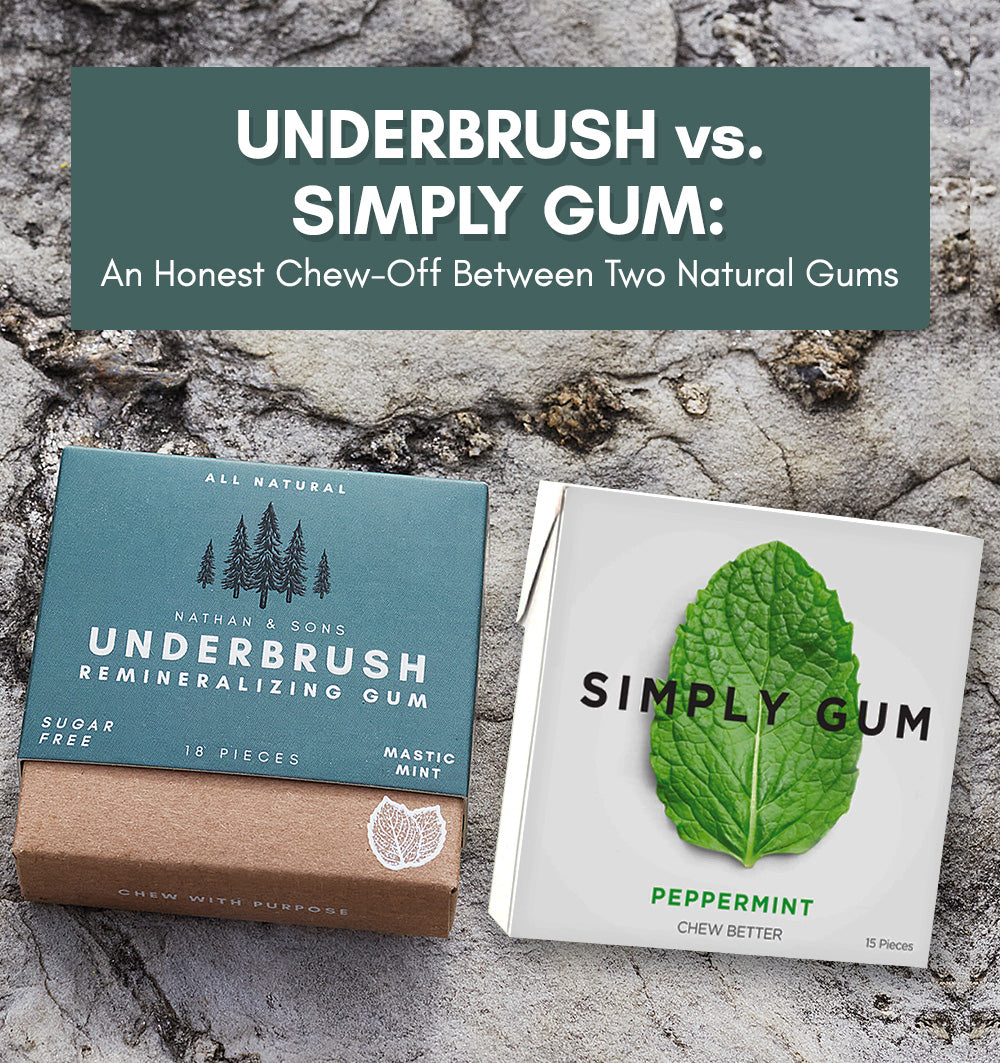
Simply Gum uses a natural chicle base and skips artificial sweeteners and flavors entirely.
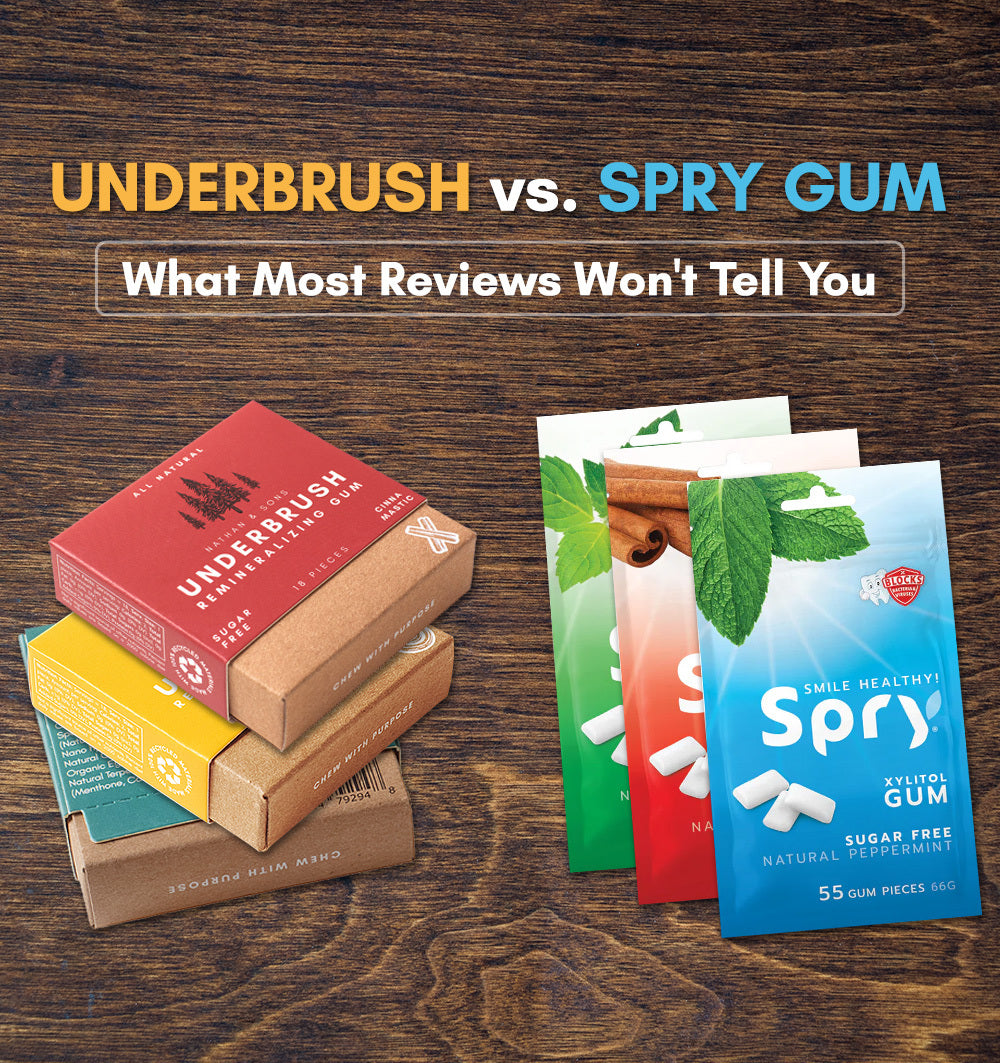
Spry is a long-standing xylitol dental gum that’s easy to find and widely stocked in pharmacies.
And PUR is a solid aspartame-free option that tastes closest to mainstream gum if that’s what you’re weaning yourself off of.
If one of those is what’s at your store and in your budget, it’s a genuinely good choice.
We’d rather you chew a clean gum you’ll actually keep buying than feel pressured toward ours.
One quick heads-up that has nothing to do with your health and everything to do with your dog’s: xylitol is genuinely toxic to dogs, even in small amounts.
So keep any xylitol gum off the floor and out of any bag a curious snout can reach.

Aspartame and the “Is It Safe?” Question
Aspartame is the sweetener a lot of people are actively trying to avoid, and it’s worth being fair about it.
Major regulatory bodies, including the FDA, consider aspartame safe at normal intake levels, and the amount in a single piece of gum is tiny.
But “regulators say it’s fine” and “I’d personally rather not chew it” can both be reasonable positions to hold at the same time.
Plenty of people simply prefer a gum sweetened with xylitol or stevia, and that’s a perfectly valid preference rather than paranoia.
We’re in the business of giving people that choice, not lecturing them about it.
Sorbitol and the Gut Question
Sorbitol is another common sugar-free sweetener, and it’s genuinely fine for your teeth.
The catch is your stomach.
Some people find that a larger amount of sorbitol can cause bloating or gas, so if a few pieces a day leave your stomach unsettled, the sweetener is a likely culprit.
Switching to a xylitol-forward gum tends to settle it.
Why Gum Base Matters in the Healthiest Chewing Gum
Here’s the part of the conversation the big brands would rather skip entirely.
What is gum actually made of ?
The chewy part — the “gum base” — is a single innocent-looking line on the label that can hide an enormous amount.
In conventional gum, that base is frequently synthetic.
As our piece on natural chewing gum covers in detail, modern commercial gum often uses petroleum-derived polymers — materials in the same family as synthetic rubber and plastic.
Current FDA labeling rules let all of that sit under the two-word umbrella “gum base,” depending on the manufacturer, so the average shopper has no easy way to know it from reading the label.
It’s considered safe to chew.
But many people are surprised to learn how synthetic a conventional gum base can be.
The healthier alternative is a natural gum base.
The classic one ischicle, the milky latex sap of the sapodilla tree, harvested by hand by skilled foresters called chicleros across the Yucatán — a practice that goes back to the Maya, long before Wrigley, long before the foil-wrapped rectangle existed.
We dig into the full story in our guide to chicle chewing gum benefits, which covers how chicle, mastic, and spruce sap built the entire category before petroleum-based bases took over in the mid-20th century.
A natural base like chicle gives you the same satisfying chew without the synthetic-plastic question.
It’s also biodegradable, which is part of why discarded synthetic gum is such a persistent litter problem on sidewalks and why some cities spend heavily on cleanup.
There’s a small bonus most people don’t expect, too: a stable plant resin holds its shape, so you can set a piece aside and come back to it.
The indigenous communities who first harvested chicle treated it as a re-chewable material, and it’s part of why we built Underbrush on a chicle base.
We just didn’t love the idea of selling people something we wouldn’t want to chew ourselves.
The Newest Frontier: Gum That Supports Your Enamel
For most of history, the best gum could do for your teeth was neutral-to-helpful: sugar-free gum stimulates saliva, saliva helps your mouth recover, end of story.
That’s still the foundation, and it’s a good one.
But there’s a newer ingredient getting a lot of research attention, and it’s worth understanding.
It’s called hydroxyapatite, and here’s why it’s interesting.
Hydroxyapatite is the main mineral your tooth enamel is already made of.
So the idea is fairly intuitive, and researchers are studying whether delivering more of that same mineral to the surface of teeth may help support the natural remineralization processes the mouth runs every day.
A 2025 narrative review in Biomimetics examined fifteen recent clinical studies on hydroxyapatite-containing dental products — including chewing gum — and described it as a safe and promising area of research for enamel remineralization and caries prevention in non-surgical dental settings.
A few important caveats, and we want to be extra upfront here because we sell a gum that contains hydroxyapatite — so this is exactly the kind of claim we have every incentive to oversell.
We’re not going to.
Much of the strongest clinical data so far comes from hydroxyapatite toothpaste, not gum.
The gum-specific evidence is real but earlier-stage, and the review authors themselves note the overall evidence base is still growing and that larger, longer studies are needed.
So the honest way to think about hydroxyapatite gum is as a promising support tool that researchers are actively studying — not a proven treatment, not a miracle, and definitely not a replacement for your toothbrush.
If anyone (including us) tells you a piece of gum will rebuild your enamel, be skeptical.
If you want the deeper dive, we wrote a full explainer on tooth remineralizing gum that lays out exactly what the research does and doesn’t say.
The research discussed above evaluates ingredients in laboratory and clinical research contexts. Underbrush is a conventional food product and has not been evaluated by the FDA for the diagnosis, treatment, cure, or prevention of any disease.
How the Cleaner Gums Actually Compare

We mentioned a few good gums earlier, so let’s put them side by side honestly — ours included, and we’ll point out where the others beat us.
Here’s the quick version, scored on the criteria we just walked through.
Competitor details reflect publicly available product information as of June 2026 and may change; check current packaging, since formulations and flavor lines are updated periodically.
Now the honest commentary, because a table alone hides the trade-offs.
Epic: is the one we’d point a pure-sweetener purist toward.
It’s 100% xylitol with a high dose per piece, which is exactly what the dental research likes.
Its gum base, though, is a conventional synthetic one — so it wins on sweetener and loses on the base question.
Simply Gum: is the closest to us on philosophy.
It uses a real chicle base and keeps the label refreshingly short.
Just read the package, because some Simply Gum lines are sweetened with cane sugar rather than xylitol, which changes the tooth math entirely.
Spry: genuinely beats us in two places we won’t pretend otherwise: price and availability.
It’s inexpensive, it’s in basically every pharmacy, and it’s a familiar name in the dental aisle.
If your priority is “cheap, clean-enough, and easy to grab,” Spry is a smart pick — full stop.
It uses a synthetic base and no hydroxyapatite, which is where our formulation differs.
PUR: wins on the thing health gums usually lose: flavor that actually lasts and tastes like the mainstream gum you grew up on.
That makes it a great gateway for someone weaning off conventional mainstream gum.
Like the others, it’s a synthetic base without hydroxyapatite.
So where does that leave Underbrush?
Among the gums we reviewed here, Underbrush was the one we identified pairing a natural plant-resin base with hydroxyapatite and xylitol together, at the time of publication.
That’s the niche we built for.
But if you don’t care about hydroxyapatite, or you want the cheapest clean option, or you want long-lasting flavor above all else, one of the others may genuinely serve you better.
We’d rather tell you that than pretend our gum is the answer to every question.
For more on what separates a well-formulated gum from the rest, see our best xylitol gum for teeth guide and our deep dive on what natural gum really is
So What Does the Healthiest Chewing Gum Actually Look Like?
If you put all of that together, a simple picture falls out.
Now, fair warning: this is the part where our own gum checks the boxes, so read it with that grain of salt.
We’re laying out the criteria we actually believe in, but we’re also aware it’s convenient that they describe what we make.
Many dental professionals consider sugar-free gum one of the healthier options, because it isn’t feeding cavity-causing bacteria.
It’s sweetened with a tooth-friendly polyol like xylitol rather than sugar or, if you prefer to avoid them, the more debated artificial sweeteners.
It uses a natural gum base like chicle instead of a synthetic plastic-family base.
It goes easy on the sorbitol so your gut doesn’t file a complaint.
And if you want the most forward-looking option, it includes a remineralization-support ingredient like hydroxyapatite that researchers are currently studying for enamel health.
Plenty of gums hit several of those marks.
A few — ours included — hit all of them.
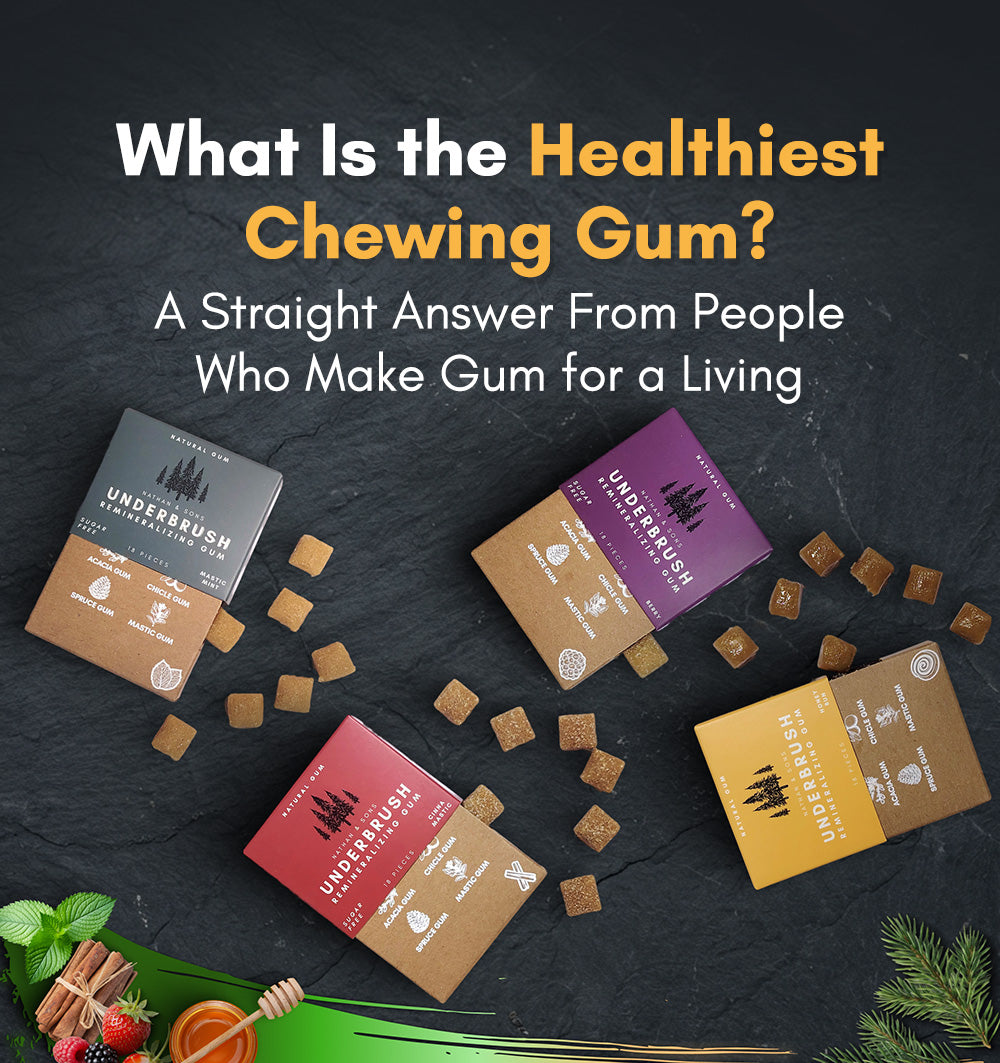
That’s the gum we wanted to exist, and honestly it’s why we built Underbrush the way we did — a chicle base, sugar-free, formulated with xylitol and nano-hydroxyapatite.
One customer told us it feels “like getting in another brushing of the teeth mid-day without actually having to brush.” We can’t make that a clinical claim, but we love that it’s how the chew feels to people in real life.
What Customers Tell Us
We’d rather show you real reviews than write our own marketing copy, so here are a few in people’s own words.
“Love this gum! At 71, my teeth health is everything to me, and this has become part of my daily routine. Keep chewing!” — Suann
“Keep your teeth healthy. I personally order the berry flavor and I love it. The flavor doesn’t last as long as other brands, but this is healthy for your teeth and can chew on it for a good amount of time. The company is also extremely honest and kind which is hard to find.” — Dustin
“I love this gum and the fact that it is healthy.” — Charles
“I’ve been duped by a knock-off in the past, and I can’t believe it took me until I saw your ad about the knockoff brands to switch. I’m loving my subscription, and in addition to using a nano-hydroxyapatite toothpaste, I’ve enjoyed the product enough to continue. Thank you for such an awesome product.” — Jaysin
These are unedited individual experiences shared by customers. They reflect personal opinions, not typical results, and are not evidence that the product treats, prevents, or cures any condition. Underbrush is a conventional food and has not been evaluated by the FDA. Chewing gum is not a substitute for brushing, flossing, or professional dental care.
A Quick Reality Check Before You Switch
We have to say this, because it’s true and because skipping it would be the un-dentist thing to do: no gum replaces brushing and flossing.
The ADA is clear that gum is a helpful addition to your routine, not a substitute for it.
Chewing sugar-free gum for about twenty minutes after a meal is a great habit — it stimulates saliva, helps clear food, and supports your mouth’s natural recovery during the window when brushing usually isn’t an option.
But it works alongside a toothbrush, not instead of one.
Think of healthy gum as the assist, not the whole game.
The Healthiest Chewing Gum: The Honest Bottom Line
The “healthiest chewing gum” isn’t a single brand you can point to on a shelf — it’s a set of choices.
Choose sugar-free over sugar.
Choose xylitol over sweeteners you’d rather avoid.
Choose a natural gum base over synthetic plastic.
And if you want to chew toward something rather than just away from sugar, look for an enamel-support ingredient like hydroxyapatite.
Do that, and you’ve got gum that’s working with your body instead of against it.
If you want a gum that already checks those boxes, that’s the lane we built Underbrush for — but it genuinely isn’t the only good answer, and we’d rather you chew something clean than chew nothing.
Either way, now you know what to look for — and that’s the part that actually keeps your teeth healthy.
Healthiest Chewing Gum - Frequently Asked Questions
What is the healthiest chewing gum?
The healthiest chewing gum is sugar-free, uses a natural gum base like chicle instead of synthetic plastic, and is sweetened with a tooth-friendly sugar alcohol such as xylitol.
Gums that also include a remineralization-support ingredient like hydroxyapatite are an increasingly popular option, since hydroxyapatite is the same mineral that makes up tooth enamel.
Is sugar-free gum actually good for your teeth?
Yes, when used as part of a normal oral-care routine.
The American Dental Association notes that chewing sugar-free gum increases saliva flow, which helps reduce plaque acid and clear food particles.
It is a helpful addition to brushing and flossing, not a replacement for them.
Is xylitol gum better than other sugar-free gum?
Xylitol is a popular choice because cavity-causing bacteria cannot ferment it into enamel-damaging acid, and it has been studied for its role in reducing Streptococcus mutans.
Many dentist-recommended gums lead with xylitol for this reason.
One important note: xylitol is toxic to dogs, so keep gum well out of their reach.
Is the gum base in regular gum bad for you?
Conventional gum often uses a synthetic gum base from the same material family used in some plastics and adhesives, hidden on the label under the umbrella term “gum base.” It is considered safe to chew, but many people prefer a natural base such as chicle — a tree sap chewed for thousands of years that is biodegradable and avoids the synthetic-polymer question.
Does hydroxyapatite gum really work?
Hydroxyapatite is the primary mineral in tooth enamel, and a 2025 review of clinical studies found it to be a promising, safe area of research for enamel remineralization support.
However, much of the strongest evidence comes from hydroxyapatite toothpaste rather than gum, and researchers note that larger, longer studies are still needed.
It is best viewed as a supportive tool that complements brushing, not a cure or a replacement for it.
References
American Dental Association.
Chewing Gum. ADA Oral Health Topics.
Nasseripour M, Newton JT, Warburton F, et al.
A systematic review and meta-analysis of the role of sugar-free chewing gum on Streptococcus mutans. BMC Oral Health. 2021;21(1):217.
The Remineralizing and Desensitizing Potential of Hydroxyapatite in Dentistry: A Narrative Review of Recent Clinical Evidence. Biomimetics. 2025.
Burt BA.
The use of sorbitol- and xylitol-sweetened chewing gum in caries control. J Am Dent Assoc. 2006;137(2):190-6