
The bottom line, up front: If you want a simple, plastic-free natural gum and don't mind cane sugar, Simply Gum Classic is an easy, pleasant choice. If you want the cleanest sugar-free option with a short label, Simply Gum Sugar-Free (xylitol) is the fair dental-minded pick. And if you want a sugar-free gum formulated with multiple oral-care-related ingredients — xylitol, erythritol, nano-hydroxyapatite, and botanical resins — Underbrush is built for that. None of these gums replaces brushing, flossing, or your dentist. We make Underbrush, so we're biased — which is exactly why everything below is sourced.
Let's do this Underbrush vs Simply Gum comparison the honest way.
Not the "every competitor is trash and our product descended from a mountain cloud" way.
And definitely not the "natural gum will fix your life, your enamel, your inbox, and your relationship with your group chat" way.
Instead, we're going to weigh Underbrush by Nathan & Sons against Simply Gum using what the labels, product pages, and oral-health evidence actually support.
Then, just as importantly, we're going to tell you where the evidence stops.
All of this matters, because gum lives in a weird little corner of daily life.
After all, it's part candy, part breath rescue, part fidget toy, part social shield after a garlic-heavy lunch.
Lately, though, for people like us, it's become part ingredient-label detective story.
Imagine you pick up a pack, read "gum base," and suddenly wonder whether your minty little rectangle is food, plastic, tree sap, or a tiny industrial secret wearing a peppermint costume.
So that's exactly why this Underbrush vs Simply Gum showdown matters.
Underbrush vs. Simply Gum: First, the part where we admit our bias
First, the obvious: we're Nathan & Sons.
Naturally, we make Underbrush.
So of course we think it solves a problem Simply Gum doesn't fully solve.
Still, being biased doesn't give us permission to be sloppy.
Because of that, here are the rules we're playing by.
First, we're citing official Nathan & Sons and Simply Gum pages for ingredients, sugar content, pricing, and brand claims.
In addition, we're citing the American Dental Association and peer-reviewed reviews for the broader oral-health science.
And here's the big one — we are not claiming that chewing Underbrush reverses cavities, replaces brushing, or substitutes for your dentist.
Frankly, if a gum brand tells you gum replaces basic oral hygiene, that gum brand needs a chair, a glass of water, and a serious talk.
A quick note on respect, because we mean it
Picture a small New York apartment in 2014.
There, Simply Gum's founder, Caron, had just learned that regular gum is built on a synthetic-plastic base — and she couldn't un-know it.
As a result, she started making her own gum by hand and selling it in shops around Manhattan.
Notably, she was asking "what's actually in my gum?" before most of us were paying attention.
Because of that, Simply Gum helped make chicle-based, plastic-free gum easy for regular people to understand.
Honestly, we genuinely respect that.
Meanwhile, Underbrush is our attempt to push the same idea further — not just less weird, but sugar-free, resin-forward, mineral-forward, and built as a real oral-care-adjacent ritual.
In short, these are two different philosophies.
On one hand, Simply Gum is mostly about simplicity.
On the other, Underbrush is mostly about a broader ingredient profile.
Ultimately, that's the whole chewy battlefield.
If you want the deeper background on our formula, our Underbrush remineralizing gum lays out every ingredient.
The most important thing in this whole article: there are three lanes, not two
This is where most comparisons go sideways, so we're going to fix it up front.
Importantly, Simply Gum actually makes two relevant products, and they are not the same conversation.
First, Simply Gum Classic (peppermint, etc.) is sweetened with organic raw cane sugar.
By contrast, Simply Gum Sugar-Free is sweetened with plant-based xylitol.
Consequently, that single difference splits everything.
For example, Classic Simply Gum is best understood as a cleaner candy gum.
Meanwhile, Sugar-Free Simply Gum is the fair dental-minded comparison.
Underbrush, then, is the fuller ingredient-profile comparison, formulated with xylitol, erythritol, nano-hydroxyapatite, and botanical resins.
If you toss all three into one lane, the whole conversation turns to mush.
Therefore, we're keeping them straight the entire way down.
Underbrush vs. Simply Gum: The labels, side by side
Imagine standing in the aisle, flipping all three packs over to read the backs.
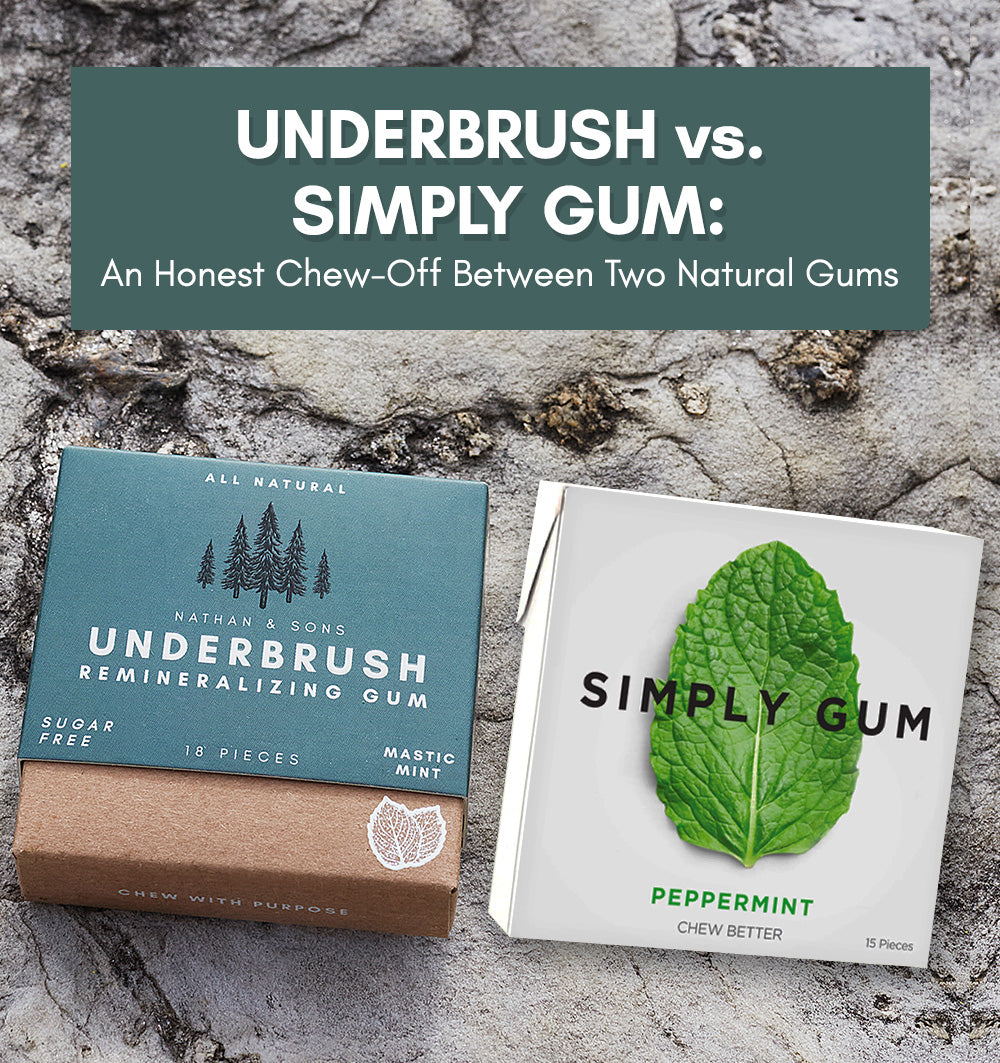
To start, Simply Gum Classic Peppermint lists organic raw cane sugar, natural chicle base (chicle, candelilla wax, citric acid), peppermint oil, organic vegetable glycerin, and organic rice flour. (reference: https://www.simplygum.com/products/peppermint-gum-6-pack)
Similarly, Simply Gum Sugar-Free Peppermint lists plant-based xylitol, natural chicle base (chicle tree sap, candelilla wax, citric acid), peppermint oil, organic vegetable glycerin, gum arabic, and organic rice flour. (reference: https://www.simplygum.com/products/sugar-free-peppermint-gum)
In both cases, the labels are short and approachable.
Underbrush Mastic Mint, however, lists xylitol, a chicle gum base (chicle, candelilla wax, citric acid), erythritol, mastic gum, spruce gum, acacia gum, mint flavor, myrrh gum, nano- and micro-hydroxyapatite, calcium carbonate, calcium bentonite clay, magnesium carbonate, zinc gluconate, and a terpene blend (menthone, carvone, cineol).
Admittedly, that's a mouthful in both senses.
As a result, Simply Gum wins label minimalism.
Underbrush, meanwhile, wins botanical-resin and mineral depth.
In the end, neither of those is automatically "better" — they're answers to different questions.
Is Simply Gum good for your teeth? What the evidence actually says about chewing gum
The strongest argument for sugar-free gum isn't mystical.
Rather, it's saliva.
Specifically, the American Dental Association notes that chewing gum increases salivary flow, and that sugar-free gum may help reduce cavity risk when added to a routine of brushing twice daily and cleaning between teeth daily.
Crucially, the ADA also says, plainly, that gum is not a substitute for brushing or flossing.
In fact, that sentence should be printed on a tiny billboard and taped to every ambitious gum brand's forehead, including ours.
Beyond that, a systematic review in the Journal of Applied Oral Science found that most accepted trials showed anti-cavity effects for sorbitol, xylitol, or sorbitol/xylitol gum.
It credited three things: saliva stimulation, the absence of sucrose, and the fact that mouth bacteria struggle to turn polyols like xylitol into acid.
Then the review concluded sugar-free gum has a cavity-reducing effect — and called for more well-designed trials.
We love that sentence, because it holds support and humility at the same time.
So here's the honest read.
On the supportive side, this evidence backs sugar-free gum (Underbrush and Simply Gum Sugar-Free) as a useful add-on to oral hygiene.
However, it does not do the same favor for cane-sugar Classic Simply Gum, because the sugar changes the conversation.
For more on this, we dig into the question in depth in Is remineralizing gum legit? and in Does remineralizing gum work?
Xylitol vs. Cane Sugar Gum: Where Classic Simply Gum Gets Awkward
To be clear, we're not anti-sugar in a joyless, slap-the-cupcake-out-of-your-hand way.
Still, gum is different, because gum hangs around your teeth for a while.
In other words, think of it less like eating a cookie and more like marinating.
According to Simply Gum's own FAQ, most Classic flavors contain a small amount of cane sugar — roughly 1 gram per piece. (simplygum.com/pages/faq)
That works out to about 2 grams of sugar per 2-piece serving.
Again, full credit to them for stating it openly.
Generally speaking, fermentable sugar is what cavity-causing bacteria use to produce enamel-eroding acid.
So if your question is "which of these fits an oral-care routine?", the cane sugar is, in our assessment, a real point against Classic Simply Gum.
To their credit, Simply Gum clearly knows this — it's literally why they launched a sugar-free line.
In the end, our honest verdict is that Classic Simply Gum is a pleasant natural candy gum, and it's less aligned with an oral-care-focused routine than sugar-free alternatives.
The xylitol question: good ingredient, not fairy dust
Notably, both Underbrush and Simply Gum Sugar-Free use xylitol, and that earns both a legitimate seat at the sugar-free table.
For instance, the ADA describes polyols like xylitol as noncariogenic, because cavity bacteria metabolize them slowly or not at all.
Even so, xylitol isn't a plot twist where your molars grow capes.
Instead, it's a sugar-free sweetener with dental-relevant properties — an entry ticket, not the final boss.
If you want the full picture, we break it down in everything you need to know about xylitol.
That's exactly why Underbrush doesn't stop there.
In addition to xylitol, we add erythritol, nano- and micro-hydroxyapatite, calcium carbonate, calcium bentonite clay, magnesium carbonate, zinc gluconate, and a handful of botanical resins.
Curious about that second sweetener? Our explainer on what erythritol is covers it.
Simply Gum Sugar-Free, by comparison, keeps the xylitol story beautifully simple.
Honestly, some people will prefer exactly that, and we won't argue with them at brunch.
Hydroxyapatite gum: our biggest differentiator, with a real caveat
Hydroxyapatite is one of the main reasons Underbrush exists.
In fact, it's the mineral that makes up roughly 90 to 97 percent of your tooth enamel.
For a deeper dive, see our explainer on what nano-hydroxyapatite is.
Therefore, the thinking behind including it is straightforward: supply a mineral that's already the main building block of enamel, in a format you use throughout the day.
For evidence, a 2021 systematic review and meta-analysis in the Canadian Journal of Dental Hygiene reported that hydroxyapatite in fluoride-free oral-care products was associated with reduced cavities, with one meta-analysis of three randomized trials showing a measurable protective effect.
Likewise, a separate review in Odontology describes hydroxyapatite toothpastes as having been studied for their interaction with demineralized enamel surfaces.
That's why hydroxyapatite is interesting.
Now, here's the part we refuse to bury.
Most of that evidence, however, comes from toothpastes, gels, and rinses — not from a product-specific clinical trial on Underbrush gum.
Put bluntly, a gum that simply lists "hydroxyapatite" is, to a real degree, borrowing toothpaste's homework.
So here's the only honest claim we'll make.
Specifically, Underbrush contains nano- and micro-hydroxyapatite, and hydroxyapatite has been studied in oral-care products with supportive findings reported.
Beyond that, we designed Underbrush to bring that ingredient into a gum format.
Even so, we will not pretend gum-specific Underbrush trial data exists unless and until it does.
That's not weakness.
Rather, that's honesty, and honesty tastes better than carnival barking.
These statements have not been evaluated by the Food and Drug Administration. This product is not intended to diagnose, treat, cure, or prevent any disease.
Gum base: tree sap, regulations, and the mystery-blob problem
Simply Gum's brand story is strongest right here.
Essentially, they point out that "gum base" on a label can cover a long list of substances, and that they use chicle tree sap instead of synthetic plastic.
And they're right that it's a broad, murky category.
For context, federal regulation (21 CFR 172.615 permits natural substances like chicle in gum base — and synthetic ones like polyisobutylene, polyvinyl acetate, polyethylene, paraffin, and petroleum wax.
Important honesty check, though: that does not mean every conventional gum contains every one of those.
Instead, it means "gum base" is a wide regulated umbrella, which is reason enough for label-curious people to want more transparency.
In response, Simply Gum answers that with chicle and a short list.
Underbrush, by contrast, answers it with chicle plus mastic, spruce, acacia, and myrrh.
To put it simply, if Simply Gum is a clean wooden spoon, Underbrush is the whole spice drawer.
Either way, both beat the "please don't ask too many questions" gum-base experience.
Taste: where ingredient philosophy meets your actual mouth
Here's a thing that happens more than people admit.
Often, someone insists they want the cleanest possible formula.
Then they chew something botanical and discover their mouth has a tiny opinionated landlord living inside it.
For its part, Simply Gum describes its peppermint as refreshing and subtly sweet, and its sugar-free peppermint as a bright xylitol-sweetened mint.
Clearly, that's approachable on purpose.
Underbrush, on the other hand, leans the other way — a sweet mint with herbal, piney, and earthy undertones from mastic, spruce, and chicle.
Granted, that's not your childhood checkout-lane gum, and that's the point.
So if you want easy mint, Simply Gum probably wins your first chew.
But if you want a woodsier, more intentional, "forest apothecary" profile, Underbrush is more your speed.
And if you want gum that tastes like electric-blue frostbite, neither of us is trying to be your soulmate.
Texture: the chew test nobody can fake
Texture is the secret boss level of natural gum.
Sure, people forgive a lot on a label.
Yet they forgive much less when a gum goes mushy, crumbly, squeaky, stiff, or somehow haunted.
To its credit, Underbrush is honest in its own FAQ that the chew is close to store-bought gum but slightly stiffer.
Personally, we actually like that, because Underbrush is meant to feel like it has a job.
Then again, if you love a soft, disappear-into-the-background chew, that firmness may surprise you.
And here's a fairness note that cuts both ways: the most common knock on natural gum, for both brands, is that flavor fades faster than the synthetic stuff.
For example, Simply Gum reviewers say it.
Likewise, Underbrush reviewers say it too.
After all, when you remove the synthetic ingredients, you also remove the synthetic ingredients that make flavor last forever.
In short, that's the shared tax on going natural, and neither of us has fully beaten it.
Price and Value: the part where everyone pretends not to care
Price matters, so let's not pretend otherwise.
When we checked, Simply Gum listed its 6-packs around $17.99, with a subscription price near $16.19 and free shipping over $35.
Underbrush runs a bit higher, and that's by design.
A 2-pack with 36 pieces is $29.99 to try once, or $20.99 on subscription—about $0.58 a piece. Shipping is $6.95, with free shipping over $50.
It's positioned as a premium gum with a more complex, oral-care-minded formula, so you're paying for what's in it, not just the chew.
Part of that formula is the gum base itself, made with premium natural gums rather than synthetic filler.
That's also why a single piece tends to last a long time—the chew holds up well past the point where cheaper gums begin to fall apart, and it can keep going for days if you want.
So while the sticker price is higher, the per-piece math closes the gap fast—especially when one piece does the work of several.
That said, prices change on both sides, so treat these as a snapshot, not a promise—check the current numbers on each product page before you decide.
But the real question isn't "which is cheapest?"
It's "what job are you hiring the gum to do?"
Want gum that's simple and pleasant?
Simply Gum is easy to evaluate, and easy to enjoy.
Want gum that's sugar-free and formulated with multiple oral-care ingredients that go the distance?
That's a different job, and that's Underbrush's lane.
Recommending a cane-sugar gum to someone chasing oral-care benefits is like recommending a raincoat with decorative holes—it technically counts, but it misses the point.


Our honest verdict on Underbrush vs Simply Gum
So here's where the Underbrush vs Simply Gum question finally lands.
On one side, Simply Gum is a very good answer to "can gum be cleaner, simpler, and made from chicle instead of synthetic plastic?"
On the other, Underbrush is our answer to a different question: "can gum be sugar-free, resin-forward, mineral-forward, and feel like part of an oral-care routine?"
Accordingly, Underbrush is the stronger pick for the person who wants a broader ingredient profile.
Meanwhile, Simply Gum is the stronger pick for the person who wants simplicity.
Specifically, we'd lean away from Classic Simply Gum for an oral-care-focused routine, because of the cane sugar.
At the same time, we'd give Simply Gum Sugar-Free real, sincere credit — it's a smart, clean xylitol gum.
As for us, we built Underbrush for the person who owns a tongue scraper, has opinions about mouthwash, and isn't scared by words like hydroxyapatite or mastic.
Honestly?
Some people should keep both — Simply Gum Sugar-Free for an easy mint, Underbrush after meals when you want the fuller ritual.
And we're secure enough to say that out loud.
If you want to see how Underbrush stacks up against other hydroxyapatite gums, our 2026 US guide to Underbrush vs. competitors goes wider than this one.
Finally, if you'd like to try it, you can find Underbrush on our remineralizing gum page.
What we can and can't honestly claim
We hold ourselves to this, so we'll put it in writing.
What we can say: Underbrush contains nano- and micro-hydroxyapatite, and hydroxyapatite has been studied in oral-care products with supportive findings reported.
What we can say: Sugar-free gum has supportive oral-health evidence as an adjunct to brushing and flossing, per the ADA and peer-reviewed reviews.
What we can say: Classic Simply Gum contains cane sugar, because its own product page and FAQ say so.
What we can't say: That Underbrush has product-specific clinical trials proving it reverses cavities — because that evidence isn't something we're citing here.
What we can't say: That any gum replaces brushing, flossing, professional cleanings, or your dentist's advice.
What we can't say: That Simply Gum is a bad product simply because we compete with it. It isn't.
That's the line.
We're happy standing on it.
Underbrush vs. Simply Gum: One last note before you shop
If you go looking for Underbrush, buy it from us directly here on nathanandsons.com, our TikTok Shop, our official Amazon seller, or Etsy.
As with many online product categories, we'd encourage you to verify you're buying from an authorized seller, since knock-offs can distort reviews and quality.
Honestly, we'd rather you buy real Simply Gum than a fake Underbrush.
After all, that's how seriously we take it.
Underbrush vs. Simply Gum - Frequently Asked Questions
How does Underbrush compare to Simply Gum — and is one better?
It depends on what "better" means to you. Underbrush is the stronger pick if you want a sugar-free gum formulated with xylitol, erythritol, nano-hydroxyapatite, minerals, and botanical resins. Simply Gum is the stronger pick if you want a simpler chicle gum with a shorter label and a more familiar chew.
Is Simply Gum good for your teeth?
Simply Gum's Sugar-Free line, sweetened with xylitol and listing 0g of sugar, fits the profile of a sugar-free gum that the ADA describes as a helpful adjunct to brushing. Simply Gum Classic contains organic raw cane sugar — about 1 gram per piece — which makes it less suited to an oral-care routine. No gum replaces brushing or flossing.
Does the hydroxyapatite in Underbrush mean it's clinically proven to remineralize teeth as a gum?
No, and we won't pretend otherwise. Underbrush lists nano-hydroxyapatite, and hydroxyapatite has been studied in oral-care products like toothpastes with supportive findings reported. That is not the same as a product-specific clinical trial proving Underbrush gum reverses cavities. These statements have not been evaluated by the FDA.
Does chewing Underbrush replace brushing or flossing?
No. The ADA says sugar-free gum may help reduce cavity risk when added to brushing twice daily and cleaning between teeth daily — and that gum is not a substitute for either. Underbrush is an add-on habit, not a dental escape hatch.
Which gum tastes more "normal," and is either one vegan?
Simply Gum tastes more familiar — straightforward peppermint profiles — while Underbrush leans herbal, piney, and earthy on purpose. On diet: Simply Gum is certified vegan and kosher, and Underbrush is also free of animal-derived ingredients.
References
- Nathan & Sons — Underbrush Remineralizing Gum product page (ingredients, positioning).
- Simply Gum — Sugar-Free Peppermint Gum product page.
- Simply Gum — Peppermint (Classic) Gum product page.
- Simply Gum — FAQ (cane sugar content, sugar-free line, shipping).
- American Dental Association — Chewing Gum, ADA Oral Health Topics (Oral Health Topics, ada.org).
- Mickenautsch S, Leal SC, Yengopal V, Bezerra AC, Cruvinel V. Sugar-free chewing gum and dental caries: a systematic review. Journal of Applied Oral Science 2007;15(2):83–88.
- Limeback H, Enax J, Meyer F. Biomimetic hydroxyapatite and caries prevention: a systematic review and meta-analysis. Canadian Journal of Dental Hygiene 2021;55(3):148–159. (PMID 34925515.)
- O'Hagan-Wong K, Enax J, Meyer F, Ganss B. The use of hydroxyapatite toothpaste to prevent dental caries. Odontology 2022;110:223–230.
- eCFR — 21 CFR § 172.615, Chewing gum base.
- Amazon — Underbrush Mastic Mint product listing (B0CTNK1ZQC).