
Most people have chewed thousands of pieces of gum without ever thinking about what's actually in it.
We didn't either. Until Nate did.
And once we saw what he found, we couldn't unsee it.
That discovery sent Nathan and Sons down a rabbit hole that eventually became Underbrush.
It also answered the question we knew people would ask the moment they saw the price tag.
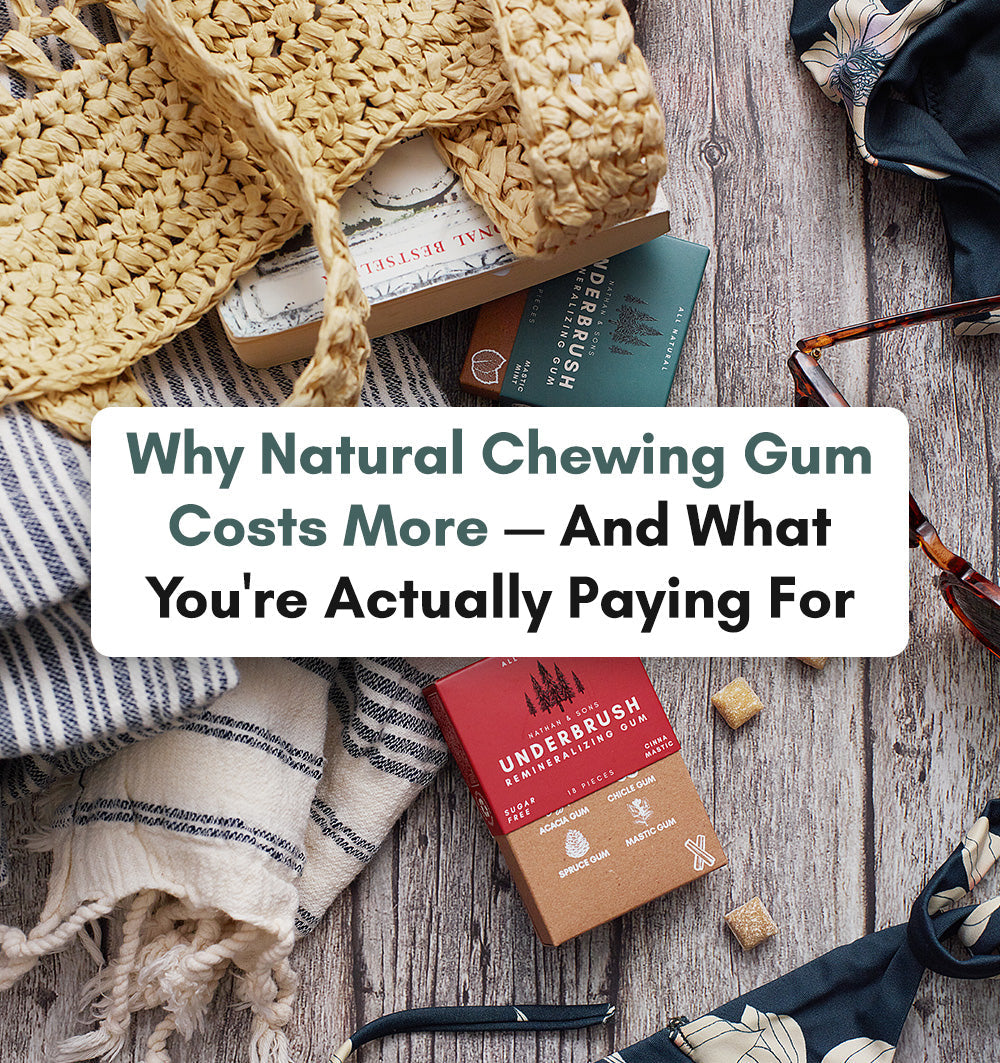
Why does natural gum cost more?
The honest answer isn't complicated. But it does require understanding what's actually in it — and what's in the gum you've been chewing your whole life without a second thought.
The Thing Nobody Talks About at the Checkout Lane
Picture the last time you grabbed gum at a gas station.
Ninety-nine cents. Maybe five dollars twenty-five cents. You didn't think twice.
You also didn't read the ingredients. Nobody does. It's gum. It's supposed to be mindless.
But here's the quiet truth hiding in plain sight on that little foil wrapper: the "gum base" listed in the ingredients of most conventional gum is a synthetic, petroleum-derived polymer.
A manufactured substance designed to be chewed but never swallowed, produced in industrial quantities at predictable, rock-bottom cost.
That's not a conspiracy theory. That's just chemistry.
And that cost — that's exactly why the gas station pack is eighty-nine cents.
It's also exactly why Underbrush isn't.
Most people also don't think about the sweeteners in that same piece of gum.
If you've ever wondered whether ingredients like sucralose are doing anything to your teeth, we wrote about that too — does sucralose cause tooth decay? is worth a read before you reach for the next gas station pack.
Natural gum is made from what gum was always made from before synthetic shortcuts existed: sap and resin harvested from specific trees, in specific places, by actual human beings.
No petroleum-derived polymers in the gum base.
Just plant resins from trees.
That's an ingredient description, not a health claim — but it's the entire reason the price is what it is.
If you're curious how we took that same plant-resin foundation and built something even more intentional, our remineralizing gum is where we went next — worth a look once you've finished here.
A Very Short History of Gum That Changes How You Think About the Whole Thing
Long before Wrigley's, before the penny candy store, before the foil-wrapped rectangle — people were chewing tree resin.
The ancient Greeks chewed mastic. Indigenous peoples across North America chewed spruce sap. Mesoamerican civilizations chewed chicle.
This wasn't candy.
It wasn't a breath freshener.
It was just something humans did with trees.
Then came industrialization.
Then came scale.
Then came the 1960s, when demand for gum outpaced what any rainforest could realistically supply.
According to Britannica's entry on chewing gum, manufacturers made the switch to synthetic butadiene-based rubber during this era — not because it tasted better, and not because it was better for you. Because it was cheaper and endlessly reproducible.[¹]
That's the whole story.
A cost decision. Made quietly. Never really announced.
We found out. And we went back.
What "Natural Gum" Actually Means (Three Ingredients, Three Stories)
When we say natural gum, we mean something specific.
We mean a gum base made from plant-derived resins that come from trees.
Three of them, to be exact.
It's worth noting that trees aren't the only source of natural gum-like compounds — acacia gum powder, for instance, is another plant-derived resin with its own long history of use.
But our gum base is built on three specific tree resins, and each one has a story that explains why we chose it.
Here's where they come from.
Chicle: The Original. The One That Started the Whole Industry.
Chicle comes from the sapodilla tree, native to the rainforests of Central America.
This is the ingredient that gave Chiclets their name.
The one that launched a global industry.
Here's the part that sounds almost fictional: a single sapodilla tree produces roughly one kilogram of chicle every three to four years.[²]
One kilogram. Every three to four years. Per tree.
To harvest it, a skilled chiclero climbs the tree — sometimes 30 feet up — and uses a machete to carve a careful zigzag pattern into the bark.
Cut too deep and you damage the tree permanently.
Too shallow and nothing comes out. The latex drips down into a bag at the base.
Done right, the tree heals and can be tapped again for 25 years or more.
That supply constraint is precisely why manufacturers abandoned chicle in the first place.
The 20th century wanted gum faster than any forest could produce it.
We chose chicle anyway. We work around the trees' schedule, not the other way around.
And yes — that decision alone is part of why Underbrush costs what it does.
Mastic: One Island. That's It. Literally.
Mastic resin comes from the mastic tree — Pistacia lentiscus — which grows all around the Mediterranean.
Here's the catch: the same species of tree, grown in Turkey or Spain or Morocco, produces almost no usable resin.
You need the trees from Chios, Greece.
That specific island.
That specific volcanic subsoil and microclimate.
Scientists have studied this. They don't fully understand it.
The trees from Chios just... do something the others don't.
This is not a marketing claim.
The European Union granted Chios mastic Protected Designation of Origin status in 1997 — the same legal category as Champagne and Parmigiano-Reggiano.[³]
You cannot call something "Chios mastic" unless it is, in fact, from Chios.
Each tree produces 150–180 grams of resin per year.
Harvesters make small cuts in the bark every four to five days starting in July.
The resin crystallizes over two to three weeks, is collected piece by piece by hand, washed in natural spring water, then cleaned individually through the winter months — a process that involves entire farming families.[⁴]
One worker collects about one kilogram in a full day.
Around 5,000 families on the island of Chios depend on this harvest for their livelihood.[⁵]
There is no fully automated equivalent for this.
No industrial-scale substitute.
No shortcut that produces the same result.
One kilogram per worker per day.
From one island in the world.
You don't have to do the math to understand why that costs more than a synthetic polymer shipped from a factory.
If you want to go deeper on mastic specifically — what to look for, how products compare — we put together a guide to the best mastic gum products for daily use.
Spruce Sap: American Gum Before American Gum Was a Thing
Before chicle reached the United States in the late 1800s, there was spruce gum.
New England corner stores sold it. It came from forests in Maine and Vermont, collected by skilled foragers called "gummers" — people who knew which trees to look for, when the resin had hardened enough to collect, and how to purify it properly: heating, filtering, straining out bark and debris until you had something actually worth chewing.[⁶]
That process is unchanged today.
Spruce sap is still wild-foraged.
Still collected by hand.
Still purified the old way.
And still meaningfully more expensive than anything that comes out of a polymer reactor.
Some things just don't need to be reinvented.
The process works. It's just not cheap — and it was never meant to be.
We wrote a full piece on spruce sap gum and its benefits if you want to understand what makes it worth sourcing — and what to look for if you ever want to find it in bulk.
So Why Does It Cost More Than the Gum at the Gas Station?
We're going to answer this directly, because it deserves a straight answer.

Conventional gum is cheap because its gum base is a synthetic polymer.
It can be manufactured anywhere, at any volume, at any time.
The supply is limitless.
The cost reflects that.
Natural gum costs more because the ingredients cannot be manufactured.
They're grown.
A mastic tree produces 150–180 grams of resin per year.
That's its biological ceiling — not a production target we can adjust by buying more equipment.[⁷]
A sapodilla tree yields roughly one kilogram of chicle every three to four years.
Spruce sap is still hand-collected from wild forests because there is no other way to get it.[⁶]
Scaling up doesn't mean building a larger factory.
It means planting more trees and waiting years for them to mature.
Then there's the labor.
A chiclero climbing 30 feet up a sapodilla tree.
A family in Chios collecting resin crystals one by one through the winter.
A forager in Maine doing what people did in the 1850s.
These aren't charming details — they're the cost structure.
The price primarily reflects ingredient sourcing, harvesting, and production costs — not mass-manufacturing economics.
That’s a major part of the price difference.
There's one more thing worth saying here, and it connects directly to the value question.
Underbrush can be chewed, set aside, and chewed again later — as many times as you'd like.
That's not a marketing claim. That's just what natural plant resin does.
Chicle, mastic, and spruce sap are structurally stable resins.
The gum base holds its form through chewing and retains it when you're done.
If you want to wrap it up, save it, and come back to it the next day, it'll be there.
The historical use of chicle as a re-chewable material by the indigenous communities who harvested it in Mesoamerica is part of the documented record of this ingredient.[²]
We actually built a product around this.
Our handmade gum dish exists specifically for people who chew before bed and want a clean, designated place to rest their piece overnight — or for anyone who wants to set their gum aside and return to it later.
Food-safe ceramic, handmade individually. It's a small thing.
But the fact that it exists tells you something about how this gum behaves.
Individual experience will vary. We are describing a material characteristic of the gum base — not a clinical or comparative performance claim.
What this means practically: one piece of Underbrush goes further than a single chewing session if you want it to.
When you're weighing the price per piece, that's worth factoring in.
One of our customers, Raul, described it without knowing any of this: "a consistent gum that doesn't break down and feel like nothing after a while."
That's the material characteristic in plain language.
What Small-Batch Actually Means (It's Not a Vibe, It's a Requirement)
Large commercial gum manufacturing is almost entirely automated.

Gum base arrives in blocks.
It melts in industrial kettles.
Rollers sheet it. Machines cut it.
Everything runs around the clock because synthetic ingredients behave identically every single time.
Natural resins don't cooperate with that.
Chicle's texture varies by harvest.
Mastic behaves differently at different temperatures.
Spruce sap has its own personality.
Getting the balance right — the chew, the texture, the way the ingredients work together — required nearly two years of iterative formulation work before we were satisfied enough to put it in front of anyone.[⁸]
Every batch of Underbrush is made by people who know exactly what's in it.
That human presence isn't nostalgia.
It's a structural requirement of working with ingredients that weren't designed to be industrialized.
It also adds to the cost. We're not apologizing for that — we're explaining it.
One thing we also thought hard about during formulation: sweeteners. Xylitol — a natural sweetener derived from birch trees — is the one we landed on.
If you're curious why, everything you need to know about xylitol explains it better than we can in a paragraph.
The short version: it fits the same philosophy as the rest of our ingredients.
That same small-batch discipline is what makes our remineralizing gum possible too — you can't rush a formulation built on ingredients that don't come with a fast-forward button.
The Environmental Part (Because It Matters)
Conventional gum base is made from synthetic polymers that do not readily biodegrade.
That piece of gum stuck to the sidewalk outside your office? It'll outlast the building.
Natural gum base — chicle, mastic, spruce — is plant-derived resin. Industry analyses of natural versus conventional gum ingredients note that plant-derived resins may biodegrade differently than synthetic polymer-based gum base does under certain environmental conditions.[⁹]
There's also something worth noting about the chicle harvest specifically: the entire economic model is built around not cutting trees down.
You tap them.
You let them heal.
You tap them again for 25 years.
According to documentation from the USDA Forest Service and research on sustainable chicle harvesting, this model has been associated with forest preservation incentives in the regions where sapodilla trees grow.[¹⁰] The forest is worth more standing than cleared, because the trees produce something people will pay for.
We like that equation.
One of our customers, Roxanne, mentioned composting her gum after chewing. That's exactly the kind of thing that makes us glad we built this the way we did.
Who Actually Makes This Stuff
We want to be honest about the supply chain, because we think it matters.
Chicle comes from indigenous and local farming communities in Central America, using methods passed down across generations.
When the ingredient costs more, it's because the people harvesting it are being paid for skilled, time-intensive labor.
Mastic comes from approximately 5,000 families in the Mastichochoria villages of southern Chios — the only place in the world where it can legally be produced, according to the Chios Mastic Growers Association.[³]
For many of those families, this harvest is the primary source of income.
Spruce sap comes from foragers in North American forests who do this work the same way it was done in the 1850s.
Our ingredient supply chains are tied to the harvesting communities in these regions. That's not marketing language.
That's the supply chain being transparent.
You can read more about how we think about sourcing and formulation on our about us page.
What People Are Actually Saying
We could tell you Underbrush is different. We have been, for this whole article.
But here's what matters more — what happens when real people actually chew it and these are only three of thousands of reviews.
"So far only had the berry flavor, let my daughter try, she loves it better than store bought gum, patiently waiting to open another flavor and hard to say which one next." — Jonathan
"Though the flavor fades fast, my tooth sensitivity has slowly gone down with the short amount of time I've had this gum. It's also nice chewing a consistent gum that doesn't break down and feel like nothing after a while. Overall my new favorite gym gum." — Raul
If tooth sensitivity is something on your mind, our article on natural solutions for tooth sensitivity goes into more depth on what people look for in a daily gum.
"Underbrush is exceeding my expectations by a large margin. Not sure what I expected but it seemed worth a try. The taste is pleasant and I compost the gum afterward. Bravo, Nathan & team!" — Roxanne
Individual experiences vary. These are unsponsored customer reviews shared voluntarily. Results described are not typical and are not intended to represent what you should expect to experience. These statements have not been evaluated by the Food and Drug Administration. This product is not intended to diagnose, treat, cure, or prevent any disease.
So: What Is Natural Gum? And Is It Worth the Price?
It's gum the way gum used to be made.
Before the synthetic shortcuts. Before the industrial scale. Before anyone decided that petroleum-derived polymers were an acceptable substitute for something that grew in the ground.
It's a chiclero in Central America making careful cuts in a sapodilla tree so it can be tapped again in four years.
It's a family in Chios, Greece, collecting resin crystals off tree trunks one by one through the winter.
It's a forager in the forests of Maine doing what people did in the 1850s, because the process works and nothing about it needed to change.
That's what's in Underbrush. That's what the price reflects.
Not branding. Not margins. The ingredients take years to grow, weeks to harvest, and significant human labor to process — every single batch. The gas station pack is cheap because it skipped all of that. We didn't.
Whether that's worth it to you is a fair question. We just wanted to make sure you had the full answer.
And if you want to see where we took that foundation — same plant-based gum base, same small-batch care, one more layer of intentional formulation — our remineralizing gum is the next thing worth exploring — or if you're ready, you can order it here.
Still not sure if remineralizing gum actually does what it claims?
We asked that question ourselves — here's the honest answer: does remineralizing gum work?
These statements have not been evaluated by the Food and Drug Administration. This product is not intended to diagnose, treat, cure, or prevent any disease.
Natural Gum - Frequently Asked Questions
Why does natural gum cost more than regular gum?
Because the ingredients can't be manufactured — they grow.
Synthetic gum base is a petroleum-derived polymer that can be produced anywhere, at any volume, at any time.
That's why a gas station pack costs under a dollar.
Natural gum base comes from trees that produce a kilogram of resin every few years, harvested by hand, in specific places, by skilled people.
The cost reflects the biology and the labor — not inflated margins.
Why did major gum companies stop using natural gum bases?
The shift happened after World War II and accelerated through the 1960s.
According to Britannica's entry on chewing gum, manufacturers switched to butadiene-based synthetic rubber because it was dramatically cheaper and could be produced at any volume.[¹]
Demand for gum had outgrown what sustainable chicle harvesting could supply.
The decision was economic, not qualitative.
Is natural gum actually better for you?
We're not going to make health claims here — that's not our lane, and it wouldn't be accurate to do so without clinical evidence.
What we can say is that our ingredients are plant-derived, our gum base is plant-based resin, and we know exactly what's in each batch.
What you do with that information is up to you.
These statements have not been evaluated by the Food and Drug Administration. This product is not intended to diagnose, treat, cure, or prevent any disease.
Does natural gum support farming communities?
Yes, directly.
Chicle harvesting sustains indigenous and local communities in Central America.
Mastic is the primary income source for approximately 5,000 families in Chios, Greece, according to the Chios Mastic Growers Association.[³]
The cost of natural ingredients reflects the labor of real people maintaining agricultural traditions across generations.
Why can't the price come down with more production?
Because the trees — not us — set the ceiling.
A mastic tree produces 150–180 grams per year. A sapodilla tree yields roughly one kilogram of chicle every three to four years.[⁷]
Those are biological limits. Scaling up means planting more trees and waiting years for them to mature.
It doesn't mean buying more equipment. We explain this in full in the "So Why Does It Cost More" section above.
Can you save a piece of Underbrush and chew it again later?
Yes. Underbrush can be chewed, set aside, and chewed again later — as many times as you'd like.
This is a characteristic of natural plant resins.
Chicle, mastic, and spruce sap are structurally stable materials that hold their form through chewing and retain it afterward.
The documented historical use of chicle includes re-chewing by the indigenous communities who harvested it in Mesoamerica.[²]
We built our handmade gum dish specifically for this purpose — a food-safe ceramic resting place for people who chew before bed or want to save their piece for later.
Individual experience will vary.
We are describing a material characteristic of the gum base, not a clinical claim.
Is natural gum more sustainable than conventional gum?
In two meaningful ways, yes.
First, natural gum base is plant-derived resin that may biodegrade differently than synthetic polymer gum base under certain environmental conditions, according to industry analyses of natural versus conventional gum ingredients.[⁹]
Second, the chicle harvest model is often viewed as a more renewable sourcing model compared to synthetic gum-base manufacturing — trees are tapped without being cut, giving local communities an economic incentive to keep forests standing, as documented by the USDA Forest Service.[¹⁰]
Does natural gum contain xylitol?
Underbrush does.
Xylitol is a natural sweetener that fits the same plant-derived philosophy as our gum base.
If you want to understand exactly what it is and why we chose it over alternatives like sucralose, our guide to the best xylitol gum and our deep-dive on xylitol as a natural sweetener cover it thoroughly.
What is remineralizing gum and how is it different from natural gum?
It starts with the same natural gum base and adds a specific formulation layer on top.
The full answer — including the ingredients and the reasoning — is on our remineralizing gum page.
Ready to order? Shop it here.
And if you want the evidence behind whether it actually works, does remineralizing gum work? is where we lay that out honestly.
These statements have not been evaluated by the Food and Drug Administration. This product is not intended to diagnose, treat, cure, or prevent any disease.
Can chewing gum give you energy?
That depends entirely on what's in it. We looked at the science behind this question — does chewing gum give you energy? is worth reading if you're thinking about gum as part of a focus or energy routine.
References
-
Britannica. "Chewing Gum." britannica.com. https://www.britannica.com/topic/chewing-gum
-
Suifafood. "What Is Chicle in Chewing Gum?" suifafood.com. https://www.suifafood.com/news/chicle-in-chewing-gum
-
Chios Mastic Growers Association. "Mastic Cultivation and Production." mastichachios.gr. https://www.mastichachios.gr/en/
-
Masticlife. "Why Is Mastic Gum So Expensive?" masticlife.com. https://masticlife.com/en-us/blogs/news/why-is-mastic-gum-so-expensive
-
Masticlife. "Mastic Tree." masticlife.com. https://masticlife.com/en-us/pages/mastic-tree
-
USDA Forest Service. "Gums — Ethnobotany of the United States." fs.usda.gov. https://www.fs.usda.gov/wildflowers/ethnobotany/gums.shtml
-
Scienceinsights. "What Is Chicle? The Natural History of Chewing Gum." scienceinsights.org. https://scienceinsights.org/what-is-chicle-the-natural-history-of-chewing-gum/
-
Nathan & Sons. "About Us." nathanandsons.com. https://nathanandsons.com/pages/aboutus
-
Edinco. "Natural Chewing Gum vs Regular Gum." edinco.co.uk. https://edinco.co.uk/blogs/blog/natural-vs-regular-chewing-gum
-
USDA Forest Service. "Gums — Ethnobotany of the United States." fs.usda.gov. https://www.fs.usda.gov/wildflowers/ethnobotany/gums.shtml