
Nootropic Gum: What It Is, The Science Behind It & Why It Works
Editorial & Commercial Disclosure: Nathan & Sons produces and sells functional chewing gum, including Uprising nootropic gum, which is discussed in this article. This article is a summary of publicly available peer-reviewed scientific research intended solely as educational content. It does not constitute medical advice. All ingredient research cited was conducted on individual ingredients in isolation at specific doses — not on Uprising as a finished product. Results from ingredient-level research may not reflect the performance of any finished product. The comparison table in this article was compiled by our team here at Nathan & Sons based on publicly available product label information as of May 2026 — always verify current formulations directly on each brand's website. Individual results will vary. For health decisions, consult a qualified healthcare professional. No statements in this article should be interpreted as claims that any finished product can diagnose, treat, mitigate, cure, or prevent disease or produce guaranteed cognitive outcomes.
These statements have not been evaluated by the Food and Drug Administration. This product is not intended to diagnose, treat, cure, or prevent any disease.

Quick Facts About Nootropics and Nootropic Gum
- The word "nootropic" was coined in 1972 by Romanian psychologist Dr. Corneliu Giurgea — from the Greek words for "mind" and "turning." His original definition had five strict criteria. Most things don't qualify.
- Humans have been pursuing cognitive enhancement for at least 5,000 years — Ayurvedic medicine documented adaptogenic herbs for brain health as far back as 3000 BCE (EBSCO Research Starters)
- The global nootropics market was valued at $21.33 billion in 2025, projected to approach $80 billion by 2035 at a ~14% CAGR (Precedence Research)
- Nootropic gum delivers cognitive support ingredients through buccal absorption — directly through the mouth's mucous membranes, bypassing the digestive system entirely
- 82% of the U.S. nootropics market in 2024 consisted of natural nootropic products — consumers want clean-label, plant-derived cognitive support (Grand View Research)
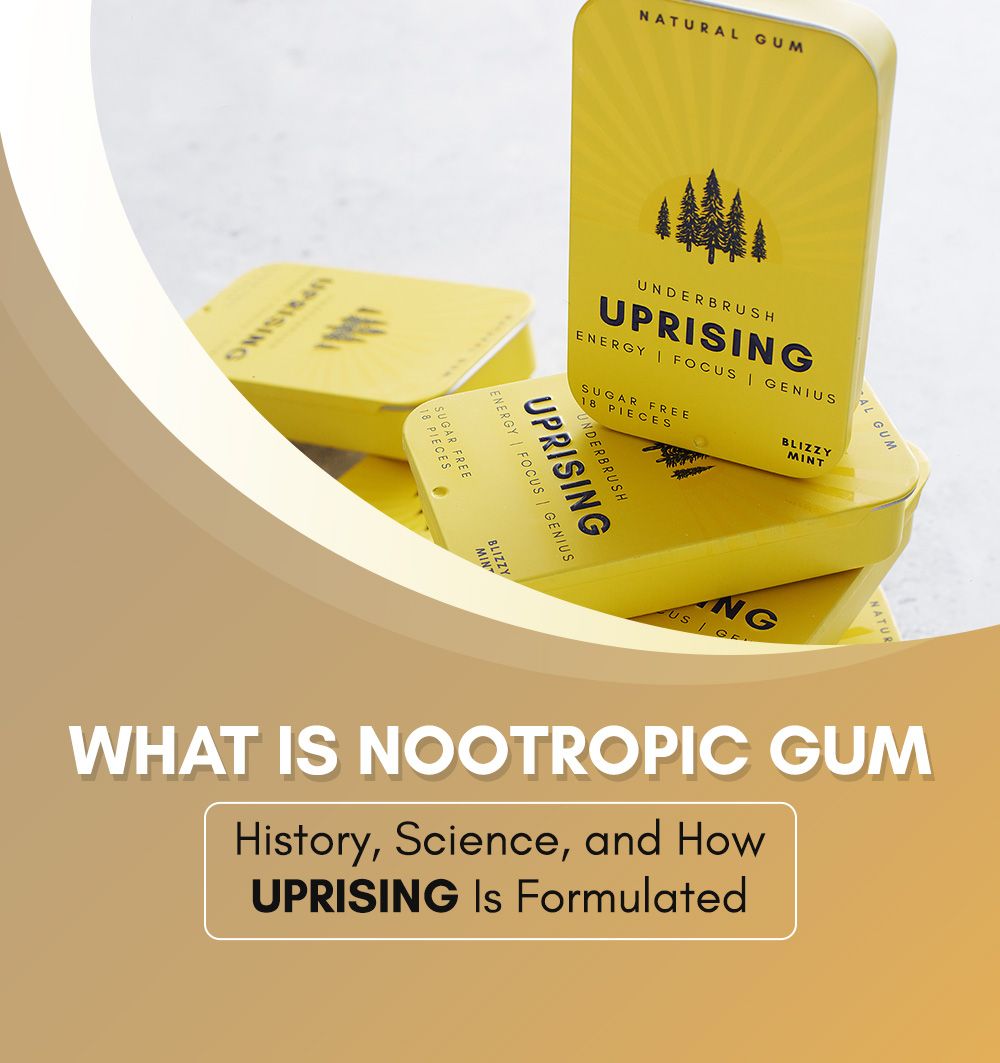
- Uprising is our nootropic gum — eight functional ingredients evaluated against Giurgea's original criteria, on a plant-based gum base, made in small batches in California
Let's be honest.
"Nootropic gum" sounds like something a Silicon Valley founder invented at 11:47pm to replace sleep.
And honestly? That's fair.
But here's the real scoop, mankind has been trying to support brain health and cognitive performance for thousands of years. The word "nootropic" is only fifty years old. The idea behind it is ancient.
What's new is the gum format — and the science sophisticated enough to explain why it works.
This guide is for anyone exploring the nootropics space for the first time — or the fifth time — who wants to understand what the science actually says, what makes an ingredient earn the nootropic label, how the category evolved from a 1972 Romanian laboratory to a $21 billion global market, and where gum fits in perfectly.
We love that last part.
By the end of this article, you'll be able to look at any nootropic product and know exactly what you're evaluating.
The Word "Nootropic" Was Invented by One Man — and He'd Probably Hate How It's Used Today
Start here, because this is the most important thing to understand about the nootropics category — and the most entertaining.
It's 1972. A Romanian psychologist and chemist named Dr. Corneliu E. Giurgea is sitting in a laboratory in Belgium having just synthesized something unusual.
A compound called Piracetam — a molecule that appeared to enhance memory and learning in animal models without sedating them or wiring them up like a stimulant would. Nothing like it existed.
No category existed for it.
So Giurgea did what scientists do when they discover something that doesn't fit existing language: he made up a word.
He combined two Greek words — nóos (mind) and tropein (to guide) — and called his new category "nootropic." Mind-guiding. Fitting.
But Giurgea didn't just name the category. He drew a fence around it. A true nootropic, he said, had to do all of the following: (PMC / Nutrients, 2022)
- Enhance learning and memory
- Protect the brain from physical or chemical injury
- Enhance the brain's resistance to disruptive conditions
- Increase the efficacy of cortical and subcortical control mechanisms
- Have very low toxicity and minimal side effects
Strict. Very strict.
Fast forward fifty years. Walk into any supplement store. Count how many products have the word "nootropic" on the label.
Now imagine Giurgea seeing that aisle.
He would not be pleased.
Because by his original definition, almost nothing on those shelves qualifies. Not most supplements. Not most "smart drugs." Certainly not the gummy bears with "cognitive blend" printed on the side.
Here's the thing though — this isn't a reason to dismiss the category. It's a reason to understand it.
The word has broadened considerably since 1972. Today, "nootropic" is commonly used to describe any ingredient studied for potential benefits to cognitive function — focus, attention, mental clarity, memory, mood, alertness.
That's a much bigger tent. And within it, there are ingredients with outstanding research records and ingredients that are essentially riding the wave with a clever label.
What Giurgea's criteria give us — even fifty years later — is a useful filter. A way to ask the right questions about any ingredient before you chew it.
We'll use that filter throughout this article. And we'll be honest when an ingredient passes it, when it doesn't, and when it's doing something valuable that Giurgea simply didn't have a category for yet.
5,000 Years of Brain Health: The History of Nootropics Before They Had a Name
The word is fifty years old. The obsession is ancient.
Let's go back. Waaaaaaay back.
It's 3000 BCE somewhere in the Indian subcontinent.
A practitioner of Ayurvedic medicine is documenting the properties of a plant called Brahmi — noting its effects on memory, mental clarity, and the capacity to learn.
This is not casual observation. Ayurvedic medicine at this point is a sophisticated, structured system. (EBSCO Research Starters)
These practitioners weren't guessing.
They were documenting, categorizing, testing across generations, and building a body of knowledge about how plants affected cognitive performance.
They didn't have the word "nootropic." They didn't need it. They had the plants.
Around 1500 BCE, Egyptian scribes were cataloguing stimulant compounds for managing mental fatigue.
The ancient Greeks were chewing mastic resin — our own mastic gum, incidentally — partly for its oral health properties and partly because chewing it was understood to promote alertness.
Chinese physicians were prescribing Ginkgo biloba for brain circulation centuries before the word "bioavailability" existed.
Every ancient civilization that left written records left evidence of intentional cognitive enhancement.
Which means humans have been trying to think more clearly, for longer, with less effort, since roughly the beginning of recorded time.
The Silicon Valley founder at 11:47pm isn't having a new idea. He's having a very old one in a new building.
Now skip forward a few thousand years to a laboratory in Belgium.
It's the 1960s. Dr. Giurgea — our Romanian scientist from the previous section — synthesizes Piracetam.
The research community is fascinated. Here's a compound that appears to improve learning retention in animal models without any of the side effects of stimulants or sedatives.
It doesn't wire you up. It doesn't knock you out.
It just seems to make the brain work a little more efficiently under difficult conditions.
Strange. Promising. Worthy of a new category.
By the 1980s, a whole family of related compounds — the racetams — had followed. Researchers were deep in the pharmacology of cognitive enhancement.
It was serious, technical, largely academic work happening in journals most people had never heard of.
Then the internet happened.
By the early 2000s, communities of self-experimenters had found the research.
Forums emerged. People began building their own "stacks" — curated combinations of multiple nootropic ingredients — and documenting what happened with the rigor of amateur scientists.
The Quantified Self movement.
The biohackers. People tracking their own sleep, focus, mood, and cognitive output with a precision that would have seemed absurd a generation earlier.
These weren't fringe people.
They were engineers, designers, writers, entrepreneurs — anyone whose output depended directly on the quality of their thinking and who had started to wonder whether that quality was optimizable.
By the 2010s, the mainstream caught up. Nootropics appeared on Shark Tank.
They showed up in productivity podcasts.
Joe Rogan mentioned them.
The category that had lived in niche forums for a decade suddenly had a national audience.
And then 2020 happened.
Remote work removed the environmental scaffolding that had structured most people's days — the commute, the office, the physical separation between work and home.
What replaced it was an open-ended demand for self-directed focus and mental stamina that most people had never had to manage consciously before.
Coffee wasn't enough. More coffee wasn't the answer.
The nootropics category was right there, waiting.
By 2025, the global nootropics market had reached $21.33 billion. (Precedence Research)
The arc from an Ayurvedic practitioner documenting Brahmi in 3000 BCE to a $21 billion global market runs through ancient Egypt, a Belgian laboratory, a U.S. Army research program, several years of internet forums, and a global pandemic that forced everyone to manage their own focus for the first time.
That's the actual history. It's a better story than the label usually tells.
The Nootropics Market: Why Brain Health Became a Global Category
Something happened around 2020 that permanently changed how people think about cognitive performance.
Remote work removed the environmental scaffolding that structured most people's days.
The commute, the office, the physical separation between work and home — gone.
What replaced it was a sustained demand for self-directed focus, energy management, and mental stamina.
People who had coasted on routine discovered they needed to actively manage their own cognitive states.
Coffee wasn't enough. Or rather, more coffee wasn't the answer — most people had already hit the ceiling on caffeine tolerance and were experiencing diminishing returns.
The nootropics market absorbed that demand.
The U.S. nootropics market was valued at $2.81 billion in 2024 and is projected to reach $4.68 billion by 2030, according to Grand View Research.
The global picture from Precedence Research is larger: $21.33 billion in 2025, on a trajectory toward $80 billion by 2035 — a compound annual growth rate of approximately 14%, roughly three times faster than the general supplement category.
Note: market estimates vary significantly by scope and methodology — different analysts define the nootropics category differently.
Both figures above point in the same directional trajectory.
The other number worth noting: according to Grand View Research, 82% of the U.S. nootropics market in 2024 consisted of natural nootropic products. (Grand View Research)
That's not a small majority. That's a dominant preference signal.
Consumers aren't just looking for cognitive support — they're looking for it from ingredients they can recognize, trace, and trust.
That's precisely the gap that well-formulated nootropic gum is designed to fill.
What Actually Makes an Ingredient a Nootropic? Running the Numbers Against Giurgea's Scorecard
Think of Giurgea's five criteria as a scorecard. We're going to run each ingredient in Uprising through it — honestly, without flinching — and tell you what it scores, why, and what that means for you.
Some ingredients will pass cleanly. Some won't — but they'll be doing something else genuinely valuable that Giurgea's 1972 framework simply didn't have language for yet.
And some will surprise you.
Ready? Let's go ingredient by ingredient.
Important: all studies cited below were conducted on individual ingredients in isolation at specific doses.
None were conducted on Uprising as a finished product.
These statements have not been evaluated by the Food and Drug Administration. This product is not intended to diagnose, treat, cure, or prevent any disease. Individual results will vary.
Caffeine — The Most Popular Nootropic You've Been Using Since Childhood
Be honest. You had caffeine today.
Maybe it was coffee. Maybe tea.
Maybe it's been so long since you went a day without it that you've stopped thinking of it as a drug at all — just a morning ritual, a personality trait, a reason to own an expensive machine.
Caffeine is the most widely consumed psychoactive substance in human history.
And by the modern, broader definition of nootropic — any ingredient studied for potential cognitive benefits — it qualifies easily. FDA GRAS status.
Decades of clinical research.
Documented effects on alertness and the perception of fatigue through a well-understood mechanism: blocking adenosine receptors in the brain, the ones that signal "you're tired now." (FDA GRAS Notice No. 209)
By Giurgea's stricter criteria though? Partial credit. Caffeine supports alertness.
It doesn't protect the brain or enhance resistance to physical injury in the neuroprotective sense Giurgea was describing.
It's a stimulant with cognitive benefits — outstanding ones — but not a classical nootropic.
Giurgea scorecard: 2.5/5. Would not pass the original test.
Is still the anchor of every serious nootropic formula anyway.
A formula that is only caffeine is not a nootropic stack — it's a stimulant in a clever package.
But a formula without caffeine is working without its most reliable tool.
L-Theanine — The Japanese Tea Secret That Took the West Fifty Years to Notice
Here's a question worth sitting with: why does a cup of green tea feel so different from a shot of espresso?
Same caffeine content, roughly. Completely different experience.
Matcha gives you focus without the buzz, calm without the crash, alertness without the edge.
Coffee gives you all the edge.
The difference is L-theanine — an amino acid found naturally in tea leaves that Western science spent decades largely ignoring while Japanese tea culture had been experiencing its effects for centuries.
L-theanine promotes alpha brain wave activity — the mental state associated with relaxed alertness.
Not sleepy. Not wired.
That particular gear where things feel clear and connected without being frantic.
Two randomized, placebo-controlled trials published in Neurology and Therapy found measurable increases in alpha brain wave power and measurable decreases in salivary cortisol — a stress marker — in moderately stressed adults following L-theanine supplementation.
The authors described the changes as "indicative of relaxation in the brain." (Evans M et al., 2021) (Moulin M et al., 2024)
A 2024 meta-analysis in Nutrition Reviews found the caffeine + L-theanine combination associated with small-to-moderate improvements in attentional task performance compared to placebo. (Senanayake N et al., 2024)
L-theanine also carries GRAS status from the FDA. (FDA GRAS Notice No. 209)
Giurgea scorecard: 3/5. L-theanine doesn't enhance learning and memory in the direct way Giurgea envisioned.
But it reduces the stress response, supports calm alertness, and meaningfully modifies how caffeine behaves in the body.
Its combination with caffeine is the most clinically studied pairing in cognitive supplementation.
It belongs in any serious formula.
See our full guide to L-theanine gum for the deep dive.
Alpha-GPC — The Ingredient Giurgea Would Have Actually Been Excited About
If you could time-travel back to 1972 and show Giurgea the ingredients in a modern nootropic gum, he'd nod politely at the caffeine, raise an eyebrow at the adaptogens, and stop cold at Alpha-GPC.
This is the ingredient closest to what he was originally describing.
Alpha-GPC (L-alpha-glycerylphosphorylcholine) is a choline precursor — meaning it gives the brain the raw material it needs to produce acetylcholine, a neurotransmitter directly involved in memory, learning, and sustained attention.
Acetylcholine was central to Giurgea's original research framework.
The whole idea that you could support cognition by supporting the brain's own neurotransmitter production?
That's Alpha-GPC. Fifty years later.
It crosses the blood-brain barrier efficiently — a property Giurgea specifically required of true nootropics. (WebMD, Alpha-GPC)
And a 2024 randomized, double-blind, placebo-controlled crossover trial in Nutrients found statistically significant improvements in Stroop test scores and processing speed in healthy adults after a single dose — with researchers noting it may be meaningful for "athletes, race car drivers, military operators, and other non-athletic populations who need to improve their mental performance." (Kerksick CM, Nutrients, 2024)
Giurgea scorecard: 4/5. The closest thing in the consumer nootropic space to his original vision. Most basic nootropic gums don't include it. We do — in Uprising.
Rhodiola Rosea — What Siberian Physicians Have Known for Centuries
Picture a physician in Siberia in the 17th century. Winter. Brutal cold. Months of darkness.
A patient comes in depleted — not sick exactly, but mentally foggy, physically dragging, running on fumes.
The physician doesn't prescribe a stimulant.
They prescribe a root.
Rhodiola Rosea.
A plant that grows in harsh, high-altitude conditions across Siberia, Scandinavia, and the Arctic.
A plant that traditional medicine systems in those regions had been prescribing for mental and physical resilience for generations.
Modern research has been catching up to the intuition.
Rhodiola is an adaptogen — a class of botanicals studied for their potential to support the body's normal response to stress and fatigue.
A randomized, double-blind, placebo-controlled trial in Phytomedicine looked at Rhodiola in physicians during night-duty shifts — real people, real fatigue, real cognitive demand — and found significantly less mental fatigue and improved cognitive performance in the Rhodiola group compared to placebo.
(Darbinyan V et al., 2000) A comprehensive review in Pharmaceuticals concluded it "exerts an anti-fatigue effect that increases mental performance, particularly the ability to concentrate." (Panossian A & Wikman G, 2010)
Giurgea scorecard: 3.5/5.
Rhodiola isn't a classical nootropic — it doesn't enhance learning or memory in a direct sense.
But it does something arguably more useful for most people's daily lives: it supports the body's ability to maintain normal cognitive function under sustained stress.
The Ayurvedic practitioners in 3000 BCE were already onto this. Giurgea just didn't have the category for it yet.
Theobromine — Why Dark Chocolate Feels Different From Coffee (And Why That's Useful)
Quick experiment. Eat a square of 85% dark chocolate. Now drink a shot of espresso. Wait an hour for each.
The espresso hits fast and sharp.
The chocolate comes on slower, softer, and stays longer. Same basic mechanism — both interact with adenosine receptors in the brain — but the experience is fundamentally different.
That difference is theobromine.
A mild methylxanthine that occurs naturally in cacao, acting on the same pathways as caffeine but with a slower onset and more gradual duration curve.
A review in Psychopharmacology confirmed it: theobromine produces a more sustained and less intense alertness effect compared to caffeine. (Smit HJ et al., 2004)
Giurgea scorecard: 2/5.
Not a nootropic by his criteria. But in a multi-ingredient formula, theobromine extends the alertness window that caffeine opens — providing a longer tail rather than a spike followed by a cliff.
It's the difference between feeling sharp for 45 minutes and feeling capable for three hours.
NAD (Nicotinamide Riboside) — The One Operating at a Level Most Formulas Don't Think About
Every other ingredient on this list is doing something you can feel — alertness, calm, focus, resilience.
NAD is doing something you can't feel directly, which is precisely why most people don't include it.
Here's the analogy that makes it click: imagine your brain is a high-performance car.
Caffeine is the accelerator.
L-theanine is the transmission.
Alpha-GPC is premium fuel.
NAD+ is the engine oil.
You can have the best of everything else — but a dry engine doesn't go anywhere, and it doesn't announce that it's failing until something expensive breaks.
NAD+ is a coenzyme essential to mitochondrial energy production — the process every cell in your body uses to convert nutrients into ATP, the molecular fuel that powers everything, including brain function.
Levels decline with age and under chronic stress. Nicotinamide Riboside is a precursor the body uses to support NAD+ production.
A randomized, double-blind, placebo-controlled trial in Nature Communications confirmed that oral Nicotinamide Riboside supplementation significantly increased blood NAD+ levels in healthy adults compared to placebo. (Trammell SA et al., 2016)
Giurgea scorecard: 3.5/5.
Not a classical nootropic, but arguably the closest thing to Giurgea's criterion about protecting the brain's fundamental operating infrastructure.
This is background maintenance — the kind that pays off over time rather than in the next twenty minutes.
Saffron Extract — The $5,000-Per-Pound Spice That Has No Business Being This Interesting
Saffron is harvested by hand from the stamens of crocus flowers.
Each flower produces exactly three.
It takes roughly 75,000 flowers to produce one pound.
The price per pound can exceed $5,000.
Most people know it as the thing that makes paella yellow and risotto expensive.
Its presence in a nootropic formula surprises people every time.
But here's the thing — researchers have been studying saffron for mood and cognitive effects for years, and the results are genuinely interesting.
A systematic review in Human Psychopharmacology examined multiple randomized controlled trials and found saffron supplementation was associated with significantly greater improvements in mood-related outcomes compared to placebo across the reviewed trials.
Proposed mechanisms include potential effects on serotonin, dopamine, and glutamate signaling — though the exact mechanism remains under investigation. (Lopresti AL & Drummond PD, 2014)
Giurgea scorecard: 3/5. Not a classical nootropic by any reading of his criteria.
But mood and cognitive function are inseparable in practice — a dysregulated or anxious mind can't focus regardless of what else is in the formula.
Saffron's role in Uprising is to support the emotional baseline that everything else depends on.
And its presence signals something important: this is not an off-the-shelf stack.
Methylated B Vitamins — The Most Unsexy Ingredient With the Most Underappreciated Impact
Nobody gets excited about B vitamins. No one has ever told a dinner party story about discovering methylcobalamin.
But here's a scenario that a surprising number of people recognize: you eat reasonably well, sleep adequately, exercise regularly — and still feel like you're running at 70%. Not sick.
Not burned out. Just not quite there. Foggy in a way that has no obvious cause.
For a meaningful portion of the population, the MTHFR gene variant is a quiet reason for exactly that.
Standard B12 (cyanocobalamin) and standard B9 (folic acid) require metabolic conversion before the body can use them.
People with common MTHFR variants can't make that conversion efficiently — meaning they consume B vitamins in everything they eat and absorb a fraction of them.
Methylated forms — methylcobalamin for B12, L-methylfolate for B9 — are already bioactive.
No conversion needed.
A review in the Journal of Perinatal Medicine documented the superior bioavailability of methylated B vitamin forms particularly in individuals with MTHFR variants. (Obeid R et al., 2013)
Giurgea scorecard: 2.5/5.
Not a nootropic.
But their absence in the wrong forms is one of the quietest reasons people feel cognitively flat.
When you see methylated forms on a label, it means the formulator thought about who was actually going to be using the product — not just what would look impressive in a stack.
Why Gum Is a Smart Delivery Format for Nootropics Specifically
Most nootropic discussions focus entirely on ingredients. The delivery format is treated as an afterthought — a capsule is a capsule, a drink is a drink.
Gum is different. And the reason matters particularly for nootropics.
When you swallow a nootropic capsule, the ingredients pass through your digestive system — stomach acid, small intestine, liver metabolism — before reaching your bloodstream.
This process takes 45 minutes to over an hour for most compounds, and some degradation occurs along the way.
Chewing gum delivers ingredients through the mucous membranes of the mouth — the inner cheeks, under the tongue — directly into the bloodstream without touching the digestive tract.
This is called buccal absorption.
A 2002 randomized clinical trial published in the International Journal of Pharmaceutics confirmed significantly faster caffeine absorption via gum than via capsule. (Kamimori GH et al., 2002)
For a detailed breakdown of the pharmacokinetics, see our full guide to focus gum and buccal absorption — we go deep on the science there.
The point here is simpler: for ingredients you want working within twenty minutes of a cognitive demand, the delivery format is not a trivial variable.
The U.S. military understood this in the 1990s when they developed caffeinated gum specifically because capsules were too slow for field conditions.
A nootropic in your bloodstream in twenty minutes is more useful than one in your bloodstream in ninety.
Curious whether chewing gum itself gives you energy? There's research on that too — the act of chewing has independent effects on alertness worth knowing about.
The Gum Base: The Variable Nobody in the Nootropics Category Talks About
There's a conversation happening in nootropics about ingredient quality, sourcing transparency, and clinical substantiation. That conversation almost never includes the gum base.
It should.

Most nootropic gum uses a synthetic elastomer base — polyvinyl acetate, polyisobutylene, petroleum-derived waxes.
The same materials found in industrial adhesives and tire inner tubes. You are chewing those materials while your nootropic ingredients absorb through the tissues of your mouth.
Natural alternatives exist and have a long history.
Chicle from the sapodilla tree was the original chewing gum base before industrial manufacturing replaced it with synthetics.
Mastic gum from Chios, Greece has been chewed since ancient times — see our guide to mastic gum for the full history.
Myrrh gum, used since ancient Egypt, has its own studied oral health properties — covered in our piece on the benefits of myrrh gum.
Acacia gum, a prebiotic fiber, adds another dimension — see our guide to acacia gum powder benefits.
We built Uprising on a plant-based foundation: chicle, mastic gum, myrrh gum, acacia gum, and candelilla wax. All plant-derived. All biodegradable.
If you care about what nootropic ingredients you're absorbing through your mouth tissue, it's worth caring about what the tissue is in contact with for the twenty minutes you're chewing.
Sweeteners Matter Too
Conventional gum relies on aspartame, sucralose, or acesulfame-K. Better options exist.
Xylitol — recognized by the American Dental Association for its oral health properties (ADA) — is the standard to look for.
We cover the full picture in our guides to xylitol, the best sugar-free xylitol gum, and whether sucralose causes tooth decay.
Uprising uses xylitol, allulose, stevia, and monk fruit. No aspartame. No sucralose.
How to Evaluate Any Nootropic Gum: A Framework
The category is noisy. Here's a clean framework for cutting through it.
Step 1 — Ask: does each ingredient have peer-reviewed research?
Not marketing claims.
Not "as studied in" language that points to a compound tangentially related to the ingredient in the formula.
Actual randomized controlled trials on the specific compound, at a dose that's disclosed on the label.
If a brand won't tell you how many milligrams of each active ingredient are in the formula, move on.
Step 2 — Ask: what does the research actually say?
There's a meaningful difference between "studied for potential effects on cognitive function" and "shown in multiple randomized controlled trials to produce statistically significant improvements in attentional outcomes."
Both are true for different ingredients. Know which category you're in.
Step 3 — Apply Giurgea's lens
Does the ingredient support learning or memory?
Does it protect or support brain tissue?
Does it help maintain normal cognitive function under demanding conditions?
Does it have a good safety profile at the studied dose?
An ingredient that checks three of five of those boxes is genuinely interesting.
An ingredient that checks none of them but has a compelling backstory is a marketing ingredient.
Step 4 — Check the base and the sweeteners
Plant-based gum base or synthetic elastomer?
Xylitol and monk fruit or aspartame and sucralose?
These don't affect nootropic efficacy directly — but they affect what you're putting in your body alongside the nootropics, and they signal something about the brand's overall commitment to clean formulation.
Step 5 — Look for the FDA disclaimer
Any legitimate nootropic supplement will carry this:
"These statements have not been evaluated by the Food and Drug Administration. This product is not intended to diagnose, treat, cure, or prevent any disease."
Its presence signals regulatory compliance. Its absence is a flag.
Nootropic Gum Compared: How the Main Options Stack Up
The following comparison was compiled by our team here at Nathan & Sons based on publicly available product label information as of May 2026. Nathan & Sons has a commercial interest in this comparison. Formulations change — always verify current labels directly on each brand's official website before purchasing.
Comparisons are for general informational purposes only and do not represent clinical head-to-head evaluations.

Apply the framework above to this table. Most of the category is caffeine + L-theanine in a synthetic base.
That's a reasonable starting point — those two ingredients have the strongest clinical research behind them and the combination is well established.
But it's a starting point, not a complete nootropic formula by any serious definition of the term.
To our knowledge, combining a full nootropic and adaptogenic stack with a plant-based gum base is uncommon in the consumer nootropic gum category as of this publication date — though the category is evolving rapidly.
For a broader look at how our full gum line compares, see the Underbrush vs. competitors 2026 guide.
Uprising by Nathan & Sons: How It Measures Against the Framework
These statements have not been evaluated by the Food and Drug Administration. This product is not intended to diagnose, treat, cure, or prevent any disease. All ingredient research cited in this article was conducted on individual ingredients in isolation — not on Uprising as a finished product. Individual results will vary.
We built Uprising with Giurgea's framework in mind — not as a marketing claim, but as a formulation discipline.
Every ingredient in the stack has peer-reviewed research behind it at a disclosed dose.
The gum base is plant-derived.
The sweeteners are clean.
It's made in small batches in California.
The full stack: caffeine (50mg), L-theanine (100mg), Alpha-GPC, Rhodiola Rosea extract, theobromine, NAD (Nicotinamide Riboside), saffron extract, methylated B9 (L-Methylfolate) and B12 (Methylcobalamin).
Run it through the five-step framework above.
Check every ingredient against the research we've cited in this article.
Verify the label.
That's what we'd want you to do — because the product holds up to it.
"Big fan of the gum in general. When I saw they had a caffeine infused version I had to try it. It's amazing! Usually take a piece and combine it with one of the standard flavors to make it last longer. Highly recommend!"
— Patrick, verified customer
Patrick is a verified Nathan & Sons customer. No compensation was provided for this review. Results described reflect his individual experience and are not necessarily typical. Individual results will vary. Testimonials reflect individual consumer opinions and are not clinical evidence.
"This is an upgrade from the initial version. It's stiffer upon first chewing, and the bitterness that was a distinct feature in the initial version is greatly reduced. I like this version much better and look forward to yet further improvements!"
— Steve, verified customer
Steve is a verified Uprising customer. No compensation was provided for this review. Results described reflect his individual experience and are not necessarily typical. Individual results will vary. Testimonials reflect individual consumer opinions and are not clinical evidence.
"It's a huge love. I have trucks to unload early in the morning at 3am and I always need that wake up hit. Usually I do loaded waters (caffeine water) from TikTok but I like chewing Underbrush in the morning to wake me up. I share it with my coworkers and they love it. Always begging me to bring it next time."
— Cassie, verified customer
Cassie is a verified Nathan & Sons customer. No compensation was provided for this review. Results described reflect her individual experience and are not necessarily typical. Individual results will vary. Testimonials reflect individual consumer opinions and are not clinical evidence.
Each piece contains 50mg of caffeine.
Start with one piece.
Maximum 6 pieces per day.
Not recommended for children, pregnant individuals, or those with caffeine sensitivity without consulting a healthcare professional.
These statements have not been evaluated by the Food and Drug Administration. This product is not intended to diagnose, treat, cure, or prevent any disease.
Frequently Asked Questions
What is a nootropic?
The term was coined in 1972 by Romanian psychologist Dr. Corneliu Giurgea with five strict criteria — enhance learning and memory, protect the brain, increase resistance to disruptive conditions, enhance cortical control mechanisms, and have very low toxicity.
Today the term is used more broadly to refer to any ingredient studied for potential benefits to cognitive function. (PMC / Nutrients, 2022)
What is nootropic gum?
Nootropic gum is chewing gum formulated with ingredients studied for potential cognitive support, designed to be absorbed through the mouth's mucous membranes via buccal absorption rather than the digestive system.
Individual results will vary.
These statements have not been evaluated by the FDA.
Not intended to diagnose, treat, cure, or prevent any disease.
Does caffeine count as a nootropic?
By the modern, broader definition — yes.
Caffeine is the world's most studied cognitive support ingredient, carries FDA GRAS status, and has well-documented effects on alertness and fatigue perception.
By Giurgea's strict original criteria it's more accurately described as a cognitive support stimulant than a classical nootropic.
Either way, it's the anchor ingredient in any serious nootropic gum formula.
What makes a nootropic gum formula complete vs. basic?
A basic formula is caffeine + L-theanine — the most clinically studied pairing.
A complete formula adds Alpha-GPC for cholinergic support, an adaptogen like Rhodiola for fatigue resistance, theobromine for sustained alertness duration, and methylated B vitamins for bioavailable metabolic support.
The gum base and sweeteners are secondary but meaningful quality signals.
All findings cited are from ingredient-level research and should not be interpreted as evidence of effects of any finished product. Individual results will vary.
How is nootropic gum different from nootropic capsules?
The delivery mechanism.
Capsules pass through the digestive system over 45 minutes to over an hour.
Nootropic gum absorbs through buccal tissues in the mouth, potentially reaching the bloodstream faster.
A 2002 clinical trial confirmed significantly faster caffeine absorption from gum versus capsule. (Kamimori GH et al., 2002)
For the full pharmacokinetics breakdown, see our focus gum guide. Individual results will vary.
Is nootropic gum safe?
Key ingredients in Uprising carry GRAS status from the FDA or have been studied in published clinical trials at specific dose ranges.
If you are sensitive to caffeine, pregnant, breastfeeding, or taking medications, consult a qualified healthcare professional before use.
Maximum use is 6 pieces per day.
These statements have not been evaluated by the FDA. Not intended to diagnose, treat, cure, or prevent any disease.
Keep Reading
- Focus Gum: The Complete Science and Buyer's Guide — our companion article covering buccal absorption pharmacokinetics, the full performance angle, and the detailed ingredient science
- L-Theanine Gum: A Deep Dive on the Research — the complete story on the most important modifier in the nootropic category
- Does Chewing Gum Give You Energy? — the independent effects of chewing itself on alertness
- The Best Mastic Gum — the history of one of our plant-based gum base ingredients
- The Benefits of Myrrh Gum — from ancient Egypt to modern formulation
- Acacia Gum: Benefits and Uses — the prebiotic fiber in our base
- Everything You Need to Know About Xylitol — our primary sweetener explained
- Underbrush vs. Competitors: 2026 Guide — our full gum line compared across the market
About the Author
The Nathan & Sons Team — Nathan & Sons was founded by Nathan, a former executive chef and entrepreneur who became personally interested in functional ingredients while exploring clean solutions for daily cognitive performance. That journey led to the creation of our Underbrush line and, most recently, Uprising. The team emphasizes ingredient transparency, careful sourcing, and clean-label products informed by publicly available scientific research.
All health and ingredient claims published by Nathan & Sons are reviewed against current peer-reviewed literature before publication. Articles cite only primary sources — randomized controlled trials, systematic reviews, and peer-reviewed journals — linked directly at the point of claim. Nathan & Sons reviews published content on a rolling 12-month basis to ensure alignment with current scientific literature and regulatory guidance. A named scientific reviewer will be credited upon engagement.
Content governance: The functional supplement industry is subject to evolving FDA and FTC regulatory guidance. Formulations, claims, and market conditions described in this article reflect information available at the time of publication and may change.
Disclosure: Nathan & Sons produces and sells functional chewing gum including Uprising nootropic gum. This article reflects a summary of publicly available peer-reviewed research and should not be interpreted as a product endorsement of any specific health outcome. Clinical findings discussed relate to individual ingredients studied in isolation and should not be interpreted as evidence of the effects of any specific finished product. These statements have not been evaluated by the Food and Drug Administration. This product is not intended to diagnose, treat, cure, or prevent any disease.
References
- Giurgea CE. "Vers une pharmacologie de l'activité intégrative du cerveau." Actual Pharmacol (Paris). 1972;25:115-56. Summarized in: Suliman NA et al. "Establishing Natural Nootropics." Evidence-Based Complementary and Alternative Medicine. 2016. pmc.ncbi.nlm.nih.gov/articles/PMC9415189
- EBSCO Research Starters. "Nootropics." Consumer Health Overview. ebsco.com
- Kamimori GH, Karyekar CS, Otterstetter R, et al. "The rate of absorption and relative bioavailability of caffeine administered in chewing gum versus capsules." International Journal of Pharmaceutics. 2002;234(1-2):159-167. pubmed.ncbi.nlm.nih.gov/11839447
- Evans M, et al. "A Randomized, Triple-Blind, Placebo-Controlled, Crossover Study — AlphaWave® L-Theanine on Stress." Neurology and Therapy. 2021;10(2):1061-1078. link.springer.com
- Moulin M, et al. "Safety and Efficacy of AlphaWave® L-Theanine for 28 Days." Neurology and Therapy. 2024. link.springer.com
- Senanayake N, et al. "Effects of Tea or its Bioactive Compounds on Cognition, Sleep, and Mood." Nutrition Reviews. 2024;83(10):1873. academic.oup.com
- Kerksick CM. "Acute Alpha-GPC Supplementation Enhances Cognitive Performance in Healthy Men." Nutrients. 2024;16(23):4240. pmc.ncbi.nlm.nih.gov/articles/PMC11644786
- Darbinyan V, et al. "Rhodiola rosea in stress induced fatigue." Phytomedicine. 2000;7(5):365-371. pubmed.ncbi.nlm.nih.gov/11081987
- Panossian A, Wikman G. "Effects of Adaptogens on the Central Nervous System." Pharmaceuticals. 2010;3(1):188-224. pmc.ncbi.nlm.nih.gov/articles/PMC3991026
- Smit HJ, Gaffan EA, Rogers PJ. "Methylxanthines are the psycho-pharmacologically active constituents of chocolate." Psychopharmacology. 2004;176(3-4):412-419. pubmed.ncbi.nlm.nih.gov/15549276
- Trammell SA, et al. "Nicotinamide riboside is uniquely and orally bioavailable in healthy humans." Nature Communications. 2016;7:12948. ncbi.nlm.nih.gov/pmc/articles/PMC5668137
- Lopresti AL, Drummond PD. "Saffron (Crocus sativus) for depression: a systematic review." Human Psychopharmacology. 2014;29(6):517-527. pubmed.ncbi.nlm.nih.gov/24830020
- Obeid R, et al. "Is 5-methyltetrahydrofolate an alternative to folic acid?" Journal of Perinatal Medicine. 2013;41(5):469-483. pmc.ncbi.nlm.nih.gov/articles/PMC4772032
- FDA GRAS Notice No. 209 — L-theanine. fda.gov GRAS Notice 209
- American Dental Association. "Chewing Gum." ada.org
- WebMD. "Alpha-GPC." webmd.com
- Grand View Research. "U.S. Nootropics Market Size, Share & Trends Analysis Report." grandviewresearch.com
- Grand View Research. "Nootropics Market Size & Share | Industry Report, 2033." grandviewresearch.com
- Precedence Research. "Nootropics Market Size To Hit USD 80.39 Billion By 2035." precedenceresearch.com
- Future Market Insights. "Functional Chewing Gum Market Size & Trends." futuremarketinsights.com