
Best Gum for Fresh Breath: What the Research Actually Says
Most chewing gum marketed for fresh breath does one thing.
It makes your mouth taste like mint for about twenty minutes.
Then it wears off.
And the bacteria producing the odor compounds that caused the breath issue in the first place are still there — entirely undisturbed.
The difference between a gum that masks breath and one that actually addresses the oral environment behind breath issues is not a matter of marketing language.
It is a matter of ingredients.
This article covers what the research says about what causes bad breath, which ingredients have been studied for their effects on the bacteria behind it, and what to look for in a formulation that goes beyond temporary masking.
These statements have not been evaluated by the Food and Drug Administration.
This product is not intended to diagnose, treat, cure, or prevent any disease.
What Actually Causes Bad Breath
Bad breath — clinically known as halitosis — affects approximately 50 percent of adults at some point, with roughly 25 percent experiencing it on a chronic basis, according to a review published in the International Journal of Oral Science.
Understanding what causes it is the starting point for understanding what actually helps.
The primary driver of bad breath is microbial activity.
Anaerobic bacteria — bacteria that thrive in low-oxygen environments — break down proteins from food particles, shed oral tissues, and saliva.
As they do this, they produce volatile sulfur compounds including hydrogen sulfide, methyl mercaptan, and dimethyl sulfide.
These molecules produce unpleasant odors at extremely low concentrations.
A review published in the Journal of Clinical Periodontology identifies specific bacterial strains — including Porphyromonas gingivalis, Treponema denticola, and Tannerella forsythia — as primary producers of the volatile sulfur compounds associated with oral malodor.
These bacteria colonize primarily on the posterior third of the tongue, in periodontal pockets, and between teeth — environments that are oxygen-poor, difficult to clean, and favorable for anaerobic activity.
This is why conventional mint-flavored gums provide only temporary relief.
They add a competing flavor signal.
They do not address the bacterial activity producing the odor in the first place.
A Cochrane Review examining interventions for managing halitosis noted that the most effective approaches to managing oral malodor combine antimicrobial action with saliva stimulation — rather than relying on flavoring agents alone.
Why Saliva Is the Foundation of Fresh Breath

Before discussing any specific ingredient, the most important thing to understand about chewing gum and fresh breath is what chewing itself does.
Chewing stimulates saliva production.
This is one of the most consistent and well-established findings in oral health research — and it applies to all chewing gum regardless of formulation.
The American Dental Association recommends sugar-free gum chewing for approximately 20 minutes after meals because of this saliva-stimulating effect.
Saliva matters for fresh breath for several reasons.
It physically washes away food particles and bacteria.
It contains antimicrobial enzymes including lysozyme and lactoferrin that inhibit bacterial growth.
It provides oxygen to oral tissues — which suppresses the growth of anaerobic, odor-producing bacteria.
It buffers oral pH toward neutral — creating conditions less favorable for the acid-producing, odor-associated bacterial species.
A systematic review and meta-analysis published in BMC Oral Health found that gum chewing significantly increased salivary flow rate across multiple populations — including elderly and medically compromised subjects — supporting its role as a practical salivary stimulant.
Reduced saliva — from medications, stress, dehydration, aging, or mouth breathing — is one of the most common contributors to persistent bad breath precisely because it removes these natural protective mechanisms.
Any gum formulated for fresh breath should begin with this baseline: stimulating saliva is the foundation, and every additional active ingredient builds on it.
These statements have not been evaluated by the FDA.
What to Look for in a Gum Formulated for Fresh Breath

Not all sugar-free gums are created equal for fresh breath.
The difference between a well-formulated breath-supporting gum and a conventional mint gum is the ingredient list — specifically which active ingredients are present and whether they have research support for their effects on the oral bacteria and volatile sulfur compounds behind bad breath.
Here is what the research says about each ingredient in Nathan and Sons' remineralizing gum and its relevance to fresh breath.
Xylitol: Targeting the Bacteria Behind Bad Breath
Xylitol is one of the most extensively studied sweeteners in oral health research — and its relevance to fresh breath goes well beyond sweetening.
Oral bacteria cannot ferment xylitol.
This means the bacteria most associated with acid production and volatile sulfur compound production — including Streptococcus mutans and Porphyromonas gingivalis — cannot use xylitol as a metabolic fuel.
Regular xylitol exposure has also been examined for its potential to disrupt bacterial adhesion — the process by which cariogenic and odor-producing bacteria colonize tooth surfaces and the tongue.
A 2022 study published in Frontiers in Nutrition found that xylitol gum was associated with a statistically significant 20 percent reduction in dental plaque accumulation and meaningful decreases in cariogenic and periodontopathic bacteria over two weeks.
A systematic review published in BMC Oral Health examining xylitol chewing gum found a linear dose-response relationship between xylitol gum use frequency and reduction of mutans streptococci in plaque and unstimulated saliva.
A study examining the effects of xylitol gum on salivary flow rate and Streptococcus mutans confirmed that chewing xylitol gum stimulates salivary flow — and that this salivary stimulation is essential to the ingredient's effectiveness in improving oral conditions.
Xylitol's combination of non-fermentability, bacterial adhesion disruption, and salivary stimulation gives it a meaningfully different research profile than sucralose, aspartame, or sorbitol — which are fermented by certain oral bacteria or have been associated with microbiome-related changes in some studies.
These statements have not been evaluated by the FDA.
Mastic Gum: One of the Most Researched Natural Resins for Oral Health

Mastic gum — derived from the resin of Pistacia lentiscus trees on the Greek island of Chios — has been used for oral hygiene across Mediterranean cultures for over 2,500 years.
The modern research behind it is genuinely interesting.
A review examining Pistacia lentiscus gum and oral health found that mastic gum can eliminate Porphyromonas gingivalis — one of the primary bacteria associated with both periodontal disease and oral malodor — and described it as a potential non-toxic topical approach for halitosis and gum disease.
A 2025 randomized clinical trial published in the Journal of Breath Research examined Chios mastic toothpaste in orthodontic patients and found that after two weeks, mastic treatment reduced objective hydrogen sulfide levels in oral breath and halitosis measures, as well as plaque and gingival indices.
The bioactive components of mastic — including triterpenic acids, flavonoids, and polyphenols — are documented in the research literature for their antibacterial, anti-inflammatory, and antioxidant properties.
For an ingredient that has been used as a breath freshener for thousands of years, the modern research provides a meaningful scientific basis for why it works.
These statements have not been evaluated by the FDA.
Zinc Gluconate: A Well-Documented VSC Neutralizer
Zinc is one of the most consistently supported ingredients in the oral malodor research literature — and its mechanism is well understood.
Zinc ions react directly with volatile sulfur compounds — the hydrogen sulfide and methyl mercaptan molecules that produce bad breath odors — neutralizing them chemically rather than masking them with competing scents.
A clinical study published in the Journal of Clinical Periodontology examining zinc-containing lozenges found that zinc gluconate at 0.5% concentration significantly reduced sulfide levels in breath odor and was effective in reducing oral malodor over a 60-minute period after use.
A study published in PMC examining zinc lactate toothpaste and mouthrinse found statistically significant reductions in hydrogen sulfide and total volatile sulfur compounds at 30 minutes, one hour, and two hours after use.
A randomized controlled trial published in PubMed examining zinc-containing toothpaste found significant reductions in Halimeter scores — the clinical measurement of volatile sulfur compounds in breath — two hours after brushing, with effects sustained after four weeks of twice-daily use.
Zinc gluconate's ability to neutralize volatile sulfur compounds directly — rather than simply masking them — gives it a fundamentally different mechanism of action than flavoring agents.
These statements have not been evaluated by the FDA.
The Terpene Blend: Menthone, Carvone, and Cineole
Nathan and Sons' remineralizing gum contains a specific terpene blend — menthone, carvone, and cineole — each of which has been studied for antimicrobial activity against oral bacteria.
A review published in the European Journal of Oral Sciences examining essential oils for oral halitosis treatment found that the main component of mentha — menthol and related terpenes including cineole — showed documented antimicrobial activity against VSC-producing oral bacteria, with peppermint oil also stimulating salivation and suppressing anaerobic bacterial conditions.
A study published in PMC examining phenolic essential oil compounds against oral microorganisms found that menthol, carvacrol, and related compounds demonstrated measurable minimum inhibitory concentrations against oral pathogens including Streptococcus mutans and Aggregatibacter actinomycetemcomitans.
Carvone — the primary flavor compound in spearmint — has been specifically examined for antimicrobial activity against oral pathogens.
Research published in the Journal of Natural Science Biology and Medicine and confirmed in subsequent studies found that carvone and limonene are primary antimicrobial components responsible for spearmint oil's activity against oral bacterial species including Streptococcus mutans and Porphyromonas gingivalis.
Cineole — also known as eucalyptol — is a major component of eucalyptus oil widely used in clinical mouthwashes.
The European Journal of Oral Sciences review confirmed antibacterial activity of eucalyptus oil containing cineole against oral bacteria including VSC-producing strains.
When terpene compounds are delivered in a natural resin base that releases them gradually during chewing, they provide sustained antimicrobial action rather than an initial flavor burst that dissipates within minutes.
These statements have not been evaluated by the FDA.
Myrrh Gum: Ancient Oral Antiseptic With Modern Research Support
Commiphora myrrha — myrrh — has been used as an oral antiseptic across Middle Eastern and African traditional medicine for centuries.
A 2023 study published in the International Journal of Dental Medicine examined the impact of Commiphora myrrha on Streptococcus mutans and Lactobacillus species involved in dental caries, finding documented antimicrobial activity across multiple concentrations tested.
A review of clinical effects of Commiphora myrrha in oral and dental medicine found growing evidence from clinical trials supporting effective anti-inflammatory and antibacterial properties on oral and dental tissues.
A chapter examining myrrha and oral health in Pharmacological Studies in Natural Oral Care summarized the research showing that myrrh resin stimulates macrophages and has bactericidal action — with the terpenoids and oleoresin identified as the active components.
Myrrh's historical use as an oral antiseptic across diverse cultures is consistent with what modern research is finding about its mechanism — antimicrobial activity against the bacteria associated with both tooth decay and oral malodor.
These statements have not been evaluated by the FDA.
Nano-Hydroxyapatite: Oral Surface Support
Nano-hydroxyapatite has been discussed throughout this portfolio of articles for its enamel remineralization research base.
Its relevance to fresh breath is through a different mechanism — oral surface modification.
A 2025 narrative review published in Biomimetics examining hydroxyapatite across multiple clinical studies found that nano-hydroxyapatite is among the formats being studied for enamel and dentin remineralization support — and that its nanoscale particle size allows it to interact with enamel microporosities and surface structures.
The ability of nano-hydroxyapatite to interact with oral surfaces is relevant to fresh breath because bacterial adhesion to oral surfaces — teeth, tongue, and soft tissue — is a key step in the formation of the biofilms where anaerobic, VSC-producing bacteria thrive.
Nathan and Sons' formulation includes both nano and micro hydroxyapatite alongside calcium carbonate, magnesium carbonate, and calcium bentonite clay — providing a mineral-rich formulation that supports enamel while contributing to the overall oral environment.
These statements have not been evaluated by the FDA.
The Chicle Gum Base: Why the Base Itself Matters
Most consumers never think about what the gum base is made of.
They should.
Most conventional chewing gums use petroleum-derived synthetic polymer bases — essentially the same family of materials as synthetic rubber and plastic.
These bases are inert from a therapeutic standpoint — they provide texture but no biological activity relevant to oral health.
Nathan and Sons uses a chicle gum base derived from the sapodilla tree (Manilkara zapota), combined with candelilla wax, citric acid, and other plant-derived components.
Chicle is a natural latex that has been used as a chewing substance for centuries.
The plant-based nature of the base matters for two reasons.
First, it biodegrades over time under certain environmental conditions — unlike synthetic polymer bases which persist in the environment.
Second, a plant-based base is the appropriate vehicle for delivering the botanical ingredients in this formulation — it is consistent with the natural resin and terpene compounds it carries.
For more on chicle specifically, our article on chicle chewing gum benefits covers the full history and research.
What This Looks Like in Practice

Here is the honest picture of what this formulation does and does not do.
Chewing any sugar-free gum after a meal stimulates saliva — which neutralizes acids, washes away food particles, and creates conditions less favorable for anaerobic bacteria.
That baseline benefit applies here.
Beyond that baseline, this formulation delivers:
Xylitol — which oral bacteria cannot ferment, reducing the acid and volatile sulfur compound production cycle.
Mastic gum — which has documented antibacterial activity against Porphyromonas gingivalis and hydrogen sulfide reduction in clinical research.
Zinc gluconate — which chemically neutralizes volatile sulfur compounds directly.
A terpene blend — menthone, carvone, and cineole — each with documented antimicrobial activity against oral bacterial species.
Myrrh gum — with bactericidal and anti-inflammatory properties examined in oral health research contexts.
Nano and micro hydroxyapatite — supporting enamel mineral composition while interacting with oral surfaces.
No artificial sweeteners.
No synthetic polymer gum base.
No sucralose, aspartame, or sorbitol.
This is not a product that simply adds mint flavor to a synthetic base and calls it fresh breath support.
The individual ingredients each have a research basis.
The combination works through multiple mechanisms simultaneously — saliva stimulation, direct VSC neutralization, bacterial adhesion disruption, and antimicrobial activity from multiple botanical sources.
That is the difference between a gum formulated for fresh breath and a gum that tastes like one.
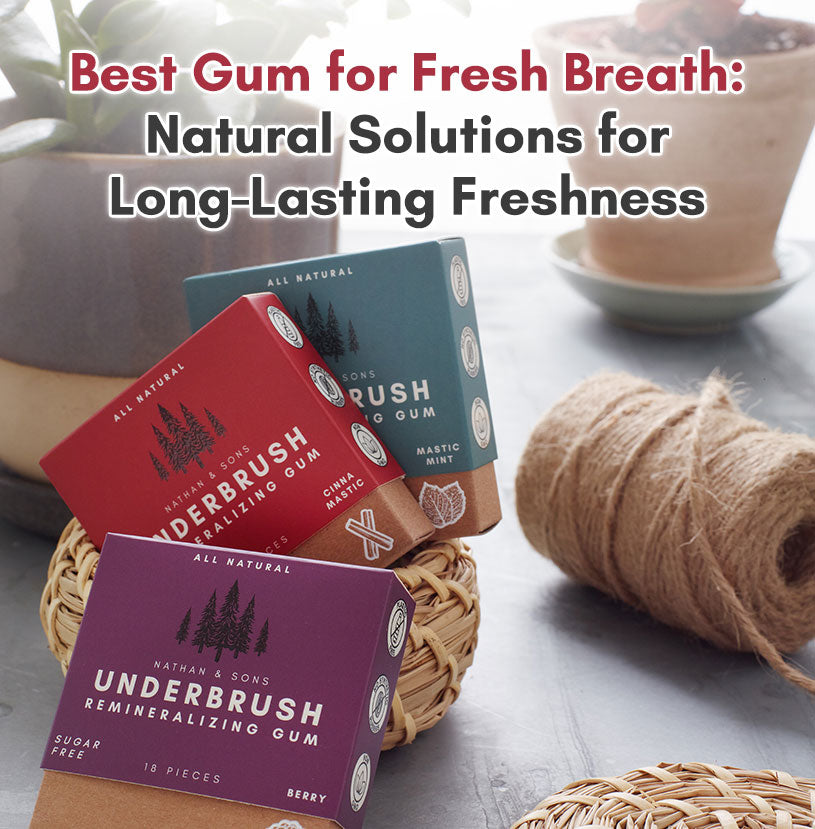
Our remineralizing gum is available with the full ingredient list on the product page.
Browse our full oral care collection to see everything we make.
To learn more about who we are and why ingredient transparency matters to us, visit our about page.
What This Gum Is Not
Honesty matters here.
This gum is not a dental treatment.
It does not address existing periodontal disease, diagnosed halitosis from systemic sources, or any other medical condition.
It does not replace brushing, flossing, tongue cleaning, or professional dental care.
Persistent bad breath that does not respond to consistent oral hygiene practices may indicate an underlying dental or medical condition that warrants professional evaluation.
Consult a qualified dental or healthcare provider before making changes to your oral care routine.
These statements have not been evaluated by the FDA and are not intended to diagnose, treat, cure, or prevent any disease.
Key Takeaways: Best Gum for Fresh Breath

Conventional mint-flavored gums provide temporary masking through flavoring agents — they do not address the bacterial activity producing volatile sulfur compounds.
All chewing gum stimulates saliva — which naturally buffers mouth acids, washes away bacteria, and suppresses anaerobic bacterial conditions.
A well-formulated breath-supporting gum adds active ingredients with documented oral health research profiles on top of that baseline.
Xylitol is non-fermentable by oral bacteria and has been associated in research with reduced cariogenic bacterial counts and plaque accumulation.
Mastic gum has documented antibacterial activity against Porphyromonas gingivalis and has been examined in clinical research for hydrogen sulfide reduction in breath.
Zinc gluconate chemically neutralizes volatile sulfur compounds directly — a fundamentally different mechanism from flavoring agents.
Menthone, carvone, and cineole have documented antimicrobial activity against oral bacterial species associated with bad breath.
Myrrh gum has bactericidal and anti-inflammatory properties examined in oral and dental health research contexts.
The gum base matters — a plant-based chicle base is consistent with and appropriate for delivering botanical active ingredients.
These statements have not been evaluated by the FDA.
Not intended to diagnose, treat, cure, or prevent any disease.
Frequently Asked Questions: Best Gum for Fresh Breath
Does chewing gum actually help with bad breath?
Chewing sugar-free gum stimulates saliva production — which the ADA recognizes as helping to neutralize acids, wash away bacteria, and suppress the anaerobic conditions that favor odor-producing bacteria.
Gum formulated with active ingredients that have oral health research profiles — such as xylitol, zinc, mastic, and terpene compounds — works through additional mechanisms beyond saliva stimulation alone.
These are research observations and should not be interpreted as treatment claims.
These statements have not been evaluated by the FDA.
What makes a gum good for fresh breath?
Look for gums that go beyond flavoring agents to include ingredients with documented oral health research profiles.
Key ingredients to look for include xylitol as the primary sweetener, zinc compounds for direct VSC neutralization, natural resin bases like mastic with documented antibacterial activity, and terpene compounds with antimicrobial research support.
Avoid gums with sucralose, aspartame, or sorbitol as primary sweeteners — and synthetic petroleum-derived polymer bases.
These statements have not been evaluated by the FDA.
How long does fresh breath gum last?
The duration of breath freshness from any gum depends on the underlying cause of breath issues, the formulation, and individual factors.
Flavoring agents in conventional gums typically dissipate within 20 to 30 minutes.
Ingredients that work through antimicrobial mechanisms — zinc, mastic, terpenes — address the bacterial activity producing odors rather than masking it, which may support more sustained effects.
Consult a dental professional if you experience persistent breath concerns.
These statements have not been evaluated by the FDA.
Is mastic gum good for bad breath?
Mastic gum — derived from Pistacia lentiscus resin — has been examined in research for its antibacterial activity against Porphyromonas gingivalis, a primary bacterial contributor to both periodontal disease and oral malodor.
A 2025 randomized clinical trial found that Chios mastic reduced objective hydrogen sulfide levels in oral breath in orthodontic patients over two weeks.
These are research observations and should not be interpreted as treatment claims for any specific condition.
These statements have not been evaluated by the FDA.
Does zinc help with bad breath?
Zinc ions react directly with volatile sulfur compounds — the hydrogen sulfide and methyl mercaptan molecules responsible for bad breath odors — neutralizing them chemically.
Multiple peer-reviewed studies have found significant reductions in measurable volatile sulfur compounds in breath following use of zinc-containing oral care products.
These are research observations and should not be interpreted as treatment claims.
These statements have not been evaluated by the FDA.
Why is xylitol better than other sweeteners for fresh breath gum?
Oral bacteria cannot ferment xylitol — which means they cannot use it to produce the lactic acid and volatile sulfur compounds associated with bad breath.
Conventional gum sweeteners like sorbitol can be fermented by certain oral bacteria — continuing the acid and odor production cycle.
Sucralose and aspartame have been associated with microbiome-related changes in certain studies.
Xylitol has a more extensively studied oral health research profile than any other commonly used gum sweetener.
These statements have not been evaluated by the FDA.
Is remineralizing gum the same as breath freshening gum?
Not necessarily — the category of remineralizing gum refers primarily to gums formulated with ingredients examined in enamel remineralization research.
Nathan and Sons' remineralizing gum combines enamel-supporting ingredients like nano-hydroxyapatite with fresh breath-supporting ingredients like xylitol, mastic, zinc gluconate, myrrh, and the terpene blend — making it a formulation designed to support both oral health dimensions simultaneously.
These statements have not been evaluated by the FDA.
Legal & Compliance Disclaimer
These statements have not been evaluated by the Food and Drug Administration.
This product is not intended to diagnose, treat, cure, or prevent any disease.
The information in this article is for educational purposes only and is not a substitute for professional dental or medical advice.
Consult a qualified dental or healthcare provider before making changes to your oral care routine.
Content current as of 2026.
Subject to revision.
References
Bollen CM, Beikler T. (2012). Halitosis: the multidisciplinary approach. International Journal of Oral Science, 4(2), 55–63. nature.com/articles/ijos201239.
Quirynen M, et al. (2009). Characteristics of 2000 patients who visited a halitosis clinic. Journal of Clinical Periodontology, 36(11), 970–975.
Slot DE, et al. (2019). Interventions for managing halitosis. Cochrane Review. PMC6905014.
American Dental Association. Chewing Gum. ADA Oral Health Topics. ada.org/resources/ada-library/oral-health-topics/chewing-gum.
Furtado Amaral CO, et al. (2023). The effect of gum chewing on xerostomia and salivary flow rate: a systematic review and meta-analysis. BMC Oral Health. PMC10280939.
Alexiou A, et al. (2025). The effect of Chios mastic toothpaste on halitosis and oral hygiene in orthodontic patients: a randomized clinical trial. Journal of Breath Research, 19, 046001.
Sterer N, et al. (2007). Antimicrobial effect of mastic gum methanolic extract against Porphyromonas gingivalis. ResearchGate.
Wu YF, Salamanca E, et al. (2022). Xylitol-containing chewing gum reduces cariogenic and periodontopathic bacteria in dental plaque. Frontiers in Nutrition, 9, 882636. PMC9131035.
Janakiram C, et al. (2022). Meta-analysis on the effectiveness of xylitol in caries prevention. PMC9022379.
Milgrom P, et al. (2006). Linear response of mutans streptococci to increasing frequency of xylitol chewing gum use. PMC1482697.
Söderling E, et al. (2010). Effects of xylitol chewing gum on salivary flow rate and Streptococcus mutans. PubMed. PMID: 20359274.
Pizato S, et al. (2007). A clinical study on the antimicrobial and breath-freshening effect of zinc-containing lozenge formulations. Journal of Clinical Periodontology. tandfonline.com.
Nalampang K, et al. (2019). Clinical effect of toothpaste and mouthrinse containing zinc lactate on oral malodor. PMC6522105.
Kozlovsky A, et al. (2008). Oral malodor reduction from a zinc-containing toothpaste. PubMed. PMID: 18763690.
Dobler D, et al. (2020). Effect of essential oils on oral halitosis treatment: a review. European Journal of Oral Sciences, 128(6). onlinelibrary.wiley.com/doi/10.1111/eos.12745.
Dallmeier K, et al. (2016). Evaluation of the antibacterial potential of phenolic essential oil compounds against oral microorganisms. PMC5040402.
Al-Ali KH, et al. (2023). Impact of Commiphora myrrha on bacteria related to dental caries. International Journal of Dental Medicine. sciencepublishinggroup.com.
Attia AM, Alqhtani M. (2023). Commiphora myrrh in management of periodontal diseases: review article. Acta Scientific Dental Sciences, 7(12), 42–46.
Wierichs RJ, et al. (2022). Efficacy of nano-hydroxyapatite on caries prevention: a systematic review and meta-analysis. Clinical Oral Investigations. PMC8979882.
Naim J, et al. (2025). The remineralizing and desensitizing potential of hydroxyapatite in dentistry: a narrative review. Biomimetics. PMC12470856.