
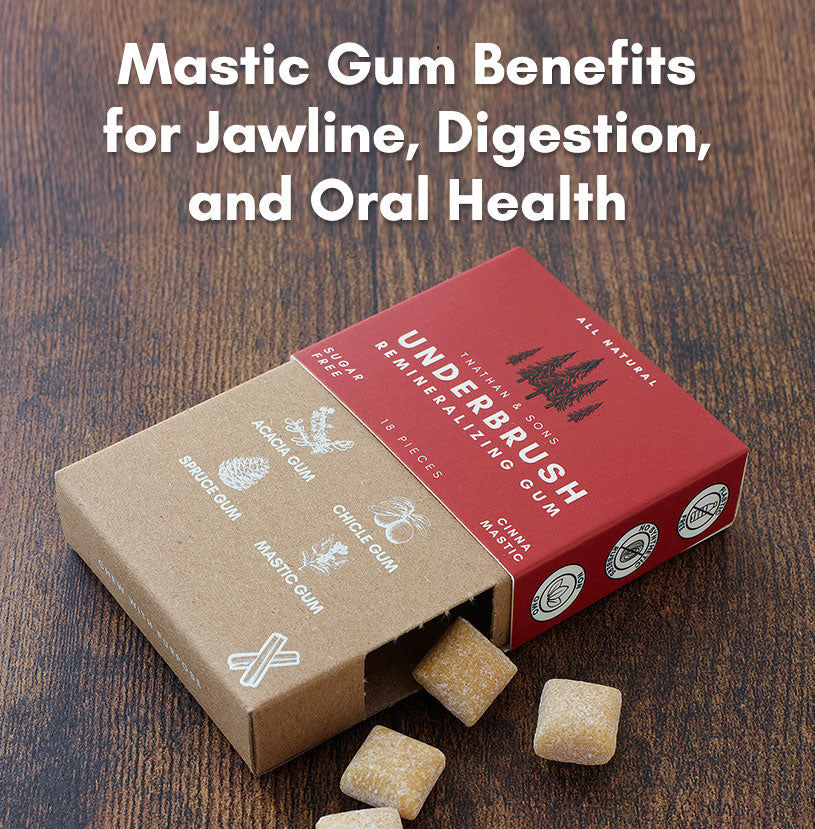
Mastic gum benefits include documented oral health research, digestive research, and jaw muscle activity — making this ancient Mediterranean resin one of the most studied natural gum ingredients available today.
And it has been used for over 2,500 years.
Ancient Greeks chewed it for oral hygiene and digestion
The Ottoman Empire traded it as a prized commodity.
Modern researchers have been studying it systematically for decades.
And in the last few years it has attracted a new wave of attention — not just for its oral health research profile but for its role in jaw muscle activity and digestive research.
This article covers what mastic gum is, what the peer-reviewed research says about it across three key areas, and what the honest picture looks like for someone evaluating it as an oral care ingredient.
These statements have not been evaluated by the Food and Drug Administration.
This product is not intended to diagnose, treat, cure, or prevent any disease.

What Is Mastic Gum?
Mastic gum is a natural resin harvested from the Pistacia lentiscus var. Chia tree — a species of flowering plant native to the Mediterranean region and cultivated predominantly on the Greek island of Chios.
The resin is collected by making small incisions in the tree bark and allowing the sap to harden into crystalline droplets — a harvesting method unchanged for centuries and recognized by UNESCO as Intangible Cultural Heritage.
These hardened crystals become soft and malleable when chewed — creating a natural gum-like consistency.
Historically known as the "tears of Chios" for the droplet shape of the crystallized resin, mastic has been used in traditional medicine across Greece, the Ottoman Empire, and the broader Mediterranean for oral hygiene, digestive support, and wound care.
Mastic's chemical composition includes a range of bioactive compounds including triterpenic acids, polyphenols, masticadienonic acid, and isomasticadienonic acid — which researchers have studied for antimicrobial, anti-inflammatory, and antioxidant properties.
A 2023 state-of-the-art review published in the Journal of Natural Medicines examined 14 peer-reviewed studies on mastic gum and oral health across 13 databases — confirming documented antibacterial and antimicrobial properties and inhibition of plaque accumulation across the reviewed literature.
These statements have not been evaluated by the FDA.
What Research Says About Mastic Gum and Oral Health
The oral health research on mastic gum is the most extensively documented area of its scientific study — and what the research has found is genuinely worth understanding.
Antibacterial activity against oral pathogens
A 2023 peer-reviewed narrative review published in PMC examining Pistacia lentiscus against oral biofilm-associated diseases reviewed the antimicrobial activity of Pistacia lentiscus essential oil, extracts, and mastic resin against microorganisms relevant to oral biofilm-associated diseases — and found that most studies focused on the capacity to antagonize Streptococcus mutans as a key bacterium in the demineralization process.
The same review found that mastic gum showed a statistically significant reduction of cariogenic bacteria in saliva compared to xylitol gum in one of the reviewed clinical studies.
A 2023 systematic review published in the Journal of Natural Medicines confirmed that mastic gum displayed antibacterial and antimicrobial properties and inhibited plaque accumulation — constituting what researchers described as an ingredient researchers have examined in caries-related research contexts.
Periodontal bacteria and anti-inflammatory properties
The same 2023 Journal of Natural Medicines review found that Pistacia lentiscus essential oil provided effective antibacterial activity against a variety of periodontal bacteria — and demonstrated anti-inflammatory properties in periodontal disease research contexts.
Fresh breath research
A 2025 randomized clinical trial published in the Journal of Breath Research examined Chios mastic toothpaste in orthodontic patients over two weeks and found that mastic treatment reduced objective hydrogen sulfide levels in oral breath — a primary measurable indicator of halitosis — alongside reductions in plaque and gingival indices.
All of the above represent research observations — not established clinical outcomes for dental disease prevention or treatment.
These findings should not be interpreted as claims that mastic gum prevents or treats tooth decay, gum disease, or bad breath.
Consult a qualified dental professional for any oral health condition.
These statements have not been evaluated by the FDA.

What Research Says About Mastic Gum and Digestive Health
Beyond oral health, mastic gum has attracted scientific interest for its potential role in digestive health — particularly in relation to Helicobacter pylori and gastrointestinal comfort.
Helicobacter pylori research
H. pylori is a bacterium associated with peptic ulcers and gastritis that affects a significant proportion of the global population.
Mastic gum has been studied for its antimicrobial activity against H. pylori across multiple research contexts.
A PMC review examining natural products and H. pylori eradication confirmed that mastic gum exhibited measurable minimum inhibitory concentrations against H. pylori in laboratory conditions — and noted that mastic gum has been included in clinical pilot studies examining its potential as an adjunct to standard therapies.
However — and this is important for honest representation — the PMC systematic review on vegetable extracts and H. pylori noted that mastic gum demonstrated nonsignificant effects on H. pylori eradication in a randomized pilot study — with antimicrobial effects more consistent in preclinical studies than in human clinical trials.
A 2024 randomized single-blind pilot study published in the Indian Journal of Gastroenterology examined mastic gum as an adjunct to standard bismuth quadruple therapy for H. pylori eradication — representing an area of ongoing clinical research.
The honest picture: mastic gum has documented antimicrobial activity against H. pylori in laboratory settings — but human clinical trial results have been mixed and the evidence does not currently support mastic gum as a standalone treatment for H. pylori infection.
Consult a qualified healthcare provider for any gastrointestinal health condition.
These statements have not been evaluated by the FDA and are not intended to diagnose, treat, cure, or prevent any disease.
Digestive comfort research
A 2022 review cited in Medical News Today referenced a randomized controlled trial in which participants taking mastic gum experienced significant reductions in dyspepsia symptoms — though the authors noted the need for further research with larger study populations.
Research on mastic gum's potential role in inflammatory bowel disease contexts has also been conducted — though a 2023 review noted that most supporting evidence comes from animal studies and that human clinical data remains limited.
These are research observations and should not be interpreted as treatment claims for any gastrointestinal condition.
These statements have not been evaluated by the FDA.
What Research Says About Mastic Gum and Jaw Muscle Activity
This is the area of mastic gum interest that has grown most significantly in recent years — driven partly by social media interest in jawline aesthetics and partly by legitimate research on mastication and muscle function.
Here is what the research actually shows — separated from the consumer marketing claims that have become common in this space.
What chewing research has found
A 2024 randomized controlled clinical trial published in the Journal of Oral Rehabilitation examined the effects of gum chewing training on occlusal force, masseter muscle thickness, and mandibular shape in 58 healthy adults over six months — finding that gum chewing training can improve masticatory muscle function and strength — but that this chewing did not alter facial shape or appearance in the study population.
A PMC study examining masticatory muscle activity with different chewing gums confirmed that harder and tougher chewing substrates produce higher masseter and temporalis muscle activity — consistent with the principle that chewing resistance influences the mechanical stimulus on jaw muscles.
Where mastic gum fits into this research
Mastic gum is notably harder than conventional chewing gum — particularly in its initial crystal form before it softens with chewing.
This greater resistance means it provides more mechanical stimulus to the masseter muscle during chewing than softer gum formulations.
The research does not specifically examine mastic gum for jawline development as a cosmetic outcome — and the 2024 Journal of Oral Rehabilitation study found that while jaw muscle thickness and bite force improved with chewing training, facial shape was not significantly altered.
The honest summary: chewing exercises — including chewing resistance gum — have been examined in research for effects on masseter muscle thickness and bite force.
Results on facial aesthetics specifically are limited and mixed.
Individual results vary based on genetics, existing muscle development, consistency, and other factors.
These are research observations and should not be interpreted as cosmetic outcome claims.

What Makes Mastic Gum Different From Conventional Gum
Most conventional chewing gums use a synthetic petroleum-derived polymer gum base — typically including polyvinyl acetate and polyisobutylene — which are inert materials that provide chewing texture without any biological activity relevant to oral health.
Mastic resin is a natural resin that has been examined in multiple areas of scientific research.
Its bioactive components — including masticadienonic acid, triterpenic acids, and polyphenols — are the same compounds researchers have studied for the antimicrobial, anti-inflammatory, and antioxidant properties described throughout this article.
For more on how natural gum bases differ from synthetic alternatives, our article on natural chewing gum covers the full research landscape including the 2025 microplastics research.
For more on the oral health research behind remineralizing gum formulations, our article on what is remineralizing gum covers the evidence in detail.
For more on the fresh breath research context, our article on best gum for fresh breath covers mastic gum alongside other ingredients examined in that research area.
For more on what the research says about enamel remineralization in general, our article on can you reverse tooth decay covers the demineralization and remineralization science.
The research discussed above evaluates mastic gum as an ingredient in laboratory and clinical research contexts.
The finished product has not been evaluated by the FDA for the prevention, treatment, or mitigation of any condition.
Nathan and Sons' remineralizing gum includes mastic gum as one of its plant-based resin ingredients alongside chicle, spruce gum, acacia gum, and myrrh gum — with full ingredient transparency on the product page.
Browse our full oral care collection to see everything we make.
To learn more about who we are and why ingredient transparency matters to us, visit our about page.
What the Research Does Not Confirm
The mastic gum research base is meaningful and growing — but important limitations deserve honest acknowledgment.
Most oral health research on mastic gum has been conducted in laboratory settings or small clinical studies — not large-scale randomized controlled trials.
The 2023 Journal of Natural Medicines review specifically noted that further research targeting Pistacia lentiscus products is required to validate and utilize these products in oral disease prevention contexts.
H. pylori eradication research on mastic gum has produced mixed results — with preclinical antimicrobial activity not consistently translating to clinical eradication outcomes in human trials.
Facial aesthetic outcomes from jaw chewing exercises are not reliably supported by current clinical evidence.
No mastic gum product has been evaluated by the FDA for the prevention, treatment, or cure of any disease.
Consult a qualified dental or healthcare provider before making changes to your oral care or health routine.
These statements have not been evaluated by the FDA and are not intended to diagnose, treat, cure, or prevent any disease.
Key Takeaways: Mastic Gum Benefits
Mastic gum is a natural resin from the Pistacia lentiscus tree — harvested on the Greek island of Chios using a traditional method unchanged for over 2,500 years.
A 2023 state-of-the-art review of 14 peer-reviewed studies confirmed that mastic gum displayed antibacterial and antimicrobial properties and inhibited plaque accumulation in oral health research contexts.
A 2025 randomized clinical trial found that Chios mastic reduced objective hydrogen sulfide levels in oral breath — a primary measurable indicator of halitosis — in orthodontic patients over two weeks.
Mastic gum has been studied for antimicrobial activity against H. pylori — though human clinical trial results have been mixed and it has not been established as a standalone treatment.
Research on gum chewing and masseter muscle activity has found that chewing resistance training can increase bite force and masseter thickness — though facial aesthetic outcomes are not reliably supported by current clinical evidence.
Mastic resin contains bioactive compounds including masticadienonic acid, triterpenic acids, and polyphenols that researchers have studied for antimicrobial and anti-inflammatory properties.
Most mastic gum research has been conducted in laboratory or small clinical settings — larger-scale human clinical trials are needed to confirm findings.
These statements have not been evaluated by the FDA.
Not intended to diagnose, treat, cure, or prevent any disease.
Frequently Asked Questions: Mastic Gum Benefits
What is mastic gum?
Mastic gum is a natural resin from the Pistacia lentiscus tree — harvested primarily on the Greek island of Chios where it has been produced for over 2,500 years.
It hardens into crystalline droplets that become soft and malleable when chewed — creating a natural gum consistency with a research profile that has attracted significant scientific interest in oral health, digestive, and muscle activity contexts.
UNESCO has recognized the traditional cultivation and harvesting of mastic on Chios as Intangible Cultural Heritage.
These statements have not been evaluated by the FDA and are not intended to diagnose, treat, cure, or prevent any disease.
What has research found about mastic gum and oral health?
A 2023 state-of-the-art review of 14 peer-reviewed studies found that mastic gum displayed antibacterial and antimicrobial properties and inhibited plaque accumulation in oral health research contexts.
Research has specifically examined mastic gum for its activity against Streptococcus mutans — a primary contributor to dental biofilm — and against periodontal bacteria.
A 2025 randomized clinical trial found that Chios mastic reduced objective hydrogen sulfide levels in oral breath in orthodontic patients over two weeks.
These are research observations and should not be interpreted as clinical claims about dental disease prevention or treatment.
These statements have not been evaluated by the FDA and are not intended to diagnose, treat, cure, or prevent any disease.
Does mastic gum help with digestion?
Mastic gum has been studied in research contexts involving Helicobacter pylori antimicrobial activity and digestive comfort.
Laboratory research has found documented antimicrobial activity against H. pylori — but human clinical trial results have been mixed, with a systematic review noting nonsignificant effects on H. pylori eradication in a randomized pilot study.
Research on digestive comfort has found promising results in some studies — though researchers note the need for larger clinical trials to confirm findings.
These are research observations and should not be interpreted as claims that mastic gum treats or prevents any digestive condition.
Consult a qualified healthcare provider for any gastrointestinal health concern.
These statements have not been evaluated by the FDA and are not intended to diagnose, treat, cure, or prevent any disease.
Does mastic gum help with jawline development?
Research on gum chewing training has found that chewing resistance exercises can increase masseter muscle thickness and bite force — but a 2024 randomized controlled trial found that gum chewing training did not significantly alter facial shape or appearance.
Mastic gum's greater hardness compared to conventional gum provides more mechanical resistance — making it a higher-stimulus chewing substrate from a muscle activity standpoint.
Individual results from any chewing exercise vary based on genetics, existing muscle development, and consistency of practice.
These are research observations and should not be interpreted as cosmetic outcome claims.
These statements have not been evaluated by the FDA and are not intended to diagnose, treat, cure, or prevent any disease.
Is mastic gum safe?
Mastic gum has a long history of use in food and traditional wellness practices.
Clinical studies have generally reported good tolerability among participants studied.
Animal studies reviewed in the literature have not reported mutagenic or carcinogenic findings under the conditions evaluated.
Allergic reactions are rare but may occur in individuals sensitive to tree resins.
Not recommended for infants due to choking risk.
Consult a qualified healthcare provider if you have known tree resin allergies or existing health conditions.
These statements have not been evaluated by the FDA and are not intended to diagnose, treat, cure, or prevent any disease.
Legal & Compliance Disclaimer
These statements have not been evaluated by the Food and Drug Administration. This product is not intended to diagnose, treat, cure, or prevent any disease. The information in this article is for educational purposes only and is not a substitute for professional dental or medical advice. Consult a qualified dental or healthcare provider before making changes to your oral care routine. Content current as of 2026. Subject to revision.
References
Alwadi MAM, et al. (2023). Mastic (Pistacia lentiscus) gum and oral health: a state-of-the-art review of the literature. Journal of Natural Medicines, 77, 430–445. DOI: 10.1007/s11418-023-01704-y.
PMC. (2023). Antimicrobial efficiency of Pistacia lentiscus L. derivates against oral biofilm-associated diseases — a narrative review. PMC10305426.
Alexiou A, et al. (2025). The effect of Chios mastic toothpaste on halitosis and oral hygiene in orthodontic patients. Journal of Breath Research, 19, 046001.
PMC. (2021). Vegetable extracts and nutrients useful in the recovery from Helicobacter pylori infection: a systematic review on clinical trials. PMC8070974.
PMC. (2017). Current knowledge on alleviating Helicobacter pylori infections through the use of some commonly known natural products. PMC5481734.
Tulsian V, et al. (2026). Mastic gum as an adjunct therapy to standard bismuth quadruple therapy for Helicobacter pylori eradication. Indian Journal of Gastroenterology. DOI: 10.1007/s12664-026-01968-8.
Jung S, et al. (2024). Effects of gum chewing training on occlusal force, masseter muscle thickness and mandibular shape: a randomised controlled clinical trial. Journal of Oral Rehabilitation. DOI: 10.1111/joor.13830.
PMC. (2024). Assessment of oral masticatory muscle activity with different chewing gums: a cross-sectional study. PMC11042667.
UNESCO. (2014). Know-how of cultivating mastic on the island of Chios. ich.unesco.org/en/RL/know-how-of-cultivating-mastic-on-the-island-of-chios-00993.