
The short version, up front: Rhodiola rosea is an adaptogenic herb that’s been studied for its relationship to mental fatigue, the foggy, worn-down feeling you get when your brain has been redlining for too long. When people search for rhodiola rosea mental fatigue, they usually want to know one thing: does it actually help? Human trials, from physicians on night shift to students cramming for exams, have reported improvements in fatigue and concentration, though the evidence isn’t unanimous and rhodiola is not a cure for anything. This article walks through what the research actually says, where it stops, and how people use it. It’s educational, not medical advice, so talk to your own healthcare provider before starting any supplement.
Let’s talk about that specific flavor of tired.
Not sleepy-tired.
The other kind.
The kind where you’ve had enough coffee, you’ve slept okay, and yet your brain is moving through wet cement.
Maybe you reread the same email three times.
Or you walk into a room and forget why.
Basically, you’re running on empty, and no amount of willpower seems to top up the tank.
That exact feeling, the mental version of a dying phone battery, is where the conversation about rhodiola rosea and mental fatigue begins.
First, what even is rhodiola rosea?
Picture the coldest, most miserable, wind-scoured cliffs in the Arctic and the mountains of Siberia.
Now picture a small yellow-flowered plant that not only survives up there but apparently thrives.
That’s rhodiola rosea, also called golden root, roseroot or Arctic root.
For centuries, people across Scandinavia, Russia, and Central Asia used it as a folk remedy for exactly the situations that grind you down: long winters, hard labor, and stress.
Notably, Russian and Scandinavian researchers spent decades studying it, which is why so much of the early clinical work has names like Spasov and Darbinyan attached to it.
Today, rhodiola gets filed under a useful little category called “adaptogens.”
The “adaptogen” idea, explained without the hand-waving
Here’s where a lot of wellness writing goes fuzzy, so let’s be concrete.
An adaptogen is, loosely, a plant compound studied for helping the body cope with stress, whether physical, mental, or environmental.
The theory is that instead of flooring the gas pedal like caffeine, an adaptogen helps smooth out your stress response so you don’t crash as hard.
A steadier curve, not a spike.
Mechanistically, researchers have pointed to rhodiola’s active compounds (mainly rosavins and salidroside) and their interaction with your stress-hormone system, the HPA axis.
In plain English: some research suggests rhodiola may blunt the peak of your stress-cortisol response without knocking you out, which would help explain why people describe it as “calm alertness” rather than “wired.”
Now, the honest caveat. “Adaptogen” is a research and traditional-use category, not a magic wand.
It doesn’t mean rhodiola fixes the underlying reason you’re exhausted.
If you’re running on four hours of sleep and three deadlines, the actual fix is sleep and fewer deadlines. A point we’ll keep coming back to.
What the research actually says about rhodiola rosea and mental fatigue
This is the heart of it, so let’s look at real studies rather than vibes.
One of the most-cited is a double-blind study of physicians on night duty, published in Phytomedicine in 2000.
Fifty-six young, healthy doctors. A group basically engineered to be sleep-deprived and mentally fried. They took a standardized rhodiola extract or a placebo.
Researchers measured a “Fatigue Index” built from tests of concentration, short-term memory, calculation, and speed of perception.
The result? A statistically significant improvement in that fatigue index during the first two weeks in the rhodiola group.
In other words, the doctors on rhodiola held their mental performance together better on brutal night shifts than the ones on placebo.
Then there’s the exam-stress study in students, also from 2000.
Foreign students. Twenty days of rhodiola or placebo, right through a stressful examination period.
The rhodiola group showed significant improvements in mental fatigue, physical fitness, neuro-motor tests, and general well-being.
If you’ve ever pulled an exam all-nighter, you already understand the population they were studying.
Zooming out from single studies, a systematic review by Ishaque and colleagues examined 11 clinical trials evaluating rhodiola for physical and mental fatigue.
For mental fatigue specifically, the review reported that three of the five mental-performance trials it examined indicated rhodiola may help in a mentally fatigued population. It also, importantly, noted that some studies didn’t use validated fatigue measures and that better-designed research is needed.
And a more recent 2022 review by Stojcheva and Quintela pulled together clinical evidence on rhodiola for cognition and life-stress symptoms, including a trial where adults with stress symptoms took 200 mg twice daily for four weeks and reported improvements in fatigue, mood, and quality of life.
So the pattern across the literature is reasonably consistent. In stressed, fatigued people, rhodiola is associated with reported improvements in mental fatigue and concentration.
Now the part most articles skip: where the evidence stops
Here’s where we earn your trust instead of just cheerleading.
The rhodiola research, while encouraging, is not airtight, and pretending otherwise would be doing you a disservice.
For one, not every study is positive.
A 2025 triple-blind crossover trial testing rhodiola under mental-fatigue conditions found its main benefits showed up in physical performance, not visuo-cognitive or mental outcomes.
That’s a real result, and it belongs in an honest write-up.
Beyond that, many of the positive studies are small, some are decades old, and reviewers consistently note that better, larger trials are needed.
Product quality is another wrinkle. Rhodiola supplements vary enormously, and many of the classic studies used one specific standardized extract (SHR-5), so a random bottle off a shelf isn’t guaranteed to match.
And the biggest caveat of all. Rhodiola is a supplement, not a treatment.
It is not a substitute for sleep, and it does not diagnose, treat, cure, or prevent any disease.
These statements have not been evaluated by the Food and Drug Administration. Rhodiola rosea is a dietary supplement and is not intended to diagnose, treat, cure, or prevent any disease.
How people actually use rhodiola rosea

Let’s get practical, with the standing reminder that this is general information, not a personalized protocol.
In the studies above, doses commonly landed in the range of roughly 200 to 680 mg per day of standardized extract, often taken in the morning.
Anecdotally, people reach for rhodiola in exactly the “running on empty” moments the research studied. Before a demanding workday. During a high-stress stretch. When jet lag and deadlines collide.
Because some people find it activating, the common folk-wisdom is to take it earlier in the day rather than at night, since a wired 2 a.m. is nobody’s goal.
These days, rhodiola also shows up in some functional-format products aimed squarely at the “running on empty” crowd.
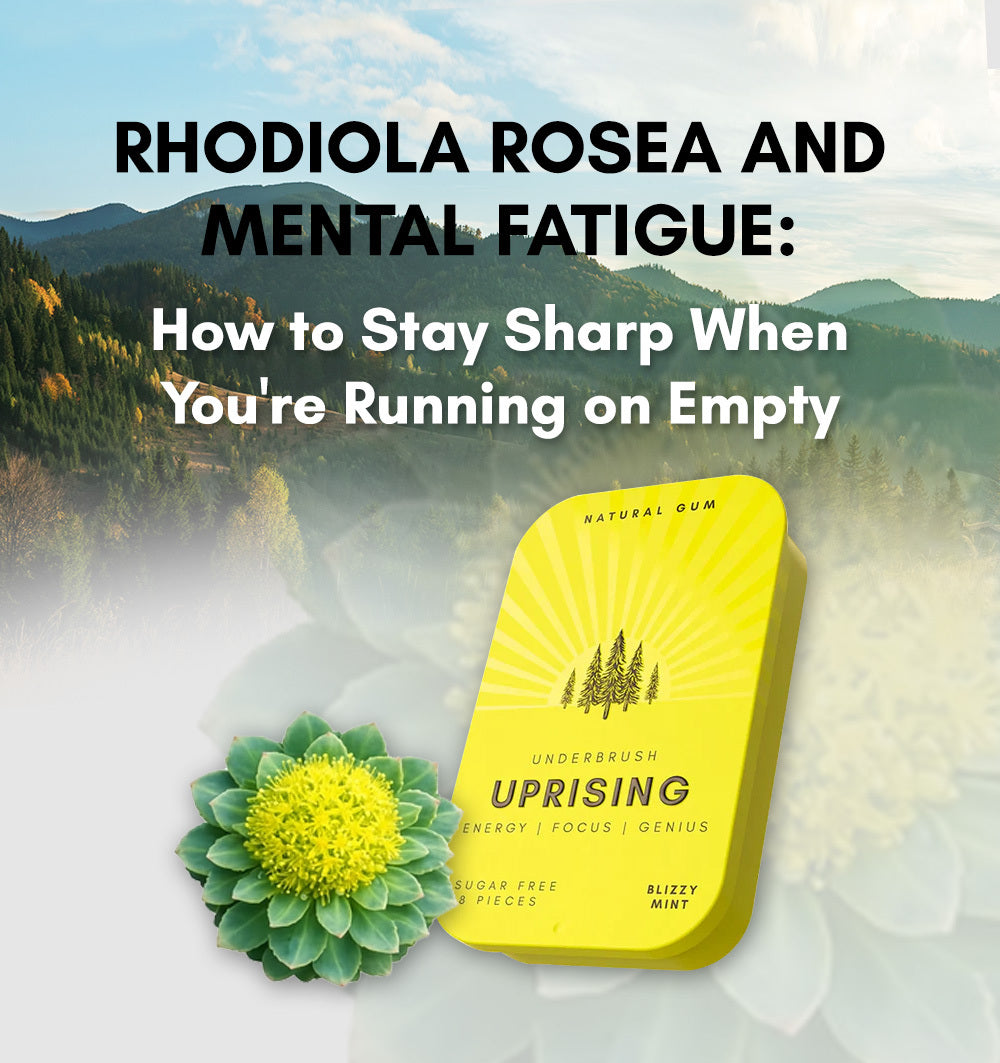
Our own Uprising Energy Gum is one example. It pairs rhodiola rosea with clean caffeine, L-theanine, and a few other studied ingredients, on the same plant-based chicle base as Underbrush.
The idea behind including rhodiola there is exactly the research we just walked through. It’s the ingredient that’s been studied for its relationship with mental performance during stressful periods, while caffeine is the part people commonly use for alertness and L-theanine has been studied for its relationship with attention and relaxation.
To be clear, that’s a delivery format, not a magic upgrade. The same honest caveats above still apply, and a piece of gum is not a substitute for sleep either.
Think of it less like an energy drink and more like a steadying hand.
Realistically, it’s not going to make you superhuman.
At best, in the research, it’s associated with supporting aspects of mental performance during periods of stress.
A quick reality check, because we like you
Imagine your mental energy as a bank account.
Rhodiola, at most, might help you avoid overdraft fees on a rough day.
But it does not deposit money.
Sleep deposits money. Real rest, movement, decent food, and actually closing the laptop. Those are the deposits.
Meanwhile, if you treat rhodiola as permission to keep withdrawing from an empty account indefinitely, you’ll lose that game no matter what’s in your supplement cabinet.
So the healthiest way to think about rhodiola rosea and mental fatigue is as a possible supporting player in a life that also includes the boring, unglamorous basics.
Now, the questions people actually ask.
Does rhodiola rosea give you energy like caffeine?
Not in the same way.
Caffeine is a stimulant that directly revs your nervous system, while rhodiola is an adaptogen studied for helping the body handle stress and reduce the sensation of mental fatigue.
People often describe the feeling as “calm focus” rather than the jittery lift of coffee.
Many use the two together, but they work through different mechanisms.
How long does rhodiola take to work for mental fatigue?
It varies.
Some of the clinical studies used repeated daily dosing over two to four weeks and measured cumulative effects, while some people report a subtle same-day sense of steadiness.
Because responses differ from person to person, and product quality varies, there’s no single guaranteed timeline.
Consistency in the research generally mattered more than a one-off dose.
Is rhodiola rosea safe to take every day?
In clinical trials, rhodiola was generally well tolerated with relatively few side effects reported, which is part of why it’s been studied as much as it has.
That said, “generally well tolerated in studies” is not the same as “right for you specifically.”
Anyone who is pregnant or nursing, taking medications, or managing a health condition should talk to a qualified healthcare provider before starting rhodiola or any supplement.
What’s the difference between rhodiola and other adaptogens like ashwagandha?
They’re often discussed together but tend to occupy different lanes.
Ashwagandha is frequently associated in research with calming and cortisol at rest, while rhodiola is more associated with stress-related fatigue and mental performance under pressure, the “running on empty” scenario.
Some people use one, some rotate, and some stack them, but the research bases are distinct.
Can rhodiola replace sleep?
No, and this is the most important answer here. Nothing replaces sleep, and rhodiola is not a workaround for chronic sleep deprivation.
In the research, its association with reduced mental fatigue showed up as support for stressed, tired people, not as a substitute for actual rest.
If you’re consistently exhausted, that’s a signal worth taking to a healthcare professional, not a problem to out-supplement.
The honest bottom line

Rhodiola rosea is one of the more genuinely interesting adaptogens. Precisely because there’s real human research behind the “running on empty” use case rather than just marketing.
Across studies of night-shift doctors, stressed students, and burned-out adults, rhodiola rosea and mental fatigue show a real relationship: it’s associated with reported improvements in fatigue and concentration, with the honest asterisks that the evidence isn’t unanimous, the trials could be bigger, and product quality varies.
Used thoughtfully, as a supporting player alongside sleep and the other basics, it’s a reasonable thing for a curious, tired person to explore with their healthcare provider.
Just don’t ask it to do sleep’s job.
Even the hardiest little Arctic flower can’t rewrite that rule.
Disclosure: Nathan & Sons makes and sells Uprising Energy Gum, mentioned above. This article is educational and reflects publicly available research; it isn’t a guarantee of any specific outcome, and individual results vary.
References
- Darbinyan V, et al. Rhodiola rosea in stress-induced fatigue: a double-blind cross-over study of SHR-5 on the mental performance of healthy physicians during night duty. Phytomedicine 2000;7(5):365-371. (PMID 11081987.)
- Spasov AA, et al. A double-blind, placebo-controlled pilot study of the stimulating and adaptogenic effect of Rhodiola rosea SHR-5 extract on the fatigue of students during an examination period. Phytomedicine 2000;7(2):85-89. (PMID 10839209.)
- Ishaque S, Shamseer L, Bukutu C, Vohra S. Rhodiola rosea for physical and mental fatigue: a systematic review. BMC Complementary and Alternative Medicine 2012;12:70. (PMID 22643043.)
- Stojcheva EI, Quintela JC. The effectiveness of Rhodiola rosea L. preparations in alleviating various aspects of life-stress symptoms and stress-induced conditions. Molecules 2022;27(12):3902.
- Randomized, triple-blind, placebo-controlled crossover trial on Rhodiola rosea and strength performance under resting and mental-fatigue conditions, 2025 (PMC11944791).
- U.S. FDA, Dietary Supplements overview (DSHEA framework; structure/function claims).