
Advertising disclosure: This comparison was prepared by Nathan & Sons, the maker and seller of Underbrush. It is promotional content and should not be considered an independent product review. Sources were last reviewed on July 20, 2026.
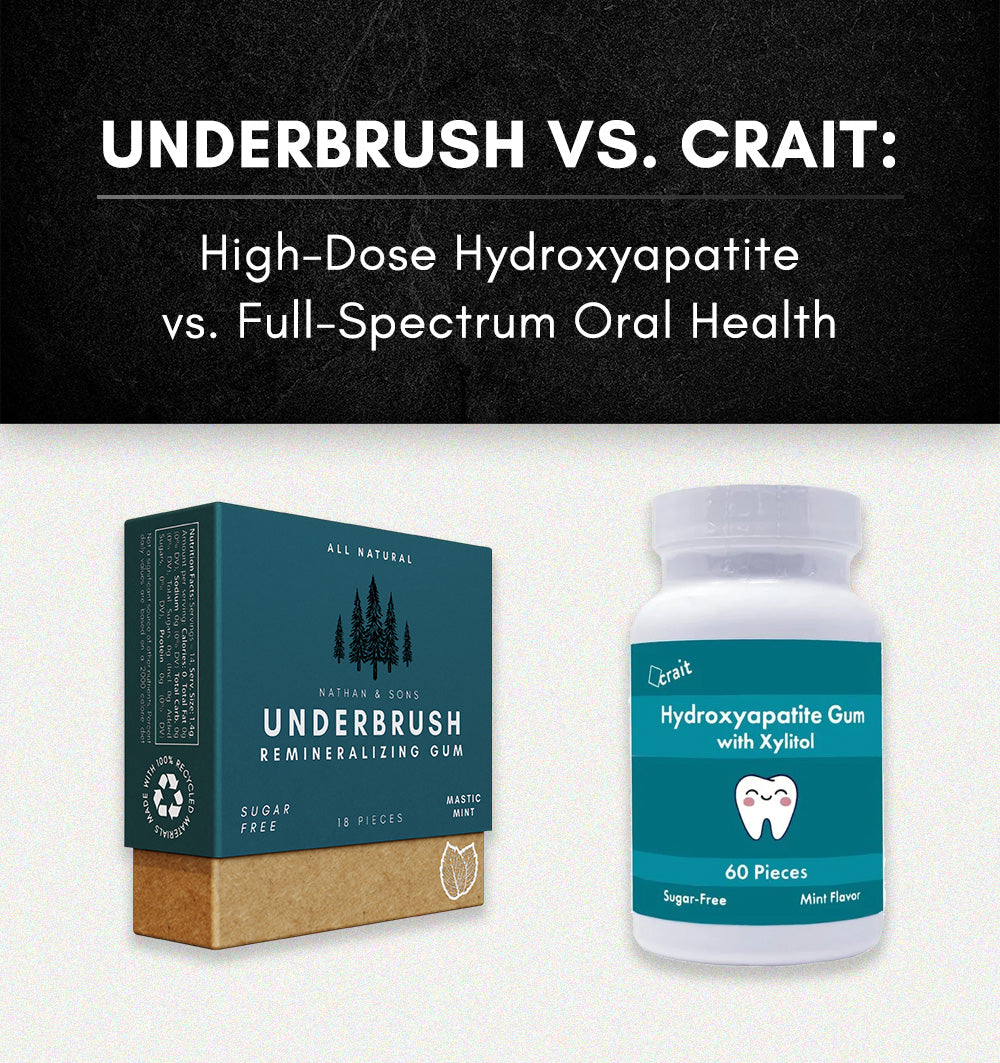
The bottom line, up front: Crait is a hydroxyapatite gum built around a big, specific number: 70 mg of non-nano hydroxyapatite per piece, plus xylitol, in mint and cinnamon, according to its Amazon listing. This Underbrush Vs. Crait hydroxyapatite gum comparison comes down to a real fork: one concentrated listed ingredient, or a broader formula. Underbrush lists nano- and micro-hydroxyapatite plus xylitol, erythritol, minerals, and botanical resins on a chicle-based gum base. Neither gum replaces brushing, flossing, or your dentist. We make Underbrush, so we’re biased, which is exactly why everything below is sourced.
Let’s do this Underbrush Vs. Crait hydroxyapatite gum comparison with full transparency.
Not the “our competitor is secretly terrible” way.
And definitely not the “our gum will rebuild your teeth while you sleep” way.
Instead, we’re going to weigh Underbrush by Nathan & Sons against Crait using what the labels and product pages actually say, plus what the oral-health evidence actually supports.
Then, just as importantly, we’re going to tell you where the evidence stops.
All of this matters, because hydroxyapatite gum has become a small gold rush.
Suddenly the word “hydroxyapatite” is on a dozen labels. And a big milligram number on the front looks like a trophy.
But “has the most of one ingredient” and “has the formula you actually want” are two different claims.
And the gap between them is the whole point of this article.
So that’s exactly why this Underbrush Vs. Crait hydroxyapatite gum showdown matters.
First, the part where we admit our bias
First, the obvious: we’re Nathan & Sons.
Naturally, we make Underbrush.
So of course we think a broader formula has advantages over a single-headline-ingredient one.
Still, being biased doesn’t give us permission to be sloppy.
Because of that, here are the rules we’re playing by.
First, we’re citing official Crait and Nathan & Sons listings for ingredients, doses, and product claims.
In addition, we’re citing the American Dental Association and peer-reviewed reviews for the broader oral-health science.
And here’s the big one. We are not claiming that chewing Underbrush reverses cavities, replaces brushing, or substitutes for your dentist.
Frankly, if a gum brand tells you gum replaces basic oral hygiene, that gum brand needs a chair, a glass of water, and a serious talk.
A quick note on respect, because we mean it
Let’s give Crait credit where it’s due.
Crait is doing something we fundamentally agree with: putting hydroxyapatite into a chewing-gum format so people can support their oral-care routine on the go.
That’s the same core idea behind Underbrush, so we’re not going to pretend it’s a bad instinct. It isn’t.
Crait also leads with a specific, disclosed number, 70 mg of hydroxyapatite per piece according to its Amazon listing.
Disclosing an amount at all is more than some brands bother to do, and we’ll give a nod to that.
So this isn’t a story about a bad gum.
It’s a story about two different philosophies.
Crait is mostly about concentrating on one headline mineral.
Underbrush is mostly about a broader ingredient list.
That’s the whole chewy battlefield.
If you want the deeper background on our formula, our Underbrush remineralizing gum page lays out every ingredient.
The labels, side by side
Imagine standing there comparing two bottles.
To start, Crait’s listing describes a remineralizing gum with non-nano hydroxyapatite and xylitol, sugar-free, in mint and cinnamon, at 70 mg of hydroxyapatite per piece.
That’s a clean, focused pitch: one big mineral number, plus xylitol to round it out.
Here’s a real gap worth noting, though.
The specific Crait Amazon listing we reviewed prominently identifies non-nano hydroxyapatite and xylitol, but we did not locate a complete, itemized ingredient statement or a detailed gum-base breakdown on that listing.
This observation is limited to that page as it appeared on our review date and does not establish that Crait provides no additional information elsewhere.

Underbrush Mastic Mint, by contrast, lists its full formula: xylitol, a chicle gum base (chicle, candelilla wax, citric acid), erythritol, mastic gum, spruce gum, acacia gum, mint flavor, myrrh gum, nano- and micro-hydroxyapatite, calcium carbonate, calcium bentonite clay, magnesium carbonate, zinc gluconate, and a terpene blend.
Clearly, that’s a mouthful in both senses.
As a result, Crait wins the single-number simplicity. One mineral, one big figure.
Underbrush, meanwhile, publishes the fuller ingredient statement reproduced above, including named components of its chicle gum base, plus additional minerals and resins not shown on Crait’s listing. Some entries, like “mint flavor” and “terpene blend,” are identified collectively rather than itemized.
Neither of those is automatically “better.” They’re answers to different questions.
The one big difference in the hydroxyapatite itself
Here’s a genuinely interesting, factual distinction, and it’s not just about the number.
Crait’s listing specifies non-nano hydroxyapatite.
Underbrush lists nano- and micro- hydroxyapatite.
That’s a real formulation difference in the particle size each brand chose, and it’s worth understanding rather than glossing over.
Nano-hydroxyapatite refers to very small particles. Micro-hydroxyapatite refers to larger ones.
Underbrush includes both sizes on its label, while Crait’s listing specifies the non-nano form.
We’re not going to claim one particle size wins a head-to-head, because we don’t have gum-specific trials proving that.
What we can say is that it’s a real, disclosed difference in approach, and if particle size matters to you, it’s worth reading both labels closely.
What the evidence actually says about hydroxyapatite
Before anyone crowns a winner on milligrams, here’s the sober baseline that applies to both gums.
In fact, hydroxyapatite is the mineral that makes up roughly 90 to 97 percent of your tooth enamel.
For a deeper dive, see our explainer on what nano-hydroxyapatite is.
The thinking behind putting it in gum is straightforward: supply a mineral that’s already the main building block of enamel, in a format you use throughout the day.
For evidence, a 2021 systematic review and meta-analysis in the Canadian Journal of Dental Hygiene reported that studies of certain hydroxyapatite-containing, fluoride-free oral-care products have reported reductions in caries outcomes, with one meta-analysis of three randomized trials showing a measurable protective effect.
Important caveat right up front, though. That evidence comes from oral-care products like toothpastes, gels, and rinses, not from a clinical trial on either of these gums.
Put bluntly, any gum that simply lists “hydroxyapatite” is, to a real degree, borrowing toothpaste’s homework.
That applies to Crait, and it applies to Underbrush too.
So here’s the scoop that covers both brands.
Hydroxyapatite has been studied in oral-care products like toothpastes, and both gums put it in a chewable format, but we did not identify a published, product-specific clinical trial for either gum in the sources we reviewed.
That limited search shouldn’t be read as proof that no studies exist.
We won’t pretend otherwise for our own gum, and it wouldn’t be fair to pretend otherwise about theirs.
Does a bigger milligram number automatically win?
Here’s the concern worth raising about the “high-dose” framing, and it’s an honest one.
A large listed dose of one ingredient is a real, concrete data point. It’s not nothing.
But “more milligrams of one thing” and “better oral-care outcome” are not automatically the same statement.
There’s no established, gum-specific dose-response curve that says a particular hydroxyapatite milligram count in gum produces a proportionally better result.
So a big front-of-label number is genuinely appealing, and we understand why it sells. It just isn’t the same as proven performance.
Think of it like buying a blender by horsepower alone.
More horsepower sounds impressive. And sometimes it matters.
But the horsepower number by itself doesn’t tell you whether the thing actually makes a better smoothie.
The milligram number is the horsepower. Useful context, not the whole story.
Additional ingredients listed by Underbrush
Underbrush’s whole design philosophy is the other direction from a single concentrated number.
It keeps hydroxyapatite and xylitol, then adds erythritol, calcium carbonate, calcium bentonite clay, magnesium carbonate, and zinc gluconate, plus botanical resins like mastic, spruce, acacia, and myrrh.
To be clear, more ingredients isn’t automatically “better.”
But if you’re looking for a gum with a broader ingredient list rather than a single high-dose headline, that’s the scope difference in a nutshell.
The formulas differ in the number and types of listed ingredients, and reasonable people can prefer either approach.
Ingredient diversity alone does not establish broader, stronger, or more effective oral-health performance.
What the ADA actually says about chewing gum
Here’s the baseline both brands rest on, no matter their mineral count.
The strongest argument for any sugar-free gum isn’t mystical. It’s saliva.
Specifically, the American Dental Association notes that chewing gum increases salivary flow, and that sugar-free gum may help reduce cavity risk when added to a routine of brushing twice daily and cleaning between teeth daily.
Both Crait and Underbrush are sugar-free and use xylitol, so both get the benefit of that baseline.
For a deeper dive on that shared sweetener, our explainer on everything you need to know about xylitol breaks it down.
Crucially, the ADA also says, plainly, that gum is not a substitute for brushing or flossing.
In fact, that sentence should be printed on a tiny billboard and taped to every ambitious gum brand’s forehead, including ours.
These statements have not been evaluated by the Food and Drug Administration. This product is not intended to diagnose, treat, cure, or prevent any disease.
Taste and texture: a deeper dive
Here’s a thing that happens more than people admit.
Someone insists they want the cleanest possible formula.
Then they chew something natural and discover their mouth has opinions.
Crait offers two familiar flavors, mint and cinnamon, which is a nice, approachable range for a focused product.
Underbrush leans woodsier, with herbal, piney, and earthy undertones from mastic, spruce, and chicle, and a firm chew that some people love and some need to adjust to.
Taste is personal, and obviously, both are natural-leaning gums where your own preference is the only review that counts.
Price and value: the part where everyone pretends not to care
Price matters, jokes about botanicals aside.
Crait has been noted around a premium price point for its pack sizes, which is common for hydroxyapatite gums generally.
Underbrush, meanwhile, is also positioned as a premium gum with a more complex formula.
But the real question isn’t “which is cheapest?”
Instead, it’s “what job are you hiring the gum to do?”
Hiring gum to deliver one big, disclosed hydroxyapatite number in a simple format?
Then Crait’s pitch is clear and easy to understand.
Hiring gum to run on a named chicle base and carry hydroxyapatite plus xylitol, erythritol, minerals, and botanical resins?
In that case, that’s a different job, and that’s Underbrush’s lane.
Frankly, recommending a broad multi-ingredient gum to someone who just wants one big mineral number is like recommending a Swiss Army knife to someone who only wanted a good screwdriver.
On the flip side, recommending a single-headline-ingredient gum to someone who wants a fuller formula leaves that person wanting.

Our final verdict on Underbrush Vs. Crait hydroxyapatite gum
So here’s where the Underbrush Vs. Crait hydroxyapatite gum question finally lands.
On one side, Crait is a clear answer to “can a gum lead with one big, disclosed hydroxyapatite number in a simple format?”
On the other, Underbrush is our answer to a different question: “can a gum carry hydroxyapatite and a broader, published set of oral-care ingredients?”
Accordingly, Underbrush may appeal to shoppers who want a published ingredient statement, a named base, and ingredients beyond a single headline mineral.
Meanwhile, Crait may appeal to shoppers who want one concentrated hydroxyapatite number and a simple, focused pitch.
Specifically, we’d give Crait sincere credit for disclosing a specific hydroxyapatite amount and for embracing the same on-the-go remineralizing-gum idea we believe in.
At the same time, the honest point we’d raise is scope.
A single large listed amount of one ingredient is one part of a formula, and on the listing we reviewed, Crait led with its headline ingredients rather than a full itemized statement, while Underbrush publishes its complete ingredient statement.
As for us, we built Underbrush for the person who wants the hydroxyapatite and the rest of the formula spelled out.
To be fair.
If your priority is one big, clearly stated mineral number in a simple gum, Crait’s pitch is easy to understand, and we won’t pretend otherwise.
If your priority is a published, broader ingredient statement on a chicle-based gum base, that’s the approach we chose for Underbrush.
And we’re secure enough to say both of those things out loud.
If you want to see how Underbrush stacks up against other hydroxyapatite gums, our 2026 US guide to Underbrush vs. competitors goes wider than this one.
Finally, if you’d like to try it, you can find Underbrush on our remineralizing gum page.
What we can and can’t legitimately claim

We hold ourselves to this, so we’ll put it in writing.
What we can say: Underbrush lists nano- and micro-hydroxyapatite on our label, and hydroxyapatite has been studied in other oral-care products with supportive findings reported.
What we can say: Crait’s Amazon listing states 70 mg of non-nano hydroxyapatite per piece, because that’s the figure on its listing.
What we can say: Both gums are sugar-free and use xylitol, which has supportive oral-health evidence as an adjunct to brushing and flossing.
What we can’t say: That either gum has product-specific clinical trials proving it remineralizes teeth, because neither of us is citing that here.
What we can’t say: That a bigger milligram number automatically produces a better result, because there’s no established gum-specific dose-response evidence for that.
What we can’t say: That any gum replaces brushing, flossing, professional cleanings, or your dentist’s advice.
That’s the line. We’re happy standing on it.
One last note before you shop
If you go looking for Underbrush, buy it from us directly here at nathanandsons.com, our TikTok Shop, our official Amazon seller, or Etsy.
As with any online purchase, we’d recommend buying Underbrush through the sales channels identified here on our official website, so you can verify the source of the product.
That’s just good practice for any gum you buy, ours or anyone else’s.
After all, that’s how seriously we take it.
Underbrush Vs. Crait - Frequently Asked Questions
Is a higher hydroxyapatite dose, like Crait’s 70 mg, better for your teeth?
Not necessarily, and it’s worth being honest about this.
A large listed dose is a real, disclosed data point, and Crait deserves credit for stating a specific number.
But there’s no established gum-specific dose-response evidence showing that a particular hydroxyapatite milligram count produces a proportionally better outcome.
Most hydroxyapatite research comes from toothpastes and rinses, not gum.
So a bigger front-of-label number is appealing, but it isn’t the same as proven performance.
What’s the main difference between Underbrush and Crait?
Philosophy. Crait concentrates on one headline mineral, leading with 70 mg of non-nano hydroxyapatite plus xylitol in a simple, focused pitch.
Underbrush keeps hydroxyapatite (nano and micro) and xylitol, then adds erythritol, minerals like calcium and magnesium carbonate and zinc gluconate, and botanical resins, on a chicle-based gum base.
Crait has the simpler single-number pitch; Underbrush publishes a broader ingredient statement.
What’s the difference between nano and non-nano hydroxyapatite?
It refers to particle size. Nano-hydroxyapatite is made of very small particles; non-nano and micro forms are larger.
Crait’s listing specifies non-nano, while Underbrush lists both nano and micro.
It’s a real, disclosed formulation difference, though we won’t claim one particle size beats another in gum, because we didn’t identify product-specific head-to-head trials in the sources we reviewed.
Does either gum actually remineralize teeth?
Both list hydroxyapatite, and hydroxyapatite has supportive evidence in oral-care products like toothpastes.
But that evidence is not the same as a clinical trial proving either gum remineralizes teeth, and neither Crait nor Underbrush is citing gum-specific trial data here.
Treat both as an adjunct to good oral care, not a proven treatment. These statements have not been evaluated by the FDA.
Where should shoppers find current product information for each gum?
Check each manufacturer’s current label and official product materials, since ingredients, amounts, flavors, and availability can change after this article’s review date.
For Underbrush, that’s our own product page and listings; for Crait, that’s their official listing.
Comparing the two current labels side by side is the most reliable way to see how the formulas differ today.
References
- Nathan & Sons, Underbrush Remineralizing Gum product page (ingredients, positioning).
- Crait Remineralizing Gum, Amazon listing (non-nano hydroxyapatite, 70 mg per piece, xylitol, sugar-free, mint and cinnamon).
- Crait Hydroxyapatite Remineralizing Gum Review, ChewingGumReviews.com (independent review; ingredient overview).
- American Dental Association, Chewing Gum, ADA Oral Health Topics (ada.org).
- Limeback H, Enax J, Meyer F. Biomimetic hydroxyapatite and caries prevention: a systematic review and meta-analysis. Canadian Journal of Dental Hygiene 2021;55(3):148-159. (PMID 34925515.)
- Amazon, Underbrush Mastic Mint product listing (B0CTNK1ZQC).