
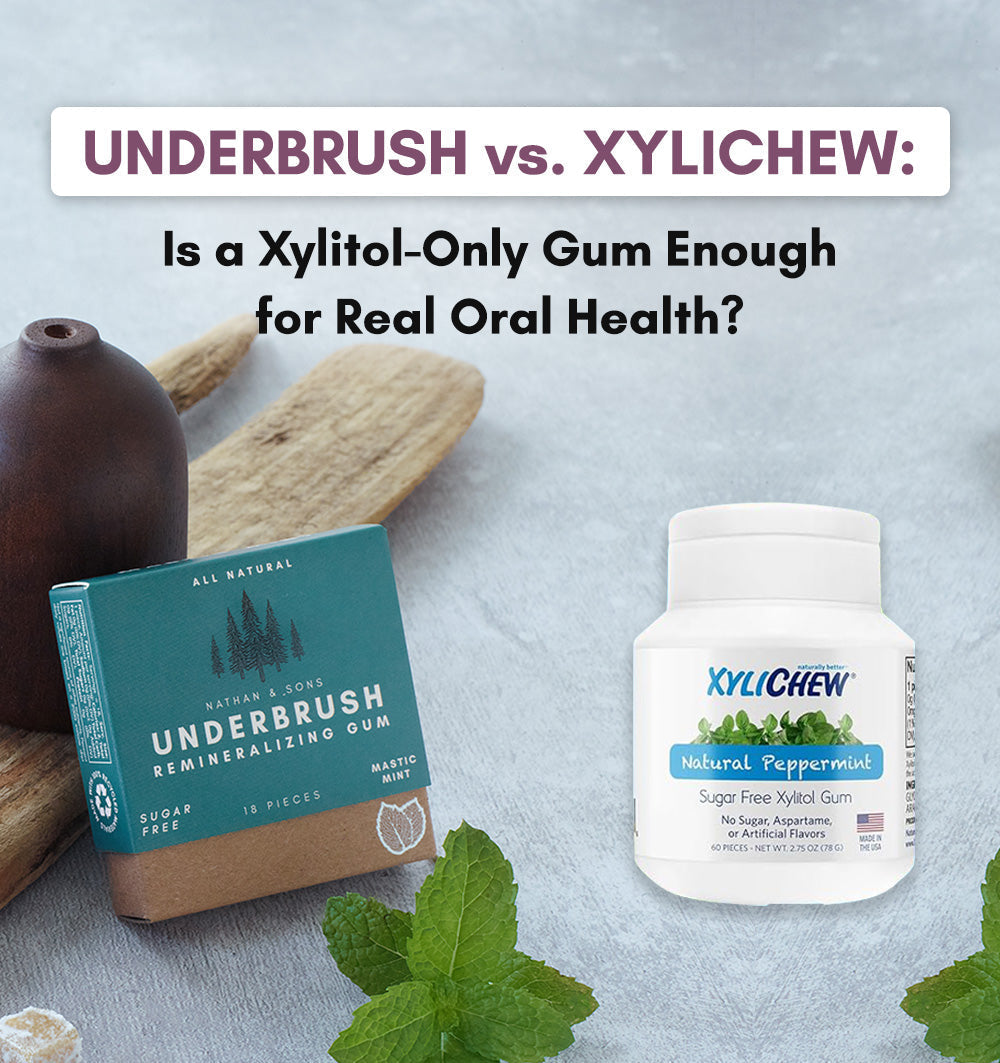
The bottom line, up front: XyliChew is a genuinely solid, transparent, 100% xylitol gum with a clean plant-based base and a loyal following, and if a simple xylitol chew is what you want, it delivers. But this Underbrush vs XyliChew gum comparison really comes down to one question: is xylitol alone enough, or do you want more working in your mouth? Underbrush keeps the xylitol and adds erythritol, nano- and micro-hydroxyapatite, minerals, and botanical resins on a chicle base. Neither gum replaces brushing, flossing, or your dentist. We make Underbrush, so we’re biased, which is exactly why everything below is sourced.
Let’s do this Underbrush vs. XyliChew gum comparison with integrity.
Not the “our competitor is secretly terrible” way.
And definitely not the “our gum will fix your teeth, your breath, and your last three dentist visits” way.
Instead, we’re going to weigh Underbrush by us (Nathan & Sons) against XyliChew using what the labels, product pages, and oral-health evidence actually support.
Then, just as importantly, we’re going to tell you where the evidence stops.
All of this matters, because “xylitol gum” has quietly become a health-shopper reflex.
You see the word xylitol. You assume the box is checked. You move on.
But “has xylitol in it” and “does everything you’d want a mouth-focused gum to do” are two different claims.
And the gap between them is the whole point of this article.
So that’s exactly why this Underbrush gum vs. XyliChew gum showdown matters.
First, the part where we admit our bias
First, the obvious: we’re Nathan & Sons.
Naturally, we make Underbrush.
So of course we think it contains additional ingredients beyond a typical xylitol-only formula.
Still, being biased doesn’t give us permission to be sloppy.
Because of that, here are the rules we’re playing by.
First, we’re citing official Nathan & Sons and XyliChew pages for ingredients, sweeteners, and brand claims.
In addition, we’re citing the American Dental Association and peer-reviewed reviews for the broader oral-health science.
And here’s the big one. We are not claiming that chewing Underbrush reverses cavities, replaces brushing, or substitutes for your dentist.
Frankly, if a gum brand tells you gum replaces basic oral hygiene, that gum brand needs a chair, a glass of water, and a serious talk.
A quick note on respect, because we mean it
Let’s give XyliChew real credit, because it earns it.
XyliChew is a straightforward, honest little product.
It’s a 100% xylitol gum, sweetened with birch xylitol from responsibly harvested trees, with no aspartame and no artificial sweeteners.
It’s Non-GMO, gluten-free, keto-friendly, and made in the USA.
And here’s something we genuinely respect. When it comes to the mysterious “gum base,” XyliChew is more forthcoming than most.
Their website describes the base as composed of resins, waxes, fillers, and elastomers, with no plastics.

That’s more transparency than a lot of “clean” gum brands offer, and it deserves a nod.
So this isn’t a story about a bad gum.
It’s a story about scope.
XyliChew is mostly about doing one thing simply.
Underbrush is mostly about doing several things at once.
That’s the entire chewy battlefield.
If you want the deeper background on our formula, our Underbrush remineralizing gum page lays out every ingredient.
The labels, side by side
Imagine standing in the aisle, flipping both packs over to read the backs.
To start, XyliChew’s peppermint gum lists xylitol, gum base, vegetable glycerin, natural peppermint flavors, gum arabic, sunflower lecithin, and carnauba wax.
Admittedly, that is a short, clean, easy-to-read list. That’s a real part of its appeal.
Each piece carries roughly half a gram of xylitol.
Underbrush Mastic Mint, by contrast, lists xylitol, a chicle gum base (chicle, candelilla wax, citric acid), erythritol, mastic gum, spruce gum, acacia gum, mint flavor, myrrh gum, nano- and micro-hydroxyapatite, calcium carbonate, calcium bentonite clay, magnesium carbonate, zinc gluconate, and a terpene blend.

Clearly, that’s a mouthful in both senses.
As a result, XyliChew has the shorter, more minimalist label.
Underbrush, meanwhile, lists additional botanical resins and mineral ingredients not found in XyliChew’s published ingredient list.
Neither of those is automatically “better.” They’re answers to different questions.
The xylitol both gums share, and what the evidence says
Here’s the good news for everybody. Both gums are built on a real, evidence-backed sweetener.
Xylitol isn’t wishful thinking.
The ADA describes polyols like xylitol as noncariogenic, because cavity-causing bacteria metabolize them slowly or not at all.
XyliChew leans on this honestly, noting that xylitol may help reduce the risk of tooth decay by supporting a healthier oral environment and stimulating saliva.
For a deeper dive on that shared sweetener, our explainer on everything you need to know about xylitol breaks it down.
So on the core question of “is xylitol worth chewing for your teeth,” both brands are standing on the same reasonably solid ground.
That’s the part where they agree.
The real question: is xylitol alone enough?
Here’s the concern worth raising, and it’s an honest one.
Xylitol is good. But xylitol is one mechanism.
It mostly works two ways: it doesn’t feed decay-causing bacteria the way sugar does, and chewing it stimulates saliva.
Saliva helps buffer acid and carries minerals around your mouth.
That’s genuinely useful. It’s just not the whole story of what an ingredient-forward oral-care gum could offer.
Think of it like a skincare routine that’s only sunscreen.
Sunscreen is fantastic. Nobody’s arguing against sunscreen.
But “only sunscreen” is a narrower routine than “sunscreen plus the other stuff.”
A xylitol-only gum is, in that sense, the sunscreen-only routine of the gum world.
It does its one good thing well.
The open question is whether you want a gum that also includes additional mineral ingredients commonly used in some oral-care formulations.
Where Underbrush goes wider
Underbrush keeps the xylitol, then adds ingredients aimed at a broader oral-care profile.
The headline addition is hydroxyapatite.
In fact, hydroxyapatite is the mineral that makes up roughly 90 to 97% of your tooth enamel.
For a deeper dive, see our explainer on, "what is nano-hydroxyapatite?"
Therefore, the thinking behind including it is straightforward: supply a mineral that’s already the main building block of enamel, in a format you use throughout the day.
For evidence, a 2021 systematic review and meta-analysis in the Canadian Journal of Dental Hygiene reported that studies of certain hydroxyapatite-containing, fluoride-free oral-care products have reported reductions in caries outcomes, with one meta-analysis of three randomized trials showing a measurable protective effect.
Important caveat right up front, that evidence comes from oral-care products like toothpastes and rinses, not from a clinical trial on Underbrush gum specifically.
So this is about what’s on the ingredient label, not a proven result from chewing our gum.
We come back to that directly in the next section.
That’s why hydroxyapatite is interesting as an ingredient.
XyliChew, for its part, does not list hydroxyapatite on its published ingredient list. Its formula is xylitol plus a plant-based base and flavor.
Underbrush also adds calcium carbonate, calcium bentonite clay, magnesium carbonate, and zinc gluconate, plus botanical resins like mastic, spruce, acacia, and myrrh.
More ingredients isn’t automatically “better,” to be clear.
But if you’re looking for a gum with a broader ingredient list than xylitol alone, that’s the scope difference in a nutshell.
Now the part most articles skip: where the evidence stops
Here’s where we earn your trust instead of just cheerleading.
The hydroxyapatite research, while genuinely interesting, comes with a real caveat we refuse to bury.
Most of that evidence comes from toothpastes, gels, and rinses, not from a product-specific clinical trial on Underbrush gum.
Put bluntly, a gum that simply lists “hydroxyapatite” is, to a real degree, borrowing toothpaste’s homework.
So here’s the only claim we’ll make.
Underbrush lists nano- and micro-hydroxyapatite on our ingredient label, and hydroxyapatite has been studied in other oral-care products with supportive findings reported.
We will not pretend gum-specific Underbrush trial data exists, until it does.
That’s not weakness. That’s honesty, and honesty tastes better than carnival barking.
And the biggest caveat of all applies to both gums equally. No gum is a substitute for brushing, flossing, and regular dental visits.
These statements have not been evaluated by the Food and Drug Administration. This product is not intended to diagnose, treat, cure, or prevent any disease.
What the ADA actually says about chewing gum
Before anyone crowns a winner, here’s the sober baseline for both gums.
The strongest argument for any sugar-free gum isn’t mystical. It’s saliva.
Specifically, the American Dental Association notes that chewing gum increases salivary flow, and that sugar-free gum may help reduce cavity risk when added to a routine of brushing twice daily and cleaning between teeth daily.
Crucially, the ADA also says, plainly, that gum is not a substitute for brushing or flossing.
In fact, that sentence should be printed on a tiny billboard and taped to every ambitious gum brand’s forehead, including ours.
So on the baseline saliva-and-xylitol story, XyliChew and Underbrush both qualify.
The difference is what each brand builds on top of that baseline.
Taste and texture: a closer look
Here’s a thing that happens more than people admit.
Some insist they want the cleanest possible formula.
Then they chew something natural and discover their mouth has opinions.
XyliChew is built around clean, familiar flavors across a decent range, from peppermint to fruit.
That’s approachable on purpose, and it’s a genuine strength.
But here’s a fairness note that cuts toward XyliChew too. Its own customers commonly report that the flavor fades fast, and that the gum can get tough or sticky after extended chewing.
Underbrush leans woodsier, with herbal, piney, and earthy undertones from mastic, spruce, and chicle, and a firm chew that some people love and some need to adjust to.
And the flavor-fade tax? The xylitol sweet chew fades initially, but the natural chew lasts consistently for the life of the piece.
When you remove the synthetic ingredients that make flavor last forever, flavor tends to fade sooner.
That’s the shared cost of going natural, and honestly, neither brand has fully beaten it.
Price and value: the part where everyone pretends not to care
Price matters, jokes about botanicals aside.
XyliChew is a mid-to-premium xylitol gum, often sold in big resealable bags and jars, and its own reviewers note it runs pricier than mainstream gum.
Underbrush, meanwhile, is positioned as a premium gum with a more complex formula.
But the real question isn’t “which is cheapest?”
Instead, it’s “what job are you hiring the gum to do?”
Hiring gum to be a simple, clean, single-purpose xylitol chew?
Then XyliChew is genuinely easy to recommend.
Hiring gum to run on a chicle base and carry hydroxyapatite, minerals, and botanical resins?
In that case, that’s a different job, and that’s Underbrush’s lane.
Recommending the more ingredient-heavy gum to someone who just wants simple xylitol is like recommending a chef’s knife to someone who only ever butters bread.
Conversely, recommending a xylitol-only gum to someone who specifically wants minerals in the mix leaves that person wanting.

Our concise verdict on Underbrush vs XyliChew gum
So here’s where the Underbrush vs XyliChew gum question finally lands.
On one side, XyliChew is a very good answer to “can a xylitol gum be clean, simple, transparent, and do its one job well?”
On the other, Underbrush is our answer to a different question: “can a gum keep the xylitol and carry a broader set of oral-care ingredients?”
Accordingly, Underbrush may appeal to shoppers who want a chicle base plus a longer ingredient list.
Meanwhile, XyliChew may appeal to shoppers who want a simple, transparent, single-purpose xylitol chew.
Specifically, we’d give XyliChew sincere credit for its transparency, its clean birch-xylitol sourcing, and for disclosing more about its base than most brands bother to.
At the same time, the honest concern we’d raise is scope.
Xylitol provides one established function within sugar-free gum, and a xylitol-only gum is, by design, a one-lever tool.
As for us, we built Underbrush for the person who wants that xylitol lever plus a few more.
Respectfully...
If your priority is simplicity and a clean single ingredient story, XyliChew is a smart, easy choice, and we won’t pretend otherwise.
If your priority is a wider oral-care ingredient scope on a plant-based base, that’s the exact gap we built Underbrush to fill.
And we’re secure enough to say both of those things out loud.
If you want to see how Underbrush stacks up against other hydroxyapatite gums, our 2026 US guide to Underbrush vs. competitors goes wider than this one.
Finally, if you’d like to try it, you can find Underbrush on our remineralizing gum page.
What we can and can’t honestly claim

We hold ourselves to this, so we’ll put it in writing.
What we can say: Underbrush lists nano- and micro-hydroxyapatite on our label, and hydroxyapatite has been studied in other oral-care products with supportive findings reported.
What we can say: Both gums are sugar-free and xylitol-sweetened, and xylitol has supportive oral-health evidence as an adjunct to brushing and flossing.
What we can say: XyliChew describes its gum base as resins, waxes, fillers, and elastomers with no plastics, because XyliChew states this on its website.
What we can’t say: That Underbrush has product-specific clinical trials proving it reverses cavities, because that evidence isn’t something we’re citing here.
What we can’t say: That any gum replaces brushing, flossing, professional cleanings, or your dentist’s advice.
What we can’t say: That XyliChew is a bad product simply because we compete with it. It isn’t.
That’s the line. We’re happy standing on it.
One last note before you shop
If you go looking for Underbrush, buy it from us here at nathanandsons.com, our TikTok Shop, our official Amazon seller, or Etsy.
As with many online product categories, we’d encourage you to verify you’re buying from an authorized seller, since knock-offs can distort reviews and quality.
Transparently speaking, we’d rather you buy real XyliChew than a fake Underbrush.
After all, that’s how seriously we take it.
Frequently Asked Questions
Is a xylitol-only gum like XyliChew enough for oral health?
It depends on what you’re after. Xylitol has genuine, evidence-backed value: it doesn’t feed decay-causing bacteria the way sugar does, and chewing stimulates protective saliva.
For many people, a clean xylitol gum like XyliChew is a perfectly reasonable adjunct to brushing and flossing.
The honest caveat is that xylitol is a single mechanism, so if you want a gum that also brings minerals like hydroxyapatite into the mix, a xylitol-only formula won’t cover that.
No gum, however it’s built, replaces brushing, flossing, or your dentist.
What’s the main difference between Underbrush and XyliChew?
Scope.
XyliChew is a clean, transparent, 100% xylitol gum focused on doing one thing simply.
Underbrush keeps the xylitol and adds erythritol, nano- and micro-hydroxyapatite, minerals like calcium and magnesium carbonate and zinc gluconate, and botanical resins, on a named chicle base.
XyliChew wins on label simplicity; Underbrush offers a broader ingredient list.
Does Underbrush actually remineralize teeth better than XyliChew?
We won’t claim that. Underbrush lists hydroxyapatite, which XyliChew doesn’t, and hydroxyapatite has supportive evidence in oral-care products like toothpastes.
But that toothpaste-and-gel evidence is not the same as a clinical trial proving Underbrush gum outperforms XyliChew, and we don’t have that head-to-head data.
These statements have not been evaluated by the FDA.
Is XyliChew’s gum base natural or synthetic?
XyliChew is more transparent than many brands here.
It doesn’t itemize the base on the label, but its website describes it as composed of resins, waxes, fillers, and elastomers, with no plastics and no preservatives.
Underbrush, by contrast, names its base outright: chicle, candelilla wax, and citric acid.
Which gum tastes better and lasts longer?
Taste is personal. XyliChew offers a wider, more familiar flavor range, while Underbrush leans herbal and woodsy on purpose.
On longevity, both are natural gums, and both draw the same common complaint: flavor fades faster than synthetic gum, and natural gums can stiffen with extended chewing.
That’s the trade-off for skipping the synthetic ingredients that make conventional gum last.
References
- Nathan & Sons, Underbrush Remineralizing Gum product page (ingredients, positioning).
- XyliChew, official product and ingredient pages (xylichew.com).
- XyliChew Peppermint Gum, Amazon listing (ingredient list, xylitol content, allergen and dietary claims).
- XyliChew gum base description (manufacturer website: resins, waxes, fillers, elastomers, no plastics), as reported in independent ingredient guides.
- American Dental Association, Chewing Gum, ADA Oral Health Topics (ada.org).
- Limeback H, Enax J, Meyer F. Biomimetic hydroxyapatite and caries prevention: a systematic review and meta-analysis. Canadian Journal of Dental Hygiene 2021;55(3):148-159. (PMID 34925515.)
- Amazon, Underbrush Mastic Mint product listing (B0CTNK1ZQC).