
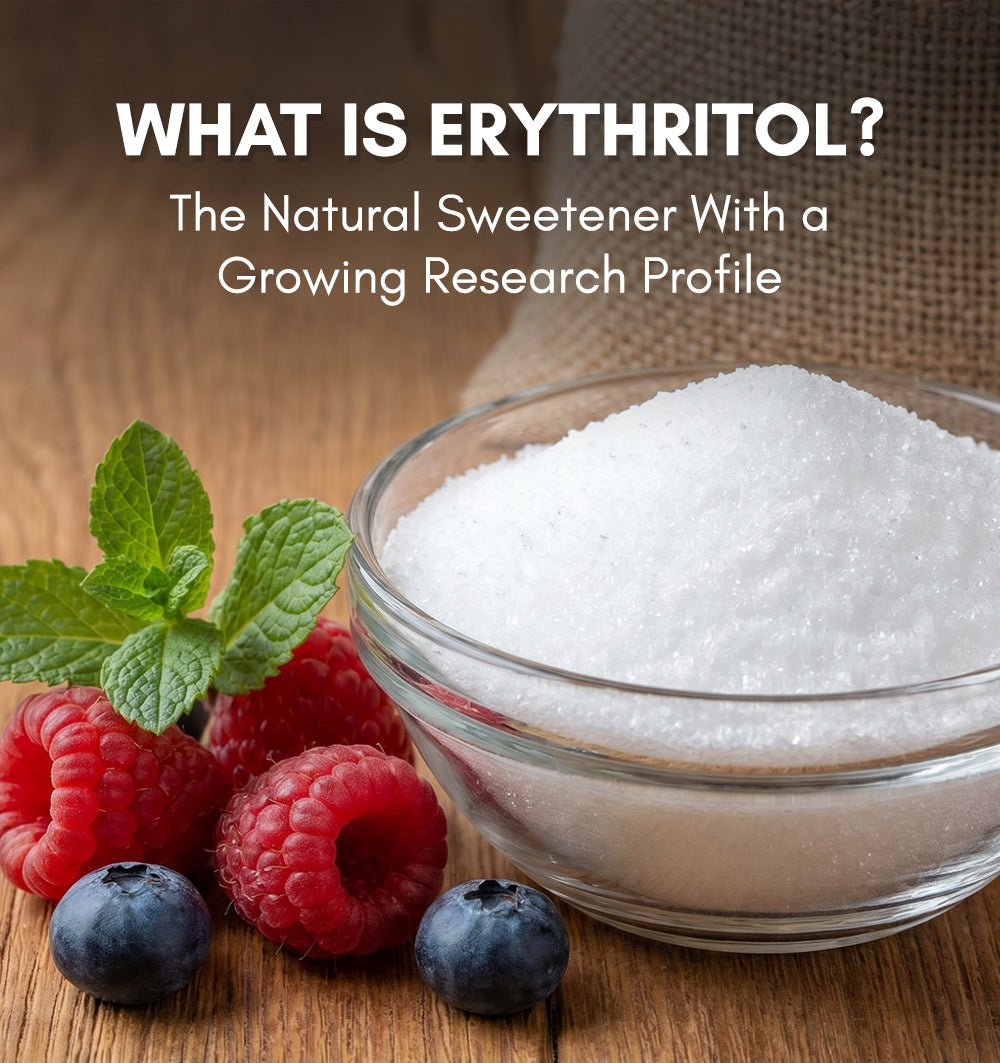
What Is Erythritol? The Natural Sweetener With a Growing Research Profile
Erythritol is a sugar alcohol — a naturally occurring compound found in small amounts in certain fruits and fermented foods — used commercially as a low-calorie sweetener in thousands of sugar-free, keto-friendly, and reduced-calorie food and beverage products worldwide.
You have probably seen it on a label without thinking twice about it.
It is in countless sugar-free and low-calorie products — protein bars, sugar-free gum, keto-friendly snacks, flavored drinks, and everything marketed as zero sugar.
It has been celebrated as one of the most well-tolerated sugar substitutes available.
And then, in 2023, a study published in Nature Medicine raised questions that put erythritol at the center of one of the most discussed sweetener debates in recent years.
The full picture — what erythritol is, what the research shows about its properties, where it is found, and what the 2023 findings mean for consumers — is worth understanding clearly and honestly.
This article covers all of it.
These statements have not been evaluated by the Food and Drug Administration.
This product is not intended to diagnose, treat, cure, or prevent any disease.
What Is Erythritol?
Erythritol is a sugar alcohol — a class of carbohydrate compounds that provide sweetness with fewer calories than regular sugar.
It occurs naturally in small amounts in certain fruits including pears, grapes, watermelon, and melons, as well as in fermented foods such as cheese, wine, soy sauce, and beer.
For commercial use, erythritol is produced through a fermentation process in which glucose — typically derived from corn or wheat starch — is fermented using specific strains of yeast including Moniliella pollinis or Trichosporonoides megachiliensis.
The yeast metabolizes the glucose and produces erythritol as a byproduct, which is then filtered and purified through crystallization into a clean, white, granulated form.
Erythritol is approximately 60 to 80 percent as sweet as table sugar and contains roughly 0.2 calories per gram — compared to sugar's 4 calories per gram, giving it approximately 6 percent of the calories of sugar.
Unlike many other sugar alcohols, erythritol is absorbed primarily in the small intestine — more than 90 percent of what you consume enters the bloodstream and is excreted unchanged in urine — which is why it causes significantly less digestive discomfort than compounds like sorbitol that are fermented by gut bacteria.
The FDA currently recognizes erythritol as Generally Recognized as Safe (GRAS) for its intended uses — the regulatory baseline for food additives in the United States.
What Does Erythritol Taste Like?
This is one of the most practically useful things to know about erythritol — and most articles skip it.
Erythritol tastes notably clean and sugar-like compared to most other sugar substitutes.
It does not have the bitter or licorice-adjacent aftertaste that stevia can produce at higher concentrations.
It does not have the sharp chemical sweetness that saccharin is known for.
What erythritol does have — and what catches many people off guard the first time they encounter it in a significant quantity — is a distinct cooling sensation in the mouth.
This cooling effect is caused by the endothermic dissolution of erythritol crystals — they absorb heat from your mouth as they dissolve, creating a noticeable coolness particularly when eating erythritol in granulated or powdered form.
In baked goods, beverages, and chewing gum, this cooling effect is generally much less noticeable because the erythritol is dissolved or dispersed throughout the product.
The combination of clean sweetness, minimal aftertaste, and relatively low bitterness is one of the primary reasons erythritol became so popular with food manufacturers — it behaves more like sugar from a sensory standpoint than most alternatives.
A Brief History of Erythritol

Erythritol was first identified in 1848 by Scottish chemist John Stenhouse, who isolated it as a naturally occurring sugar alcohol.
It remained largely unexplored for over a century.
It was not until the late 20th century — when advancements in fermentation technology made large-scale production commercially viable — that erythritol began its journey from laboratory curiosity to widespread food ingredient.
Commercial production expanded significantly through the 1990s, initially in Japan where it was first approved for use as a food ingredient.
By the early 2000s, erythritol had gained global recognition as a sweetener in sugar-free products — valued for its clean taste, minimal digestive impact compared to other sugar alcohols, and zero glycemic response.
Today it is one of the most widely used polyol sweeteners in the world — and also one of the most actively studied.
How Erythritol Is Made

The commercial production of erythritol mirrors, in a general sense, how it occurs naturally in fermented foods.
It begins with glucose derived from corn or wheat starch.
That glucose is dissolved in water and inoculated with a specific yeast strain.
During fermentation, the yeast metabolizes the glucose and produces erythritol as a metabolic byproduct.
The erythritol-containing solution is then filtered, concentrated, and purified through crystallization — producing the fine white crystalline powder used in food and beverage products.
Some manufacturers describe erythritol as naturally derived because it is produced through biological fermentation rather than chemical synthesis — which distinguishes it from synthetic sweeteners like sucralose and aspartame.
Is Erythritol Natural or Artificial?
This is one of the most commonly searched questions about erythritol — and the honest answer is: it depends on how you define the terms.
Erythritol occurs naturally in small amounts in fruits and fermented foods.
The compound itself is identical whether it comes from a pear or a fermentation vat.
In that sense, erythritol is a naturally occurring substance.
However, the erythritol used in commercial food products is manufactured through an industrial fermentation process using glucose derived from cornstarch or wheat starch.
The scale and processing involved mean it is not simply extracted from fruit.
Most food scientists and regulatory bodies categorize it as a naturally derived sweetener rather than a synthetic one — it is produced through biological processes rather than chemical synthesis.
This distinguishes it from sucralose, which is made by chlorinating sugar molecules, and aspartame, which is synthesized from amino acids.
Whether that distinction matters to you depends on what you are looking for in a sweetener.
For consumers who prioritize fermentation-based, non-petrochemically synthesized ingredients, erythritol fits that profile.
For consumers who want ingredients as close to whole-food sources as possible, erythritol's industrial production scale is worth factoring in.
What Is Erythritol Used For?
Erythritol appears in a remarkably wide range of products across multiple food and beverage categories.
In sugar-free confectionery — candies, chocolate, chewing gum, and mints — erythritol provides sweetness without contributing to the acid production that causes tooth decay.
In low-calorie and diet beverages, erythritol is used as a calorie-free flavor enhancer and sweetener.
In keto and low-carb packaged foods — protein bars, baking mixes, ice creams, and yogurts — erythritol is one of the most commonly used sweeteners because it does not affect blood glucose or count as a net carbohydrate in most low-carb accounting frameworks.
In baking, erythritol is valued for its heat stability — unlike some other sweeteners, it does not break down or lose sweetness at high baking temperatures.
However, it does not caramelize the way sugar does, which can affect the browning and texture of baked goods.
In pharmaceuticals and nutraceuticals, erythritol appears as a sweetening agent in chewable tablets, capsules, and liquid medications.
For consumers interested in erythritol-adjacent ingredients in chewing gum specifically, our article on what is remineralizing gum covers the research on xylitol and nano-hydroxyapatite gum formulations in detail.
Understanding where erythritol appears is practically useful because it is not always obvious from a food label.
How to Find Erythritol on Food Labels
This is something most consumers do not know — and it matters for anyone tracking their sweetener intake.
In the United States, sugar alcohols including erythritol are not required to be listed individually on the Nutrition Facts panel.
They may appear under a collective "Sugar Alcohols" line — or not at all if present in small amounts.
To know whether a product contains erythritol specifically, you need to check the ingredient list rather than the Nutrition Facts panel.
Erythritol will appear as "erythritol" in the ingredient list — it does not have an E-number commonly used in US labeling though it is designated E968 in the European Union.
Products most likely to contain erythritol include those labeled sugar-free, zero sugar, keto-friendly, reduced calorie, or no added sugar — particularly in the confectionery, beverage, and protein product categories.
Erythritol and Keto and Low-Carb Diets
Erythritol became one of the most popular sweeteners in the keto and low-carb community for a straightforward reason: it does not raise blood glucose or trigger meaningful insulin response.
On a ketogenic diet, the goal is to maintain a metabolic state called ketosis — in which the body burns fat for fuel rather than glucose.
Most sugars and many sweeteners disrupt ketosis by raising blood sugar.
Erythritol does not.
Because it is absorbed in the small intestine and excreted unchanged rather than metabolized for energy, it does not count as a net carbohydrate in the way most low-carb dieters calculate their intake.
This characteristic has contributed to erythritol's popularity in products marketed toward ketogenic and low-carbohydrate dietary preferences.
Erythritol is also heat-stable — meaning it can be used in keto baking at standard oven temperatures without breaking down or losing its sweetness.
Granulated erythritol works as a one-to-one sugar substitute in many recipes, though the lack of caramelization and the cooling effect can affect texture and appearance in some baked goods.
Powdered erythritol dissolves more readily and is preferred in frostings, icings, and recipes where texture smoothness matters.
Consult a healthcare provider for dietary guidance specific to your health situation.
These statements have not been evaluated by the FDA.
What the Research Says About Erythritol and Blood Sugar
One of the most frequently studied characteristics of erythritol is its negligible effect on blood glucose and insulin levels.
A study published in the Journal of Korean Medical Science examining erythritol in patients with glucose intolerance found that erythritol did not significantly affect blood glucose or insulin response compared to control conditions.
A clinical study published in ScienceDirect examining oral administration of erythritol in patients with diabetes found that serum glucose and insulin levels remained unchanged following erythritol administration, and that erythritol was rapidly absorbed and excreted without metabolic processing.
A 2023 systematic review published in Current Developments in Nutrition examined the effects of erythritol and xylitol on glycemic control, insulin sensitivity, and satiety hormones across multiple human intervention studies — finding erythritol's glycemic profile to be consistently minimal across the reviewed literature.
These findings are meaningful context for understanding why erythritol became so widely adopted in products targeting consumers managing blood sugar levels.
However — the 2023 cardiovascular research discussed below has added important complexity to the picture for consumers at elevated metabolic risk.
These statements have not been evaluated by the FDA and should not be interpreted as disease-treatment claims.
Consult a qualified healthcare provider before making dietary changes related to blood sugar management.
Erythritol Side Effects: What the Research Shows
For most people at typical consumption levels, erythritol is well-tolerated and produces minimal side effects compared to other sugar alcohols.
Understanding where side effects do and don't occur is worth knowing before assuming erythritol is entirely without concerns.
Digestive effects
Because erythritol is absorbed in the small intestine rather than fermented by gut bacteria, it does not produce the significant gas, bloating, and laxative effects associated with higher doses of sorbitol, xylitol, or maltitol.
At very high doses — well above what is typically encountered in everyday food consumption — some individuals may experience mild nausea or digestive discomfort.
For most adults consuming erythritol through normal food sources, digestive side effects are generally not a significant concern.
The cooling effect
The mouth-cooling sensation described earlier is not harmful but can be surprising if you are not expecting it.
In powdered or granulated forms used at higher concentrations, it is more noticeable.
In most commercial food products, it is significantly reduced.
The cardiovascular research signal
The most significant side effect concern raised in recent research is cardiovascular — specifically the 2023 Nature Medicine findings discussed in the next section.
These findings are observational and do not establish direct causation from dietary consumption, but they represent an important research development that consumers deserve to know about.
Consult a healthcare provider if you have specific health concerns.
These statements have not been evaluated by the FDA.
The 2023 Cardiovascular Research: What It Says and What It Doesn't
In February 2023, researchers at Cleveland Clinic published a study in Nature Medicine examining the relationship between circulating erythritol levels and cardiovascular event risk.
The study examined over 4,000 patients in the United States and Europe undergoing cardiac risk assessment.
The researchers found that patients with the highest circulating erythritol levels had approximately 1.8 to 2.2 times the risk of a major adverse cardiovascular event — including non-fatal heart attack, stroke, or death — over three years compared to those with the lowest erythritol levels.
The researchers also found that adding erythritol to blood samples increased platelet aggregation — the clumping behavior associated with clot formation — and that elevated circulating erythritol levels in animal models accelerated clot formation.
These findings have generated significant scientific discussion and prompted calls for additional research.
However, it is equally important to present the full scientific context.
The study was observational — it demonstrated an association between circulating erythritol levels and cardiovascular risk, but did not establish that dietary erythritol consumption directly causes cardiovascular events.
A critical evaluation published in PMC noted that the erythritol measured in participants' blood may reflect endogenous production — meaning the body's own metabolic processes may produce erythritol as a byproduct of glucose metabolism, particularly in individuals with obesity or insulin resistance — rather than dietary intake alone.
A 2024 Mendelian randomization study published in Diabetes — a genetic method specifically designed to test causal relationships — found no causal evidence that erythritol itself drives cardiovascular disease, suggesting the association observed in the 2023 study may reflect reverse causality, where metabolic conditions produce higher erythritol levels rather than erythritol causing those conditions.
The Cleveland Clinic researchers themselves acknowledged the study's limitations and called for additional long-term safety studies to confirm the findings.
The FDA's GRAS designation for erythritol has not changed as of 2026.
What the 2023 research does establish is that the assumption of total safety for erythritol — particularly in high-risk populations including people with obesity, diabetes, or existing cardiovascular conditions — warrants continued scientific examination.
We are presenting this research because it is real, peer-reviewed, and part of an ongoing scientific conversation that every informed consumer deserves to know about.
We are not making claims that erythritol causes cardiovascular harm at normal dietary consumption levels.
Consult a qualified healthcare provider for guidance specific to your health situation.
These statements have not been evaluated by the FDA and are not intended to diagnose, treat, cure, or prevent any disease.
What the Research Says About Erythritol and Oral Health
One of the more genuinely interesting areas of erythritol research — and one that has received less public attention than the cardiovascular findings — is its oral health research profile.
A 2016 review published in the International Journal of Dentistry examined erythritol's effects on dental plaque, dental caries, and periodontal health compared to xylitol and sorbitol.
The review found that erythritol effectively decreased the weight of dental plaque and the adherence of common streptococcal oral bacteria to tooth surfaces, inhibited the growth and activity of bacteria including Streptococcus mutans, decreased the expression of bacterial genes involved in sucrose metabolism, and reduced the overall number of dental caries in the studies examined.
The review reported favorable findings for erythritol in several oral health-related outcomes.
However, researchers noted that differences between sweeteners may vary depending on study design, dosage, duration, and population studied.
A 2020 study published in Scientific Reports found that both xylitol and erythritol expressed high growth inhibition effects on cariogenic bacteria — and that combinations of the two polyols showed synergistic effects against different bacterial strains.
It is important to note that this research examines erythritol as an ingredient in oral care research contexts — not as a claim that any specific product prevents dental disease.
Erythritol-containing oral care products are not dental treatments.
These statements have not been evaluated by the FDA.
Erythritol vs. Sucralose and Aspartame: Natural vs. Synthetic Sweeteners

Not all sweeteners have the same research profile — and understanding the differences helps consumers make more informed choices.
Erythritol vs. xylitol
Both erythritol and xylitol are sugar alcohols that are non-fermentable by oral bacteria and have been studied in oral health research contexts.
The 2016 International Journal of Dentistry review reported favorable findings for erythritol in certain oral health endpoints — with researchers noting that differences between sweeteners may vary depending on study design, dosage, duration, and population studied.
Xylitol has a more extensively studied oral health research base — particularly in chewing gum format — and its long-term safety research profile has been developed over a longer period.
Erythritol is generally better tolerated digestively than xylitol at higher doses because it is absorbed in the small intestine rather than fermented by gut bacteria.
Erythritol vs. sorbitol
Sorbitol is fermentable by certain oral bacteria — a meaningful distinction from both erythritol and xylitol.
Sorbitol produces acid through bacterial fermentation at a slower rate than sugar, but at a measurable level.
Erythritol is not fermentable by oral bacteria.
From a digestive standpoint, sorbitol produces significantly more gas, bloating, and laxative effects than erythritol because it is fermented in the colon.
For more on sorbitol specifically, our article on what is sorbitol covers the research in detail.
Erythritol vs. stevia
Stevia is a plant-derived sweetener extracted from the leaves of the Stevia rebaudiana plant — it is not a sugar alcohol but a glycoside compound.
Stevia is significantly sweeter than sugar — roughly 200 to 300 times sweeter — meaning it is used in much smaller quantities.
Like erythritol, stevia does not raise blood glucose or insulin levels significantly.
Unlike erythritol, stevia has a distinctive aftertaste that some consumers find bitter or licorice-like — which is why many commercial products combine stevia with erythritol to mask the aftertaste.
Stevia does not have the same cooling sensation as erythritol.
From an oral health research standpoint, stevia has a smaller body of research compared to erythritol and xylitol specifically in the context of cariogenic bacterial activity.
Erythritol vs. sucralose and aspartame
Erythritol is produced through biological fermentation and occurs naturally in small amounts in fruits and fermented foods.
Sucralose and aspartame are produced through chemical synthesis processes.
Neither sucralose nor aspartame has an oral health research profile comparable to erythritol or xylitol.
For more on sucralose specifically, our article on what is sucralose covers the current evidence in detail.
Why Nathan and Sons Uses Xylitol Rather Than Erythritol

This is a reasonable question for anyone reading an erythritol article on a Nathan and Sons blog.
Our formulation decisions reflect our interpretation of the currently available research and our product development priorities.
Xylitol has a more extensively studied oral health research base specifically in chewing gum format — the product format we specialize in.
The 2023 Nature Medicine cardiovascular findings, while observational and not conclusive, represent a research signal we take seriously when recommending an ingredient for daily use over extended periods.
We continue to monitor the erythritol research as it evolves.
For more on xylitol's oral health research profile, our guide to everything you need to know about xylitol covers the full evidence base.
Our remineralizing gum uses xylitol alongside nano-hydroxyapatite in a plant-based, artificial sweetener-free formulation.
Browse our full oral care collection to see everything we make.
What the Research Does Not Yet Confirm
The 2023 Nature Medicine cardiovascular study has not been fully replicated in large-scale prospective dietary intervention trials.
The 2024 Mendelian randomization study found no causal evidence for erythritol driving cardiovascular disease — but this also requires further replication and longer-term follow-up.
The relationship between dietary erythritol consumption and endogenous erythritol production — and which is more relevant to cardiovascular risk — remains an active area of scientific investigation.
The oral health research on erythritol, while promising, includes fewer large-scale human clinical trials than the xylitol literature.
The antioxidant properties and gut microbiome effects attributed to erythritol in some earlier studies remain preliminary areas requiring more robust human evidence.
Research regarding erythritol continues to evolve, and findings may vary depending on study design, population, and individual circumstances.
Anyone making dietary decisions based on erythritol research should discuss them with a qualified healthcare provider — particularly if they have existing cardiovascular conditions, diabetes, or metabolic syndrome.
These statements have not been evaluated by the FDA and are not intended to diagnose, treat, cure, or prevent any disease.
Key Takeaways: What Is Erythritol?

Erythritol is a naturally occurring sugar alcohol produced commercially through fermentation of glucose from corn or wheat starch.
It contains approximately 0.2 calories per gram, has a glycemic index of zero, and does not significantly affect blood glucose or insulin levels in research settings.
It tastes clean and sugar-like with a distinctive cooling sensation when consumed in granulated or powdered form.
The FDA currently recognizes erythritol as Generally Recognized as Safe for its intended uses.
A 2023 study published in Nature Medicine found an association between elevated circulating erythritol levels and increased cardiovascular event risk in over 4,000 patients — the study was observational and did not establish direct causation from dietary consumption.
A 2024 Mendelian randomization study found no causal evidence that erythritol itself drives cardiovascular disease, suggesting the association may reflect reverse causality.
Research has found favorable outcomes for erythritol in several oral health-related endpoints — with researchers noting that differences between sweeteners may vary depending on study design, dosage, duration, and population studied.
Erythritol is widely used in keto and low-carb products because it does not raise blood glucose or disrupt ketosis.
Erythritol is generally better tolerated digestively than most other sugar alcohols because it is absorbed in the small intestine rather than fermented by gut bacteria.
Nathan and Sons uses xylitol rather than erythritol based on xylitol's more extensively studied oral health research base in chewing gum format and our interpretation of the currently available research.
These statements have not been evaluated by the FDA.
Not intended to diagnose, treat, cure, or prevent any disease.
Frequently Asked Questions: What Is Erythritol?
What is erythritol?
Erythritol is a sugar alcohol that occurs naturally in small amounts in certain fruits and fermented foods.
For commercial use, it is produced through a fermentation process in which glucose from corn or wheat starch is fermented by specific yeast strains.
It contains approximately 0.2 calories per gram, is approximately 60 to 80 percent as sweet as sugar, and has a glycemic index of zero.
The FDA currently recognizes erythritol as Generally Recognized as Safe for its intended uses.
These statements have not been evaluated by the FDA and are not intended to diagnose, treat, cure, or prevent any disease.
What does erythritol taste like?
Erythritol tastes clean and notably sugar-like — without the bitter aftertaste of stevia or the sharp sweetness of saccharin.
Its most distinctive sensory characteristic is a cooling sensation in the mouth, caused by the endothermic dissolution of the crystals as they dissolve.
This cooling effect is most noticeable when erythritol is used in granulated or powdered form and is significantly reduced in most commercial food and beverage products.
These statements have not been evaluated by the FDA and are not intended to diagnose, treat, cure, or prevent any disease.
Is erythritol natural or artificial?
Erythritol occurs naturally in small amounts in fruits and fermented foods.
Commercial erythritol is produced through an industrial fermentation process using glucose from cornstarch or wheat starch — a biological process rather than chemical synthesis.
Most regulatory bodies and food scientists categorize it as naturally derived rather than synthetic.
Whether it meets your personal definition of natural depends on where you draw the line between natural occurrence and industrial-scale production.
These statements have not been evaluated by the FDA and are not intended to diagnose, treat, cure, or prevent any disease.
Is erythritol keto-friendly?
Erythritol does not raise blood glucose, trigger meaningful insulin response, or count as a net carbohydrate in most low-carb frameworks — which has contributed to its popularity in products marketed toward ketogenic and low-carbohydrate dietary preferences.
It is also heat-stable, making it suitable for keto baking.
Consult a healthcare provider for dietary guidance specific to your health situation.
These statements have not been evaluated by the FDA and are not intended to diagnose, treat, cure, or prevent any disease.
Is erythritol safe?
The FDA currently recognizes erythritol as Generally Recognized as Safe for its intended uses, and it has been widely consumed as a food additive for decades.
However, a 2023 study published in Nature Medicine found an association between elevated blood erythritol levels and increased cardiovascular event risk in over 4,000 patients.
The study was observational and did not establish that dietary erythritol directly causes cardiovascular events.
A 2024 Mendelian randomization study found no causal evidence that erythritol itself drives cardiovascular disease.
Current evidence does not establish definitive harm at normal dietary consumption levels.
Consult a qualified healthcare provider — particularly if you have existing cardiovascular conditions, diabetes, or metabolic syndrome.
These statements have not been evaluated by the FDA and are not intended to diagnose, treat, cure, or prevent any disease.
What is the 2023 erythritol cardiovascular study?
A study published in Nature Medicine by Cleveland Clinic researchers examined over 4,000 patients and found that those with the highest circulating erythritol levels had approximately 1.8 to 2.2 times the cardiovascular event risk of those with the lowest levels.
The researchers also found that erythritol increased platelet aggregation in laboratory conditions.
The study was observational — association was found but causation was not established.
A 2024 Mendelian randomization study subsequently found no causal evidence that erythritol itself drives cardiovascular disease, suggesting the association may reflect reverse causality.
Further long-term safety studies were called for by the original researchers.
These statements have not been evaluated by the FDA and are not intended to diagnose, treat, cure, or prevent any disease.
Does erythritol raise blood sugar?
Research has found that erythritol does not significantly affect blood glucose or insulin levels across multiple human studies.
It has a glycemic index of zero and is absorbed in the small intestine without metabolic processing for energy.
Consult a qualified healthcare provider for dietary guidance specific to your situation.
These statements have not been evaluated by the FDA and are not intended to diagnose, treat, cure, or prevent any disease.
Is erythritol good for oral health?
Research has examined erythritol in oral health contexts with findings that researchers have described as favorable in several oral health-related outcomes.
A 2016 review found erythritol reduced dental plaque weight and inhibited cariogenic bacterial activity across multiple study conditions — while noting that differences between sweeteners may vary depending on study design, dosage, duration, and population studied.
These are research observations and should not be interpreted as disease-treatment claims.
Erythritol-containing oral care products are not dental treatments.
These statements have not been evaluated by the FDA and are not intended to diagnose, treat, cure, or prevent any disease.
What foods contain erythritol?
Erythritol is commonly found in sugar-free candies and chocolates, keto protein bars and baking mixes, diet beverages and flavored waters, sugar-free chewing gum, low-calorie ice creams and yogurts, and a wide range of products labeled sugar-free, zero sugar, or keto-friendly.
To identify erythritol in a specific product, check the ingredient list — it will appear as "erythritol" — rather than the Nutrition Facts panel, where it may be grouped under Sugar Alcohols or not listed individually.
These statements have not been evaluated by the FDA and are not intended to diagnose, treat, cure, or prevent any disease.
How does erythritol compare to xylitol?
Both erythritol and xylitol are sugar alcohols that are non-fermentable by oral bacteria and have been studied in oral health research contexts.
Research has reported favorable findings for erythritol in certain oral health endpoints — with differences between sweeteners varying depending on study design, dosage, duration, and population studied.
Xylitol has a more extensively studied oral health research base — particularly in chewing gum format — and its long-term safety research profile has been developed over a longer period.
Erythritol is generally better tolerated digestively than xylitol at higher doses.
These statements have not been evaluated by the FDA and are not intended to diagnose, treat, cure, or prevent any disease.
How does erythritol compare to stevia?
Erythritol is a sugar alcohol produced through fermentation — stevia is a plant-derived glycoside extracted from the Stevia rebaudiana leaf.
Erythritol is 60 to 80 percent as sweet as sugar — stevia is roughly 200 to 300 times sweeter and used in much smaller quantities.
Erythritol has a clean, cooling sweetness — stevia can produce a bitter or licorice-like aftertaste at higher concentrations.
Both have minimal glycemic impact.
Many commercial products combine both sweeteners — using stevia for intensity and erythritol to mask the aftertaste and provide bulk.
These statements have not been evaluated by the FDA and are not intended to diagnose, treat, cure, or prevent any disease.
Why does Nathan and Sons use xylitol instead of erythritol?
Our formulation decisions reflect our interpretation of the currently available research and our product development priorities.
Xylitol has a more extensively studied oral health research base specifically in chewing gum format, and its long-term safety research profile has been developed over a longer period.
We continue to monitor the erythritol research as it evolves.
The full ingredient list for every product is available at nathanandsons.com/collections/oral-care.
These statements have not been evaluated by the FDA and are not intended to diagnose, treat, cure, or prevent any disease.
Legal & Compliance Disclaimer
These statements have not been evaluated by the Food and Drug Administration. This product is not intended to diagnose, treat, cure, or prevent any disease. The information in this article is for educational purposes only and is not a substitute for professional medical or dental advice. Consult a qualified healthcare provider before making changes to your diet or oral care routine.Content current as of 2026. Subject to revision.
References
Witkowski M, Nemet I, et al. (2023). The artificial sweetener erythritol and cardiovascular event risk. Nature Medicine, 29, 710–718. DOI: 10.1038/s41591-023-02223-9.
Cleveland Clinic Newsroom. (2023). Cleveland Clinic study finds common artificial sweetener linked to higher rates of heart attack and stroke. newsroom.clevelandclinic.org.
NIH Research Matters. (2023). Erythritol and cardiovascular events. nih.gov/news-events/nih-research-matters/erythritol-cardiovascular-events.
Heber D, et al. (2023). Plasma erythritol and cardiovascular risk: is there evidence for an association with dietary intake? PMC10242034.
Joost O, et al. (2024). Erythritol as a potential causal contributor to cardiometabolic disease: a Mendelian randomization study. Diabetes, 73(2), 325. DOI: 10.2337/db23-0709.
de Cock P, Mäkinen K, et al. (2016). Erythritol is more effective than xylitol and sorbitol in managing oral health endpoints. International Journal of Dentistry. PMC5011233.
Janssen AWF, et al. (2020). Exploration of singular and synergistic effect of xylitol and erythritol on causative agents of dental caries. Scientific Reports. nature.com/articles/s41598-020-63153-x.
Systematic review on erythritol and xylitol glycemic control and insulin sensitivity. (2023). Current Developments in Nutrition.
Yokozawa T, et al. (2002). Effects of oral administration of erythritol on patients with diabetes. ScienceDirect.
Wu YF, Salamanca E, et al. (2022). Xylitol-containing chewing gum reduces cariogenic and periodontopathic bacteria in dental plaque. Frontiers in Nutrition, 9, 882636. PMC9131035.
U.S. Food and Drug Administration. Aspartame and Other Sweeteners in Food. fda.gov/food/food-additives-petitions/aspartame-and-other-sweeteners-food.