
Here is something most DIM articles do not tell you.
DIM does not work in isolation.
No single compound does.
The biological systems DIM has been studied in — estrogen metabolism pathways, inflammatory signaling, oral biology — all depend on other systems functioning alongside them.
Mineral availability.
Elimination pathways.
Oral health conditions that researchers have documented as reflecting internal hormonal balance.
This article covers what the peer-reviewed research says about each of the nine ingredient areas that Nathan and Sons pairs with DIM in our pearl powder tooth scrub — and why each one is relevant to the biological systems DIM has been studied in.
Each section links to the dedicated research article in our portfolio where the full evidence base is covered in depth.
These statements have not been evaluated by the Food and Drug Administration.
This product is not intended to diagnose, treat, cure, or prevent any disease.
Why a Systems Approach Matters for DIM Research
DIM — diindolylmethane — is a naturally occurring phytochemical formed during the digestion of cruciferous vegetables.
A 2025 PMC comprehensive review of the pharmacological actions of DIM confirmed that DIM alters multiple signaling pathways controlling diverse cellular events including estrogen metabolism, oxidation, inflammation, and immunity.
The same review specifically noted that most protective effects of DIM are from preclinical studies — and that large-scale clinical trials are still needed.
A 2022 peer-reviewed editorial published in Frontiers in Nutrition confirmed that minerals including calcium and zinc serve as cofactors for hundreds of enzymes — and that zinc specifically plays catalytic, structural, and biological roles in many proteins and hormones.
The Linus Pauling Institute at Oregon State University confirms that magnesium is an essential mineral that serves as a cofactor for hundreds of enzymes — needed for energy production, protein synthesis, and cell signaling.
The practical implication: the enzyme systems that DIM has been studied in — including estrogen metabolism pathways — depend on mineral cofactors to function.
Addressing only DIM without also addressing the mineral environment in which those enzymes operate is an incomplete approach from a systems biology perspective.
This is the research rationale for the formulation described in this article.
These statements have not been evaluated by the FDA.

Benefit 1 — DIM's Studied Influence on Estrogen Metabolism Pathways
The first and most foundational benefit of DIM in the research literature is its studied influence on estrogen metabolism pathways.
DIM does not raise or suppress hormones directly.
Research has examined how it influences which estrogen metabolite pathways are more active — specifically the balance between 2-hydroxylation and 16-alpha-hydroxylation.
A 2025 peer-reviewed study published in PMC examining DIM's impact on estradiol and estrogen metabolism confirmed that DIM's mechanism of action involves the alteration of estrogen metabolism — and noted that DIM is an active area of research due to its influence on estrogen metabolism pathways.
For the full estrogen metabolism research context, our article on how DIM supports estrogen metabolism covers the evidence in detail.
These statements have not been evaluated by the FDA.
Benefit 2 — Calcium Carbonate Supports Mineral Availability for Enzyme Function
The enzyme systems involved in estrogen metabolism — and the broader hormonal signaling systems DIM has been studied in — depend on mineral cofactors.
Calcium is among the most important.
A 2022 Frontiers in Medicine editorial on calcium metabolism confirmed that calcium is involved in several biological functions including cell signaling, neural transmission, muscle function, membrane regulation, and biomineralisation — and that its levels are finely regulated in intracellular and extracellular compartments.
Calcium carbonate — one of the most studied bioavailable calcium sources — is also the primary mineral component of hydroxyapatite, the compound that makes up approximately 90 to 97 percent of tooth enamel.
Its inclusion in an oral care formulation serves two research-supported purposes: contributing to the mineral environment that enzyme-dependent metabolic systems rely on, and providing a calcium source relevant to oral tissue mineralization.
These are research observations and should not be interpreted as claims that calcium carbonate treats or prevents any hormonal or dental condition.
These statements have not been evaluated by the FDA.
Benefit 3 — Nano and Micro Hydroxyapatite Support Oral Health During Hormonal Shifts
Hormonal fluctuations have been documented in peer-reviewed research to influence saliva composition, oral pH, and gum tissue sensitivity — creating oral health conditions that researchers have studied in relation to estrogen levels.
A 2025 cross-sectional study published in BMC Oral Health confirmed that hormonal fluctuations across life stages can influence salivary flow rate, oral pH, and gingival sensitivity.
Nano and micro hydroxyapatite — chemically identical to the mineral compound that makes up tooth enamel — has been examined in peer-reviewed research for its potential to interact with enamel mineral surfaces.
A systematic review published in Clinical Oral Investigations found significant remineralization potential for nano-hydroxyapatite when surface hardness testing was used as the measurement standard.
DIM does not act directly in the mouth — its studied mechanisms involve systemic processes after absorption.
The connection is that the same hormonal environment DIM is studied in also influences oral health conditions — making oral mineral support a relevant parallel consideration.
For more on the nano-hydroxyapatite safety and research profile, our article on is nano-hydroxyapatite safe covers the full evidence base including the 2025 SCCS final safety opinion.
These statements have not been evaluated by the FDA.
Benefit 4 — Calcium Bentonite Clay: What the Research Says
Calcium bentonite clay is included in this formulation for its studied absorptive and binding properties in oral care contexts.
The research on bentonite clay requires honest framing — both for what it has found and for the safety considerations worth knowing.
A ScienceDirect study examining bentonite clay and intestinal flora found that bentonite clay has documented absorptive properties — with examined applications in binding aflatoxins and other compounds in the digestive tract — while noting that high doses have adverse effects and that therapeutic doses require careful calibration.
The same body of research notes that bentonite clay can bind non-selectively — meaning it may also bind medications and reduce their absorption if taken simultaneously.
An important safety note: the FDA has reported elevated lead levels in some bentonite clay products.
Today's RDH — a peer-reviewed dental hygiene publication — has specifically flagged that lead in bentonite clay products becomes bioavailable when ingested, unlike in water filtration contexts where the binding mechanism differs.
Nathan and Sons uses food-grade calcium bentonite clay — and consumers should look for products that specify food-grade sourcing and have been tested for heavy metal content when evaluating any bentonite clay oral care product.
These are research observations and should not be interpreted as claims that calcium bentonite clay treats or prevents any condition.
These statements have not been evaluated by the FDA.
Benefit 5 — Xylitol and Erythritol Support a Balanced Oral Environment
Xylitol and erythritol are plant-derived sugar alcohols that oral bacteria cannot ferment — meaning they cannot use them to produce the acid that drives enamel demineralization.
A 2022 study published in Frontiers in Nutrition found that xylitol gum was associated with a statistically significant 20 percent reduction in dental plaque accumulation and meaningful decreases in cariogenic and periodontopathic bacteria over two weeks of consistent use.
The connection to the DIM research context: researchers have documented that hormonal fluctuations can influence the oral environment — including saliva composition and gum tissue sensitivity.
Supporting a balanced oral bacterial environment through ingredients that have been specifically studied for this purpose is a relevant parallel oral care consideration.
For more on xylitol's full oral health research profile, our article on everything you need to know about xylitol covers the evidence in detail.
For more on erythritol's oral health research profile, our article on what is erythritol covers the evidence.
These statements have not been evaluated by the FDA.
Benefit 6 — Sodium Bicarbonate Helps Maintain Oral pH
Sodium bicarbonate is one of the most well-established oral pH buffering ingredients in dentistry — and its mechanism is straightforward.
It neutralizes acids in the oral environment — helping maintain a pH that is less favorable to the demineralization of enamel.
A PMC review on salivary changes and oral health in hormonal transitions confirmed that declining estrogen levels are associated with decreased saliva flow and reduced buffering capacity — the natural defense mechanism that protects enamel from acid attack.
When natural salivary buffering capacity is reduced — as researchers have documented during hormonal transitions — a pH-buffering ingredient like sodium bicarbonate provides additional oral acid neutralization support.
This is consistent with its established role in oral care formulations — not a novel claim.
These statements have not been evaluated by the FDA.
Benefit 7 — Pearl Powder Contributes Mineral Diversity
Pearl powder — derived from freshwater or marine pearl — contains calcium carbonate alongside trace minerals including magnesium, zinc, and amino acids.
The trace mineral content is relevant because enzyme systems — including those involved in hormone metabolism pathways — depend on mineral cofactors that include zinc and magnesium.
The Linus Pauling Institute confirms that magnesium serves as a cofactor for hundreds of enzymes needed for energy production and cell signaling.
A 2022 Frontiers in Nutrition editorial confirmed that zinc serves as a catalytic component for a large number of enzymes and plays structural and biological roles in many proteins, peptides, and hormones.
Pearl powder is also relevant to oral care research contexts — our article on pearl powder benefits covers the specific oral care research in detail.
These statements have not been evaluated by the FDA.
Benefit 8 — Natural Terpene Blend Supports Oral Comfort and Consistent Daily Use
The natural terpene blend in this formulation — including menthone, carvone, and cineole — contributes to oral comfort and freshness in ways that go beyond flavoring.
Each of these terpene compounds has been examined in peer-reviewed research for antimicrobial activity against oral bacterial species.
A 2024 peer-reviewed PubMed study examining Mentha piperita essential oil — with menthone identified as one of the primary active components — found that the oil significantly reduced Streptococcus mutans biofilm formation in laboratory conditions.
A review published in the European Journal of Oral Sciences found that terpene compounds from peppermint oil showed documented antimicrobial activity against volatile sulfur compound-producing oral bacteria and demonstrated salivation-stimulating effects.
There is also a practical compliance consideration worth naming directly.
DIM's studied mechanisms involve sustained exposure over time — not single-dose effects.
A formulation that is comfortable and pleasant to use daily is more likely to be used consistently — and consistent daily use is the practical prerequisite for any sustained-exposure research protocol.
Natural terpene compounds that contribute both antimicrobial research profiles and oral comfort serve both the oral biology and the compliance objectives of the formulation.
For more on the menthone research profile specifically, our article on benefits of menthone covers the evidence.
These statements have not been evaluated by the FDA.
Benefit 9 — Mineral Salt Blend Supports Electrolyte and Enzyme Function
The mineral salt blend in this formulation contributes electrolytes — sodium, potassium, magnesium, and trace minerals — that support nerve signaling, hydration, and enzyme activity.
Electrolyte balance is a foundational requirement for the enzyme systems involved in hormone metabolism pathways — the same systems that DIM has been studied in.
A 2023 peer-reviewed editorial published in Frontiers in Molecular Biosciences confirmed that in approximately one-third of all proteins, functioning depends on the presence of cofactors — including minerals and electrolytes — underscoring how broadly mineral availability affects biological function.
The mineral salt blend is designed to contribute to this foundational mineral environment — not to produce standalone health effects.
These are research observations and should not be interpreted as claims that a mineral salt blend treats or prevents any condition.
These statements have not been evaluated by the FDA.
How These Ingredients Work as a Research-Informed System
DIM has been studied for its influence on estrogen metabolism pathways.
Those pathways depend on enzyme systems.
Those enzyme systems depend on mineral cofactors.
The oral environment — where this product is delivered — is influenced by the same hormonal conditions that DIM is studied in.
Each ingredient in this formulation addresses one of these connected systems:
DIM addresses the estrogen metabolism pathway research context.
Calcium carbonate, pearl powder, and the mineral salt blend address the mineral cofactor environment that enzyme systems depend on.
Nano and micro hydroxyapatite address the oral mineral support context that is relevant during hormonal shifts.
Xylitol, erythritol, and sodium bicarbonate address the oral bacterial and pH environment that researchers have documented is influenced by hormonal fluctuations.
The terpene blend addresses both oral antimicrobial research contexts and the daily compliance that sustained-exposure research protocols require.
The research discussed above evaluates individual ingredients in laboratory and clinical research contexts.
The finished product has not been evaluated by the FDA for the prevention, treatment, or mitigation of any condition.
For more on DIM's full research profile, our article on what is DIM covers the oral science research context.
For more on how DIM works mechanically, our article on how does DIM work covers the full evidence base.
For more on how DIM interacts with mineral cofactors specifically, our article on minerals that support DIM effectiveness covers that research.
For more on the hormonal balance and oral health connection, our article on hormonal balance and oral health covers the peer-reviewed evidence.
For a comprehensive overview of all DIM research areas, our ultimate guide to DIM benefits covers the full landscape.
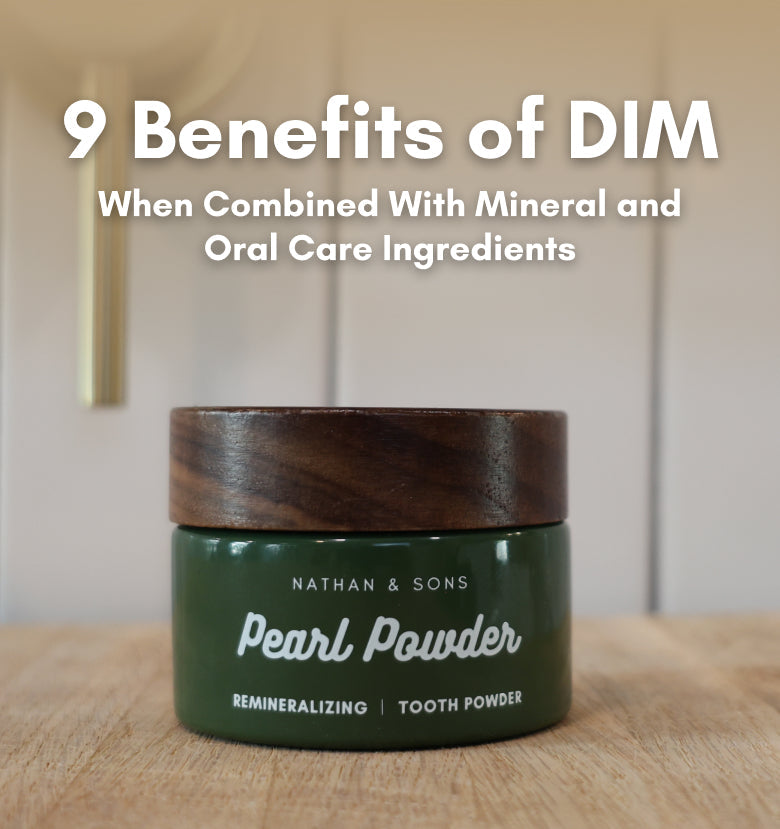
Nathan and Sons' pearl powder tooth scrub combines all nine of these ingredient areas in a single daily oral care formulation.
Browse our full oral care collection to see everything we make.
To learn more about who we are and why ingredient transparency matters to us, visit our about page.
What This Article Does Not Claim
No ingredient in this formulation has been evaluated by the FDA for the prevention, treatment, or mitigation of any disease.
The research cited throughout this article evaluates individual ingredients in laboratory and clinical research contexts — not as components of this finished formulation.
Most DIM research has been conducted in preclinical settings — large-scale human clinical trials are still needed.
The bentonite clay safety note is worth repeating: some bentonite clay products have been found to contain elevated lead levels according to FDA reports — consumers should look for products that specify food-grade sourcing and heavy metal testing.
Consult a qualified dental or healthcare provider before making changes to your oral care routine.
These statements have not been evaluated by the FDA and are not intended to diagnose, treat, cure, or prevent any disease.
Key Takeaways: Benefits of DIM With Minerals and Oral Care Ingredients

DIM's studied mechanisms involve estrogen metabolism pathways that depend on enzyme systems — and those enzyme systems depend on mineral cofactors including calcium, magnesium, and zinc.
Nano and micro hydroxyapatite have been examined in peer-reviewed research for enamel remineralization support — relevant because hormonal fluctuations have been documented to influence salivary flow, oral pH, and enamel vulnerability.
Xylitol has been associated in research with statistically significant reductions in cariogenic bacterial counts and plaque accumulation.
Bentonite clay has documented absorptive properties in research — but also carries important safety considerations including FDA-reported lead content concerns in some products and potential medication binding.
The terpene blend — menthone, carvone, cineole — has individual antimicrobial research profiles against oral bacterial species alongside oral comfort properties.
Pearl powder and the mineral salt blend contribute trace minerals including magnesium and zinc that serve as cofactors for the enzyme systems DIM has been studied in.
Most DIM research remains preclinical — large-scale human clinical trials are needed to confirm findings.
These statements have not been evaluated by the FDA.
Not intended to diagnose, treat, cure, or prevent any disease.
Frequently Asked Questions: Benefits of DIM
What are the benefits of DIM when combined with minerals?
DIM has been studied in peer-reviewed research for its influence on estrogen metabolism pathways — which depend on enzyme systems that require mineral cofactors including calcium, magnesium, and zinc to function.
A 2022 Frontiers in Nutrition editorial confirmed that minerals including calcium and zinc serve as cofactors for hundreds of enzymes — and that zinc specifically plays catalytic, structural, and biological roles in many proteins and hormones.
The research rationale for combining DIM with mineral-rich ingredients is that the enzyme systems DIM has been studied in are the same systems that depend on adequate mineral availability.
These statements have not been evaluated by the FDA and are not intended to diagnose, treat, cure, or prevent any disease.
Does DIM need other ingredients to work?
Research has not established that DIM requires specific co-ingredients to exert its studied effects.
The rationale for combining DIM with mineral-rich and oral care ingredients is based on the systems-biology observation that the enzyme pathways DIM has been studied in depend on mineral cofactors — and that the oral environment DIM is delivered through is influenced by the same hormonal conditions that DIM research examines.
Most DIM research remains preclinical — large-scale human clinical trials are needed to establish clinical outcomes.
These statements have not been evaluated by the FDA and are not intended to diagnose, treat, cure, or prevent any disease.
Can oral care ingredients affect overall wellness?
Peer-reviewed research has documented that hormonal fluctuations — including changes in estrogen levels — influence salivary flow rate, oral pH, and gum tissue sensitivity.
A 2025 BMC Oral Health study confirmed that hormonal fluctuations across life stages can measurably affect the oral environment.
Supporting oral health is one component of overall wellness — it does not replace systemic health support or professional medical or dental care.
These statements have not been evaluated by the FDA and are not intended to diagnose, treat, cure, or prevent any disease.
What does nano-hydroxyapatite do in this formulation?
Nano-hydroxyapatite is chemically identical to the mineral compound that makes up approximately 90 to 97 percent of tooth enamel — and has been examined in peer-reviewed research for its potential to interact with enamel mineral surfaces.
A systematic review published in Clinical Oral Investigations found significant remineralization potential for nano-hydroxyapatite when surface hardness testing was used as the measurement standard.
It is included in this formulation for its oral mineral support research profile — relevant because hormonal fluctuations have been documented to influence oral mineral stability.
These statements have not been evaluated by the FDA and are not intended to diagnose, treat, cure, or prevent any disease.
Is calcium bentonite clay safe in oral care products?
Calcium bentonite clay has documented absorptive properties in research — and has been used in oral care formulations.
However important safety considerations apply: the FDA has reported elevated lead levels in some bentonite clay products, and Today's RDH — a peer-reviewed dental hygiene publication — has specifically noted that lead in bentonite clay products becomes bioavailable when ingested.
Consumers should look for products that specify food-grade sourcing and have been tested for heavy metal content.
Consult a qualified dental or healthcare provider before using bentonite clay oral care products — particularly if you are pregnant, breastfeeding, or managing a health condition.
These statements have not been evaluated by the FDA and are not intended to diagnose, treat, cure, or prevent any disease.
Legal & Compliance Disclaimer
These statements have not been evaluated by the Food and Drug Administration. This product is not intended to diagnose, treat, cure, or prevent any disease. The information in this article is for educational purposes only and is not a substitute for professional dental or medical advice. Consult a qualified dental or healthcare provider before making changes to your oral care routine. Content current as of 2026. Subject to revision.
References
PMC. (2025). Unveiling the multifaceted pharmacological actions of indole-3-carbinol and diindolylmethane: a comprehensive review. PMC11902694.
PMC. (2025). The impact of 3,3′-diindolylmethane on estradiol and estrogen metabolism in postmenopausal women using a transdermal estradiol patch. PMC12188845.
PMC. (2022). Editorial: calcium metabolism — hormonal crosstalk, pathophysiology and disease. Frontiers in Medicine. PMC9082161.
PMC. (2022). Editorial: bioactive compounds in mineral bioavailability. Frontiers in Nutrition. PMC9623313.
Linus Pauling Institute, Oregon State University. Magnesium. lpi.oregonstate.edu/mic/minerals/magnesium.
PMC. (2023). Editorial: the role of cofactors in protein stability and homeostasis. Frontiers in Molecular Biosciences. PMC9907023.
Colaco AS, et al. (2025). Impact of hormonal phases on salivary characteristics and oral hygiene in women. BMC Oral Health. PMC12790710.
PMC. (2022). Appraisal of saliva and its sensory perception in reproductive transitions of women. PMC9759273.
Wierichs RJ, et al. (2022). Efficacy of nano-hydroxyapatite on caries prevention: a systematic review and meta-analysis. Clinical Oral Investigations. PMC8979882.
SCCS. (2025). Scientific Opinion on Hydroxyapatite (nano) — Submission IV, SCCS/1677/25.
Wu YF, Salamanca E, et al. (2022). Xylitol-containing chewing gum reduces cariogenic and periodontopathic bacteria in dental plaque. Frontiers in Nutrition. PMC9131035.
Today's RDH. (2024). Bentonite clay oral care products: a healthy choice or hidden danger. todaysrdh.com.
ScienceDirect. (2024). Evaluating bentonite clay's potential in protecting intestinal flora. sciencedirect.com/article/abs/pii/S0306987724001865.
PubMed. (2024). Chemical composition and antibiofilm activity of Mentha piperita essential oil against Streptococcus mutans. PMID: 38984907.
Dobler D, et al. (2020). Effect of essential oils on oral halitosis treatment: a review. European Journal of Oral Sciences. onlinelibrary.wiley.com/doi/10.1111/eos.12745.