
Is "Brain Gum" Real? What the Science Says About Gum That Claims to Boost Focus
You have probably seen the pitch somewhere online.
Chew a piece of gum, get your concentration back after lunch, and skip the second cup of coffee.
It sounds convenient. Maybe a little too convenient?
So is brain gum a real thing, or is it the same old chewing gum in a fancier wrapper?
The answer to "is brain gum real" sits somewhere in between.
Researchers have studied chewing gum itself for its effects on alertness and attention.
Some of the ingredients most commonly found in functional gum, particularly caffeine and L-theanine, have been tested in human studies.
That does not mean every product marketed as "brain gum" has evidence behind it.
Many have never been tested for cognition, memory, productivity, or mental performance.
The ingredients matter. The doses matter. And there is an important difference between two kinds of evidence.
One covers a single ingredient tested on its own.
The other covers that ingredient inside a specific finished product.
Quick Take: Is Brain Gum Real?
Brain gum is a real category of product.
The term is best understood as consumer-friendly shorthand for functional chewing gum that contains ingredients associated with alertness or attention.
So yes, brain gum is real. That is different from saying gum makes you smarter.
Some evidence suggests chewing can have a temporary influence on alertness and certain forms of attention.
Other studies, looking at different measures of cognition, have reported mixed or negative results.
Functional gums may also contain ingredients such as caffeine, L-theanine, theobromine, Alpha-GPC, Rhodiola rosea, and B vitamins.
So the useful question is not simply, "Does brain gum work?"
The useful question is different. What is in this specific gum, at what dose, and what does the human research on those ingredients actually show?
What Does "Brain Gum" Actually Mean?
There is no official scientific product category called "brain gum."
In practice, brain gum refers to real chewing gum formulated with ingredients associated with alertness or focus.
Companies selling these products typically describe them as supporting mental energy or concentration.
Related search terms include focus gum, nootropic gum, energy gum, and functional chewing gum.
These labels can sound impressive.
On its own, though, a label tells you very little about whether the formula has any evidence behind it.
A basic piece of gum with caffeine can be sold as energy gum.
A more complex formula might combine several ingredients, each included for a different reason.
That is why the real test of any brain gum is the ingredient panel, not the name.
Does Chewing Gum Itself Improve Focus Concentration?
This is where the science gets interesting.
Researchers have examined how chewing gum affects alertness, memory, reaction time, and attention. The results are mixed.
A 2012 study reported that chewing gum was associated with higher self-reported alertness and better performance on some attention measures.
The effects varied by task and by how long participants had been working, though. Read the 2012 study about chewing gum, alertness, and attention on PubMed.
An earlier randomized crossover study reached a more cautious conclusion.
In that study, chewing gum was associated with improved sustained attention (Tucha et al., 2004).
It did not improve memory, and it negatively affected alertness and attentional flexibility.
The authors concluded that claims about gum improving cognition should be viewed with caution.
See the randomized study examining chewing gum and different aspects of attention on PubMed.
So chewing gum alone is not a guaranteed cognitive shortcut, whether or not it is sold as brain gum.
The reported effects appear limited to particular outcomes and testing conditions.
They should not be generalized to every person or product.
There may be short-term effects on alertness or specific attention tasks.
But "chewing makes your brain perform better" is far too broad a conclusion.
The More Interesting Part: Functional Gum as an Ingredient Delivery Format
The functional-gum story becomes clearer if you stop thinking of chewing as the active component.
Instead, think of gum as a delivery format.
The best-known example involves caffeine.
In one clinical study, healthy adults received the same caffeine dose from either chewing gum or capsules in a randomized comparison.
The tested caffeine-gum formulation absorbed faster than the tested capsule formulation.
The researchers attributed this to some absorption through tissue in the mouth rather than the gastrointestinal tract alone.
You can review the clinical research comparing caffeine gum with caffeine capsules on PubMed.
That result applies to the specific caffeine gum that was studied.
It does not mean every ingredient placed in gum absorbs quickly through the mouth.
Nor should it be generalized to other ingredients or other finished gum products without product-specific evidence.
Different compounds behave differently.
Still, it helps explain the appeal of caffeinated gum.
Some people want caffeine without a coffee or an energy drink.
For a broader comparison, we also cover caffeinated gum vs. coffee vs. energy drinks.
Caffeine Is Still Doing a Lot of the Heavy Lifting
Strip away the "brain" terminology and caffeine remains one of the most established ingredients used for wakefulness and alertness.
That matters because consumers sometimes assume a product needs an exotic nootropic to have a noticeable effect.
Not necessarily.
Sometimes the most relevant ingredient is the one already in your kitchen.
The more useful question is what else is paired with the caffeine and whether those pairings make sense.
Caffeine sensitivity also varies significantly from person to person.
FDA has cited 400 mg of caffeine per day as an amount not generally associated with negative effects for most adults.
This is not a universally safe limit. Sensitivity can vary based on pregnancy, medications, health conditions, and individual metabolism.
It is also worth remembering that caffeine adds up across all sources.
FDA's caffeine guidance notes that caffeine can appear in chewing gum and other less obvious products, not just coffee and energy drinks.
That makes checking the actual caffeine content of any gum, and counting it alongside your other caffeine intake, important.
Why Caffeine and L-Theanine Get Paired So Often
Spend any time looking at focus products and you will quickly run into caffeine plus L-theanine.
There is a reason for that.
One randomized controlled trial compared placebo, 50 mg of caffeine, and 50 mg of caffeine with 100 mg of L-theanine in 27 healthy volunteers.
The combination improved speed and accuracy on an attention-switching task at one measurement point.
It also reduced susceptibility to distracting information during phases of a memory task.
Read the randomized caffeine and L-theanine study for the full methodology and results.
A separate study using 97 mg of L-theanine with 40 mg of caffeine in 44 young adults reported improved accuracy on a task-switching test and higher self-reported alertness.
It found no significant effects on several other cognitive tasks.
That is useful evidence, but it comes with an important limitation.
These studies tested particular doses under controlled conditions.
They did not show that every caffeine and L-theanine gum produces the same outcome.
For a deeper ingredient breakdown, see Nathan and Sons' guide to L-theanine gum.
What About Alpha-GPC in Gum?
Alpha-GPC is a compound you will see in newer nootropic and functional-energy products.
It is a choline-containing compound involved in acetylcholine metabolism, which is one reason researchers have looked at its possible relationship to cognitive performance.
A 2024 study compared placebo with two doses of Alpha-GPC (315 mg and 630 mg) in a randomized, double-blind, crossover design involving twenty healthy resistance-trained males.
Both Alpha-GPC conditions differed significantly from placebo on the Stroop total score and on performance time, with faster performance at the higher dose.
However, other cognitive tests in the study did not show significant differences.
The sample was small and limited to healthy men.
The study also disclosed that an author served as a paid scientific adviser to the sponsor.
That makes the finding interesting, but far from the final word.
You can read the 2024 Alpha-GPC randomized controlled trial or our plain-English guide to Alpha-GPC benefits.
What Should a Good Brain Gum Actually Contain?

There is no single perfect formula.
When evaluating a functional gum, though, it helps to look for a few basics:
- Clearly identified active ingredients, rather than a vague proprietary "brain blend"
- Transparent caffeine content, so you know how much you are consuming
- Ingredients with human research, while recognizing that evidence varies in strength
- Reasonable claims, such as supporting alertness or focus rather than promising extraordinary cognitive improvements
- A formula that makes sense as a whole, rather than trendy ingredients included because they look impressive on a label
- Clear usage and safety guidance, particularly when stimulants are involved
This is where marketing language becomes a useful filter.
If a functional focus gum claims to unlock genius-level thinking, permanently improve memory, or transform your brain after a few chews, skepticism is appropriate.
Expectations about any brain gum should rest on its specific ingredients, doses, delivery characteristics, and finished-product evidence.
The category name alone tells you nothing real. Functional ingredients can support normal processes.
They are not miraculous.
Where Uprising Energy Gum Fits Into the Focus Brain Gum Conversation
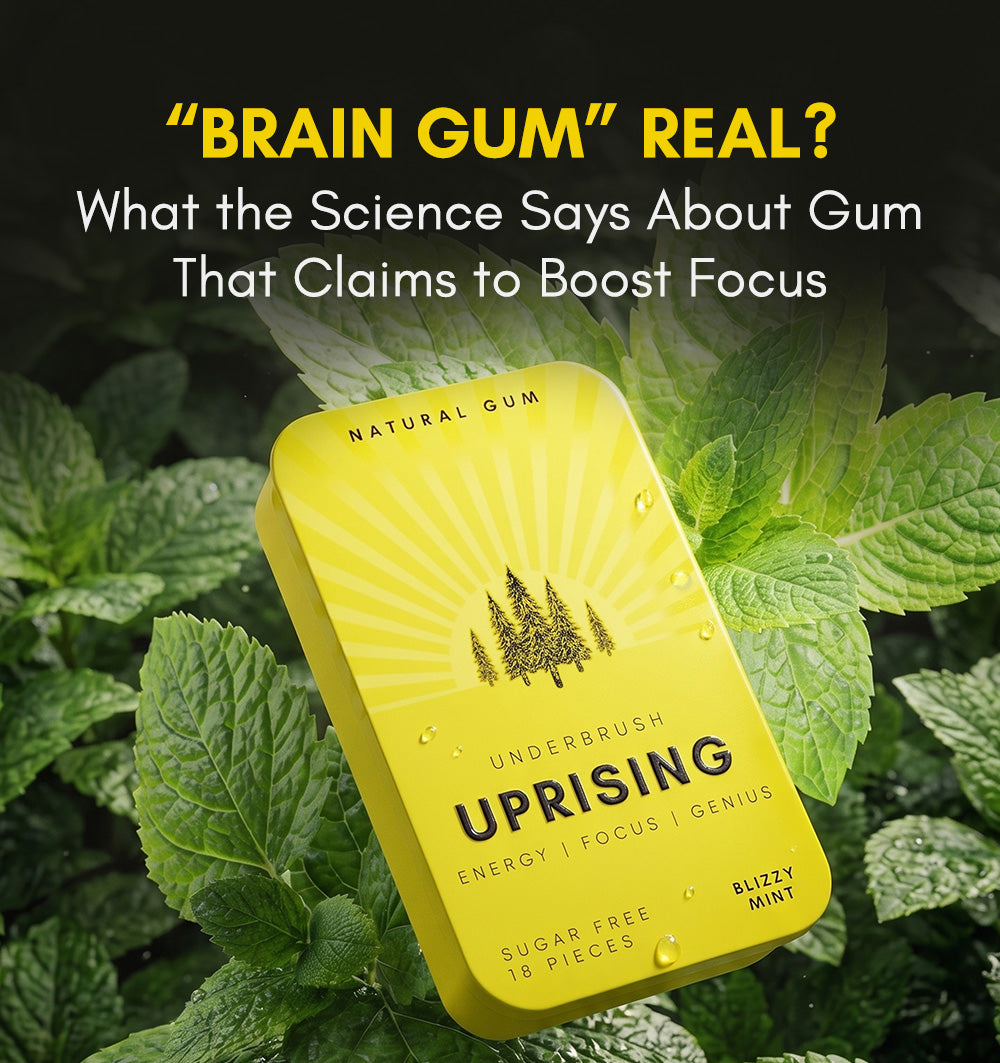
We approach this category through Uprising Energy Gum, a functional chewing gum formulated with several ingredients commonly discussed in energy and focus products.
According to the product's current label, Uprising Energy Gum contains caffeine, L-theanine, theobromine, Alpha-GPC, Rhodiola rosea, saffron extract, NAD (nicotinamide adenine dinucleotide), vitamin B12, and folate (vitamin B9).
These are delivered in a natural gum base of chicle, mastic gum, spruce gum, myrrh gum, and acacia gum, sweetened with xylitol, sorbitol, and allulose and flavored with peppermint oil.
Each piece contains 30 mg of caffeine (60 mg in a two-piece serving) as currently labeled.
Consumers should consult the current product label for the complete ingredient list, quantities, allergen information, and directions.
That broader formula is what distinguishes the Uprising approach from a basic caffeinated gum.
Still, the scientific distinction matters, and it belongs here rather than in a footnote.
Uprising Energy Gum has not been clinically tested as a finished product. Studies on caffeine, L-theanine, Alpha-GPC, Rhodiola rosea, or any other single ingredient are not clinical trials of Uprising as a whole.
Those studies used specific doses, formats, and populations. Including an ingredient does not establish that the finished product produces the same outcomes.
Being clear about that is part of what it means to assess functional products responsibly.
Is Brain Gum Better Than Coffee?

Not automatically.
Coffee contains caffeine. So do many energy gums.
The difference mostly comes down to format, dosage, the other ingredients in the formula, and personal preference.
If coffee works well for you and you tolerate it comfortably, there may be no reason to replace it.
Someone else may reach for gum because it is portable and requires no drink.
It also makes the caffeine dose easy to track, sometimes alongside ingredients commonly paired with caffeine, such as L-theanine.
Research on one caffeinated gum found that the tested gum delivered caffeine to peak concentration faster than the same dose in capsule form.
That is pharmacokinetically interesting.
But the study did not compare gum with coffee, so it does not show that gum is better across the board.
Whichever format you prefer, track caffeine from all sources and follow the product directions.
Consider your individual sensitivity and any medical guidance that applies to you.
So, Is "Brain Gum" Mostly Marketing?
The term is marketing.
The underlying concept of brain gum is real.
There is real research on chewing gum and attention, on the delivery of caffeine through gum, and on several ingredients that commonly appear in these products.
At the same time, the evidence is nowhere near strong enough to claim that chewing any gum will "switch on your brain."
That is why ingredient transparency matters more than a catchy product name.
A credible functional gum should tell you exactly what is in it and why.
It should avoid medical claims and let the research speak for itself.
What People Are Asking About Brain Gum
The first of course, "Is brain gum actually real?"
Yes.
Brain gum is an informal term for functional chewing gum made with ingredients associated with alertness, attention, or mental energy.
It is not a formal scientific category, and products vary widely in what they contain.
Does regular chewing gum improve focus?
Possibly, in some situations, but the research is mixed.
Some studies have reported increased alertness and improvements on certain attention measures.
Other research found little benefit, or effects that varied by the type of cognitive task.
I need a gum that works fast, "How quickly does caffeine gum work?"
In one clinical study comparing a caffeinated gum with caffeine capsules, the tested gum produced faster absorption of the same caffeine dose.
How quickly a person notices caffeine can still vary with dose, chewing time, and individual sensitivity.
Results from that study also do not necessarily apply to other gum products.
I don't think all focus gum are the same, "What are the most important ingredients in focus gum?"
Caffeine, and caffeine combined with L-theanine, have been examined in controlled human studies of short-term attention-related outcomes.
Those results apply to the specific doses, formulations, populations, and testing conditions studied.
Other ingredients, including Alpha-GPC and Rhodiola rosea, have also been researched, but the depth and consistency of evidence differ substantially between ingredients.
Can brain gum replace coffee?
For some adults, gum can be an alternative format for caffeine.
There is no scientific reason you must replace coffee with gum.
Which one is "better" depends on your caffeine tolerance, preferred dose, convenience needs, and the other ingredients in the formula.
Is brain gum safe to use every day?
That depends on the ingredients, the amount consumed, and your total caffeine intake from all sources.
Your sensitivity to stimulants, any medications you take, and other health factors matter too. FDA has cited 400 mg of caffeine per day as an amount not generally associated with negative effects for most adults.
This is not a universal safe limit, and tolerance varies by age, health status, and other factors.
Pregnant people and anyone with health or medication concerns should speak with a healthcare professional about how much caffeine is appropriate for them.
Is Brain Gum Real? What to Take Away
So, is brain gum real? Yes, in the sense that functional chewing gum can combine a convenient format with ingredients studied for alertness, attention, and related areas.
What is not supported is the idea that every gum carrying a focus or nootropic label automatically makes you think better.
The real science of brain gum is more specific than that.
Chewing itself may influence alertness in some situations. Caffeine has well-established stimulant effects.
Caffeine combined with L-theanine has shown promising attention-related results in controlled studies.
Other ingredients, such as Alpha-GPC, have interesting but more limited evidence in healthy adults.
A good formula should respect those distinctions rather than papering over them with big promises.
Nathan and Sons developed Uprising around that broader functional-gum approach.
It combines caffeine with L-theanine and additional ingredients rather than relying on caffeine and a clever label alone.
Explore our website to learn more, or take a closer look at Uprising Energy Gum. Then decide whether a real brain gum makes sense for your routine.
This article is for educational purposes only and is not medical advice. Research discussed on individual ingredients does not establish the effects of Uprising Energy Gum or any other finished functional gum product. Uprising has not been clinically tested as a finished product. Consult a healthcare professional before using any product containing caffeine or other stimulants if you are pregnant, taking medication, or have a health condition.
These statements have not been evaluated by the Food and Drug Administration. This product is not intended to diagnose, treat, cure, or prevent any disease.