
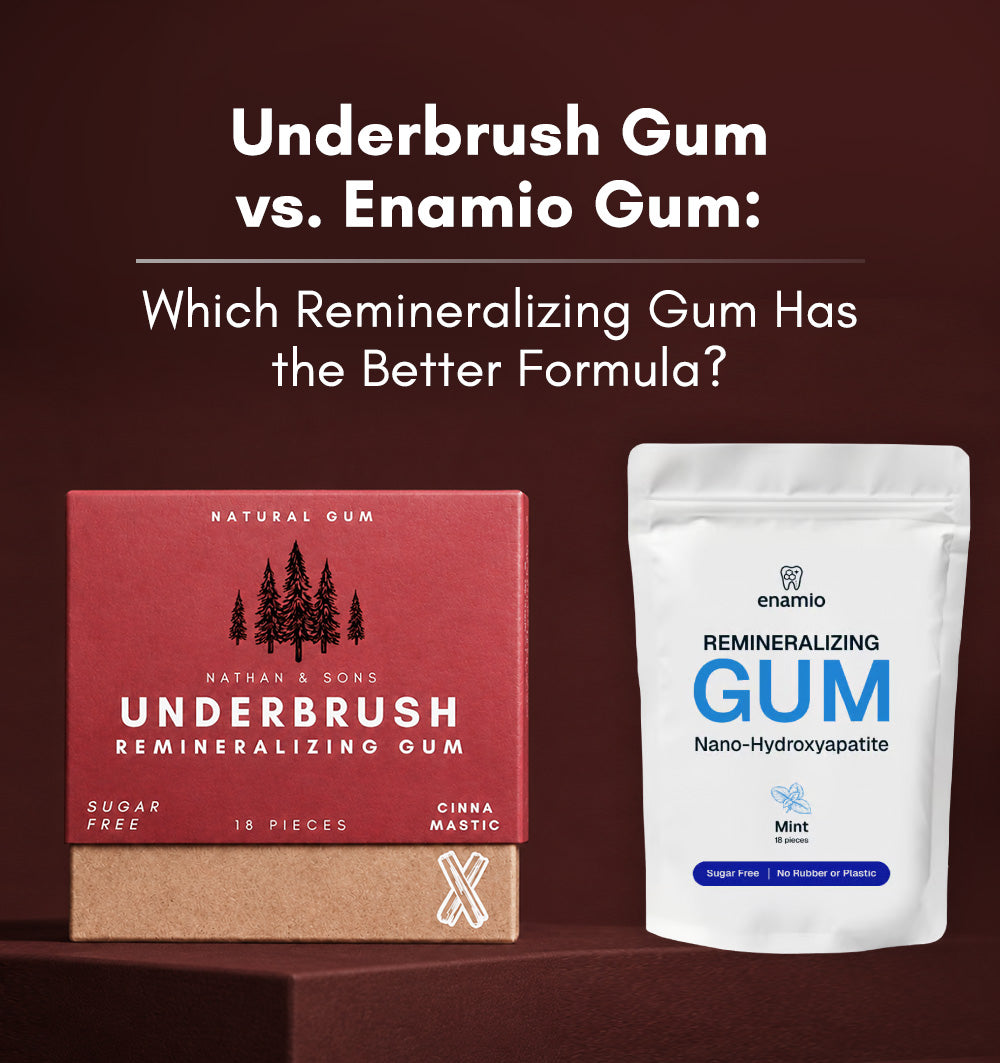
So you've got two packs of gum in front of you, and both of them are whispering the word "hydroxyapatite."
Now what?
Underbrush and Enamio are both sugar-free chewing gums that list hydroxyapatite and xylitol among their ingredients.
The real differences show up in everything else each company decided to put in the pack.
Enamio lists nano-hydroxyapatite alongside ingredients like calcium glycerophosphate, magnesium citrate, L-arginine, zinc, sodium bicarbonate, and green tea extract. [1]
Underbrush lists nano- and micro-hydroxyapatite alongside xylitol, erythritol, calcium and magnesium compounds, zinc, and a whole lineup of natural gums and resins. [2]
Here's the honest part before we go any further.
An ingredient list tells you what's in a gum, not how a finished gum performs.
We did not find a published controlled clinical trial comparing finished Underbrush and Enamio gum.
And research on individual ingredients isn't proof that either finished gum does the same thing.
Transparency notice: We are Nathan and Sons and we manufacture and sell Underbrush. This comparison is based on publicly disclosed ingredient information reviewed in August 2026. It is not an independent review. We did not identify a published controlled clinical trial directly comparing finished Underbrush and Enamio gum. Studies involving individual ingredients do not establish the performance of either finished product.
Okay. Cards on the table.
Let's compare some ingredient lists.
Underbrush Remineralizing Gum vs Enamio Remineralizing Gum

Formulas change, and some Underbrush flavors have slight variations in their ingredient lists.
Always check the current packaging before you buy.
The short version?
Enamio keeps its supporting cast focused on minerals, pH-related ingredients, and one plant extract.
Underbrush invites a much bigger crowd of botanical resins, natural gums, and mineral compounds to the party.
The Ingredient Both Underbrush & Enamio Gums Share: Hydroxyapatite
Let's start with the headliner.
Hydroxyapatite is a calcium-phosphate mineral that's chemically similar to the mineral component of tooth enamel. [3]
That's the main reason it keeps showing up in oral-care products.
Nano-hydroxyapatite is the same material in very, very small particles.
It has been studied in dental research for a couple of decades now.
A 2014 literature review by Pepla et al. described nano-hydroxyapatite as a biomimetic material and surveyed how it has been studied in preventive, restorative, and regenerative dentistry. [3]
You can read the review at the National Institutes of Health.
A 2022 scoping review looked at nano-hydroxyapatite research related to early dental caries and called for more well-designed clinical studies. [4]
See the 2022 scoping review if you want the details.
One thing to keep straight: these papers examine the ingredient in various research settings.
They did not test finished Underbrush or Enamio gum, and they don't tell us how either product performs.
Curious for more?
We at Nathan and Sons have an explainer on what nano-hydroxyapatite is and a comparison of nano-hydroxyapatite and fluoride.
How the Two Hydroxyapatite Formulas Differ
Both brands build around hydroxyapatite, but not in the same way.
Enamio lists nano-hydroxyapatite together with calcium glycerophosphate, magnesium citrate, and other disclosed ingredients. [1]
Underbrush lists both nano- and micro-hydroxyapatite, per Nathan and Sons' current disclosure. [2]
It combines those with calcium carbonate, magnesium carbonate, zinc gluconate, xylitol, erythritol, and several natural gums and resins.
Neither approach can be called superior based on a list.
They're just two different recipes.
Xylitol: The Sweetener Underbrush & Enamio Both Agree On
Xylitol is a sugar alcohol that sweetens a lot of sugar-free gum, and both Underbrush and Enamio list it.
It's also one of the more widely studied chewing-gum ingredients out there.
A 2025 systematic review compared clinical studies of xylitol gum with other polyol gums, and the authors framed xylitol gum as something to use alongside brushing, never instead of it. [5]
We (Nathan and Sons) have a friendly guide to xylitol if you want to go deeper.
Same caveat as always: that research is about the ingredient and other formulations, not about these two finished gums.
And since both products list xylitol, neither one gets bonus points for it.
The fun starts with what each company mixes in next.
Where Underbrush's List Goes Its Own Way: Mastic, Myrrh, Spruce, and Acacia

This is where the two ingredient lists stop looking like cousins.
Underbrush lists four natural gums and resins that Enamio's current disclosure doesn't: mastic gum, spruce gum, acacia gum, and myrrh gum. [1] [2]
Mastic Gum
Mastic is a natural resin from the Pistacia lentiscus tree.
People were chewing it centuries before anyone thought to wrap gum in foil.
Mastic has been looked at in a small 2003 pilot study and a 2023 review related to oral health. [6] [7]
Those papers studied mastic in other settings and formulations, so they don't tell us anything about how finished Underbrush gum performs.
Want the backstory?
Here's the Nathan and Sons guide to mastic gum, plus a fun read on what mastic gum actually tastes like.
What mastic does do, for sure, is make the Underbrush ingredient list look clearly different from Enamio's.
Myrrh Gum
Yes, that myrrh.
The one from the ancient-gift story.
Myrrh is another traditional resin on the Underbrush list.
It has been examined in published research, including a 2026 systematic review and meta-analysis of randomized trials, but again, in settings and formulations unrelated to Underbrush. [8]
You can read more about it in our article on myrrh gum and its traditional uses.
Spruce and Acacia Gum
Spruce gum and acacia gum are plant-derived natural gums.
In Underbrush, they work alongside the chicle base, mastic, and myrrh to make up the gum itself.
If you're curious about where they come from, here's some articles on spruce tree gum and acacia gum.
Put it all together and Underbrush lists mastic and myrrh on top of its mineral ingredients and sugar alcohols.
Published studies have examined those substances elsewhere, but those findings don't establish the effectiveness of finished Underbrush gum.
Where Enamio's List Goes Its Own Way: Arginine, Green Tea, and Calcium Glycerophosphate
Enamio isn't just "hydroxyapatite plus xylitol" either.
Its current disclosure includes several ingredients Underbrush doesn't list in Mastic Mint: calcium glycerophosphate, L-arginine, sodium bicarbonate, bamboo silica, and green tea extract. [1]
Calcium glycerophosphate is a compound containing calcium and phosphate.
L-arginine and sodium bicarbonate round out the formulation, green tea extract brings plant polyphenols, and bamboo silica is a plant-derived mineral ingredient.
You know the refrain by now.
Research on these ingredients in other settings doesn't establish any particular result from the finished gum.
If you like a tidy, focused ingredient list built around nano-hydroxyapatite and a handful of mineral and pH-related components, Enamio lays that out clearly.
Underbrush just took a different road.
Underbrush Vs. Enamio: Two Distinct Ingredient Profiles
Underbrush lists a larger variety of natural gums and resins.
Enamio lists several ingredients not found in the reviewed Underbrush Mastic Mint disclosure, including L-arginine, calcium glycerophosphate, sodium bicarbonate, and green tea extract.
Which profile you prefer is personal preference.
The ingredient lists do not establish clinical superiority either way.
For reference, here's what the Underbrush Mastic Mint disclosure currently lists: [2]
- Xylitol
- Erythritol
- Chicle and candelilla wax
- Mastic gum
- Spruce gum
- Acacia gum
- Myrrh gum
- Nano- and micro-hydroxyapatite
- Calcium carbonate
- Calcium bentonite clay
- Magnesium carbonate
- Zinc gluconate
- A terpene blend containing menthone, carvone, and cineole
And Enamio's disclosure lists nano-hydroxyapatite, xylitol, monk fruit, calcium glycerophosphate, magnesium citrate, L-arginine, sodium bicarbonate, zinc, bamboo silica, green tea extract, and a natural chicle base. [1]
Curious how Underbrush's list stacks up against the rest of the category?
See the 2026 hydroxyapatite gum ingredient comparison.
Okay, But What's Underbrush Like to Actually Chew?

Ingredient lists are great, but at some point you have to put the thing in your mouth.
Underbrush reviewers tend to bring up two things: flavor and chew.
And they're refreshingly honest about both.
On flavor, Teddy H. (Verified Buyer, 5 stars) put it this way: "I know the gum doesn't get its charm from the flavor, lol, flavor only hits for 5 seconds in my opinion." [9]
Lisa L. (Verified Buyer, 5 stars) echoed that: "Though the initial flavor fades pretty quickly, the texture of the gum remains remarkably chewable for a long, long time." [9]
These reviewers described a strong initial flavor that faded relatively quickly while the gum remained chewable.
Several selected reviewers commented favorably on the gum's texture and chew.
Jay (5 stars), who tried the variety pack, ranked the flavors and said Tropic Twist "has got to be the best with the most consistent and comfortable chew, longer lasting flavor and the flavor itself is decent and even has a slightly minty/fresh finish." [9]
Jay added, "I have to emphasize the chew on this particular flavor is great; my jaw tends to get tired with some of the others."
Selected Customer-Review Excerpts
"I kind of started out as a skeptic, but I've learned that I really really enjoy their gum."
— Alli, Verified Reviewer, 5 stars
"You do get a burst of flavor and it is delicious."
— Shellie B., Verified Buyer, 5 stars
"As a 'gum lover' I appreciate having a natural option."
— Lisa L., Verified Buyer, 5 stars
"Out of the variety pack, mint seemed to be the best, with cinnamastic being really enjoyable to me."
— Jay, 5 stars
These excerpts were selected by Nathan and Sons and should not be interpreted as representative of every customer's experience. They are drawn from customer reviews posted on the Nathan and Sons website in August 2026, trimmed for length; "Verified Buyer" and "Verified Reviewer" labels reflect the review platform's designations. They reflect individual opinions about flavor, texture, and enjoyment. Individual experiences vary, and customer reviews are not evidence of product performance.
Which Formula Fits You, Underbrush or Enamio?
Enamio Remineralizing Gum might be your pick if you like:
A shorter ingredient list centered on nano-hydroxyapatite and a small set of mineral ingredients.
Enamio clearly discloses nano-hydroxyapatite, calcium glycerophosphate, magnesium citrate, L-arginine, zinc, bamboo silica, green tea extract, and a natural chicle base. [1]
It's a thoughtfully disclosed formulation, and credit where it's due.
Underbrush Remineralizing Gum might be your pick if you like:
The same core building blocks (hydroxyapatite, xylitol, minerals, and a natural chicle base) with a bigger cast of natural gums and resins.
Mastic, myrrh, spruce, and acacia make the Underbrush list noticeably different from a typical nano-hydroxyapatite gum.
These differences distinguish the formulas.
They do not establish that either finished product is clinically superior or produces a particular dental-health outcome.
Does Chewing Gum Replace Toothpaste?
Nope.
Not even a little bit.
Neither Underbrush nor Enamio is a replacement for brushing, flossing, routine dental checkups, or anything your dentist recommends.
Enamio describes its gum as something that complements regular brushing and flossing. [1]
We at Nathan and Sons say the same about Underbrush: "alongside your routine, never instead of it."
Think of gum as the thing you reach for between brushings, especially after lunch when the toothbrush is at home.
For more on the category, see the Nathan and Sons overview of natural chewing gum.
Underbrush Vs Enamio Final Ingredient Considerations
Based on the disclosures reviewed in August 2026, both products list hydroxyapatite, xylitol, zinc, and a chicle-based gum base. [1] [2]
Enamio's disclosed formula includes calcium glycerophosphate, magnesium citrate, L-arginine, sodium bicarbonate, bamboo silica, and green tea extract.
Underbrush's Mastic Mint formula lists nano- and micro-hydroxyapatite, erythritol, calcium and magnesium compounds, mastic, myrrh, spruce, acacia, and a terpene blend.
That gives you two distinct ingredient profiles to choose from.
It does not demonstrate that either finished product repairs enamel, prevents disease, reduces plaque, changes oral bacteria, or clinically outperforms the other.
Formulas change, so check the current packaging before you buy.
Learn More About Underbrush Remineralizing Gum
Nathan and Sons created Underbrush as a sugar-free, plastic-free chewing gum that combines hydroxyapatite with xylitol, minerals, mastic, myrrh, spruce, acacia, and other selected natural ingredients.
Review the current Underbrush ingredient list, available flavors, usage directions, and product information here at this Nathan and Sons link.
Have questions? The Nathan and Sons FAQ page is a good place to start.
Chewing gum is not intended to replace brushing, flossing, professional dental examinations, or dental treatment. Research discussed above evaluates individual ingredients in other formulations and research settings; it does not establish that either finished chewing-gum product produces any particular dental-health outcome or clinically outperforms the other. Customer reviews reflect individual opinions and experiences and are not evidence of product performance. Ingredient information reflects manufacturer disclosures reviewed in August 2026 and is subject to change.
References
- Enamio. Product ingredient disclosure, manufacturer website. Reviewed August 2026.
https://enamiogum.com/products/remineralizing-gum - Nathan and Sons. Underbrush Mastic Mint ingredient disclosure, product page. Reviewed August 2026. https://nathanandsons.com/products/remineralizing-gum
- Pepla E, Besharat LK, Palaia G, Tenore G, Migliau G. Nano-hydroxyapatite and its applications in preventive, restorative and regenerative dentistry: a review of literature. Annali di Stomatologia. 2014;5(3):108–114. PMID 25506416. https://pmc.ncbi.nlm.nih.gov/articles/PMC4252862/
- Anil A, Ibraheem WI, Meshni AA, Preethanath RS, Anil S. Nano-hydroxyapatite (nHAp) in the remineralization of early dental caries: a scoping review. International Journal of Environmental Research and Public Health. 2022;19(9):5629. doi:10.3390/ijerph19095629. https://www.ncbi.nlm.nih.gov/pmc/articles/PMC9102186/
- Söderling E, Pienihäkkinen K. Specific effects of xylitol chewing gum on mutans streptococci levels, plaque accumulation and caries occurrence: a systematic review. BMC Oral Health. 2025;25:1275. doi:10.1186/s12903-025-06602-1. https://pmc.ncbi.nlm.nih.gov/articles/PMC12305977/
- Takahashi K, Fukazawa M, Motohira H, Ochiai K, Nishikawa H, Miyata T. A pilot study on antiplaque effects of mastic chewing gum in the oral cavity. Journal of Periodontology. 2003;74(4):501–505. doi:10.1902/jop.2003.74.4.501. https://doi.org/10.1902/jop.2003.74.4.501
- Alwadi MA, et al. Mastic (Pistacia lentiscus) gum and oral health: a review. 2023. London School of Hygiene & Tropical Medicine Research Online. https://researchonline.lshtm.ac.uk/id/eprint/4669593/1/Alwadi-etal-2023-Mastic-gum-and-oral-health.pdf
- Myrrh in the management of periodontal disease and gingival healing: a systematic review and meta-analysis. 2026. PubMed Central, PMC13086453. https://pmc.ncbi.nlm.nih.gov/articles/PMC13086453/
- Nathan and Sons. Customer reviews of Underbrush gum, published August 18–20, 2026. https://nathanandsons.com/pages/reviews