
This breakdown is written by Nathan & Sons, the makers of Uprising Energy Gum.
Every claim below is sourced, and Run Gum is represented fairly based on Run Gum’s own publicly available materials as cited.
Comparative claims about Run Gum should be periodically re-verified against Run Gum’s current labeling and site content, since product specifications can change, last updated July 21, 2026.
Picture Two People Reaching Into a Pocket
Six in the morning, a track in the rain.
An Olympic-caliber runner ties his shoes.
Instead of choking down a warm energy drink before a hard workout, he unwraps a piece of gum instead.
Two thousand miles away, a founder is three coffees deep at 11pm.
The slide deck still is not right.
She reaches for a different kind of gum, one formulated around ingredients studied for focus and stress response rather than a straight caffeine hit.
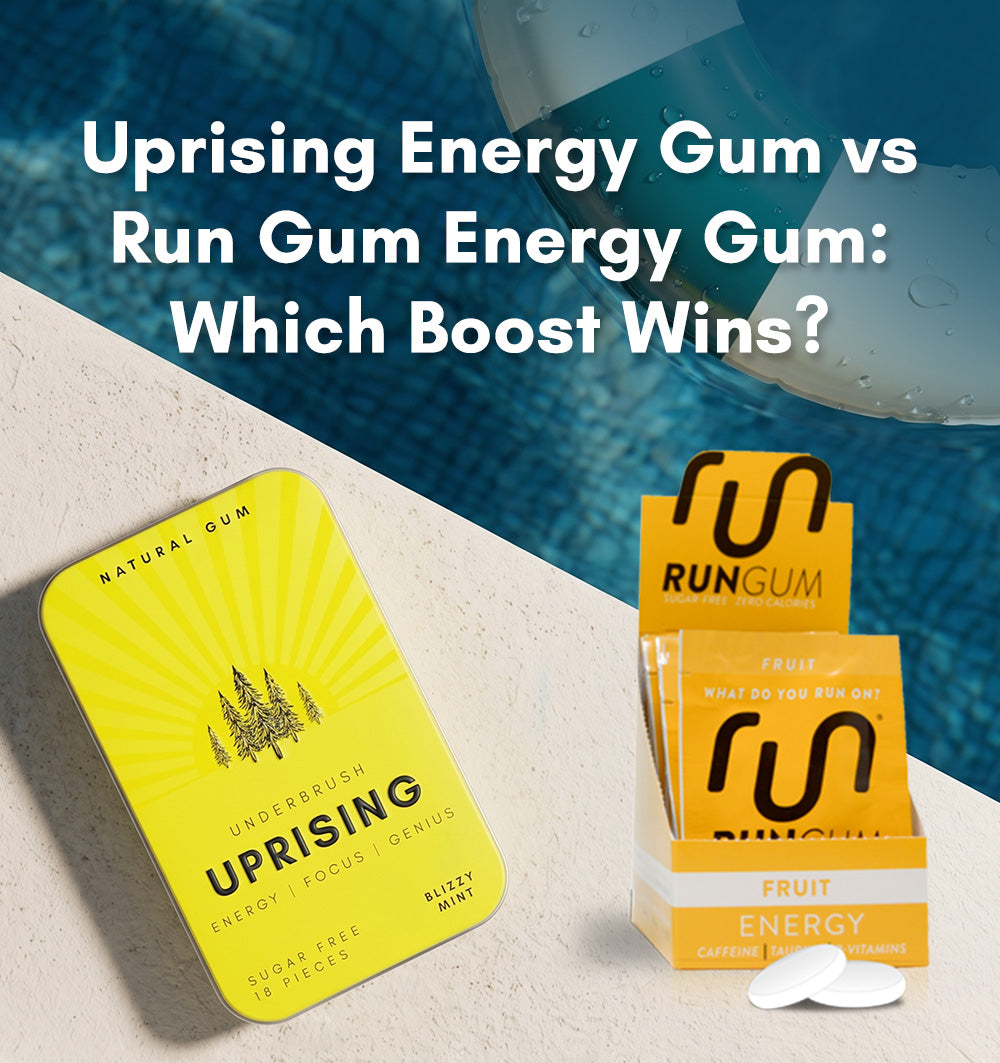
That is the real shape of the uprising energy gum vs run gum energy gum question.
It is not really about which product wins in some abstract sense.
It is about which pocket you are reaching into, and why.
Meet the Two Gums
Run Gum Energy Gum started on a track.
It was founded in 2014 by two-time Olympic runner Nick Symmonds and his coach Sam Lapray.
They built it because Symmonds wanted the lift of an energy drink without the sloshing, acidic liquid sitting in his stomach before a race, according to Run Gum’s own account of its founding. (https://rungum.com/blogs/blog/54441923-how-rejection-led-to-the-rise-of-run-gum)
It is a direct, athletic formula: 50mg of caffeine, taurine, and B-vitamins in every piece, per Run Gum’s product page. (https://rungum.com/pages/caffeine-gum-by-rungum)
Uprising Energy Gum, made by us here at Nathan & Sons, takes a different road entirely.
We formulated Uprising with caffeine, L-Theanine, Alpha-GPC, Rhodiola, Saffron, and NAD, as described on our Uprising product page.
The gum itself is built on a natural tree-resin base, a different formulation approach than the synthetic gum base systems used across most of the conventional gum industry, as we break down in our Uprising vs. NeuroGum comparison.
Here is a fair way to picture it.
Run Gum is the sprinter.
Uprising is the person who studies the sprinter’s biology and builds around a different set of ingredients entirely, ones chosen for how they’ve performed in research, not for a guaranteed outcome.

Why the Category May Interest Investors and Strategic Buyers
Gum sounds small until you look at the market it sits inside.
The global energy gum market is projected to grow from roughly $124.69 million in 2025 to more than $265 million by 2035, a compound annual growth rate near 7.85%, according to Precedence Research.
A separate estimate for the broader caffeine gum category, which is defined differently and includes a wider set of products, projects growth toward $1.22 billion by 2033, per DataIntelo’s market research.
These are third-party commercial forecasts that scope the category differently from one another.
They are directional rather than precise, and Nathan & Sons has not independently verified either figure.
Precedence Research also cites the global wellness economy at $6.3 trillion in 2023, in the same report, and functional gum sits at the intersection of convenience and clean-label demand within that broader category.
That is exactly why a Fortune 500 beverage or wellness team, or a potential investor evaluating this category, would not just taste the gum.
They would pull the label, check the FDA framework the product sits under, and read the advertising claims line by line before anyone signs anything.
Run Gum has already proven that this category can scale into major retail, expanding into stores like Walmart and Target, as reported by Side Hustle Lab.
That kind of retail traction is exactly what makes due diligence on the regulatory side so important, because the bigger the distribution, the bigger the exposure if a claim does not hold up.
What Is Actually Inside Each Piece
Run Gum: The Energy Drink, Compressed
Run Gum is built to feel like a familiar energy drink, just without the can.
Caffeine sits at 50mg per piece in the Original formula and 100mg in Extra Strength, per Run Gum’s product page. (https://rungum.com/pages/caffeine-gum-by-rungum)
Because it is absorbed through the lining of the mouth rather than the stomach, it can hit your system up to five times faster than a liquid energy drink, the brand states.
That buccal route is actually the answer to one of the most common questions people ask about this whole category.
How does energy gum work faster than coffee?
Because caffeine absorbed through the mouth skips a big chunk of the digestive process, you can start feeling it in 5 to 10 minutes.
Coffee typically needs 30 to 60 minutes to reach peak levels in your bloodstream, research on caffeinated chewing gum confirms.
Taurine rounds out the Run Gum formula, an amino acid found in nearly every commercial energy drink.
The research on taurine alone is mixed, but some studies suggest it may help amplify caffeine’s performance effects when the two are combined, according to a review in PMC.
Vitamin B6 and B12 are also in the mix, both essential for how your body converts food into usable energy, per the NIH’s fact sheet on Vitamin B6.
The gum base is conventional and synthetic, sweetened with sugar alcohols and the artificial sweetener sucralose, as listed on Run Gum’s site.(https://rungum.com/pages/caffeine-gum-by-rungum)
That is a straightforward formula built for its purpose.
If you’re an athlete wondering whether Run Gum fits your training, the label lists caffeine, taurine, and B-vitamins, all common in sports nutrition.
A founder’s athletic background doesn’t substitute for checking your own health considerations, and anyone in a drug-tested sport should verify every ingredient against their organization’s banned substance list before trying anything new.
This article doesn’t independently certify either product as safe or permitted for every athlete.
Uprising: Built Like a Supplement, Not Just a Snack
Uprising carries 60mg of caffeine and 100mg of L-Theanine per serving, per Nathan & Sons’ own ingredient breakdown, alongside Alpha-GPC, Rhodiola Rosea extract, saffron extract, and NAD.
Exact per-serving amounts for Alpha-GPC, Rhodiola, saffron, and NAD are not disclosed in this article; those figures should be pulled from current Supplement Facts documentation and added here before this piece is used in any investor, retail, or regulatory review.
We designed Uprising around a simple observation: caffeine on its own can bring jitters for some people, followed by a drop-off later.
So we selected ingredients that have each been studied individually for different functional properties.
L-Theanine is the first piece, a naturally occurring amino acid from green tea studied for its relationship to alpha brain waves and stress response.
L-Theanine and caffeine have been studied together in other research for certain attention and subjective-response measures, as we explain in our full L-Theanine gum breakdown, though those studies did not evaluate Uprising, and their results shouldn’t be read as proof of what any specific gum delivers.
Alpha-GPC is next, a choline compound.
A 2021 single-blind, randomized, placebo-controlled study in Nutrients found that 400mg of Alpha-GPC over two weeks was associated with improved self-reported motivation in a small group of healthy volunteers, published on PMC.
That study evaluated Alpha-GPC as an isolated ingredient, not Uprising as a finished product, and its results shouldn’t be read as proof of what any specific gum delivers.
Rhodiola Rosea is our adaptogen, a small yellow-flowered plant that has been used for centuries in Scandinavian and Russian folk medicine long before it turned up in a modern gum stack.
A comprehensive 2023 review in the Journal of the International Society of Sports Nutrition found that Rhodiola’s bioactive components have been studied for their relationship to stress resistance and fatigue reduction, also on PMC.
We go deeper on exactly how that research applies to workday fatigue in our piece on Rhodiola Rosea and mental fatigue, which walks through the studies in plain language.
Saffron shows up too.
Research published through the National Institutes of Health has investigated saffron’s active compounds for their relationship to mood and cognitive measures, as detailed in a PMC review, though that evidence doesn’t establish that Uprising itself produces those outcomes.
NAD closes out the stack, a coenzyme present in every cell in your body and involved in energy metabolism, levels of which are understood to decline with age and stress.
Here’s a transparency note we think matters: every ingredient study cited above was conducted on that ingredient in isolation, not on Uprising as a finished, chewed product, and individual responses to any of these ingredients can vary.
That’s standard for the supplement and functional food industry, but it deserves to be said plainly rather than left for the ingredient list to imply on its own.
The gum base itself is natural tree resin, made from chicle, mastic gum, spruce resin, and myrrh.
Most gum sold today, including many conventional and functional gums, uses a synthetic gum base instead, as we cover in our Uprising vs. NeuroGum comparison.
Consumers who want specifics on any product’s base material should check that product’s current label.
If you are wondering whether Uprising contains artificial sweeteners, it does not, which is one of the clearest differences between the two products, since Run Gum does include sucralose.
And if you have ever asked whether energy gum can actually cause tooth decay, the answer depends entirely on the base and the sweetener.
Sucralose itself is generally considered non-cariogenic by dental researchers, but the sugar alcohols and overall formulation still matter, and we go deep on the full research picture in our piece on whether sucralose causes tooth decay, which is worth a read if you chew gum daily.
Caffeine Safety and What to Know Before You Buy
What the FDA has been clear about is its concern with products that make it too easy to overconsume caffeine without realizing it.
The clearest cautionary tale in this exact category is Wrigley’s 2013 Alert Energy Caffeine Gum.
It launched with just 40mg of caffeine per piece, and the FDA opened an investigation into added caffeine in food almost immediately, prompting Wrigley to voluntarily pull the product while the review was underway, as reported by Grocery Dive.
That is why both Run Gum and Uprising publish clear usage guidance rather than leaving dosing to guesswork.
Run Gum tells users not to exceed eight pieces a day, per its product page, and Uprising provides 60mg of caffeine per serving along with usage directions on its label. (https://rungum.com/pages/caffeine-gum-by-rungum)
Which brings up one of the most common questions in this whole category.
How much caffeine does the FDA say is reasonable in a day?
FDA cites 400 milligrams a day as an amount not generally associated with negative effects for most adults, though sensitivity, health considerations, medications, and total caffeine intake from all sources vary by person, according to the FDA’s own guidance.
That works out to roughly eight pieces of Original Run Gum, but the FDA’s own recommendation is to talk with a healthcare provider if you have questions about your personal limit.
Uprising Energy Gum is not intended to diagnose, treat, cure, or prevent any disease, and none of the statements here have been evaluated by the Food and Drug Administration.
If you’re pregnant, trying to become pregnant, breastfeeding, taking medication, or managing a health condition, the FDA recommends talking to your healthcare provider about whether you need to limit caffeine consumption, per the FDA’s own guidance.
What It Actually Feels Like to Chew

Run Gum comes in Mint, Fruit, Cinnamon, Wintergreen, and Bubblegum, per its product listing (https://rungum.com/pages/caffeine-gum-by-rungum), a lineup built around familiar, functional flavors rather than a premium positioning.
It is a straightforward, get-it-done product, and for its intended use case, that is exactly the point.
You are not meant to savor it. You are meant to lace up and go.
Uprising’s natural resin base gives it a different chew than conventional synthetic gum, something users have described as a distinct texture rather than a typical gum snap.
The flavor is designed to work alongside the functional ingredients rather than mask them.
Which One's Actually For You?
Grab Run Gum if you are lacing up before a run, a ride, or a lift, and you want the familiar caffeine, taurine, and B-vitamin combination without a liquid sloshing around in your stomach.
Grab Uprising if you are heading into hours of deep, mentally demanding work and you’re drawn to a formula built around L-Theanine, Alpha-GPC, Rhodiola, Saffron, and NAD instead of caffeine alone, especially if you’d rather skip sucralose and other artificial sweeteners.
A lot of people we hear from do not actually pick one forever.
They keep Run Gum in the gym bag for workouts and Uprising in the laptop bag for the desk.
A few smaller questions tend to come up around this decision too, so let’s clear them quickly.
Is Run Gum made in the USA?
Yes, it is manufactured domestically, per Run Gum’s site.
Is Uprising available on Amazon?
Right now (as of July 2026) it is sold here directly through the Nathan & Sons site, where you can check current availability and pricing, so that is the most reliable place to buy it.
And for anyone curious what buccal absorption actually means, it is simply the process of a substance absorbing through the tissue inside your mouth rather than traveling through your digestive system first.
That is exactly why gum-based caffeine tends to hit faster than a cup of coffee, as caffeine absorption research confirms.
Uprising Energy Gum vs Run Gum In Plain Terms
This is not really a story about one gum beating another.
It is a story about two very different philosophies solving two very different problems.
Run Gum took the shape of an energy drink and made it portable for athletes, formulated by a team with direct experience in competitive running.
Uprising took the shape of a nootropic stack and made it chewable for anyone whose job is mostly happening inside their own head.
Now go chew something great.
Disclaimer: These statements have not been evaluated by the Food and Drug Administration. Uprising Energy Gum is not intended to diagnose, treat, cure, or prevent any disease. This article describes Run Gum Energy Gum based on publicly available information from Run Gum’s own materials; Nathan & Sons makes no representation regarding Run Gum’s regulatory status or compliance. Always consult a qualified healthcare professional before starting any new supplement regimen, especially if you are pregnant, nursing, managing a health condition, or sensitive to caffeine. Individual results may vary. This article is for informational purposes only and does not constitute medical, legal, financial, or investment advice. It was written by Nathan & Sons, the maker of Uprising Energy Gum.
References
- How Rejection Led to the Rise of Run Gum, Run Gum Blog
https://rungum.com/blogs/blog/54441923-how-rejection-led-to-the-rise-of-run-gum
- Caffeine Chewing Gum by Run Gum
https://rungum.com/pages/caffeine-gum-by-rungum
-
Uprising Energy Gum Product Page, Nathan & Sons
- Uprising vs. NeuroGum Energy Gum Comparison, Nathan & Sons
- L-Theanine Gum, Nathan & Sons
- Rhodiola Rosea and Mental Fatigue, Nathan & Sons
- Does Sucralose Cause Tooth Decay, Nathan & Sons
- Nootropic Gum: What It Is, The Science Behind It & Why It Works, Nathan & Sons
- Energy Gum Market Size, Share and Trends 2026 to 2035, Precedence Research
https://www.precedenceresearch.com/energy-gum-market
- Caffeine Gum Market Research Report 2033, DataIntelo
https://dataintelo.com/report/caffeine-gum-market
- How Olympic Athlete Nick Symmonds Built a 7-Figure Side Business, Side Hustle Lab https://sidehustlelab.com/nick-symmonds-run-gum/
- The Dose Response of Taurine on Aerobic and Strength Exercises, PMC/NIH
- Vitamin B6, Health Professional Fact Sheet, NIH
- Alpha-Glycerylphosphorylcholine Increases Motivation in Healthy Volunteers, Tamura et al., 2021, Nutrients/PMC
- Rhodiola Rosea as an Adaptogen to Enhance Exercise Performance, PMC/NIH
- Saffron and Its Active Ingredients Against Human Disorders, PMC/NIH
- Spilling the Beans: How Much Caffeine is Too Much?, U.S. Food and Drug Administration
- Wrigley Pulls Caffeinated Gum Off Shelves Until FDA Investigation Is Over, Grocery Dive
- Caffeinated Chewing Gum, Faster Caffeine Absorption, Mysportscience
https://www.mysportscience.com/post/caffeinated-chewing-gum