
Advertising disclosure: This comparison was prepared by us, Nathan and Sons, the maker and seller of Underbrush. It is promotional content and should not be considered an independent product review. Sources were last reviewed on July 21, 2026.
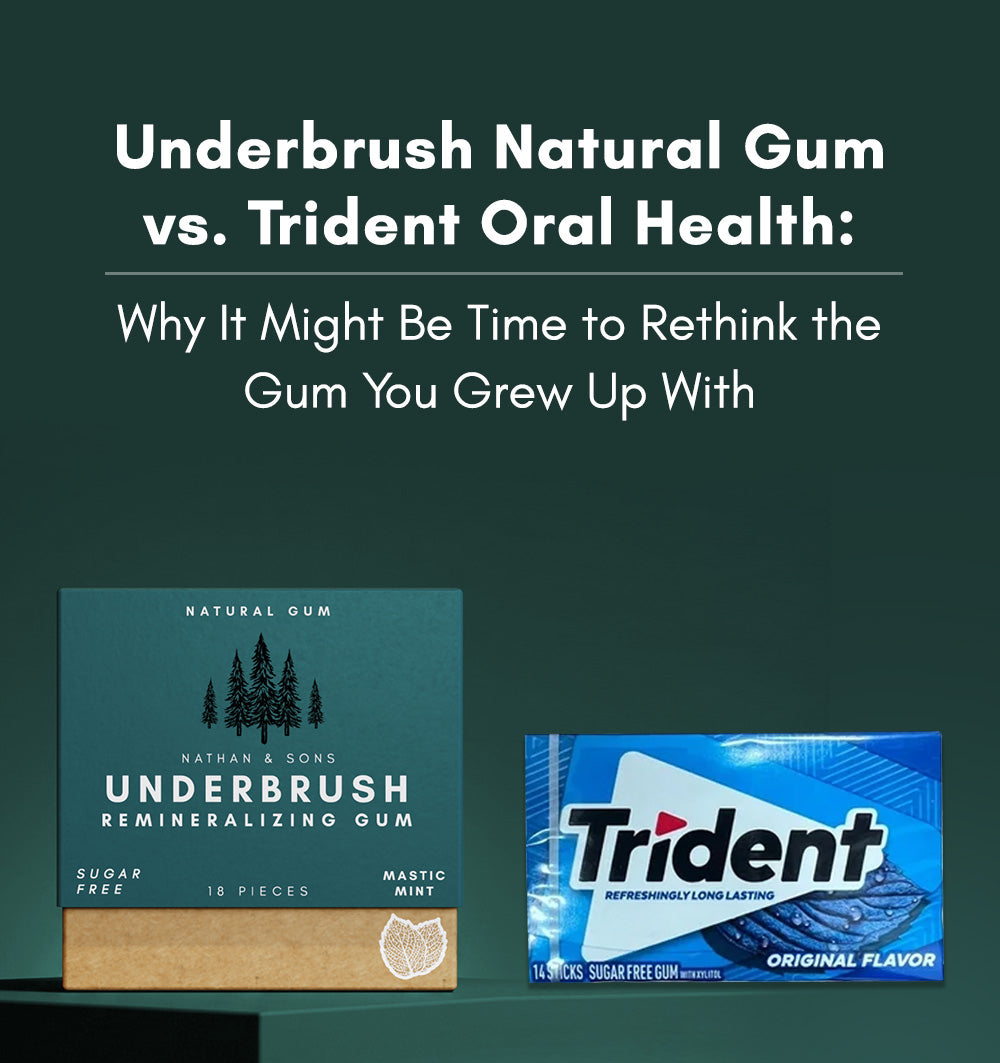
In a nutshell: Trident is the gum a lot of us grew up with, and it does some real things well, including holding an ADA Seal and using xylitol. But when you read the label, it’s also a conventional sugar-free gum formulation: an undisclosed gum base, artificial sweeteners like aspartame and acesulfame potassium, artificial flavors, and in some flavors artificial colors. When people search natural gum vs Trident oral health, this is really the question underneath it: now that you can read the label, is that still the gum you want? It’s a comparison of ingredients and formulas, not a claim that either gum produces better health outcomes. Underbrush takes a different path, with a named chicle base, xylitol, and nano- and micro-hydroxyapatite. Neither gum replaces brushing, flossing, or your dentist. We make Underbrush, so we’re biased, which is exactly why everything here is sourced.
Let’s take a nostalgic little trip.
You’re a kid. Somebody hands you a stick of Trident.
That crinkly foil, that first snappy chew, that familiar burst of flavor many of us remember before it fades.
For a lot of us, Trident just is what gum tastes like. It’s the default. The wallpaper of the candy aisle.
And truthfully. There’s nothing wrong with a little nostalgia.
But here’s the thing about the gum you grew up with. Back then, ingredient labels got less attention than they often do today.
We just chewed.
These days, more of us actually read the label. And once you do, the natural gum vs Trident oral health question becomes a straightforward matter of comparing what’s on each label.
A quick, genuinely wild history detour
Before we compare labels, indulge us, because the backstory here is too good to skip.
Humans have chewed things since mouths were created.
The ancient Maya chewed chicle, the natural latex from the sapodilla tree, and Indigenous peoples in New England chewed spruce resin long before any of this hit a checkout aisle.
But modern gum owes its existence to a spectacularly failed business idea.
In the late 1860s, the exiled former Mexican president Antonio Lopez de Santa Anna was boarding on Staten Island with a photographer named Thomas Adams.

Santa Anna had a big supply of chicle and a pitch: turn it into a cheap rubber substitute for things like carriage tires.
Adams spent more than a year trying to make tires, toys, and boots out of chicle.
Every experiment failed.
About to give up, Adams remembered that Santa Anna liked to simply chew the stuff, the way people had in Mexico for generations.
So he boiled a small batch, sold it at a local shop, and people bought it.
He patented a gum-making machine in 1871, and the modern chewing gum industry was born from a rubber-tire flop.
Here’s the part that matters for our story.
For decades, gum meant chicle, actual tree sap.
Then, by the mid-1900s, demand outran the sapodilla trees, and the industry moved to manufactured gum-base ingredients.
That’s the fork in the road that eventually produced both Trident and, much later, the natural-gum comeback.
If you want the fuller version, we wrote a whole explainer on what natural chewing gum actually is.
First, let’s be fair to Trident
We’re not here to trash a classic. That’s not the credible way to do this.
So let’s start with what Trident genuinely gets right, because it’s real.
And let’s give it its due historically, too.
Trident was introduced by the American Chicle Company in 1960, right as sugar was getting scientific scrutiny as a cause of tooth decay.
It was one of the first nationally distributed sugar-free gums, and the whole brand was built around dental health.
The name itself is a marketing claim: “Trident” nods to three dental benefits.
There’s even a fun footnote, in 1964 NASA reportedly packed Trident into the provisions for the Gemini space missions.
You probably remember the slogan, too: “Four out of five dentists surveyed recommend sugarless gum for their patients who chew gum.”
That line ran for decades and became cultural shorthand.
For one, Trident is sugar-free, and it’s sweetened partly with xylitol, a sugar alcohol commonly used in sugar-free oral-care products.
Even better, and we’ll give full credit here, Trident sugarfree gum carries the American Dental Association Seal of Acceptance.
The seal appears right on the pack, with the ADA’s approved wording: it helps prevent cavities when chewed for 20 minutes after eating.
That’s not nothing.
The ADA notes that chewing sugar-free gum stimulates saliva, which helps wash away food and neutralize acids.
So if your only question is “is Trident better than chewing a sugary gum,” the answer is genuinely yes.
Trident does the basic job.
It’s widely available, familiar, and generally less expensive than premium gums, and the established benefit of sugar-free gum, primarily stimulating saliva, applies to it.
We respect the classic. We just think the recipe hasn’t kept up with what a lot of people now want.
Now flip the pack over
Here’s where reading the label changes things.
Take the U.S. label for Trident Original sugar-free gum, as published on the official Trident website.
It lists sorbitol, an undisclosed “gum base,” xylitol, glycerin, and “natural and artificial flavor.”

Then, in the “less than 2%” section, that same label lists aspartame, acesulfame potassium, sucralose, and BHT.
Ingredients vary by flavor, though. Trident Spearmint lists Blue 1 Lake and Yellow 5 Lake, and Trident Tropical Twist lists Yellow 5 Lake and Yellow 6 Lake plus additional ingredients like maltitol syrup, citric acid, and malic acid, none of which appear on the Trident Original label.
None of that is hidden. It’s right there on the label, and it’s legal, and millions of people chew it happily every day.
But it is, recognizably, a conventional sugar-free gum formulation. Artificial sweeteners, an unnamed base, artificial flavors, and in some flavors artificial colors.
And some shoppers prefer to avoid those ingredients. Not because of any one scary headline, but as a preference for fully itemized, chicle-based formulas.
That preference has contributed to consumer interest in chicle-based, ingredient-forward gums.
So is Trident bad for you?
No, and we won’t say that, because we can’t and it wouldn’t be honest.
Trident is a legal, ADA-Sealed product, and we’re not making a safety claim about any of its ingredients.
The fair way to put it is this: Trident is built on an older recipe with artificial sweeteners, artificial flavors, an undisclosed base, and sometimes artificial colors.
Whether you want those in your gum is a personal preference, and some consumers prefer to avoid those ingredients.
The “gum base”? What almost nobody asks…
Here’s the part almost nobody notices, and it’s our favorite detail.
That innocent little phrase “gum base” is doing a lot of quiet work.
Under federal regulation, “gum base” can legally include a long list of substances, including synthetic materials like polyvinyl acetate, polyethylene, and paraffin, all bundled under those two words with nothing itemized.
We’re not saying that’s what’s in any specific gum.
We genuinely can’t know, because it isn’t disclosed.
And that’s exactly the point. When a label just says “gum base,” you’re trusting without seeing.
Underbrush goes the other way. Our base is named outright: chicle, which is actual tree sap, plus candelilla wax and citric acid.
It’s the same tree sap that started the whole industry before manufactured bases became standard.
Why Underbrush is completely unique

Underbrush was built for the person who flipped the pack over and decided they wanted a fully itemized, chicle-based formula without the high-intensity sweeteners listed on the compared Trident label.
It keeps the genuinely good idea Trident had, sugar-free and xylitol, and then rethinks the rest.
Instead of an undisclosed base, it uses named chicle, the tree sap humans chewed for centuries before synthetic bases took over.
Underbrush also lists nano- and micro-hydroxyapatite among its ingredients, the mineral that makes up most of your tooth enamel.
You can read our explainer on what nano-hydroxyapatite is for the full picture.
Instead of the high-intensity sweeteners listed on the compared Trident label, Underbrush uses xylitol and erythritol.
Its fully itemized formula also includes botanical resins like mastic, spruce, acacia, and myrrh, plus minerals like calcium and magnesium carbonate and zinc gluconate.
What is hydroxyapatite, and why is it in Underbrush?
It’s the main mineral in tooth enamel, and Underbrush lists nano- and micro-hydroxyapatite on its label.
Here’s the honest caveat we always include: hydroxyapatite has been studied in oral-care formats like toothpaste, but Underbrush has not been clinically demonstrated to remineralize teeth or prevent cavities.
Most hydroxyapatite research comes from toothpastes and rinses, not gum, so we’re describing what’s on our label, not claiming a proven result from chewing our gum.
We won’t pretend gum-specific trial data exists when it doesn’t.
Let’s talk about what the evidence actually supports
Before anyone thinks we’re claiming Underbrush works miracles, here’s the sober part that applies to both gums.
Any honest natural gum vs Trident oral health discussion has to be clear about what the science does and doesn’t show.
The strongest, most established argument for any sugar-free gum is saliva.
The American Dental Association notes that chewing sugar-free gum increases salivary flow, which helps reduce cavity risk when it’s added to brushing twice a day and cleaning between your teeth.
Crucially, the ADA also says plainly that gum is not a substitute for brushing or flossing.
That applies to Trident, to Underbrush, and to every gum ever made.
We’d tape that sentence to our own forehead.
On the hydroxyapatite side, a 2021 systematic review in the Canadian Journal of Dental Hygiene reported that studies of certain hydroxyapatite-containing oral-care products have reported reductions in caries outcomes.
But again, that evidence comes from toothpastes and rinses, not from a clinical trial on any gum, ours included.
Does Underbrush actually remineralize teeth better than Trident?
We won’t claim that. Underbrush contains nano- and micro-hydroxyapatite, which Trident doesn’t list, and hydroxyapatite has been studied in oral-care formats like toothpaste.
But Underbrush has not been clinically demonstrated to remineralize teeth or prevent cavities, and we don’t have a head-to-head trial showing one gum outperforms the other.
We’re describing what’s on the label, not a proven result from chewing our gum.
Underbrush Natural Gum vs Trident Gum – The flavor-fade truth, for both gums
Let’s be honest about something, because it cuts against us too.
Flavor duration is another difference worth considering.
Underbrush leans woodsier and more herbal, with mastic, spruce, and chicle, and a firmer, more substantial chew. Some people love it immediately. Some need a couple of pieces to adjust.
That’s the honest trade-off of a chicle-based gum, and we’d rather tell you upfront than oversell it.
Why might Underbrush’s flavor fade sooner than conventional gum?
Flavor duration varies by formulation.
Underbrush is not formulated to provide an extended flavor experience, so its flavor may fade sooner than some conventional gums.
If you switch, expect a woodsier, more herbal chew with a potentially shorter flavor window. Whether that trade-off is worthwhile is a matter of personal preference.
Underbrush Natural Gum vs Trident Gum – The Comparison Grid
This grid compares Underbrush against one specific product: the U.S. ingredient label for Trident Original Flavor sugar-free gum, as reviewed on July 21, 2026.
Trident ingredients vary by flavor, so other Trident varieties may differ from what’s shown here.

A note on colors, since this is where flavors differ most: Trident Original does not list artificial colors.
Other flavors do. Trident Spearmint lists Blue 1 Lake and Yellow 5 Lake, and Trident Tropical Twist lists Yellow 5 Lake and Yellow 6 Lake.
If artificial colors matter to you, check the specific flavor’s label.
Underbrush Natural Gum vs Trident Gum: which one is actually for you?
Here’s the honest, no-spin version.
Trident makes sense if you want the cheapest, most available, most familiar sugar-free gum, you prioritize familiar, longer-lasting flavor, and the ingredient list doesn’t concern you.
It’s a fine classic at what it does, and the ADA Seal is a real credential.
Underbrush makes sense if you’ve started reading labels, you prefer a formula without the high-intensity sweeteners listed on the compared Trident label, and you want a named chicle base plus xylitol and hydroxyapatite.
That’s the exact gap we built it to fill.
Is switching from Trident to a natural gum worth it?
That depends entirely on what you care about.
If price and familiarity rule, Trident is hard to beat.
If a fully itemized, chicle-based formula matters to you, that’s the reason gums like Underbrush exist.
There’s no universally correct answer, just the one that fits your priorities.
If you want to see how Underbrush compares to other modern options, our 2026 guide to Underbrush vs. competitors goes wider than this one.
Underbrush Natural Gum vs Trident Gum: The bottom line
So where does the Underbrush natural gum vs Trident oral health question land?
Trident isn’t the villain of this story.
It’s the nostalgic classic that did a real job for decades, and it still holds an ADA Seal today.
But the recipe is a conventional one. Artificial sweeteners, an undisclosed base, artificial flavors, and sometimes artificial colors were just how mainstream gum got made.
The gum many of us grew up with was developed when ingredient transparency received less consumer attention than it often does today.
Now that more of us read labels, it’s fair to ask whether that recipe still fits your priorities, or whether a fully itemized, chicle-based formula fits better.
We built Underbrush for the second kind of person. If that’s you, you can find it on our official Underbrush product page.
And whichever you choose, keep brushing and flossing. No gum, ours or anyone’s, gets you out of that.
References
- Nathan and Sons, Underbrush product page (ingredients, positioning).
- Trident Original Flavor sugar-free gum, 14-stick pack, U.S. ingredient label as published on the official Trident website and reviewed on July 21, 2026 (listed as: sorbitol, gum base, xylitol, glycerin, natural and artificial flavor; less than 2% of acesulfame potassium, aspartame, BHT, mannitol, soy lecithin, sucralose; contains soy; contains a bioengineered food ingredient). Independently corroborated by the Costco retailer product listing for the same product (Item 1187811, “Trident Sugar Free Gum, Original, 14-count,” reviewed July 21, 2026), which shows an identical ingredient list. Trident Original does not list artificial colors. The color and flavor-variation note reflects Trident Spearmint and a physical Trident Tropical Twist package. Ingredients vary by flavor; readers should consult current packaging.
- American Dental Association Seal of Acceptance for Trident Sugarfree Gum (ada.org product record). The ADA Accepted seal, with the wording “helps prevent cavities when chewed for 20 minutes after eating,” is physically present on the Trident Tropical Twist package reviewed on July 21, 2026 (UPC 073390055172).
- American Dental Association, Chewing Gum, ADA Oral Health Topics (ada.org).
- eCFR, 21 CFR 172.615, Chewing gum base (permissible gum-base substances).
- Limeback H, Enax J, Meyer F. Biomimetic hydroxyapatite and caries prevention: a systematic review and meta-analysis. Canadian Journal of Dental Hygiene 2021;55(3):148-159. (PMID 34925515.)
- Trident Spearmint sugar-free gum, 14-stick pack, U.S. ingredient label on the official Trident website, reviewed July 21, 2026 (source for Blue 1 Lake and Yellow 5 Lake). Trident Tropical Twist sugar-free gum, 14-stick physical package (UPC 073390055172, best before 29 OCT 2026), reviewed July 21, 2026, listing sorbitol, gum base, xylitol, mannitol, maltitol syrup, natural and artificial flavor; less than 2% of acesulfame potassium, aspartame, BHT, citric acid, glycerin, malic acid, soy lecithin, sucralose, Yellow 5 Lake, Yellow 6 Lake; contains soy; contains phenylalanine (source for the flavor-variation and color note; carries the ADA Accepted seal).
- Chewing gum history (Thomas Adams and Antonio Lopez de Santa Anna; chicle rubber experiments; 1871 gum-machine patent; Maya and New England spruce-resin chewing traditions), as documented in the Brooklyn Public Library historical archive, the Encyclopaedia entry for the American Chicle Company, and contemporaneous gum-industry histories.
- Trident brand history (American Chicle Company, 1960 introduction; first nationally distributed sugar-free gum; “four out of five dentists surveyed” advertising slogan; “three dental benefits” name origin; 1964 Gemini mission provisioning; current Mondelez International ownership), as documented in published brand and advertising histories.