
Advertising disclosure: This comparison was prepared by us here at Nathan and Sons, the maker and seller of Underbrush. It is promotional content and should not be considered an independent product review. Sources were last reviewed on July 21, 2026.
The bottom line, up front: “Sugar free” is a real, meaningful thing, and Orbit does it well enough to carry an ADA Seal. But “sugar free” is a claim about what a gum doesn’t have. It says nothing about the gum base, the sweetener type, or whether anything else is working in your mouth. This comparison looks at what “sugar free” does and doesn’t tell you, using Orbit and Underbrush as the two examples. Underbrush is a chicle-based gum that also lists nano- and micro-hydroxyapatite; it has not been clinically demonstrated to remineralize teeth or prevent cavities. Orbit is a conventional sugar-free gum with an undisclosed base. Neither replaces brushing, flossing, or your dentist. We make Underbrush, so we’re biased, which is exactly why everything here is sourced.
Let’s start with a phrase you’ve seen ten thousand times.
“Sugar free.”
It’s on the pack. It’s in the ads. It’s practically a personality trait for gum at this point.
And here’s the thing: sugar free is genuinely good. It’s not marketing fluff.
But “sugar free” has quietly become a stand-in for “healthy,” and those are not the same claim.
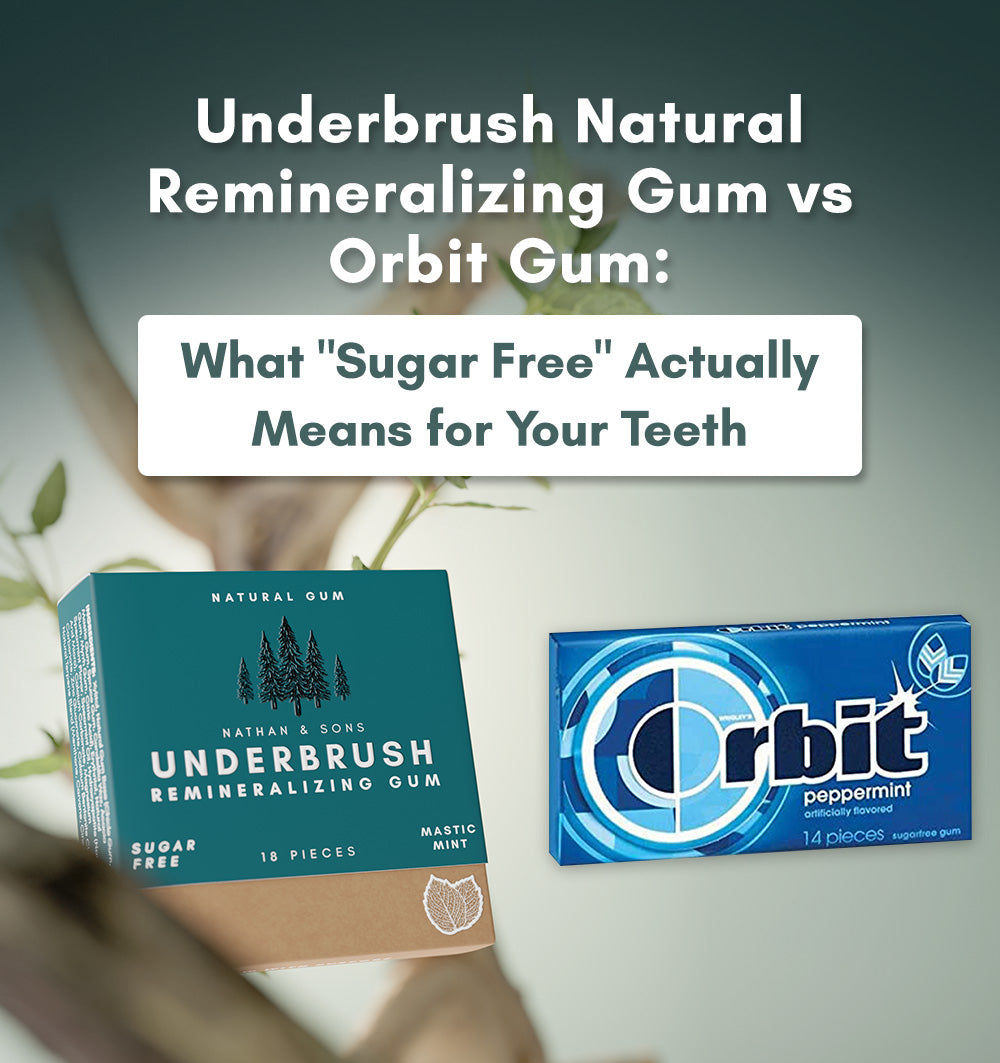
When people compare natural remineralizing gum vs Orbit gum, that’s usually the confusion underneath it: assuming “sugar free” tells you everything about what a gum does for your teeth.
It doesn’t. It tells you one specific, useful thing, and stays completely silent on several others.
So let’s unpack what “sugar free” actually means, where Orbit genuinely earns it, and what the label doesn’t say.
First, let’s be fair to Orbit
We’re not here to trash a classic, because that wouldn’t be honest.
Orbit is a genuinely solid sugar-free gum, and it earns real credit.
For one, it’s sugar-free and carries the American Dental Association Seal of Acceptance, which recognizes the oral-care benefit of chewing sugar-free gum.
That benefit is real, and we’ll explain the science of it in a minute.
Orbit is also convenient, widely available, affordable, and comes in a huge range of flavors. Millions of people chew it every day and enjoy it.
So this isn’t a story about a bad gum.
It’s a story about what one little phrase on the front of the pack does and doesn’t promise.
What “sugar free” actually means (the good part)
Here’s the genuinely good news, and it applies to both gums.
The strongest, most established argument for any sugar-free gum is saliva.
Specifically, the American Dental Association notes that chewing sugar-free gum increases salivary flow, which helps reduce cavity risk when it’s added to brushing twice a day and cleaning between your teeth.
There are two things happening there.
First, “sugar free” means the cavity-causing bacteria in your mouth aren’t being fed a fresh supply of sugar to turn into acid.
Second, the physical act of chewing stimulates saliva, and saliva is your mouth’s natural rinse cycle. It buffers acid and carries minerals around.
That’s a real, ADA-recognized benefit, and Orbit delivers it. So does Underbrush. So does any sugar-free gum.
Crucially, though, the ADA also says plainly that gum is not a substitute for brushing or flossing.
That applies to every gum ever made, ours included.
So on the core “sugar free equals saliva benefit” story, Orbit is standing on solid ground.
What “sugar free” does NOT tell you
Here’s where the phrase goes quiet.
“Sugar free” is a claim about one thing a gum doesn’t contain: sugar.
It says nothing at all about three other things people often assume it covers.
It doesn’t tell you what sweetens the gum instead.
Sugar-free gums use sugar alcohols and often artificial sweeteners.
Orbit’s label lists sorbitol, maltitol or mannitol, and, in the “less than 2%” section, aspartame and acesulfame potassium, with xylitol in some varieties.
(https://www.orbitgum.com/products/orbit/orbit-peppermint-sugarfree-chewing-gum-14-piece-single-pack-single-pack)
Underbrush uses xylitol and erythritol.
Both are “sugar free,” but the sweetener systems are different.
It doesn’t tell you what the gum base is.
Both Orbit and Underbrush are “sugar free,” but Orbit’s base is listed simply as “gum base,” with no itemization, while Underbrush names its base: chicle, which is actual tree sap, plus candelilla wax and citric acid.
More on that below.
It doesn’t tell you what else is or isn’t in the formula.
“Sugar free” is silent on whether a gum contains added minerals, botanical resins, or hydroxyapatite.
Orbit’s label focuses on the sweetener-and-flavor essentials.
Underbrush lists additional ingredients like nano- and micro-hydroxyapatite and mineral additives.
So “sugar free” is true for both. It’s just a much smaller claim than it sounds.
So is “sugar free” meaningless?
Not at all, and we won’t say that.
Sugar-free is a genuine, ADA-recognized benefit, and choosing sugar-free gum over sugared gum is a real improvement for your teeth.
The point is narrower: “sugar free” answers one question (no sugar, saliva benefit) and leaves several others, sweetener type, gum base, added ingredients, entirely unanswered.
Those are the questions this comparison is actually about.
The “gum base” most consumers overlook this
Here’s the part almost nobody notices, and it’s our favorite detail.
That innocent little phrase “gum base” is doing a lot of quiet work.
Under federal regulation, “gum base” can legally include a long list of substances, including synthetic materials like polyvinyl acetate, polyethylene, and paraffin, all bundled under those two words with nothing itemized.
We’re not saying that’s what’s in any specific gum.
We genuinely can’t know, because it isn’t disclosed.
And that’s exactly the point. When a label just says “gum base,” you’re trusting without seeing.
Orbit’s label lists “gum base” without itemizing it, which is completely standard and completely legal.
Underbrush goes the other way.
Our base is named outright: chicle, candelilla wax, and citric acid.
It’s the same tree sap humans chewed for centuries before manufactured bases became standard.
If you want the fuller story, we wrote a whole explainer on what natural chewing gum actually is.
So what makes Underbrush different?
Underbrush was built for the person who reads “sugar free,” nods, and then asks the next three questions.
Before we get into the formula, here’s the short version of how Underbrush started, straight from us.
It keeps the genuinely good idea, sugar-free and saliva-stimulating, and rethinks the rest.
Instead of an undisclosed base, it uses named chicle.
Instead of the high-intensity sweeteners on Orbit’s label, it uses xylitol and erythritol.
Underbrush also lists nano- and micro-hydroxyapatite among its ingredients, the mineral that makes up most of your tooth enamel.
You can read our explainer on what nano-hydroxyapatite is for the full picture.
Its fully itemized formula also includes botanical resins like mastic, spruce, acacia, and myrrh, plus minerals like calcium and magnesium carbonate and zinc gluconate.
What is hydroxyapatite, and why is it in Underbrush?
It’s the main mineral in tooth enamel, and Underbrush lists nano- and micro-hydroxyapatite on its label.
Here’s the honest caveat we always include: hydroxyapatite has been studied in oral-care formats like toothpaste, but Underbrush has not been clinically demonstrated to remineralize teeth or prevent cavities.
Most hydroxyapatite research comes from toothpastes and rinses, not gum, so we’re describing what’s on our label, not claiming a proven result from chewing our gum.
We won’t pretend gum-specific trial data exists when it doesn’t.
A note on the word “remineralizing”
Since people search for “natural remineralizing gum vs Orbit gum,” it’s worth being precise about that word.
“Remineralizing” describes hydroxyapatite’s role as an enamel mineral, and it’s part of how our category is commonly described.
But we want to be clear, not clever, about it. Underbrush has not been clinically demonstrated to remineralize teeth or prevent cavities.
The honest version is this: Underbrush lists hydroxyapatite, hydroxyapatite has supportive evidence in other oral-care products, and we’re describing what’s on the label rather than promising an outcome.
Orbit, for its part, does not list hydroxyapatite, and doesn’t claim to. It’s a sugar-free gum built around the saliva benefit, and it’s honest about being exactly that.
The evidence, with integrity
Before anyone thinks we’re claiming Underbrush works miracles, here’s the sober part that applies to both gums.
For hydroxyapatite, a 2021 systematic review in the Canadian Journal of Dental Hygiene reported that studies of certain hydroxyapatite-containing oral-care products have reported reductions in caries outcomes.
But that evidence comes from toothpastes and rinses, not from a clinical trial on any gum, ours included.
For the saliva benefit, the evidence is stronger and applies to both gums equally, because it’s about the act of chewing sugar-free gum, not about any special ingredient.
Does Underbrush remineralize teeth better than Orbit?
We won’t claim that. Underbrush lists hydroxyapatite and Orbit doesn’t, and hydroxyapatite has been studied in oral-care formats like toothpaste.
But Underbrush has not been clinically demonstrated to remineralize teeth, and we don’t have a head-to-head trial showing one gum outperforms the other.
We’re describing what’s on the label, not a proven result.
Taste and texture: a closer look
Let’s be honest about the chewing experience, because it cuts against us too.
Orbit is engineered for a clean, familiar, crowd-pleasing flavor across a wide range, and a soft, easy chew.
That’s a genuine strength, and it’s why it’s a bestseller.
Underbrush leans woodsier and more herbal, with mastic, spruce, and chicle, and a firmer, more substantial chew. Some people love it immediately.
Some need a couple of pieces to adjust.
Why might Underbrush’s flavor fade sooner than Orbit?
Flavor duration varies by formulation. Underbrush is not formulated to provide an extended flavor experience, so its flavor may fade sooner than some conventional gums.
If you switch, expect a woodsier chew with a potentially shorter flavor window. Whether that trade-off is worthwhile is a matter of personal preference.
Underbrush Natural Remineralizing Gum vs Orbit Gum: Comparison Grid

A note on colors and additives, since flavors differ:
Orbit Peppermint’s label centers on sweeteners, flavors, and BHT.
Some other Orbit varieties list additional additives, such as a colorant like titanium dioxide or a color additive, so if that matters to you, check the specific flavor’s label.
Underbrush Natural Remineralizing Gum vs Orbit Gum: which one is actually for you?
Here’s the honest, no-spin version.
Orbit makes sense if you want the most available, most familiar, most affordable sugar-free gum, you like a wide range of clean flavors, and the saliva benefit is what you’re after.
It’s a fine classic at exactly that, and the ADA Seal is a real credential.
Underbrush makes sense if you’ve started reading past “sugar free,” you’d prefer a named chicle base and xylitol over an undisclosed base and high-intensity sweeteners, and you want a fully itemized formula that also lists hydroxyapatite and minerals.
That’s the exact gap we built it to fill.
Is a hydroxyapatite gum worth it over a standard sugar-free gum?
That depends on what you’re after. If the saliva benefit and low price are your priorities, a standard sugar-free gum like Orbit does that well.
If you want a named natural base plus a fully itemized formula that lists hydroxyapatite, that’s the reason gums like Underbrush exist, with the honest caveat that we don’t claim a proven remineralization outcome.
There’s no universally right answer, just the one that fits your priorities.
If you want to see how Underbrush compares to other modern options, our 2026 guide to Underbrush vs. competitors goes wider than this one.
Underbrush Natural Remineralizing Gum vs Orbit Gum – The bottom line
“Sugar free” is a real benefit, and Orbit earns its ADA Seal by delivering it. If your question is “is sugar-free gum better for my teeth than sugary gum,” the answer is genuinely yes, and Orbit is a perfectly good way to get there.
But “sugar free” is a small claim wearing a big coat. It tells you there’s no sugar and you’ll get the saliva benefit. It stays silent on the sweetener type, the gum base, and whether anything else is in the formula.
Underbrush was built for the person who wants those other questions answered on the label: a named chicle base, xylitol and erythritol, and listed hydroxyapatite and minerals, with the honest caveat that we describe what’s on the label rather than promising a clinical outcome.
If that’s you, you can find Underbrush here on the official Underbrush product page.
And whichever you choose, keep brushing and flossing. No gum, ours or anyone’s, gets you out of that.
References
- Nathan and Sons, Underbrush product page (ingredients, positioning).
- Orbit Peppermint Sugarfree Chewing Gum, U.S. ingredient label verified against the product package and reviewed on July 21, 2026 (listed as: sorbitol, gum base, glycerol, mannitol, natural and artificial flavors; less than 2% of hydrogenated starch hydrolysate, aspartame, acesulfame K, soy lecithin, xylitol, BHT; contains phenylalanine). Corroborated by the official Orbit website (orbitgum.com) listing for the same product. Orbit Peppermint does not list artificial colors. Ingredients vary by flavor; other Orbit varieties (e.g. Bubblemint) list additional additives such as maltitol, acacia, sodium bicarbonate, carnauba wax, and a color additive; capture dated screenshots of any specific flavor referenced before publishing.
- American Dental Association, Seal of Acceptance program (ada.org); Orbit sugarfree gum carries the ADA Seal per manufacturer and retailer listings.
- American Dental Association, Chewing Gum, ADA Oral Health Topics (ada.org).
- eCFR, 21 CFR 172.615, Chewing gum base (permissible gum-base substances).
- Limeback H, Enax J, Meyer F. Biomimetic hydroxyapatite and caries prevention: a systematic review and meta-analysis. Canadian Journal of Dental Hygiene 2021;55(3):148-159. (PMID 34925515.)