
Advertising disclosure: we at Nathan and Sons manufactures and sells Uprising Energy Gum and therefore we have a financial interest in this comparison. This is marketing content, not an independent product review. Sources are provided so readers can evaluate the underlying information. We do our best to put forth an unbiased clear comparison about each product. Product details reflect labels and manufacturer information reviewed as of July 2026.
Think about the last time you hit that 3 p.m. wall.
You probably reached for another coffee, waited twenty minutes, then wondered whether it was doing anything at all.
That gap is exactly why caffeinated gum stopped being a niche product.
People are chewing their way to alertness instead of sipping it, and the numbers back that shift up. Precedence Research projects the global energy gum market growing from $124.69 million in 2025 to $265.36 million by 2035.
So when people start comparing Uprising Energy Gum vs Military Energy Gum, they're usually asking one real question, "Which one fits how I actually work?"
Here's the truth, with the receipts.
Quick Take
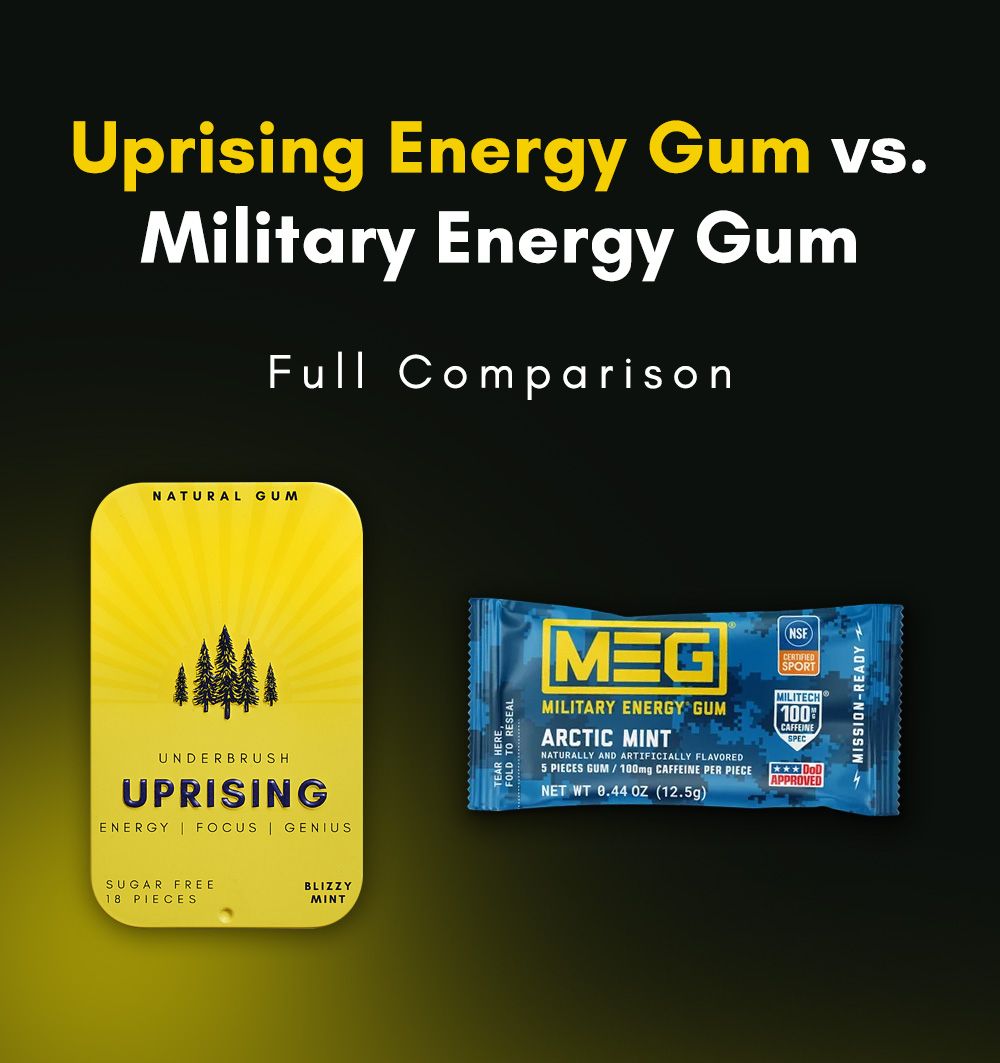
- Military Energy Gum: 100 mg of caffeine per piece, a long military history, and NSF Certified for Sport certification.
- Uprising Energy Gum: 30 mg of caffeine per piece (60 mg per labeled two-piece serving), plus L-theanine, Alpha-GPC, rhodiola, saffron, theobromine, B vitamins, and NAD.
- The real difference: smaller versus larger amounts of caffeine per piece.
- What neither one is: a clinically tested finished formula with proof of a specific outcome for you personally.
Which one is right comes down to your tolerance, your goals, and how much control you want over your dose. Not a marketing claim.
Let's take a closer look at each option...
What Is Military Energy Gum?
Military Energy Gum started life as Stay Alert Gum.
It grew out of military research into caffeine delivery, aimed at supporting alertness during long operations, according to Best Glide ASE's product background on Stay Alert caffeine gum.
In 2001, the Committee on Military Nutrition Research recommended it for military use after studying fatigue and operational alertness.
It went on to earn a real place in U.S. Army field rations, and it even carries its own National Stock Number for military supply channels.
Each piece contains 100 mg of caffeine, roughly what you'd get from a six-ounce cup of coffee.
More recently, NSF announced that Military Energy Gum became the first gum to earn NSF Certified for Sport certification in March 2026, a third-party program that screens for banned athletic substances.
The following month, ACCESS Newswire reported it was added to USO Care Package shipments sent to service members overseas.
That's a genuinely strong résumé, and we're not going to pretend otherwise.
What Is Uprising Energy Gum?
Uprising Energy Gum takes a different approach.
Each piece has 30 mg of caffeine, or 60 mg per labeled two-piece serving.
That lower per-piece dose is the point, because it lets you step up one piece at a time instead of committing to a full hit.
The caffeine is paired with L-theanine, Alpha-GPC, rhodiola, saffron, theobromine, B vitamins, and NAD.
Those ingredients show up across the functional-energy category, and several have their own research behind them.
That being said, individual ingredient research doesn't guarantee a specific effect for every person, and the finished formula hasn't been clinically tested as a whole.
It's labeled sugar-free, vegan, and made in the USA, with a gum base described as natural, using chicle, mastic, and spruce.
If you want the full ingredient rundown, our ingredient transparency page lays it out line by line.
(We encourage you to research ALL Uprising's unique ingredients, but this article specifically highlights the main differences between Uprising and Military gum.)

Uprising Energy Gum vs Military Energy Gum – A Closer Look at Uprising’s Functional Ingredients
Uprising's pitch isn't just "less caffeine."
It's caffeine paired with ingredients that carry their own research. Worth being upfront, though: that research is on the individual compounds, not on the finished gum.
Here's what the science actually says, caveats included.
L-theanine
This is the best-studied pairing in the whole formula.
L-theanine is an amino acid found naturally in tea, and it's been tested alongside caffeine in multiple controlled human trials.
A widely cited 2010 trial in Nutritional Neuroscience on L-theanine and caffeine for cognitive performance and alertness combined 97 mg of L-theanine with 40 mg of caffeine.
Compared with placebo, it found improvements in task-switching accuracy and self-reported alertness, along with less self-reported tiredness.
Other trials using higher doses, up to 250 mg theanine with 150 mg caffeine, found effects that only appeared when the two were combined.
Faster task speed, better semantic memory, more alertness.
There's a plausible reason why.
A double-blind, placebo-controlled study on caffeine and L-theanine alone and in combination reported that L-theanine blunted part of caffeine's blood-pressure response.
That may be behind the "smoother" feeling a lot of people describe from theanine and caffeine together.
Dosing varies from study to study, and Uprising's exact theanine amount per piece isn't independently verified here, so check the current label.
Rhodiola rosea
Rhodiola is an adaptogenic herb, traditionally used for stamina and fatigue.
A 2012 systematic review in BMC Complementary and Alternative Medicine on rhodiola for physical and mental fatigue is probably the fairest summary of where things stand.
Only two of six trials on physical fatigue in healthy people reported a real benefit.
The review's overall take was blunt; efficacy research is contradictory, and methodological flaws make it hard to assess confidently.
More recent evidence reviews of rhodiola land in a similar spot.
Real potential for supporting the body's response to stress and fatigue, paired with a consistent call for better trials and better product-quality standards across the supplement industry.
Bottom line assessment, "promising, not proven," and heavily dependent on formulation and dose.
Theobromine
Did you know? Theobromine is the main alkaloid in chocolate, chemically related to caffeine but much weaker.
The controlled research here is fairly consistent...
It behaves like a mild stimulant with minimal effect on alertness compared with caffeine, which is part of why chocolate doesn't keep most people awake the way coffee does.
One placebo-controlled study comparing theobromine and caffeine on mood, psychomotor performance, and blood pressure found strong alerting effects from caffeine and almost nothing from theobromine.
That same study found theobromine lowered blood pressure while caffeine raised it, with no sign the two worked together.
Its likely role in a caffeine gum isn't alertness at all.
Theobromine generally has a longer reported elimination half-life than caffeine, but that fact alone does not establish a noticeable or beneficial prolonged effect in Uprising.
Comparisons of theobromine and caffeine half-life put theobromine at roughly 6 to 8 hours to clear by half, versus about 5 for caffeine.
Nootropic All-Stars: Alpha-GPC, Saffron, B vitamins, and NAD
These four show up across the nootropic and functional-beverage world, each with its own separate research base covering cognitive support, mood, or energy metabolism depending on the ingredient.
Please note, none of them have been studied specifically in combination with caffeine in gum form.
Uprising also hasn't published clinical data on the finished formula.
Their presence reflects common formulation choices in the category, not a demonstrated combined effect.
So what's it all mean?
The L-theanine and caffeine pairing has the strongest direct evidence of anything on this list.
Rhodiola has real research behind it, just mixed.
Theobromine's contribution to alertness looks minor on its own, even accounting for its other effects.
The rest of the formula leans on ingredients with solid individual research that simply hasn't been tested together in this exact product.
None of that means the formula doesn't work for you.
Uprising picked their ingredients thoughtfully.
Some ingredients have been evaluated in human studies, but the strength, consistency, population, formulation, and dosage of that evidence vary. These studies do not establish that Uprising’s finished formula produces the same results.
For some other ingredients, we're relying on assumptions or tradition without clinical proof.
But here's the thing, even if we have solid evidence for some ingredients, you still need a full clinical trial on the finished product to make sure everything works together.
If you want to go deeper on any single ingredient, our functional ingredient guides and scientific studies section breaks them down one at a time.
Formulations and labels can vary by flavor and change over time, so always check the current package before you buy.

Formulations and labels can vary by flavor and change over time, so check the current package before you buy.
Uprising Energy Gum vs Military Energy Gum – Texture and Chew
Gum review sites describe Military Energy Gum's chew as starting firm, then softening within seconds as the flavor releases.
Its own directions, per its Amazon product listing, say to chew one piece for five minutes, and if you're not alert within 15, chew a second.
Uprising uses a gum base containing chicle, mastic, and spruce.
Texture is subjective, though.
It shifts with freshness, storage, how long you chew, and plain personal preference.
What one person calls smooth, another calls soft.
Speed is where gum has a structural advantage.
Research by Kamimori and colleagues in 2002 reported caffeine from gum reaching peak blood concentration in 44 to 80 minutes, versus 84 to 120 minutes for swallowed capsules, because it's absorbed directly through the lining of the mouth and bypasses first-pass liver metabolism.
Results still depend a lot on formulation, dose, and how you chew.
So is caffeine gum better than coffee or an energy drink?
Not necessarily "better," but it can act faster for some people.
Caffeine absorbed through the lining of your mouth can start entering your bloodstream before it reaches your stomach at all.
It's more a difference in speed and convenience than raw potency.
Uprising Energy Gum vs Military Energy Gum – Choosing Between Them
- Want a bigger dose in one piece? Military Energy Gum, at 100 mg, is built for that.
- Want a smaller amount of caffeine per piece, plus additional listed ingredients? Uprising contains 30 mg of caffeine per piece, subject to its complete serving directions.
Neither one should be treated as automatically fine for a specific job or safety-sensitive activity.
Factor in your own tolerance, your total daily caffeine intake, the product directions, and of course, any workplace policy that applies to you.
And please do not forget to count caffeine from coffee, tea, supplements, energy drinks, and medications taken throughout the day.
The FDA states that for the general population of healthy adults, moderate caffeine intake up to 400 mg per day is not associated with adverse effects such as general toxicity, cardiovascular effects, effects on bone status, changes in behavior, increased cancer incidence, or effects on male fertility (FDA, "Scientific Review of the Risks Associated with Caffeine Consumption").
That’s not a target to hit, though — sensitivity varies a lot from person to person.
If you’re pregnant, nursing, caffeine-sensitive, on medication, managing a medical condition, or thinking about giving either product to a minor, talk to a healthcare professional first.
Why the FDA Watches This Category Closely
In 2013, Wrigley launched Alert Energy Caffeine Gum at 40 mg per piece.
Within about a week, the FDA announced it was investigating added caffeine in foods, with particular concern about easy access for kids and teens.
Wrigley then voluntarily paused production, sales, and marketing while the agency worked out a regulatory framework, a decision covered in detail at the time.
That history is a useful reminder of how closely regulators watch caffeinated foods, especially anything a child could purchase off a shelf.
Nathan and Sons is responsible for making sure Uprising's formulation, labeling, and marketing meet every applicable requirement.
What the Research Actually Shows
Published research has looked at caffeinated chewing gum’s absorption and its effects on certain measures of alertness or performance.
But results depend on the dose, the population, the study design, and the specific product tested.
A ClinicalTrials.gov protocol lists Military Energy Gum as the test product in a study on physical and cognitive performance.
A study protocol alone doesn’t prove effectiveness or confirm favorable results.
Uprising’s finished formula hasn’t been clinically tested the way this article presents it.
Research on individual ingredients shouldn’t be read as proof the combined product delivers the same outcomes.
Uprising Energy Gum vs Military Energy Gum – What people are asking...
- Do people chew both a Military Energy Gum piece and an Uprising piece in the same day or at the same time?
The article cannot determine whether combining them is appropriate for a particular person.
Combining them increases total caffeine exposure, so consumers should follow both labels, count all caffeine sources, and consult a healthcare professional when appropriate.
That includes coffee, tea, soda, energy drinks, and any caffeine-containing medications or supplements.
The FDA's general guidance of 400 mg a day for most healthy adults covers everything combined, not each product separately.
- What about "sugar-free" gum? Does that mean it's better for your teeth?
Not automatically.
Sugar-free gum skips feeding the bacteria that cause cavities from sugar specifically, and some sugar-free sweeteners, like xylitol, have their own oral-health research behind them.
But "sugar-free" on its own doesn't establish a specific comparative dental benefit between two products.
Sugar alcohols can also cause digestive discomfort for some people in larger amounts. Our guide to sugar-free sweeteners in gum covers the trade-offs.
- I've not heard of a National Stock Number before. Why does Military Energy Gum have a National Stock Number (NSN)?
A National Stock Number, or NSN, is a 13-digit code the U.S. Department of Defense assigns to items it standardizes across military supply chains.
It lets units order the product consistently through official logistics systems.
It reflects integration into military rations and procurement, not a claim about how it compares to civilian products.
- I don't exercise or even play sports, is NSF Certified for Sport relevant if I'm not an athlete?
Yes, it still matters.
NSF Certified for Sport is an independent certification program that evaluates applicable label claims, tests for potentially harmful levels of specified contaminants, and screens certified production lots for substances prohibited in sport.
NSF reported in March 2026 that Military Energy Gum’s certification included screening for more than 295 athletic banned substances.
This certification may also interest non-athletes who value independent product testing.
It does not prove that the product provides a particular health or performance benefit, guarantee that it is appropriate for every consumer, or certify every aspect of the manufacturer’s operations.
Consumers can verify currently certified products and lots through NSF’s directory.
- Can I give my teenager either of these products?
This is exactly the gray area that drew FDA scrutiny to the category in 2013.
Caffeine can affect younger people differently than adults, and the FDA has flagged concerns about children and teens getting easy access to products with added caffeine.
If you're a parent or caregiver considering either product for a teenager, check the current label closely and talk to a pediatrician first.
- How long does it take the caffeine in the gum to work once I start chewing?
Research on caffeinated gum has reported peak blood caffeine concentrations in roughly 44 to 80 minutes, compared with 84 to 120 minutes for swallowed capsules.
Individual timing varies with dose, formulation, and how long you actually chew, so treat those ranges as a general pattern rather than a promise.
Uprising Energy Gum vs Military Energy Gum – Bottom Line
Neither product is universally "better."
Military Energy Gum offers 100 mg of caffeine per piece and carries NSF Certified for Sport certification, plus a documented history in military supply channels.
Uprising offers 30 mg per piece, is labeled sugar-free and vegan, and comes with several additional functional ingredients whose research is stronger in some places than others.
Want a bigger dose per piece? Military Energy Gum is the more direct option.
Want to dose lower and get Uprising's particularly rich ingredient profile? That's where Uprising fits.
Either way, follow the current package directions and keep track of your total caffeine intake across everything you consume.
This article is for general informational purposes only and isn't medical advice. Formulations and labels change, so always check the current package.
References
Best Glide ASE. "Stay Alert Caffeine Gum: Military Energy Gum Product Background."
Amazon. "MEG Military Energy Gum, Arctic Mint, Pack of 24, Product Listing."
https://www.amazon.com/MEG-Military-Caffeine-Increase-Performance/dp/B0017O19Q2
NSF. "Military Energy Gum Becomes the First Gum to Earn NSF Certified for Sport Certification." 2026.
ACCESS Newswire. "Military Energy Gum Added to USO Care Package Program." 2026.
CNN. "Wrigley Halts Production of Caffeine Gum." 2013.
CNBC. "Production of Wrigley's Alert Caffeine Gum Halted." 2013.
Precedence Research. "Energy Gum Market Size to Hit USD 265.36 Million by 2035."
ClinicalTrials.gov. "Caffeinated Chewing Gum on Ice Hockey Performance, Study Protocol." NCT06557655.
U.S. Food and Drug Administration. "Spilling the Beans: How Much Caffeine Is Too Much?"
Nutritional Neuroscience. "The Combination of L-theanine and Caffeine Improves Cognitive Performance and Increases Subjective Alertness." 2010.
Biological Psychology. "A Double-Blind, Placebo-Controlled Study Evaluating the Effects of Caffeine and L-theanine Both Alone and in Combination."
BMC Complementary and Alternative Medicine. "Rhodiola rosea for Physical and Mental Fatigue: A Systematic Review." 2012.
News-Medical. "Rhodiola Rosea: Evidence-Based Health Benefits and Clinical Insights."
Physiology & Behavior. "Differential Contributions of Theobromine and Caffeine on Mood, Psychomotor Performance and Blood Pressure." 2011.
Roon. "Theobromine vs Caffeine: What Makes Them Different?"
Kamimori, G. H., et al. "The Rate of Absorption and Relative Bioavailability of Caffeine Administered in Chewing Gum Versus Capsules to Normal Healthy Volunteers." International Journal of Pharmaceutics. 2002.