
The short version, up front: Saffron is the ruby-red spice you know from paella and biryani, and it turns out modern researchers have spent a lot of time studying saffron extract for mood and focus. In human trials, mostly in adults with low or subclinical mood, saffron extract has been associated with improvements in mood measures. The connection to focus is more indirect: when your mood steadies, concentration often has an easier time showing up. The evidence is genuinely interesting but not unanimous, and saffron is not a treatment for depression or any other condition. This article walks through what the research says, where it stops, and how people use it. It’s educational, not medical advice, so talk to your own healthcare provider before starting any supplement.
Let’s start with something a little absurd.
The most-studied natural mood ingredient of the last decade is also the thing that turns your rice yellow.
Saffron.
The spice in your grandmother’s paella. The one that costs more per gram than some precious metals.
For most of human history, saffron was a luxury seasoning and a folk remedy.
Now it’s sitting in peer-reviewed journals, being tested in double-blind trials for how it affects human mood.
That’s a strange journey for a flower stigma. And it’s exactly why saffron extract for mood and focus has become such an interesting little corner of the research world.

First, what is saffron, really?
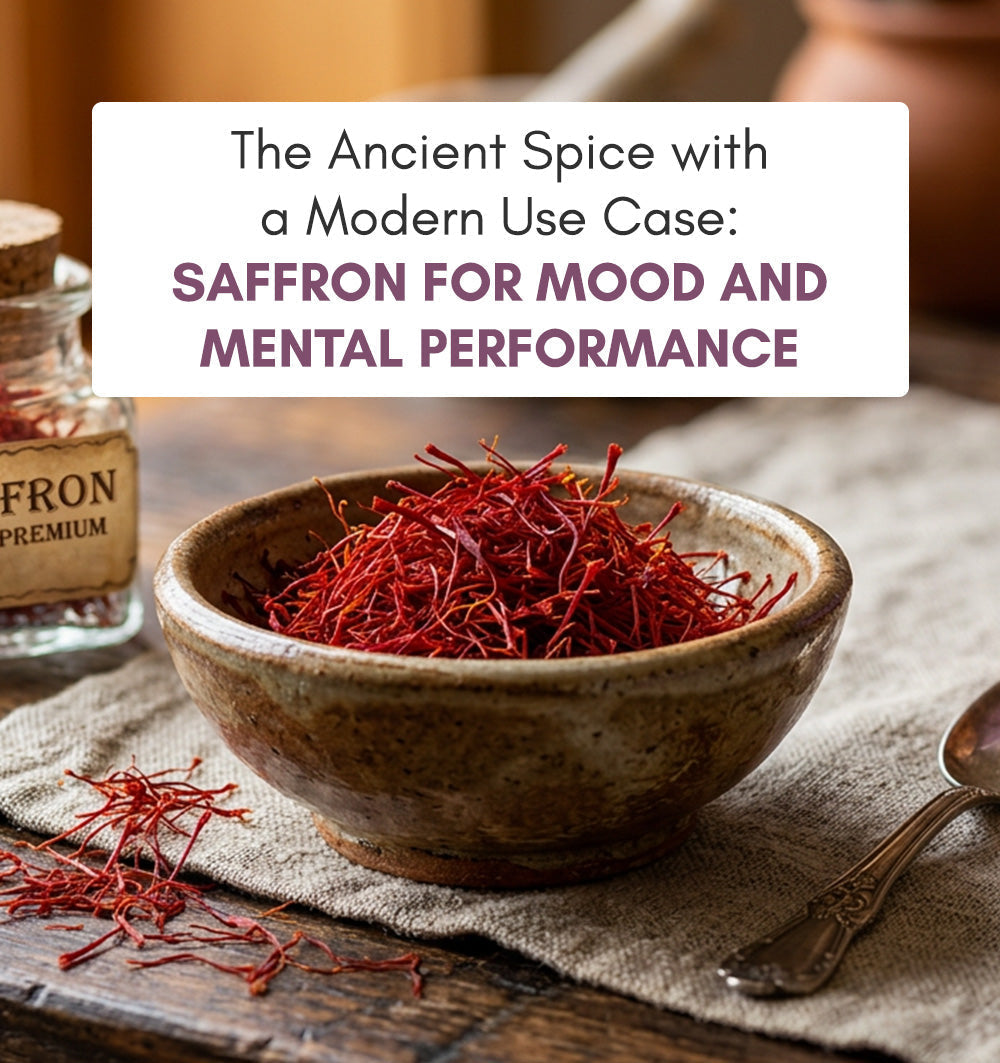
Picture a purple crocus flower.
Inside each bloom sit three tiny crimson threads, the stigmas.
Those threads are saffron. And they have to be hand-picked, which is why it takes something like 150 flowers to make a single gram.
That labor is the reason saffron has been treasured, and pricey, for thousands of years.
Traditionally, cultures across Persia, India, and the Mediterranean used it for far more than flavor.
They reached for it during low spirits, sluggish stretches, and the general heaviness of hard seasons.
Modern science got curious about why. And the answer seems to live in saffron’s active compounds, with names like crocin, crocetin, and safranal.
So what does the research actually say about saffron and mood?
This is the heart of it, so let’s look at real studies rather than folklore.
Start with a big one.
A 12-week randomized, double-blind, placebo-controlled trial by Lopresti and colleagues, published in The Journal of Nutrition in 2025, gave 202 adults with depressive symptoms either 28 mg of a standardized saffron extract daily or a placebo.
The saffron group showed greater improvement on the study’s main depression-and-stress measure than placebo.
In fact, about 72% of the saffron group hit a clinically meaningful improvement, versus roughly 54% on placebo.
Here’s the honest footnote, though. The other, secondary measures in that same study didn’t show a clear difference between groups.
That’s a real result, and it belongs in an honest write-up.
Then there’s a study in healthy people, which is the more relevant crowd for most readers.
A randomized, double-blind trial published in Frontiers in Nutrition gave 56 healthy adults with mild low mood either a saffron extract or a placebo for eight weeks.
The saffron group reported reduced depression scores and improved social relationships by the end.
Even more interesting: after an acute dose, saffron appeared to soften the usual stress-induced dip in heart rate variability during a lab stressor.
In plainer terms, the saffron group looked a little more physiologically steady under pressure.
Zooming out, researchers keep circling back to saffron precisely because these signals keep showing up across multiple trials.

Okay, but where does “focus” come in?
Here’s where honesty matters, because this is the part marketing usually oversells.
Most of saffron’s strongest human evidence is about mood, not raw cognitive horsepower.
The direct “makes you focus” story is thinner than the mood story, and it deserves to be told carefully.
Some of saffron’s cognitive research does look promising. But a lot of it was done in people with mild cognitive impairment or dementia, as summarized in a systematic review and meta-analysis.
That’s a clinical population, not a healthy person trying to power through a Tuesday afternoon.
So it would be misleading to take dementia-population results and imply they mean saffron sharpens focus in an already-healthy brain.
We won’t do that.
Instead, the more reasonable read is indirect. And honestly, it makes intuitive sense.
Think about your own worst mental days.
The foggy, can’t-concentrate days often aren’t about raw intelligence.
They’re about mood. Low mood, stress, and that heavy static make focus genuinely harder.
So if an ingredient is associated, in studies, with steadier mood under stress, it’s reasonable to think that steadier baseline could give focus a friendlier environment to show up in.
Not a stimulant. Not a focus switch. More like clearing some of the emotional weather so the sky is easier to see through.
That’s the honest version of the saffron-and-focus story. Mood first, with focus as a plausible knock-on effect, not a guarantee. Looking for more details about improving your focus check out the nootropic behind sharper focus.
Now the part most articles skip: where the evidence stops
Here’s where we earn your trust instead of just cheerleading.
The saffron research, while genuinely encouraging, is not airtight.
For one, not every study is a home run.
A 2025 trial in the American Journal of Clinical Nutrition tested saffron in healthy adults with subclinical depressive symptoms and did not find significant effects on the individual neuropsychiatric symptoms it measured.
The researchers themselves suggested the mildness of symptoms in that group might explain the muted result.
Beyond that, many saffron studies are relatively small, use different extracts and doses, and run for only a couple of months.
Product quality is another wrinkle. Saffron is one of the most adulterated spices on earth, and supplement quality varies a lot, so a random bottle isn’t guaranteed to match what the trials used.
And the biggest caveat of all. Saffron is a supplement, not a treatment.
It is not a substitute for professional mental-health care, and it does not diagnose, treat, cure, or prevent any disease.
If your low mood is persistent or serious, that’s a conversation for a qualified healthcare provider, not a spice.
These statements have not been evaluated by the Food and Drug Administration. Saffron is a dietary supplement ingredient and is not intended to diagnose, treat, cure, or prevent any disease.
How people actually use saffron extract
Let’s get practical, with the standing reminder that this is general information, not a personalized protocol.
In the mood trials, a common dose landed around 28 to 30 mg per day of a standardized extract, usually taken consistently over several weeks.
Consistency mattered. Most of these studies measured cumulative effects over time, not a single dramatic dose.
Anecdotally, people reach for saffron during exactly the stretches the research studied. Grey moods. High-stress seasons. That flat, running-at-70% feeling that isn’t quite burnout but isn’t quite right either.
Because it’s studied for a gentle, cumulative effect rather than a jolt, saffron tends to be a slow-and-steady kind of ingredient. Not a fast-acting one.
These days, saffron also shows up in some functional-format products aimed at that same steady-mood crowd.
Disclosure: Nathan & Sons makes and sells Uprising Energy Gum, discussed below, which contains saffron extract. The following describes the ingredient rationale behind the formula and is not a guarantee of individual results. Results from ingredient studies do not guarantee the same experience from a finished product, and individual responses vary.
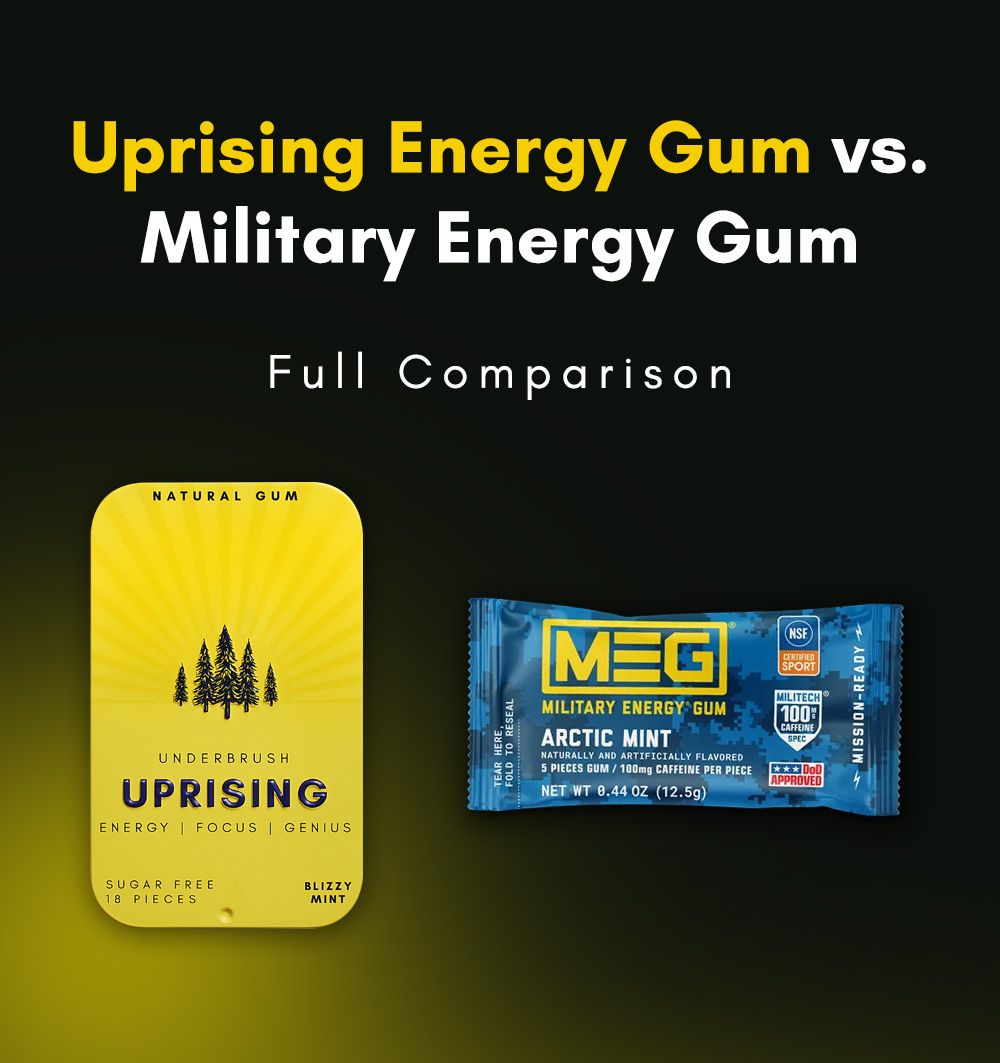
Our own Uprising Energy Gum is one example. It includes saffron extract alongside caffeine, L-theanine, rhodiola rosea, and a few other studied ingredients, on the same plant-based chicle base as Underbrush.
Important: The clinical studies discussed throughout this article evaluated standardized saffron extract as an individual ingredient. Uprising Energy Gum has not been evaluated in clinical trials for mood, focus, or any other health outcome. Research on individual ingredients should not be interpreted as evidence that the finished product will produce the same effects.
One reason saffron was selected for the formula is that published research has explored standardized saffron extract in relation to mood measures. It’s studied for its relationship with mood, while caffeine is the part people commonly use for alertness and L-theanine has been studied for its relationship with attention and relaxation.
The saffron is there to complement other ingredients that have separately been studied for alertness or relaxation.
To be clear, that’s a delivery format, not a magic upgrade. The same honest caveats above still apply, and no gum is a substitute for sleep, real rest, or professional care.

A quick reality check, because we like you
Imagine your focus as a radio signal.
Stress and low mood are the static.
Saffron, at most, might help turn down some of that static in the research. It does not build you a new radio.
Sleep builds the radio. Movement, connection, decent food, and actually addressing what’s stressing you. Those are the real hardware.
A spice extract can be a supporting player. It cannot be the whole band.
So the healthiest way to think about saffron extract for mood and focus is as one small, interesting piece of a much bigger picture.
Now, the questions people actually ask.
Okay but does saffron actually do anything for mood, or is it just hype?
Turns out there's real research here, unlike a lot of trending ingredients that are riding on vibes alone.
Several placebo-controlled human trials have found that standardized saffron extract is linked to mood improvements, especially for people already dealing with low or subclinical mood.
That said, it's not a slam dunk across the board, some studies come back neutral, and to be clear, saffron isn't a depression treatment.
Think of it as something studied for mood support, not a replacement for actual care.
Wait, if saffron's a "mood" thing, what's the focus connection?
Honestly, it's mostly a side effect.
The strongest research is on mood, and what cognitive research exists mostly comes from clinical populations, not your average healthy adult.
So the logical read is: steadier mood tends to make it easier to concentrate, so saffron could help focus indirectly by helping mood first.
It's not caffeine.
Don't expect it to flip a switch.
You might be asking yourself, "How fast should I expect to feel something?"
Don't expect overnight results.
Most of the mood studies had people taking a standardized extract daily for several weeks before measuring change.
It's a slow build, and it'll look different person to person, plus product quality is all over the map.
The one thing that seemed to matter most was just... taking it consistently.
We know many of you might be wanting to know, "Can I take saffron every day?"
In the studies, people generally tolerated typical doses fine, with only mild side effects showing up.
But "fine in a clinical trial" isn't the same as "fine for you."
If you're pregnant, nursing, on medication (especially antidepressants), or managing any health condition, loop in a doctor before adding this to your routine.
Another common concern people make is if they can replace their antidepressant or therapy?
Nope.
This is the one that matters most.
Saffron is a supplement, not medication, and nothing here should talk you into changing anything about your prescribed treatment.
If you're navigating your mental health, that conversation belongs with your prescriber or therapist, not a supplement bottle.
Saffron Extract, Mood & Focus: Plain Truth
Saffron is one of the more genuinely interesting mood ingredients out there. Precisely because there’s real human research behind it rather than just ancient reputation and marketing.
Across trials in low-mood and healthy adults, standardized saffron extract has been associated with improvements in mood measures, with the honest asterisks that the evidence isn’t unanimous, the trials could be bigger, and the focus connection is more indirect than direct.
Used thoughtfully, as one supporting piece alongside sleep, movement, connection, and professional care when it’s needed, saffron is a reasonable thing for a curious person to explore with their healthcare provider.
Just don’t ask a spice to do the work of a full night’s sleep or a good therapist. Even a flower this famous has its limits.
Curious how saffron feels in real life?
Uprising Energy Gum puts a standardized saffron extract right where you can actually use it, folded into a gum you chew when you need it, alongside the energy support you’re already reaching for.
No powders, no droppers, no waiting.
Just pop a piece, get back to your day, and see how it fits into the bigger picture of sleep, movement, and everyday care.
Try Uprising Energy Gum and give your mood-and-focus routine a little backup.
References
- An examination into the effects of a saffron extract (Affron) on mood and general wellbeing in adults experiencing low mood: a randomized, double-blind, placebo-controlled trial. The Journal of Nutrition 2025.
- Jackson PA, et al. Effects of saffron extract supplementation on mood, well-being, and response to a psychosocial stressor in healthy adults: a randomized, double-blind, parallel group, clinical trial. Frontiers in Nutrition 2020;7:606124.
- Effect of saffron extract supplementation on mood in healthy adults with subclinical symptoms of depression: a randomized, double-blind, placebo-controlled study. American Journal of Clinical Nutrition 2025.
- Ayati Z, et al. Saffron for mild cognitive impairment and dementia: a systematic review and meta-analysis of randomised clinical trials. BMC Complementary Medicine and Therapies 2020;20:333.
- Sugiura M, et al. Cognitive functions of saffron and its major constituent crocin: a narrative review. Longhua Chinese Medicine 2022.
- U.S. FDA, Dietary Supplements overview (DSHEA framework; structure/function claims).