
Here is a scenario that plays out in millions of grocery store aisles every week.
Someone picks up a pack of sugar-free gum, flips it over, sees "xylitol" listed on the label, and thinks: good, this one is good for my teeth.
Then they put it back down and grab a different pack because it comes in a flavor they like better.
Which is completely understandable.
But if you are actually trying to choose the best xylitol gum for your teeth — rather than the best-tasting gum that happens to contain some xylitol — the conversation gets a lot more interesting.
Because not all xylitol gums are created equal.
And the difference between a gum that contains a little xylitol and a gum formulated around xylitol as a primary oral health ingredient is a difference worth understanding.
This article covers what xylitol actually does in oral health research contexts, what makes a xylitol gum worth choosing for your teeth specifically, and why Nathan and Sons formulated their remineralizing gum the way they did.
These statements have not been evaluated by the Food and Drug Administration.
This product is not intended to diagnose, treat, cure, or prevent any disease.
What Is Xylitol and Why Does It Matter for Teeth?
Xylitol is a naturally occurring sugar alcohol found in small amounts in many fruits, vegetables, and even in the human body as part of normal metabolism.
It tastes sweet — about as sweet as regular sugar — but behaves completely differently once it is in your mouth.
Here is the key distinction: the oral bacteria most associated with tooth decay — particularly Streptococcus mutans — cannot ferment xylitol.
Regular sugar feeds these bacteria, which respond by producing the lactic acid that drives enamel demineralization.
Xylitol does not.
The bacteria attempt to metabolize it, fail, and — with regular xylitol exposure — experience measurable reductions in their numbers over time.
A 2022 study published in Frontiers in Nutrition found that xylitol gum was associated with a statistically significant 20 percent reduction in dental plaque accumulation and meaningful decreases in cariogenic and periodontopathic bacteria over two weeks of consistent use.
A systematic review published in BMC Oral Health examining xylitol chewing gum frequency found a linear dose-response relationship — the more frequently xylitol gum was used, the greater the reduction in mutans streptococci in plaque and unstimulated saliva.
A peer-reviewed literature review of sugar alcohols and remineralization published in PMC found that habitual xylitol use can be associated with significant reduction in caries incidence and that xylitol may form complexes with calcium in saliva — potentially stabilizing the mineral availability that supports remineralization.
These are research observations — not established clinical outcomes for any dental condition.
But they represent one of the most consistently studied oral health research profiles of any sweetener available in chewing gum format.
These statements have not been evaluated by the FDA.
What the Research Is Honest About

Credibility requires honesty — and the honest picture on xylitol research includes some nuance.
A Cochrane Review examining xylitol products and tooth decay found that while there is low-quality evidence that fluoride toothpaste containing xylitol may reduce tooth decay compared to fluoride-only toothpaste in children, the evidence on xylitol-containing chewing gum specifically was insufficient to draw robust conclusions — with the authors noting they were particularly surprised by the lack of strong evidence on xylitol gum.
The American Academy of Pediatric Dentistry has similarly noted that the evidence base on xylitol for children requires more high-quality research before definitive recommendations can be made.
What this means in practical terms: xylitol has a meaningful oral health research profile — particularly around cariogenic bacteria reduction and plaque accumulation — but the evidence is not as settled as some marketing language implies.
The most honest framing is the one this article uses throughout: xylitol has been studied in research contexts with findings that are encouraging and continuing to develop — not proven beyond debate.
This is the same standard applied to every ingredient across this portfolio.
These statements have not been evaluated by the FDA.
What Makes a Xylitol Gum Worth Choosing for Your Teeth
Not every gum that contains xylitol is worth choosing specifically for oral health support.
Here is what separates a well-formulated xylitol gum from one that simply uses xylitol as a sweetener:
Xylitol as the primary sweetener — not a secondary one.
Many conventional sugar-free gums list sorbitol first and xylitol second or third.
Sorbitol can be fermented by certain oral bacteria — continuing the acid production cycle that xylitol is specifically chosen to avoid.
If xylitol is buried after sorbitol, aspartame, or acesulfame K in the ingredient list, the oral health research profile of xylitol is not what you are primarily getting.
Look for xylitol as the first sweetener listed.
No artificial sweeteners alongside it.
Aspartame, sucralose, and acesulfame K have different research profiles from xylitol and have been associated with microbiome-related changes in some studies.
A gum that combines xylitol with these ingredients dilutes the very reason you chose xylitol in the first place.
A gum base that is not synthetic polymer.
Most conventional sugar-free gums use petroleum-derived synthetic polymer bases — polyvinyl acetate, styrene-butadiene — that are listed generically as "gum base" without individual disclosure.
These bases contribute nothing to oral health.
A plant-based gum base — chicle, mastic, acacia — is consistent with a formulation built around genuine oral health considerations rather than manufacturing convenience.
Active oral health ingredients beyond just xylitol.
Xylitol alone is a meaningful ingredient.
Xylitol combined with nano-hydroxyapatite, mastic gum, zinc gluconate, and a natural terpene blend is a formulation that layers multiple individually researched oral health ingredients on top of the saliva-stimulation baseline that all chewing gum provides.
These statements have not been evaluated by the FDA.
Why Nathan and Sons' Remineralizing Gum Is the Xylitol Gum We Chose to Make

Nathan and Sons did not set out to make a slightly-better-than-average sugar-free gum.
The goal was to build a xylitol gum formulated entirely around what the oral health research actually supports — starting with ingredient transparency and working outward from there.
Here is what that looks like in practice.
Xylitol is the primary sweetener.
Not sorbitol.
Not aspartame.
Not a blend of six sweeteners with xylitol somewhere in the middle.
Xylitol — with the oral health research profile described throughout this article — is the sweetener this gum is built around.
Nano and micro hydroxyapatite are included as active oral health ingredients.
Hydroxyapatite is the mineral compound that makes up approximately 90 to 97 percent of tooth enamel.
A systematic review and meta-analysis published in Clinical Oral Investigations found significant remineralization potential for nano-hydroxyapatite when surface hardness testing was used as the measurement standard across multiple studies.
A 2025 narrative review published in Biomimetics confirmed that hydroxyapatite-containing products are among the formats being studied for enamel and dentin remineralization support.
Including nano-hydroxyapatite in a xylitol gum means every piece delivers two of the most extensively studied oral health ingredients in chewing gum research contexts simultaneously — on top of the saliva stimulation that chewing itself provides.
The gum base is plant-derived — not synthetic.
Nathan and Sons uses chicle, mastic gum, spruce gum, acacia gum, and myrrh gum as the gum base — all plant resins with their own individual research profiles.
Mastic gum specifically has been examined in research for antibacterial activity against Porphyromonas gingivalis and hydrogen sulfide reduction in breath.
A 2023 systematic review published in the Journal of Natural Medicines examining 14 studies confirmed that mastic gum displayed antibacterial and antimicrobial properties and inhibited plaque accumulation in oral health research contexts.
For more on the plant-based gum base research, our article on natural chewing gum covers the full ingredient landscape including the 2025 microplastics research.
Zinc gluconate and a natural terpene blend complete the formulation.
Research on zinc-containing oral care products has examined zinc's ability to interact with volatile sulfur compounds — the molecules most associated with bad breath.
The terpene blend — menthone, carvone, and cineole — are each plant-derived compounds that have been examined for antimicrobial activity against oral bacterial species in peer-reviewed research.
For more on the fresh breath research, our article on best gum for fresh breath covers each of these ingredients in detail.
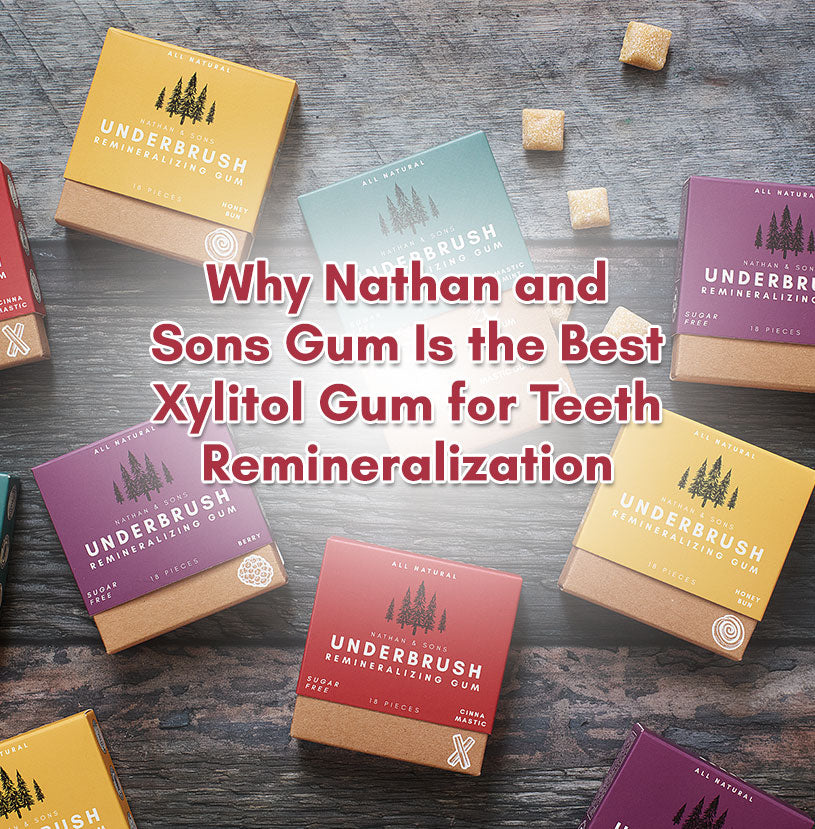
No artificial sweeteners. No synthetic gum base. Full ingredient disclosure.
Every ingredient in Nathan and Sons' remineralizing gum is disclosed individually on the product page.
No "gum base" catchall hiding synthetic polymers.
No proprietary blend designations.
Just a complete transparent ingredient list that consumers can evaluate against the research.
The research discussed above evaluates individual ingredients in laboratory and clinical research contexts.
The finished product has not been evaluated by the FDA for the prevention, treatment, or mitigation of any condition.
Our remineralizing gum is available with the full ingredient list on the product page.
Browse our full oral care collection to see everything we make.
To learn more about who we are and why ingredient transparency matters to us, visit our about page.
How Xylitol Gum Fits Into a Complete Oral Care Routine
One more thing worth being direct about.
The best xylitol gum for teeth is not a substitute for brushing and flossing.
It is a complement to them — and a particularly useful one for the gaps in your day when brushing is not practical.
After lunch at your desk.
On a long drive.
After a meal at a restaurant.
These are exactly the moments when chewing xylitol gum provides the most practical value — stimulating saliva during the critical 20-minute post-meal window when the ADA recommends sugar-free gum chewing, and delivering xylitol to oral bacteria at the exact moment acid production would otherwise be peaking.
For more on how saliva stimulation supports enamel health after meals, our article on what is remineralizing gum covers the mechanism in detail.
For the research on whether enamel can remineralize, our article on can you reverse tooth decay covers the demineralization and remineralization science in full.
For more on xylitol's complete research profile, our guide to everything you need to know about xylitol covers the full evidence base.
Consult a qualified dental or healthcare provider for guidance specific to your oral health situation.
These statements have not been evaluated by the FDA and are not intended to diagnose, treat, cure, or prevent any disease.
Key Takeaways: Best Xylitol Gum for Teeth

Not all xylitol gums are equivalent — xylitol as the primary sweetener rather than a secondary one is the most important thing to look for on an ingredient label.
Xylitol is non-fermentable by the oral bacteria most associated with acid production and has been associated in research with statistically significant reductions in cariogenic bacterial counts and plaque accumulation.
The Cochrane Review on xylitol found encouraging evidence in some contexts but noted that the evidence specifically on xylitol chewing gum requires more high-quality research — honest context for evaluating marketing claims.
A well-formulated xylitol gum for teeth combines xylitol as the primary sweetener with additional ingredients that have their own oral health research profiles — not just xylitol alone.
Nathan and Sons' remineralizing gum uses xylitol as the primary sweetener alongside nano-hydroxyapatite, a plant-based mastic resin gum base, zinc gluconate, and a natural terpene blend — each with individual peer-reviewed research support.
The finished product has not been evaluated by the FDA for the prevention, treatment, or mitigation of any condition.
Xylitol gum is a complement to brushing and flossing — not a substitute.
These statements have not been evaluated by the FDA.
Not intended to diagnose, treat, cure, or prevent any disease.
Frequently Asked Questions: Best Xylitol Gum for Teeth
What makes a xylitol gum good for teeth?
The most important factor is xylitol as the primary sweetener — not buried after sorbitol or other sweeteners that can be fermented by oral bacteria.
Beyond sweetener position, a well-formulated xylitol gum for teeth uses a plant-based gum base rather than synthetic polymers, avoids artificial sweeteners that dilute the xylitol benefit, and ideally includes additional ingredients with oral health research profiles.
These statements have not been evaluated by the FDA and are not intended to diagnose, treat, cure, or prevent any disease.
How does xylitol help teeth?
Oral bacteria cannot ferment xylitol — meaning they cannot use it to produce the lactic acid that drives enamel demineralization.
Research has associated habitual xylitol use with significant reductions in cariogenic bacterial counts, decreased plaque accumulation, and potential calcium stabilization in saliva that may support remineralization conditions.
These are research observations and should not be interpreted as claims that xylitol prevents or treats dental disease.
Consult a qualified dental professional for guidance specific to your oral health situation.
These statements have not been evaluated by the FDA and are not intended to diagnose, treat, cure, or prevent any disease.
How much xylitol gum should you chew for teeth?
The ADA recommends sugar-free gum chewing for approximately 20 minutes after meals for its saliva-stimulating effects.
Research on xylitol has found a dose-response relationship — more frequent use is associated with greater reductions in cariogenic bacteria — though optimal dosing has not been definitively established.
Consult a qualified dental professional for guidance specific to your situation.
These statements have not been evaluated by the FDA and are not intended to diagnose, treat, cure, or prevent any disease.
Why does Nathan and Sons use xylitol instead of sorbitol or aspartame?
Xylitol has a more extensively studied oral health research profile than sorbitol, aspartame, sucralose, or acesulfame K — specifically in relation to cariogenic bacteria reduction and plaque accumulation.
Sorbitol can be fermented by certain oral bacteria.
Aspartame and sucralose have different research profiles and have been associated with microbiome-related changes in some studies.
Nathan and Sons uses xylitol as the primary sweetener because the oral health research supports it specifically — not as a generic sugar-free sweetener choice.
These statements have not been evaluated by the FDA and are not intended to diagnose, treat, cure, or prevent any disease.
What other ingredients does Nathan and Sons include alongside xylitol?
Nathan and Sons' remineralizing gum combines xylitol with nano and micro hydroxyapatite, a plant-based gum base of chicle, mastic gum, spruce gum, acacia gum, and myrrh gum, zinc gluconate, calcium carbonate, magnesium carbonate, calcium bentonite clay, and a natural terpene blend of menthone, carvone, and cineole.
Each ingredient has its own individual oral health research profile.
The full ingredient list is available at nathanandsons.com/products/remineralizing-gum.
The finished product has not been evaluated by the FDA for the prevention, treatment, or mitigation of any condition.
These statements have not been evaluated by the FDA and are not intended to diagnose, treat, cure, or prevent any disease.
Is xylitol gum a substitute for brushing and flossing?
No — xylitol gum is a complement to brushing and flossing, not a substitute.
It is most practically useful during the gaps in your day when brushing is not possible — particularly during the 20-minute post-meal window when the ADA recommends sugar-free gum chewing for its saliva-stimulating effects.
Regular professional dental care remains essential regardless of which oral care products you use.
These statements have not been evaluated by the FDA and are not intended to diagnose, treat, cure, or prevent any disease.
Legal & Compliance Disclaimer
These statements have not been evaluated by the Food and Drug Administration. This product is not intended to diagnose, treat, cure, or prevent any disease. The information in this article is for educational purposes only and is not a substitute for professional dental or medical advice. Consult a qualified dental or healthcare provider before making changes to your oral care routine. Content current as of 2026. Subject to revision.
References
Wu YF, Salamanca E, et al. (2022). Xylitol-containing chewing gum reduces cariogenic and periodontopathic bacteria in dental plaque. Frontiers in Nutrition, 9, 882636. PMC9131035.
Milgrom P, et al. (2006). Linear response of mutans streptococci to increasing frequency of xylitol chewing gum use. PMC1482697.
Mäkinen KK. (2010). Sugar alcohols, caries incidence, and remineralization of caries lesions: a literature review. PMC2836749.
Riley P, et al. (2015). Xylitol-containing products for preventing dental caries in children and adults. Cochrane Database of Systematic Reviews. cochranelibrary.com.
Alwadi MAM, et al. (2023). Mastic (Pistacia lentiscus) gum and oral health: a state-of-the-art review. Journal of Natural Medicines, 77, 430–445. DOI: 10.1007/s11418-023-01704-y.
Wierichs RJ, et al. (2022). Efficacy of nano-hydroxyapatite on caries prevention: a systematic review and meta-analysis. Clinical Oral Investigations. PMC8979882.
Naim J, et al. (2025). The remineralizing and desensitizing potential of hydroxyapatite in dentistry: a narrative review. Biomimetics. PMC12470856.
American Dental Association. Chewing Gum. ADA Oral Health Topics. ada.org/resources/ada-library/oral-health-topics/chewing-gum.