
The bottom line, up front: PUR Gum is a genuinely popular, aspartame-free, 100% xylitol gum with a famously clean, allergen-friendly reputation — and if a simple “kick aspartame” chew is all you want, it delivers. But there’s a wrinkle most shoppers miss: PUR’s “clean label” sits on top of a gum base the company keeps proprietary and has never fully disclosed. Underbrush takes a different path — a named plant-based chicle base plus oral-care-related ingredients listed on our label like xylitol, erythritol, and nano- and micro-hydroxyapatite. Neither replaces brushing, flossing, or your dentist. We make Underbrush, so we’re biased — which is exactly why everything below is sourced.

Let’s do this Underbrush vs PUR Gum comparison the transparent way.
Not the “our rival is secretly poison” way.
And definitely not the “our gum will fix your enamel, your breath, your dating life, and your credit score” way.
Instead, we’re going to weigh Underbrush by Nathan & Sons against PUR Gum using what the labels, product pages, and oral-health evidence actually support.
Then, just as importantly, we’re going to tell you where the evidence stops.
All of this matters, because “clean label” has quietly become one of the most powerful phrases in the grocery aisle.
After all, it sounds like a promise.
It sounds like someone did the homework for you.
But “clean label” and “what’s actually in the formula” are two different questions, and the gap between them is the whole point of this article.
So that’s exactly why this Underbrush vs PUR Gum showdown matters.
First, the part where we admit our bias
First, the obvious: we’re Nathan & Sons.
Naturally, we make Underbrush.
So of course we think it does something PUR doesn’t.
Still, being biased doesn’t give us permission to be sloppy.
Because of that, here are the rules we’re playing by.
First, we’re citing official Nathan & Sons and PUR pages for ingredients, sweeteners, allergen claims, and brand claims.
In addition, we’re citing the American Dental Association and peer-reviewed reviews for the broader oral-health science.
And here’s the big one — we are not claiming that chewing Underbrush reverses cavities, replaces brushing, or substitutes for your dentist.
Frankly, if a gum brand tells you gum replaces basic oral hygiene, that gum brand needs a chair, a glass of water, and a serious talk.
A quick note on respect, because we mean it
There, a York University grad named Jay Klein set out to build a gum with no sugar, no aspartame, no gluten, no soy, and no nuts.
As the story goes, he sold it door-to-door, then landed in airport duty-free shops, and the brand took off internationally from there.
Notably, PUR built its whole identity on one clear, honest message: “Kick Aspartame.”
Because of that, PUR made aspartame-free, xylitol-sweetened gum genuinely mainstream — you can find it in over 50 countries now.
Honestly, we respect that.
Getting millions of people to ditch aspartame is a real public good, and PUR did it with a simple story anyone could follow.
Meanwhile, Underbrush is our attempt to answer a different question — not just “what’s not in the gum?” but “what else is on the ingredient list?”
In short, these are two different philosophies.
On one hand, PUR is mostly about a clean, allergen-friendly label.
On the other, Underbrush is mostly about a broader ingredient profile.
Ultimately, that’s the whole chewy battlefield.
If you want the deeper background on our formula, our Underbrush remineralizing gum page lays out every ingredient.
The labels, side by side
Imagine standing in the aisle, flipping both packs over to read the backs.
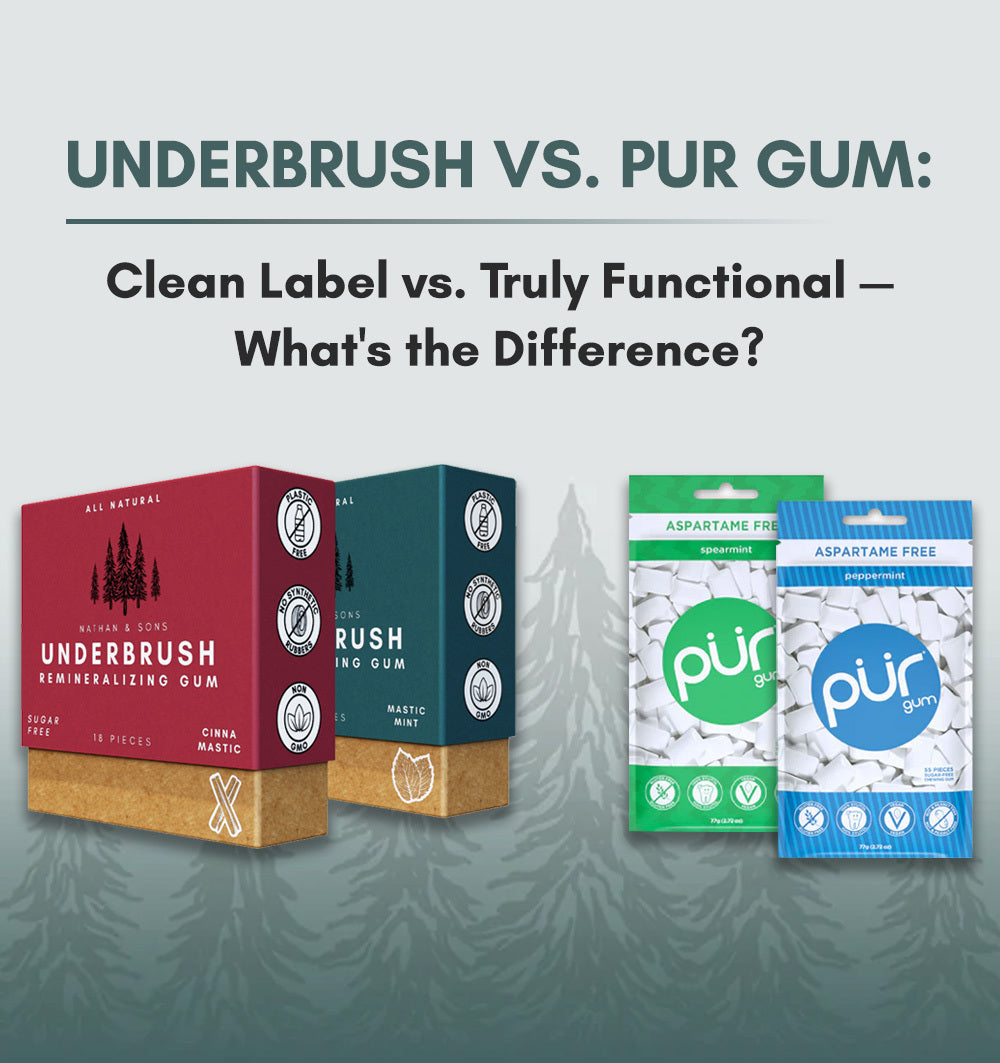
To start, PUR’s spearmint gum lists xylitol, gum base, gum arabic, natural flavors, carnauba wax, and tocopherols.
Admittedly, that is a beautifully short, approachable list — it’s a big part of PUR’s appeal.
Similarly clean-looking, PUR is proudly vegan, non-GMO, gluten-free, soy-free, nut-free, kosher, and keto-friendly.

Underbrush Mastic Mint, by contrast, lists xylitol, a chicle gum base (chicle, candelilla wax, citric acid), erythritol, mastic gum, spruce gum, acacia gum, mint flavor, myrrh gum, nano- and micro-hydroxyapatite, calcium carbonate, calcium bentonite clay, magnesium carbonate, zinc gluconate, and a terpene blend (menthone, carvone, cineol).

Clearly, that’s a mouthful in both senses.
As a result, PUR has the shorter, more minimalist label.
Underbrush, meanwhile, lists additional botanical resins and mineral ingredients not found in PUR’s published ingredient list.
In the end, though, the most interesting difference between these two gums isn’t on the front of the label at all.
It’s in two little words on PUR’s list: “gum base.”
The two words that change everything: “gum base”
Here’s where “clean label” gets more complicated than it looks.

PUR’s ingredient list is short and readable, and most of it is exactly what it says.
But “gum base” is a broad umbrella term on any ingredient label.
For context, federal regulation (21 CFR 172.615) lets companies list many different substances collectively as “gum base” without naming a single one.
So the natural question is: what’s in PUR’s base?
Here’s the factual answer: PUR keeps that composition proprietary, so it isn’t publicly disclosed.
PUR has addressed the question publicly, using different descriptions in different statements.
In one customer-service response, PUR described its base as a high-quality synthetic gum base sourced from Europe, with the breakdown kept proprietary.
In other public statements, PUR has described the base as plant-based, again without disclosing the specific ingredients.

So the fair, careful summary is this: PUR’s gum base is proprietary and not publicly disclosed, and PUR has used different descriptions of it in different public responses.
Independent reviewers, for their part, generally treat PUR as not a named plant-based, chicle-based gum — one non-toxic-gum roundup notes that PUR lists “gum base” with no further detail.

Now, is that a scandal?
No.
PUR never listed chicle on the label, and plenty of people chew it happily every day.
But it does mean the “clean label” reputation has an asterisk: the sweetener is clean and fully disclosed, while the base — the single largest structural ingredient — is proprietary and not publicly disclosed.
That’s the exact gap this whole article is about.
Where Underbrush goes the other way
Underbrush is built on a named chicle gum base — actual tree sap — rather than the generic “gum base” most brands list.
Chicle is the latex traditionally tapped from sapodilla trees, chewed by people for millennia before petroleum polymers took over mid-century.
For the fuller story on that history, see our explainer on what natural chewing gum is.
So on the single question of “what is the base made of?”, Underbrush and PUR land in genuinely different places.
PUR: clean, disclosed sweetener; base proprietary and unnamed.
Underbrush: clean sweetener, plant-based chicle base, fully named.
If PUR is a spotless label wrapped around an undisclosed center, Underbrush is trying to make the center itself something you’d want to know about.
Underbrush vs PUR Gum, Where the two gums actually agree
Let’s be fair, because there’s real common ground here.
Both gums are sugar-free.
Both use xylitol, and both skip aspartame entirely.
Both are betting that people want an alternative to the sugary, synthetic-sweetener gum at the checkout lane.
For a deeper dive on that shared sweetener, our explainer on everything you need to know about xylitol breaks it down.
So if your only goal is “sugar-free and aspartame-free,” honestly?
Either gum gets you there.
You could stop reading right now, buy either one, and be better off than you were with the pink stuff.
The xylitol question: good ingredient, not fairy dust
Both brands lean hard on xylitol, and they’re right to — it’s earned its seat at the table.

For instance, the ADA describes polyols like xylitol as noncariogenic, because cavity bacteria metabolize them slowly or not at all.
Even so, xylitol isn’t a plot twist where your molars grow capes.
Instead, it’s a sugar-free sweetener with dental-relevant properties — an entry ticket, not the final boss.
This is where the two brands split.
For PUR, xylitol is essentially the ingredient story, and its formulation centers on xylitol and its aspartame-free positioning.
For Underbrush, xylitol is where the story starts.
In addition to xylitol, we add erythritol, nano- and micro-hydroxyapatite, calcium carbonate, calcium bentonite clay, magnesium carbonate, zinc gluconate, and a handful of botanical resins.
Curious about that second sweetener? Our explainer on what erythritol is covers it.
Hydroxyapatite: the ingredient not on PUR’s published list — with a real caveat
Hydroxyapatite is the biggest formulation difference between Underbrush and PUR.

In fact, it’s the mineral that makes up roughly 90 to 97 percent of your tooth enamel.
For a deeper dive, see our explainer on what nano-hydroxyapatite is.
Therefore, the thinking behind including it is straightforward: supply a mineral that’s already the main building block of enamel, in a format you use throughout the day.
For evidence, a 2021 systematic review and meta-analysis in the Canadian Journal of Dental Hygiene reported that studies of certain hydroxyapatite-containing, fluoride-free oral-care products have reported reductions in caries outcomes, with one meta-analysis of three randomized trials showing a measurable protective effect.

Likewise, a separate review in Odontology describes hydroxyapatite toothpastes as having been studied for their interaction with demineralized enamel surfaces.
That’s why hydroxyapatite is interesting.
PUR, for its part, does not list hydroxyapatite on its published ingredient list — its label is xylitol plus its proprietary base and flavor.
Now, here’s the part we refuse to bury.
Most of that hydroxyapatite evidence comes from toothpastes, gels, and rinses — not from a product-specific clinical trial on Underbrush gum.
Put bluntly, a gum that simply lists “hydroxyapatite” is, to a real degree, borrowing toothpaste’s homework.
So here’s the only honest claim we’ll make.
Specifically, Underbrush lists nano- and micro-hydroxyapatite on our ingredient label, and hydroxyapatite has been studied in other oral-care products with supportive findings reported.
Even so, we will not pretend gum-specific Underbrush trial data exists unless and until it does.
That’s not weakness.
Rather, that’s honesty, and honesty tastes better than carnival barking.
These statements have not been evaluated by the Food and Drug Administration. This product is not intended to diagnose, treat, cure, or prevent any disease.
What the evidence actually says about chewing gum
Before anyone crowns a winner, here’s the sober baseline for both gums.
The strongest argument for any sugar-free gum isn’t mystical.
Rather, it’s saliva.
Specifically, the American Dental Association notes that chewing gum increases salivary flow, and that sugar-free gum may help reduce cavity risk when added to a routine of brushing twice daily and cleaning between teeth daily.
Crucially, the ADA also says, plainly, that gum is not a substitute for brushing or flossing.
In fact, that sentence should be printed on a tiny billboard and taped to every ambitious gum brand’s forehead, including ours.
Beyond that, a systematic review in the Journal of Applied Oral Science found that most accepted trials showed anti-cavity effects for sorbitol, xylitol, or sorbitol/xylitol gum.
So on the baseline saliva-and-xylitol story, PUR and Underbrush both qualify.
The difference is what each brand builds on top of that baseline.
Taste: where ingredient philosophy meets your actual mouth
Here’s a thing that happens more than people admit.
Often, someone insists they want the cleanest possible formula.
Then they chew something botanical and discover their mouth has a tiny opinionated landlord living inside it.

For its part, PUR is built around bright, familiar, crowd-pleasing flavors — spearmint, peppermint, cinnamon, even chocolate mint.
Clearly, that’s approachable on purpose, and it’s a real strength.
Underbrush, on the other hand, leans woodsier — a sweet mint with herbal, piney, and earthy undertones from mastic, spruce, and chicle.
Granted, that’s not your childhood checkout-lane gum, and that’s the point.
So if you want easy, familiar mint across a big flavor lineup, PUR probably wins your first chew.
But if you want a more intentional, “forest apothecary” profile that tastes like its ingredient list, Underbrush is more your speed.
And if you want gum that tastes like electric-blue frostbite, neither of us is trying to be your soulmate.
Texture and the flavor-fade tax
Texture is the secret boss level of natural and synthetic gum alike.
Sure, people forgive a lot on a label.
Yet they forgive much less when a gum goes stiff, crumbly, or somehow haunted.
Here’s an honest irony worth naming: PUR’s base is engineered partly for a consistent, familiar chew that resists breaking down.
Underbrush, by contrast, is honest in its own FAQ that its chicle-based chew is close to store-bought gum but slightly stiffer.
We actually like that trade, because we’d rather chew a named chicle base than an undisclosed one — but it’s a real preference, not a fact, and your mileage may vary.
Then there’s the flavor-fade tax, and it hits natural gum harder.
Because Underbrush skips the synthetic ingredients that make flavor last forever, its flavor can fade sooner than a highly engineered gum’s.
In short, that’s part of the price of a plant-based base, and we’d rather be upfront about it than pretend it away.
Price and value: the part where everyone pretends not to care
Price matters, jokes about botanicals aside.
For context, PUR is competitively priced and sold nearly everywhere, often in big resealable 55-piece bags — value and availability are genuine PUR strengths.
Underbrush, meanwhile, is positioned as a premium gum with a more complex formula and a plant-based base.
But the real question isn’t “which is cheapest?”
Instead, it’s “what job are you hiring the gum to do?”
Hiring gum to be a clean, cheap, widely available aspartame-free chew?
Then PUR is genuinely hard to beat.
Hiring gum to run on a named plant-based base and list additional oral-care-related ingredients?
In that case, that’s a different job, and that’s Underbrush’s lane.
Honestly, recommending the more ingredient-heavy gum to someone who just wants a cheap, clean chew is like recommending hiking boots to walk to the mailbox.
Conversely, recommending an undisclosed-base gum to someone who specifically wants named tree-sap-plus-actives is like buying a “wood-look” table without being told what it’s actually made of.
The Underbrush Vs. PUR Gum Comparison Grid

The practical “which one, when” test

Our honest verdict on Underbrush vs PUR Gum
So here’s where the Underbrush vs PUR Gum question finally lands.
On one side, PUR is a very good answer to “can gum be cheap, clean, aspartame-free, allergen-friendly, and available everywhere?”
On the other, Underbrush is our answer to a different question: “can gum run on a named plant-based base and list additional oral-care-related ingredients?”
Accordingly, Underbrush may appeal to shoppers who want a chicle base plus a longer list of oral-care-related ingredients.
Meanwhile, PUR may appeal to shoppers who want a simple, affordable, widely available clean-label chew.
Specifically, we’d give PUR sincere credit for its allergen-friendly transparency on sweeteners and for making aspartame-free gum mainstream.
At the same time, we’d gently point out that “clean label” and “named plant-based base” are not the same thing — PUR’s base is proprietary and not publicly disclosed, and Underbrush’s is named chicle.
As for us, we built Underbrush for the person who reads the words “gum base” and wants to see what’s on the list.
Honestly?
If your priority is price and availability, PUR is a smart, easy choice, and we won’t pretend otherwise.
If your priority is a named plant-based base with a broader ingredient list, that’s the exact gap we built Underbrush to fill.
And we’re secure enough to say both of those things out loud.
If you want to see how Underbrush stacks up against other hydroxyapatite gums, our 2026 US guide to Underbrush vs. competitors goes wider than this one.
Finally, if you’d like to try it, you can find Underbrush on our remineralizing gum page.
Underbrush vs PUR Gum: What we can and can’t honestly claim
We hold ourselves to this, so we’ll put it in writing.
What we can say: PUR’s gum base is proprietary and not publicly disclosed, and PUR has used different descriptions of it in different public statements.
What we can say: Underbrush contains nano- and micro-hydroxyapatite, and hydroxyapatite has been studied in oral-care products with supportive findings reported.
What we can say: Both gums are sugar-free, xylitol-sweetened, and aspartame-free.
What we can’t say: That Underbrush has product-specific clinical trials proving it reverses cavities — because that evidence isn’t something we’re citing here.
What we can’t say: That any gum replaces brushing, flossing, professional cleanings, or your dentist’s advice.
What we can’t say: That PUR is a bad product simply because we compete with it. It isn’t.
That’s the line.
We’re happy standing on it.
One last note before you shop

If you go looking for Underbrush, buy it from us directly at nathanandsons.com, our TikTok Shop, our official Amazon seller, or Etsy.
As with many online product categories, we’d encourage you to verify you’re buying from an authorized seller, since knock-offs can distort reviews and quality.
Honestly, we’d rather you buy real PUR than a fake Underbrush.
After all, that’s how seriously we take it.
Underbrush vs PUR Gum – Frequently Asked Questions
How does Underbrush compare to PUR Gum — and is one better?
It depends on what “better” means to you.
Underbrush may appeal to shoppers who want a named plant-based chicle base plus a longer ingredient list including erythritol, nano- and micro-hydroxyapatite, minerals, and botanical resins.
PUR may appeal to shoppers who want a simple, affordable, widely available, aspartame-free clean-label gum.
Is PUR Gum plastic-free or made with chicle?
PUR does not name a chicle or plant-based base on its label — it lists “gum base,” and keeps the exact composition proprietary and not publicly disclosed.
PUR has used different descriptions of that base in different public statements, without disclosing the specific ingredients. Independent reviewers generally treat PUR as not a named chicle-based gum.
Its sweetener (100% xylitol) is clean and fully disclosed. Underbrush, by contrast, uses a named chicle (plant-based) base.
Does the hydroxyapatite in Underbrush mean it’s clinically proven to remineralize teeth as a gum?
No, and we won’t pretend otherwise.
Underbrush lists nano- and micro-hydroxyapatite, and hydroxyapatite has been studied in oral-care products like toothpastes with supportive findings reported.
That is not the same as a product-specific clinical trial proving Underbrush gum reverses cavities. These statements have not been evaluated by the FDA.
Does chewing gum replace brushing or flossing?
No. The ADA says sugar-free gum may help reduce cavity risk when added to brushing twice daily and cleaning between teeth daily — and that gum is not a substitute for either.
Both PUR and Underbrush are add-on habits, not dental escape hatches.
Which gum has more flavors, and is either one vegan?
PUR offers a wider everyday flavor range — spearmint, peppermint, cinnamon, wintergreen, bubblegum, and more — and is certified vegan and kosher.
Underbrush is mint-forward and also free of animal-derived ingredients, with a focus on its broader ingredient list rather than flavor variety.
References
- Nathan & Sons — Underbrush Remineralizing Gum product page (ingredients, positioning).
- The PUR Company — PUR Gum product and ingredient pages (thepurcompany.com).
- The PUR Company — Spearmint Gum ingredient list and FAQ (xylitol sourcing, allergen claims).
- PUR Company statements re: gum base composition (proprietary and not publicly disclosed; different descriptions given in different public responses; manufacturer statements via retailer Q&A and third-party analyses).
- Green Choice Lifestyle — non-toxic gum brand review (PUR “gum base” not publicly disclosed).
- Wikipedia — PÜR Gum (company history, founder Jay Klein, 2010; flavor and format range).
- American Dental Association — Chewing Gum, ADA Oral Health Topics (ada.org).
- Mickenautsch S, Leal SC, Yengopal V, Bezerra AC, Cruvinel V. Sugar-free chewing gum and dental caries: a systematic review. Journal of Applied Oral Science 2007;15(2):83–88.
- Limeback H, Enax J, Meyer F. Biomimetic hydroxyapatite and caries prevention: a systematic review and meta-analysis. Canadian Journal of Dental Hygiene 2021;55(3):148–159. (PMID 34925515.)
- O’Hagan-Wong K, Enax J, Meyer F, Ganss B. The use of hydroxyapatite toothpaste to prevent dental caries. Odontology 2022;110:223–230.
- eCFR — 21 CFR § 172.615, Chewing gum base.
- Amazon — Underbrush Mastic Mint product listing (B0CTNK1ZQC).