
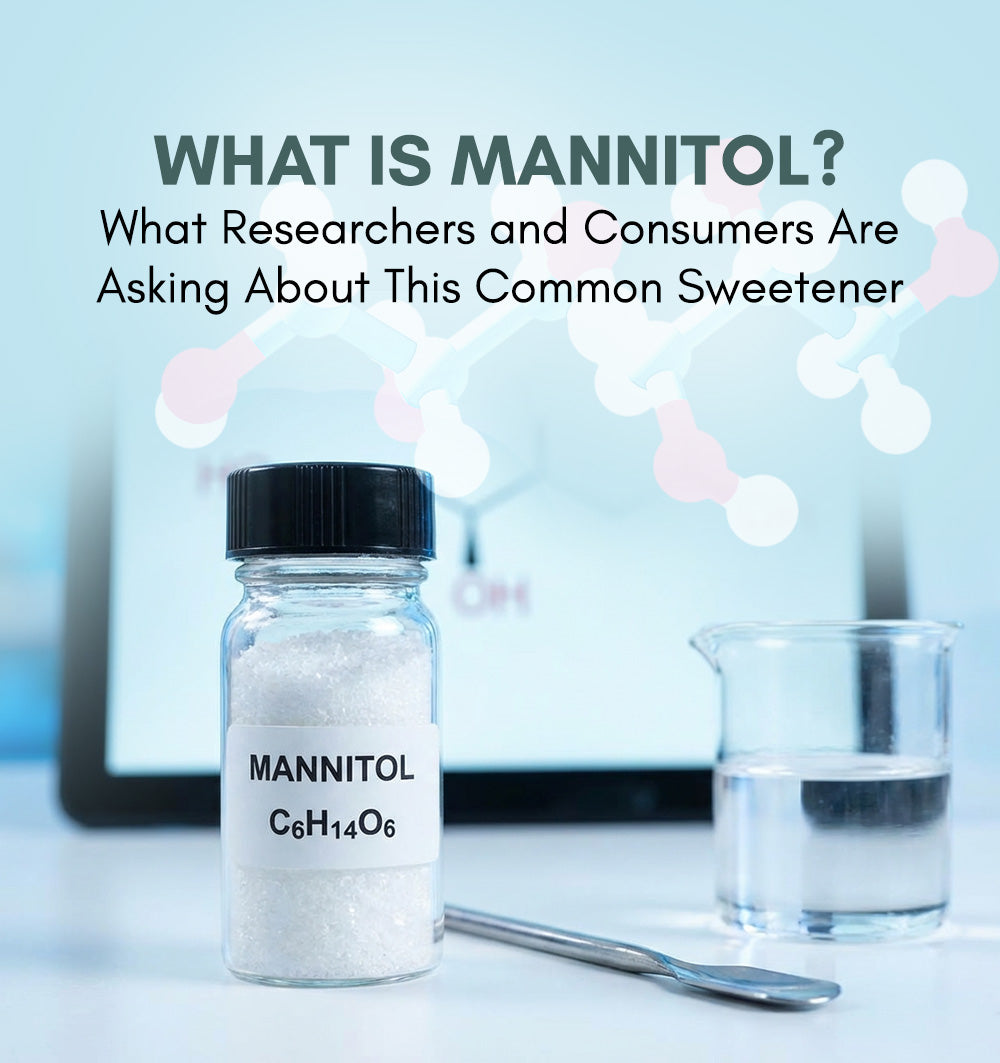
Mannitol is a six-carbon sugar alcohol found naturally in fruits, vegetables, and fungi — and one of the most widely used sweeteners in sugar-free gum, mints, and oral care products worldwide.
Pick up almost any sugar-free gum, mint, or oral care product at a pharmacy.
Flip it over.
Look at the ingredient list.
There is a reasonable chance you will see mannitol somewhere in the first few ingredients.
It is one of the most widely used sugar alcohols in the food, pharmaceutical, and oral care industries — and most people who encounter it every day have never thought to ask what it actually is, how it differs from other sweeteners in the same category, or what the research says about its oral health profile.
This article answers those questions honestly — covering what mannitol is, how it is made, what the science says about its properties, and how its research profile compares to other sweeteners commonly used in oral care products.
These statements have not been evaluated by the Food and Drug Administration. This product is not intended to diagnose, treat, cure, or prevent any disease.
What Is Mannitol?
Mannitol is a six-carbon sugar alcohol — a class of carbohydrate compounds that provide sweetness with fewer calories than regular sugar.
It occurs naturally in small amounts in a wide range of organisms including plants, bacteria, fungi, and algae.
Natural food sources include mushrooms, seaweed, celery, pumpkins, and certain fruits and vegetables.
For commercial use, mannitol is primarily produced through the hydrogenation of fructose-glucose mixtures — a chemical synthesis process that converts these sugars into the polyol form used in food and pharmaceutical products.
A 2020 review published in Applied Microbiology and Biotechnology confirmed that mannitol is a naturally occurring six-carbon sugar alcohol with wide applications in the food and pharmaceutical industry — valued for its metabolic characteristics and low glycemic response.
Mannitol is approximately half as sweet as table sugar and contains approximately 1.6 calories per gram — compared to sugar's 4 calories per gram.
The FDA recognizes mannitol as Generally Recognized as Safe for its intended uses as a food additive.
It is found in sugar-free gum, candies, mints, chewable tablets, pharmaceutical excipients, and a wide range of products marketed as sugar-free or lower-calorie alternatives.
A Brief History of Mannitol
Mannitol's name comes from the manna ash tree — one of its earliest identified natural sources.
The compound was first isolated from manna — the sweet exudate of the Fraxinus ornus tree — in the early 19th century.
It was subsequently identified across a broad range of natural organisms and began attracting attention for both its sweetening properties and its osmotic characteristics.
Commercial production expanded significantly through the 20th century as demand grew for low-calorie sweetener alternatives in food and pharmaceutical manufacturing.
A ScienceDirect review of mannitol applications confirmed that mannitol has applications in food, pharmaceutical, chemical, and medical industries — and can be produced by extraction, chemical synthesis, or fermentation — with biotechnological fermentation methods receiving increasing research attention as a more sustainable production alternative.
Today mannitol is among the most widely produced polyols globally — used across thousands of consumer and pharmaceutical products.
What Is Mannitol Used For?
Mannitol serves several distinct functions across different industries — and understanding those functions helps explain why it appears in so many products.
In food and chewing gum:
Mannitol is used as a sweetener, bulking agent, and texture stabilizer in sugar-free gum, candies, chocolate coatings, and a wide range of processed food products marketed as sugar-free or lower-calorie alternatives.
One of its less-known but practical roles in chewing gum is as a dusting powder on the outside of gum sticks.
Because mannitol has very low hygroscopicity — meaning it does not readily absorb moisture from the environment — it is applied as a fine coating on the exterior of gum pieces to prevent them from sticking to manufacturing equipment and wrappers.
This means that even in products where mannitol is not listed prominently as a sweetener, it may still be present on the gum surface itself.
A technical review confirms that mannitol is extensively used in chewing gum because it prevents moisture absorption from the air, exhibits good mechanical properties, and its sweet cooling taste masks the unpleasant taste of other ingredients.
In pharmaceuticals:
Mannitol is used as a sweetening agent in chewable tablets, a tablet and capsule diluent, an excipient in granulated powders, and a vehicle for lyophilized preparations.
Mannitol is used as an excipient in hundreds of FDA-approved pharmaceutical products.
In medical settings:
In hospital settings, mannitol is administered intravenously as an osmotic diuretic — a well-established clinical use for reducing brain swelling and managing increased intracranial pressure.
This medical use is short-term, carefully dosed, and closely monitored — and is entirely different in context from daily exposure through oral care or food products.
Mannitol vs. Sugar: How Are They Different?
This is one of the most commonly searched questions about mannitol — and the answer is more straightforward than for some other sweetener comparisons.
The primary differences are caloric content, glycemic response, and cariogenicity.
Regular table sugar — sucrose — contains 4 calories per gram, produces a significant blood glucose response, and is readily fermented by oral bacteria to produce lactic acid that drives enamel demineralization.
Mannitol contains approximately 1.6 calories per gram — roughly 60 percent fewer calories than sugar — and has a low glycemic response because it is poorly absorbed in the small intestine and not readily metabolized for energy.
Most importantly for oral health contexts: mannitol is classified as non-cariogenic — oral bacteria do not ferment it in the same way they ferment sugar, so it does not directly trigger the acid production cycle associated with tooth decay.
The FDA confirms that sugar alcohols including mannitol do not promote tooth decay or cause a sudden increase in blood glucose — distinguishing the entire polyol category from fermentable sugars.
However — as discussed throughout this article — non-cariogenic is not the same as actively beneficial for oral health.
The research profile for mannitol stops at not causing direct harm, rather than extending into the active oral health support documented for ingredients like xylitol.
These statements have not been evaluated by the FDA.
Mannitol and Oral Health: What the Research Shows
For a sweetener used extensively in oral care products and sugar-free gum, mannitol's oral health research profile is notably thinner than that of some other sugar alcohols.
Here is what the peer-reviewed literature actually shows.
Mannitol is classified as non-cariogenic
Mannitol is classified as low-cariogenic or non-cariogenic — meaning it does not fuel cavity-causing bacteria in the same direct way that fermentable sugars like sucrose do.
This is the basis for its "tooth-friendly" and "sugar-free" labeling across many products.
A 2024 bibliometric analysis of clinical trials on sugar alcohols and oral health published in PMC confirmed that mannitol is among the polyols studied in the oral health literature — alongside xylitol, sorbitol, and erythritol.
A peer-reviewed review of the role of sugar alcohols in caries prevention published in Dimensions of Dental Hygiene noted that sugar alcohols are scarcely metabolized by microorganisms in dental plaque — which is the basis for their non-cariogenic classification — but that a systematic review examining a combination of sorbitol and mannitol reported that the combination did not affect dental caries with statistical significance, concluding that there is inadequate evidence to support the use of mannitol alone for caries prevention.
That last finding is important context.
Non-cariogenic is not the same as actively beneficial for oral health.
Not causing direct harm is a different category from actively supporting oral health — and the research on mannitol occupies the former rather than the latter.
Mannitol has not been associated with the active oral health benefits documented for xylitol
A 2024 systematic review and meta-analysis of clinical effects of sugar substitutes on cariogenic bacteria published in PMC found that xylitol more effectively reduced the amount of cariogenic bacteria than other treatments examined — and that systematic reductions in mutans streptococci have not been reported for other polyols the way they have been for xylitol.
A 2025 systematic review of xylitol chewing gum effects on mutans streptococci published in PMC confirmed that apart from xylitol, systematic decreases in mutans streptococci levels have not been reported for other polyols used in oral care research contexts.
This does not mean mannitol is harmful.
It means that the active oral health research profile that exists for xylitol — studies involving cariogenic bacteria, plaque accumulation, increased saliva production, and potential calcium stabilization in saliva — has not been demonstrated for mannitol in the peer-reviewed literature.
These statements have not been evaluated by the FDA.
Mannitol Side Effects: What the Research Shows

For most people using mannitol in typical amounts through one or two products, side effects are unlikely to be significant.
Understanding where side effects do and do not occur is worth knowing — particularly for consumers who use mannitol-containing products regularly across multiple formats simultaneously.
Digestive effects
Like other sugar alcohols, mannitol is poorly absorbed in the small intestine.
Rather than being absorbed for energy, it passes into the large intestine where it draws water through osmosis — which can produce a laxative effect at higher intake levels.
The FDA specifically requires that foods whose reasonably foreseeable consumption may result in a daily ingestion of 20 grams of mannitol must carry the label warning: "Excess consumption may have a laxative effect."
This threshold is an important practical reference.
A single piece of sugar-free gum typically contains well under one gram of mannitol.
For most people chewing one or two pieces of gum occasionally, digestive effects are not a concern.
However, mannitol can also appear in mints, sugar-free candies, chewable vitamins, and pharmaceutical tablets simultaneously — and cumulative intake across multiple products throughout a day is something some consumers consider when evaluating their routine.
FODMAP classification
Unlike some other polyols including xylitol, mannitol falls under the FODMAP category — Fermentable Oligosaccharides, Disaccharides, Monosaccharides, and Polyols — a classification particularly relevant to individuals managing digestive conditions such as irritable bowel syndrome.
For people following a low-FODMAP dietary approach, mannitol is among the ingredients typically reviewed with a healthcare provider.
Other documented effects
At very high consumption levels — well above typical dietary exposure — mannitol has been associated with nausea and abdominal cramping in addition to laxative effects.
These effects are consistent with the class-level properties of poorly absorbed sugar alcohols rather than being specific to mannitol.
Consult a qualified healthcare provider if you have specific digestive sensitivities or existing health concerns.
These statements have not been evaluated by the FDA.
Mannitol vs. Xylitol: A Different Research Profile
Not all sugar alcohols have the same oral health research profile.
This is the distinction that matters most when evaluating what is in your chewing gum or oral care product.
Mannitol and xylitol are both sugar alcohols.
Both are used in sugar-free gum.
Both are classified as non-cariogenic.
But their research profiles diverge meaningfully beyond that shared baseline.
A peer-reviewed review of xylitol and dental caries published in PMC confirmed that xylitol has been studied in research involving salivary flow, pH, cariogenic bacteria, and plaque levels — and that xylitol has been examined for its potential to form a complex with calcium in saliva, with researchers exploring implications for enamel mineral availability.
A 2022 study published in Frontiers in Nutrition found that xylitol gum was associated with a statistically significant 20 percent reduction in dental plaque accumulation and meaningful decreases in cariogenic and periodontopathic bacteria over two weeks.
Xylitol has been studied in peer-reviewed research involving cariogenic bacteria, plaque accumulation, and saliva production — while comparable findings have not been reported for mannitol in equivalent research contexts.
That is a meaningful difference for consumers who are choosing gum specifically for oral health support rather than simply for taste or sweetness.
Consumers interested in the research on other sweetener comparisons may also find our articles on what is sorbitol, what is sucralose, and what is erythritol useful — all three cover the current evidence on those ingredients in detail.
These statements have not been evaluated by the FDA.
What to Look for in Oral Care Products and Chewing Gum
The honest takeaway from the mannitol research picture is this:
Mannitol is FDA-recognized as Generally Recognized as Safe, widely used, and non-cariogenic.

But for consumers choosing chewing gum specifically for oral health support — rather than simply for taste or breath freshness — the ingredient list is worth reading carefully.
The difference between a gum that contains xylitol as its primary sweetener and a gum that contains mannitol or sorbitol as its primary sweetener is a difference in oral health research profiles — not just a labeling preference.
Look for xylitol listed early in the ingredient list rather than buried after other polyols.
Some consumers choose products containing nano-hydroxyapatite because of research exploring its role in enamel-related oral care applications.
Look for a plant-based gum base rather than a synthetic polymer base.
Look for brands that link their ingredient choices to published research.
This is exactly why Nathan and Sons uses xylitol — not mannitol, sorbitol, sucralose, or aspartame — in our remineralizing gum and across our oral care product line.
For a deeper look at xylitol's oral health research profile, our guide to everything you need to know about xylitol as a natural sweetener covers the full evidence base.
For more on why we use the specific ingredients we do, our article on what is remineralizing gum explains the formulation rationale in detail.
Browse our full oral care collection to see everything we make — with full ingredient transparency on every product.
To learn more about who we are and why ingredient choices matter to us, visit our about page.
Key Takeaways: What Is Mannitol?
Mannitol is a six-carbon sugar alcohol found naturally in small amounts in plants, fungi, and seaweed — and produced commercially through hydrogenation of fructose-glucose mixtures.
It is valued for its metabolic characteristics and low glycemic response and is FDA-recognized as Generally Recognized as Safe.
Mannitol contains approximately 1.6 calories per gram — roughly 60 percent fewer calories than sugar — and is classified as non-cariogenic because oral bacteria do not ferment it in the same way they ferment sugar.
However a systematic review reported inadequate evidence to support the use of mannitol alone for caries prevention — distinguishing it from ingredients like xylitol with more extensive active oral health research profiles.
Xylitol has been studied in peer-reviewed research involving cariogenic bacteria, plaque accumulation, and saliva production — while comparable findings have not been reported for mannitol in equivalent research contexts.
The FDA requires a laxative warning on foods that may result in daily mannitol ingestion of 20 grams or more — a useful practical reference for consumers using mannitol across multiple products simultaneously.
Mannitol falls under the FODMAP category — relevant for individuals managing digestive conditions such as irritable bowel syndrome.
For consumers choosing gum specifically for oral health support, xylitol has a more extensively studied oral health research profile than mannitol.
Nathan and Sons uses xylitol rather than mannitol in our oral care products based on the ingredient profile and oral care research discussed above.
These statements have not been evaluated by the FDA.
Not intended to diagnose, treat, cure, or prevent any disease.
Frequently Asked Questions: What Is Mannitol?
What is mannitol and where does it come from?
Mannitol is a six-carbon sugar alcohol that occurs naturally in small amounts in plants, fungi, algae, and bacteria — including in mushrooms, seaweed, celery, and certain fruits.
For commercial use it is primarily produced through the hydrogenation of fructose-glucose mixtures — a chemical synthesis process.
It is valued for its metabolic characteristics and low glycemic response and the FDA recognizes it as Generally Recognized as Safe for its intended uses.
These statements have not been evaluated by the FDA and are not intended to diagnose, treat, cure, or prevent any disease.
What is mannitol used for?
Mannitol is used as a sweetener, bulking agent, texture stabilizer, and dusting powder in sugar-free gum, candies, and processed food products marketed as sugar-free or lower-calorie alternatives.
In chewing gum specifically, it is used both as a sweetener inside the gum and as a fine powder coating on the outside of gum sticks to prevent them from sticking to wrappers and manufacturing equipment.
In pharmaceuticals it is used as a tablet diluent, excipient, and flavor-masking agent in chewable tablets and granulated powders.
In hospital settings it is administered intravenously as an osmotic diuretic — a closely monitored medical use entirely different in context from daily food and oral care product exposure.
What are the side effects of mannitol?
At typical consumption levels through one or two products, side effects from mannitol are generally not significant for most adults.
At higher cumulative consumption levels, documented side effects include a laxative effect, gas, bloating, and abdominal discomfort — consistent with the class-level properties of poorly absorbed sugar alcohols.
The FDA requires a laxative warning on foods that may result in daily mannitol ingestion of 20 grams or more.
Mannitol falls under the FODMAP category — relevant for individuals managing digestive conditions such as irritable bowel syndrome.
Consult a healthcare provider if you have specific digestive sensitivities.
These statements have not been evaluated by the FDA and are not intended to diagnose, treat, cure, or prevent any disease.
Is mannitol safe?
Mannitol is FDA-recognized as Generally Recognized as Safe for its intended uses and has been widely used as a food and pharmaceutical additive for decades.
At higher cumulative consumption levels it may cause digestive effects including a laxative response.
It falls under the FODMAP category — relevant for individuals managing digestive conditions such as irritable bowel syndrome.
Consult a healthcare provider if you have specific digestive sensitivities or existing health concerns.
These statements have not been evaluated by the FDA and are not intended to diagnose, treat, cure, or prevent any disease.
Is mannitol good for teeth?
Mannitol is classified as non-cariogenic — it does not directly feed the acid-producing bacteria most associated with tooth decay in the same way fermentable sugars do.
However a systematic review reported inadequate evidence to support the use of mannitol alone for caries prevention.
The research involving cariogenic bacteria, plaque accumulation, and saliva production that has been reported for xylitol has not been reported for mannitol in equivalent research contexts.
These statements have not been evaluated by the FDA and are not intended to diagnose, treat, cure, or prevent any disease.
Is mannitol vs. sugar — which is better for teeth?
Mannitol is considerably less likely to contribute to tooth decay than fermentable sugars like sucrose because oral bacteria do not ferment it in the same way.
The FDA confirms that sugar alcohols including mannitol do not promote tooth decay or cause a sudden increase in blood glucose.
However — within the sugar alcohol category — xylitol has a more extensively studied oral health research profile than mannitol, with studies examining its effects on cariogenic bacteria and plaque accumulation that have not been similarly reported for mannitol.
These statements have not been evaluated by the FDA and are not intended to diagnose, treat, cure, or prevent any disease.
How does mannitol compare to xylitol for oral health?
Mannitol and xylitol are both sugar alcohols and both classified as non-cariogenic.
However they have distinct oral health research profiles.
Xylitol has been studied in peer-reviewed research involving cariogenic bacteria, plaque accumulation, and saliva production — while comparable findings have not been reported for mannitol in equivalent research contexts.
A systematic review concluded that systematic cariogenic bacteria decreases have not been reported for other polyols the way they have been for xylitol.
For consumers choosing gum specifically for oral health support, xylitol has a more extensively studied oral health research profile than mannitol.
These statements have not been evaluated by the FDA and are not intended to diagnose, treat, cure, or prevent any disease.
Is mannitol vegan?
Mannitol is commercially produced from plant-derived sources — primarily through the hydrogenation of fructose derived from corn or other plant starches.
It does not contain animal-derived ingredients and is generally considered vegan.
Always verify specific product sourcing if this is a priority for you.
These statements have not been evaluated by the FDA and are not intended to diagnose, treat, cure, or prevent any disease.
Is mannitol gluten free?
Mannitol is generally considered gluten free.
It is produced from glucose or fructose through hydrogenation processes that do not typically involve gluten-containing grains.
However, manufacturing environments vary — if gluten avoidance is medically important for you, verify the specific source and manufacturing conditions of mannitol in the products you use.
These statements have not been evaluated by the FDA and are not intended to diagnose, treat, cure, or prevent any disease.
What products commonly contain mannitol?
Mannitol is found in sugar-free chewing gum — both as a sweetener and as a dusting powder coating on gum sticks — as well as in mints, hard candies, chocolate coatings, chewable tablets, liquid medications, granulated pharmaceutical powders, and a wide range of food and beverage products labeled sugar-free or lower-calorie.
Reading ingredient labels is the most reliable way to identify mannitol content in your daily routine.
These statements have not been evaluated by the FDA and are not intended to diagnose, treat, cure, or prevent any disease.
Why does Nathan and Sons use xylitol instead of mannitol?
Nathan and Sons uses xylitol in our oral care products based on xylitol's more extensively studied oral health research profile.
Xylitol has been studied in peer-reviewed research involving cariogenic bacteria, plaque accumulation, and saliva production — while comparable findings have not been reported for mannitol in equivalent research contexts.
We do not use mannitol, sorbitol, sucralose, aspartame, or acesulfame potassium.
The full ingredient list for every product is available on our product pages at nathanandsons.com/collections/oral-care.
These statements have not been evaluated by the FDA and are not intended to diagnose, treat, cure, or prevent any disease.
Legal & Compliance Disclaimer
These statements have not been evaluated by the Food and Drug Administration. This product is not intended to diagnose, treat, cure, or prevent any disease. The information in this article is for educational purposes only and is not a substitute for professional dental or medical advice. Consult a qualified dental or healthcare provider before making changes to your oral care routine. Content current as of 2026. Subject to revision.
References
Chen M, Zhang W, Wu H, Guang C, Mu W. (2020). Mannitol: physiological functionalities, determination methods, biotechnological production, and applications. Applied Microbiology and Biotechnology, 104, 6941–6951. DOI: 10.1007/s00253-020-10757-y.
Drugs.com. Mannitol: uses, inactive ingredient information, side effects. drugs.com/inactive/mannitol-142.html.
U.S. Food and Drug Administration. Aspartame and Other Sweeteners in Food. fda.gov/food/food-additives-petitions/aspartame-and-other-sweeteners-food.
International Food Information Council. What is mannitol? ific.org/resources/articles/what-is-mannitol.
Center for Science in the Public Interest. Mannitol. cspi.org/article/mannitol.
Dagli N, Haque M, Kumar S. (2024). Bibliometric analysis of clinical trials on the effect of sugar alcohol consumption on oral health: trends, insights, and future directions. PMC11170056.
Dimensions of Dental Hygiene. (2018). The role of sugar alcohols in caries prevention. dimensionsofdentalhygiene.com/article/the-role-of-sugar-alcohols-in-caries-prevention.
Khairnar MR, et al. (2024). Clinical effects of sugar substitutes on cariogenic bacteria: a systematic review and meta-analysis. PMC11561516.
Söderling E, Pienihäkkinen K. (2025). Specific effects of xylitol chewing gum on mutans streptococci levels, plaque accumulation and caries occurrence: a systematic review. PMC12305977.
Moynihan P, et al. (2019). The effect of xylitol on dental caries and oral flora: a review. PMC4232036.
Wu YF, Salamanca E, et al. (2022). Xylitol-containing chewing gum reduces cariogenic and periodontopathic bacteria in dental plaque. Frontiers in Nutrition, 9, 882636. PMC9131035.
American Dental Association. Chewing Gum. ADA Oral Health Topics. ada.org/resources/ada-library/oral-health-topics/chewing-gum.