

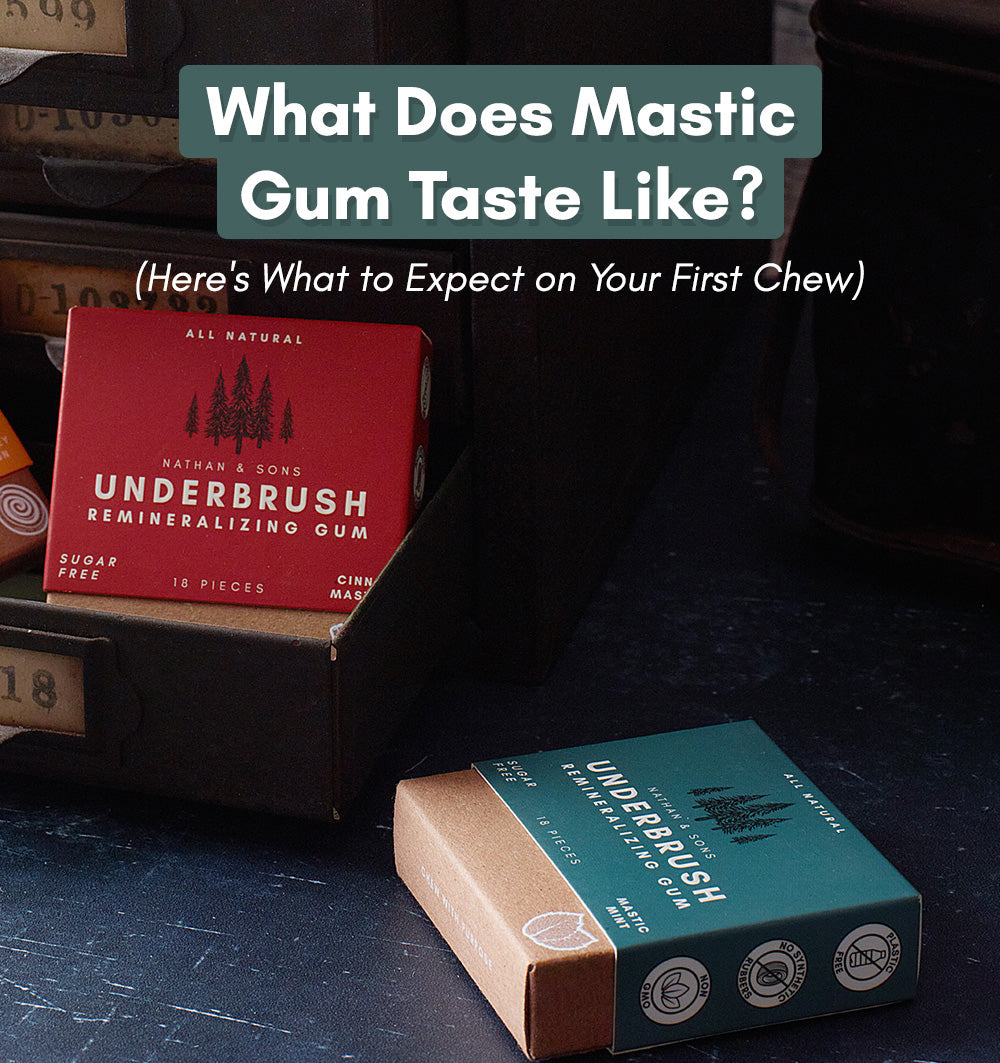
The short answer: Mastic gum tastes piney, resinous, and earthy — a flavor that evolves over three distinct phases as you chew. Nothing like conventional mint gum. Entirely its own thing.
Mastic gum tastes like a pine forest filtered through a Mediterranean herb garden.
Slightly resinous. Gently earthy. A faint cedar warmth underneath.
Nothing like mint.
Nothing like fruit.
Nothing like anything most people have chewed before.
So what does mastic gum taste like, exactly?
That surprises people. It shouldn't — mastic resin has been chewed for over 2,500 years, long before anyone invented synthetic menthol or artificial cherry flavoring.
It tastes like what it is: a tree resin from a specific island in Greece, doing what it has always done.
If you're about to try it for the first time, or you just did and you're trying to figure out what exactly happened in your mouth — this is the guide you need.
Editorial & Commercial Disclosure: Nathan & Sons produces and sells Underbrush natural chewing gum, which is discussed in this article.
This article is intended solely as educational content about mastic resin flavor and sensory experience.
These statements have not been evaluated by the Food and Drug Administration. This product is not intended to diagnose, treat, cure, or prevent any disease.
The Flavor in Three Phases
Nobody tells you that mastic gum flavor changes as you chew it. They should — because that evolution is the whole experience of what mastic gum tastes like from start to finish.

Here's exactly what happens, from the first second to the finish.
Phase 1: The First 30 Seconds
Firm. A little resistant. Then — a burst of resinous character that hits differently than anything you've tasted in gum before.
The first impression is piney. Clean. Slightly astringent in the way that fresh herbs are slightly astringent.
There's a faint bitterness in the very first seconds — not unpleasant, just unexpected. Like the first sip of good black tea before your palate adjusts.
Some people love it immediately. Some people need a moment. Both reactions are completely normal.
Phase 2: Minutes 1 Through 5
The resin warms and softens. The sharpness of that first impression settles into something rounder and more herbal.
This is where the distinctive character of mastic really lives.
The piney note shifts toward something warmer — cedar, perhaps, or a dry Mediterranean herb. A subtle earthiness that feels grounding rather than heavy.
The mild natural sweetness of the xylitol becomes more present as the resin flavor softens.
Many people find the flavor becomes more approachable as they continue chewing. This is where it stops being unfamiliar and starts being genuinely enjoyable.
Phase 3: Five Minutes and Beyond
The initial resin character has settled fully. What remains is subtle, clean, and distinctly botanical.
There is no abrupt cutoff — no moment where the flavor disappears and you're left with nothing, the way conventional gum eventually goes flavorless.
The earthy, herbal base of the mastic stays present throughout. Quieter than the opening phase, but still there.
This is what 2,500 years of chewing actually tastes like. Not a factory's approximation of freshness. The real thing.
Why Mastic Tastes the Way It Does — The Science Behind the Flavor
The flavor of mastic resin isn't added. It comes from the resin itself — specifically from the natural volatile compounds produced by the Pistacia lentiscus tree on the island of Chios, Greece.
The primary flavor compounds in mastic include:[¹]
Alpha-pinene — the terpene most responsible for the characteristic piney, resinous note. The same compound responsible for the aroma of pine forests and many Mediterranean herbs.
Limonene — a naturally occurring citrus compound present in smaller amounts, contributing the faint brightness underneath the pine character.
Carvacrol and related terpenes — herbal, slightly spicy notes in trace amounts that contribute complexity and depth.
These compounds are not added during manufacturing.
They are the natural composition of mastic resin itself — the same profile that made it a prized flavoring, breath freshener, and chewing material across Mediterranean cultures for centuries.[¹]
This is also why mastic from Chios tastes different from any other resin.
The same species of tree grows across the Mediterranean.
Only the Chios trees — in that specific volcanic soil, that specific microclimate — produce resin with this compound profile.
The EU granted Chios mastic Protected Designation of Origin status in 1997, placing it in the same legal category as Champagne and Parmigiano-Reggiano.[²]
You are tasting geography. That's not a marketing line. It's botany.
Pure Mastic vs. Underbrush: How Our Formulation Changes the Experience

If you've ever wondered what does mastic gum taste like in its purest form — pure mastic gum sold in Greek specialty stores as small crystallized pieces is the answer.
It is intensely resinous, quite firm, and firmly in the "for enthusiasts" category.
Underbrush is different. And that difference is deliberate.
When Nate created Underbrush, the goal was to make the mastic experience approachable for people who had never tasted anything like it — without stripping away what makes it interesting.
Our gum base blends mastic with chicle and spruce sap. Chicle is mild and nearly neutral in flavor — it softens the mastic's intensity while preserving its character.
Spruce adds a fresh-earth undertone that rounds out the pine note rather than doubling down on it.
The result is mastic made approachable without being made anonymous.
Then we add our Mastic Mint flavor: organic spearmint essential oil layered over the resin base.
Spearmint's dominant flavor compound is carvone — sweet, clean, herbaceous — rather than the menthol that makes most mint gum feel numbing.[³]
The spearmint joins the mastic character rather than overriding it.
What you get is a mint gum with a botanical backbone.
The spearmint is upfront. The mastic is present but not overwhelming.
The spruce and chicle provide the foundation.
For first-time natural gum chewers, Mastic Mint is the right starting point.
It gives you the mastic experience in a format that doesn't require any adjustment period.
Cinna-Mastic takes the base in a different direction — real Ceylon cinnamon layered over the same resin blend.
Warm, slightly spiced, with that earthy mastic finish underneath.
If you want to taste the mastic character more directly, this flavor reveals it more clearly than the mint does.
How Mastic Compares to the Other Natural Resins in Our Base
Mastic is the most distinctive-tasting natural gum base. Here's how it sits relative to the others we use:

Underbrush uses all three together. The mastic leads. The chicle softens. The spruce grounds.
This table reflects general flavor characteristics of natural gum resins.
Individual formulations vary.
These statements have not been evaluated by the Food and Drug Administration. This product is not intended to diagnose, treat, cure, or prevent any disease.
Who Will Love It Immediately vs. Who Needs to Adjust
Let's be honest about this, because it matters for your first experience.
You'll probably love it immediately if you:
Drink black coffee or dark tea without sweetener. Eat dark chocolate regularly.
Enjoy herbal teas — especially ones with pine, cedar, or Mediterranean herb notes like thyme or oregano.
Have a general preference for complex, botanical flavors over sweet ones. Already chew pure mastic as a traditional practice.
You'll need two or three pieces to adjust if you:
Primarily chew conventional mint gum and expect that experience.
Find resinous or piney flavors initially unfamiliar. Are expecting the gum to taste like standard spearmint.
The adjustment period is real. It is also short.
Some people find the flavor grows on them after a few chewing experiences.
Give it at least three pieces before you decide.
Why the Flavor Evolves — And Why That's Not a Bug
Here's the part most people don't expect until they experience it.
The flavor in natural gum doesn't stay constant. It evolves. This isn't a flaw. It's physics.
In conventional synthetic gum, flavor compounds are encapsulated within a polymer matrix and released through a controlled process of diffusion — a slow, consistent fade specifically engineered for artificial persistence.[⁴]
In natural gum, the flavor compounds in essential oils and resins are part of the actual material — not added to it.
They release more quickly in the initial phase of chewing as the resins warm and soften.
Then the flavor profile shifts toward the natural character of the base resins: earthy, slightly piney, herbaceous.
What remains isn't the absence of flavor. It's a different, subtler flavor.
The inherent botanical character of mastic and spruce remains present throughout the chewing experience.
Some customers say this is the moment they actually understand what they're chewing.
If you want the full story on what makes natural gum different from conventional gum at an ingredient level, our guide to natural gum covers it in depth.
What Other Customers Are Saying
Customer reviews reflect individual opinions and experiences.
"Love the taste. Just started them and so far, so good." — Justin
"Great product as always — berry will always be #1." — Austin
"It is what it says it is. I'm satisfied. I will be ordering again. Hopefully I can get a coupon!" — Marlon
Here is what customers are saying about the chewing experience itself:
"Gum is pretty tasty. I usually chew 2 at a time because they are little. And I do feel revitalized after a good chew." — Benjamin
Customer experiences are subjective and may differ from person to person.
Individual experiences vary. These are unsponsored customer reviews shared voluntarily. Results described are not typical and are not intended to represent what you should expect to experience.
These statements have not been evaluated by the Food and Drug Administration. This product is not intended to diagnose, treat, cure, or prevent any disease.
Ready to Taste It for Yourself?
Now that you know what mastic gum tastes like — the phases, the chemistry, the story behind it — the only thing left is to actually chew it.
Start with Mastic Mint — the most approachable entry point into the mastic flavor experience.
Try Cinna-Mastic if you want to taste the mastic character more directly.
Or try all three flavors with the Variety Pack.
Curious about the oral care side of natural gum beyond just the taste? Our piece on natural solutions for tooth sensitivity is a good next read.
These statements have not been evaluated by the Food and Drug Administration. This product is not intended to diagnose, treat, cure, or prevent any disease.
Mastic Gum Taste - Frequently Asked Questions
What does mastic gum taste like?
Mastic gum has a subtle pine and cedar flavor — slightly resinous and earthy, with faint herbal notes and a mild natural sweetness.
The flavor evolves as you chew: an initial resinous burst in the first thirty seconds, warming into a rounded herbal character over the next few minutes, then settling into a clean, quiet botanical finish.
It is nothing like conventional mint or fruit gum.
Does mastic gum taste good?
For people who enjoy complex, non-sweet flavors — dark chocolate, black tea, herbal teas, Mediterranean herbs — yes, immediately.
For people accustomed to conventional mint gum, it typically takes two or three pieces to adjust.
Many people find the flavor grows on them with each chewing experience. It is a genuinely different flavor experience, not a worse one.
Why is mastic gum slightly bitter at first?
The initial slight bitterness comes from the natural terpene compounds in mastic resin — particularly alpha-pinene and related volatile compounds — that create the characteristic piney, resinous flavor.[¹]
This bitterness softens quickly as the resin warms.
The same phenomenon occurs with fresh herbs, pine nuts, and certain teas — an initial astringency that gives way to something rounder and more pleasant.
How long does mastic gum flavor last?
The active resin flavor is most present in the first one to five minutes.
After that it settles into a quieter but still present botanical base.
Unlike conventional gum, which delivers sustained artificial flavor intensity before cutting off abruptly, mastic gum flavor evolves gradually and remains subtly present throughout the chewing experience. Individual experience will vary.
What does Nathan and Sons gum taste like specifically?
Underbrush blends mastic with chicle and spruce sap, which softens the intensity of pure mastic while preserving its character.
Mastic Mint adds organic spearmint essential oil — a sweet, clean mint — over the resin base. Cinna-Mastic adds real Ceylon cinnamon for a warm, gently spiced profile.
Berry uses real fruit powders for a mild, genuinely fruity flavor.
All three flavors carry the mastic resin character underneath — more present in Cinna-Mastic, gently supported in Mastic Mint.
Is mastic gum an acquired taste?
For most people who are new to it, yes — in the same way that dark chocolate, olives, and good coffee are acquired tastes.
The flavor is complex and botanical rather than sweet and simple.
Two or three pieces is usually enough to move from "unfamiliar" to "I actually really like this." The adjustment period is real and short.
Where can I learn more about mastic gum's other properties?
This article covers flavor only. For the full story on mastic gum's history, sourcing, and the research on its other properties, our guide to the best mastic gum covers it in depth.
These statements have not been evaluated by the Food and Drug Administration. This product is not intended to diagnose, treat, cure, or prevent any disease.
References
- Chios Mastic Growers Association. "Mastic Cultivation and Production." mastichachios.gr. https://www.mastichachios.gr/en/
- Masticlife. "Mastic Tree — History and Harvesting." masticlife.com. https://masticlife.com/en-us/pages/mastic-tree
- Zheng X, et al. "Chemical Composition and Antioxidant Properties of Essential Oils from Peppermint, Native Spearmint and Scotch Spearmint." PMC / MDPI Molecules, 2019. https://pmc.ncbi.nlm.nih.gov/articles/PMC6696458/
- How Products Are Made. "Chewing Gum." madehow.com. https://www.madehow.com/Volume-1/Chewing-Gum.html